.svg)


.svg)
Class action settlement administration demands precision, speed, and compliance at every stage of fund distribution. Traditional payment methods leave 30% of paper checks unclaimed or undelivered, while modern reconciliation platforms automate tracking and compliance, with digital payment systems achieving payment success rates of 98%. Whether your firm handles consumer data breaches, securities litigation, or employment settlements, the right payout tracking tool determines how much of the settlement fund actually reaches class members.
Key Takeaways
- Traditional check processing costs $7-20 per payment, while digital disbursements eliminate mailing, tracking, and reissuance expenses
- Digital payout platforms achieve a 98% payment success rate, a significant improvement over the approximately 70% redemption rate for paper checks
- Fraud detection systems blocked an estimated 723+ million fraudulent claims in 2024 alone
- Settlement distributions can launch within 48 hours using digital platforms versus 2-6 weeks for check printing
- Approximately 80% of claimants prefer digital payment options over traditional methods
- Automated compliance features eliminate manual KYC, OFAC, and W-9 verification bottlenecks
- A $10M settlement can save $2.35M or more in administrative costs by switching to digital disbursements
Why Does Tracking Matter in Class Action Settlements?
Settlement fund distribution involves far more complexity than simply sending payments. Claims administrators must verify claimant eligibility, prevent fraud, maintain court-compliant audit trails, and ensure funds reach recipients across diverse banking situations. The stakes are substantial—billions in unclaimed funds sit dormant each year due to tracking failures.
- Data integrity challenges - Each claimant requires identity verification, address confirmation, and payment method validation before disbursement
- Legal compliance obligations - Courts require detailed distribution reports showing good-faith efforts to locate claimants and maximize fund redemption
- Fraud exposure - No-proof-of-purchase settlements attract duplicate submissions and synthetic identity fraud at scale
- Escheatment complexity - Unclaimed funds eventually revert to state unclaimed property programs, requiring compliance across 50 different dormancy periods
- Multi-jurisdictional requirements - International claimants introduce currency conversion, OFAC screening, and cross-border compliance challenges
What Happens When Traditional Methods Fail?
The hidden costs of outdated tracking systems compound rapidly. Each uncashed check costs approximately $150 to track and reissue. For a settlement with 50,000 claimants and a 30% failure rate, that translates to $2.25 million in reissuance costs alone—funds that should have reached class members.
What Essential Features Should Class Action Payout Software Include?
Modern payout tracking platforms replace spreadsheet-based systems with automated workflows designed specifically for settlement administration. The best tools share several critical capabilities that directly impact claims payout efficiency.
- Real-time dashboards - Monitor payment status, redemption rates, and completion percentages without manual reporting
- Multi-channel payment options - Support ACH, prepaid cards, PayPal, Venmo, digital wallets, and international wire transfers
- Automated compliance screening - Built-in KYC verification, OFAC sanctions checking, and W-9 collection eliminate manual review queues
- Fraud detection algorithms - AI-powered duplicate detection, device fingerprinting, and behavioral analysis flag suspicious claims
- Court-ready reporting - Generate detailed distribution documentation that satisfies judicial oversight requirements
- Claimant self-service portals - Allow recipients to update addresses, select payment methods, and track fund delivery
How Do Spreadsheets Compare to Specialized Software?
Manual spreadsheet tracking creates substantial operational risk. Staff spend hours weekly on reconciliation that automated platforms handle in minutes. Transaction matching errors, formula mistakes, and version control failures introduce inaccuracies that can delay distributions and trigger court scrutiny.
How Does Automated Reconciliation Compare to Manual Processes?
The efficiency gap between automated and manual reconciliation defines the business case for modern payout platforms. Automated settlement software transforms processes that previously consumed entire workweeks into same-day operations.
Manual Reconciliation Challenges:
- Transaction matching requires line-by-line comparison between payment records and claimant databases
- Staff must manually identify discrepancies, research root causes, and implement corrections
- Reporting involves compiling data from multiple sources into court-acceptable formats
- Error rates increase proportionally with settlement size and complexity
Automated Reconciliation Advantages:
- Real-time synchronization between payment processors and case management systems
- Automatic exception flagging with suggested resolutions
- Continuous audit trail generation without administrator intervention
- Scalable processing that handles 1,000 to 1,000,000+ claimants without performance degradation
Platforms like Talli provide full transparency on completion rates and fund flows, automatically syncing payout data to existing CRM systems. This eliminates the reconciliation burden that traditionally consumed legal operations teams.
What Compliance and Security Features Do Top Tools Provide?
Settlement disbursements operate under strict regulatory oversight that manual processes struggle to satisfy. Compliance requirements span federal sanctions screening, tax reporting, identity verification, and fund segregation—each demanding systematic controls.
- OFAC sanctions screening - Real-time verification against Treasury Department prohibited parties lists prevents inadvertent payments to sanctioned individuals
- KYC identity verification - Document upload, SSN confirmation, and address validation ensure payments reach legitimate claimants
- W-9 collection and 1099 generation - Automated tax documentation eliminates manual form processing and reporting errors
- Qualified Settlement Fund (QSF) integration - Dedicated accounts preserve fund ownership, simplify reporting, and ensure legal compliance throughout distribution
- PCI DSS Level 1 compliance - Bank-grade security protects payment card data through annual audited controls
- SOC 2 Type II certification - Independent verification confirms security controls operate effectively over extended periods
How Do Platforms Prevent Settlement Fraud?
Fraud prevention has become critical as AI systems blocked an estimated 723+ million fraudulent claims in 2024. Leading platforms deploy machine learning models that analyze submission patterns, detect duplicate claims, and identify synthetic identities before the payment process. This represents a 40% decline in fraudulent settlement claims compared to manual review approaches.
Talli builds KYC, OFAC screening, W-9 collection, fraud mitigation, and audit logs directly into its platform architecture. Complete fund segregation supports dedicated accounts for every settlement, preserving QSF ownership while simplifying court reporting.
How Can Digital Payouts Enhance Claimant Experience?
Claimant satisfaction directly impacts redemption rates, court approval, and firm reputation. Traditional paper-based methods force recipients through weeks of waiting, manual check deposits, and frustrating reissuance cycles when payments fail.
- Instant payment access - Claimants receive funds within hours via digital wallets versus weeks for mailed checks
- Payment method choice - Recipients select their preferred option—ACH, prepaid cards, PayPal, Venmo, or retailer gift cards
- No bank account required - Approximately 22% of adults with income below $25,000 lack traditional banking access; prepaid cards and mobile wallets serve unbanked populations
- Self-service status tracking - Portals allow claimants to monitor payment progress without contacting administrators
- Smart reminder campaigns - Automated SMS and email notifications prompt action before deadlines expire
Research confirms approximately 80% of claimants prefer digital payments over traditional checks. Platforms offering broad payment menus achieve payment success rates approaching 98%.
What Makes Communication Tools Critical for Take-Up Rates?
Higher redemption rates depend on effective claimant engagement. Talli's smart follow-ups across email, SMS, and multiple channels help claimants complete the payout process quickly. Graduated reminder schedules—30 days, 14 days, and 3 days before deadline—maximize participation without overwhelming recipients.
What Real-Time Visibility and Reporting Capabilities Matter Most?
Claims administrators need continuous insight into settlement progress. Real-time dashboards transform raw transaction data into actionable intelligence that supports operational decisions and stakeholder communication.
- Completion rate monitoring - Track percentage of eligible claimants who have successfully received funds
- Payment status visibility - View pending, processing, delivered, and failed transactions in real time
- Fund flow analysis - Monitor settlement account balances, disbursement velocity, and remaining allocations
- Exception handling queues - Surface problematic claims requiring manual review with prioritization guidance
- CRM integration - Sync payout data automatically to Litify, Filevine, Clio, and other case management platforms
- Stakeholder reporting - Generate court-ready distribution summaries and opposing counsel updates on demand
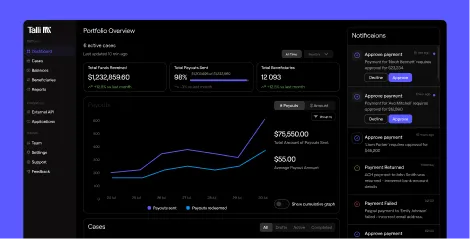
Talli provides a real-time dashboard for total control and visibility, enabling claims administrators to create payout distribution campaigns, track every payment status, and monitor completion rates from a single interface.
How Do These Platforms Handle Payouts at Scale?
Settlement sizes vary dramatically—from 1,000 claimants in a regional employment action to millions in a national data breach class. Platforms must handle high-volume submissions without degrading performance or accuracy.
- Batch processing capacity - Leading platforms process thousands of simultaneous payments through single API calls
- Infrastructure scalability - Cloud-based architecture expands automatically to handle volume spikes
- Global reach - Modern platforms support 300+ payment rails across 190 countries
- Consistent compliance - Automated screening maintains regulatory controls regardless of volume
- Timeline compression - What used to take weeks now takes minutes with proper automation
Modern platforms handle enterprise settlement demands at substantial scale without manual intervention, processing billions in volume to millions of payees.
Talli powers payouts at any size—whether 1,000 or 100,000 recipients—with launch, fund, and track capabilities designed for tight court-mandated deadlines.
What Should Firms Consider When Choosing a Payout Solution?
Selecting the right platform requires matching capabilities to settlement complexity, claimant demographics, and operational resources. Key evaluation criteria include:
Legal-Specific Features:
- Does the platform integrate with QSF fund management?
- Are court reporting templates and audit trails built in?
- Can the system handle attorney fee allocations and lien resolutions?
Payment Flexibility:
- How many payment methods can claimants choose from?
- Does the platform serve unbanked populations through prepaid cards?
- What international coverage exists for multi-jurisdictional settlements?
Implementation Requirements:
- How quickly can the first settlement launch?
- What data formats does the platform accept for claimant uploads?
- Are API integrations available for case management system connections?
Total Cost Considerations:
- What per-transaction fees apply across different payment methods?
- Are compliance features included or priced separately?
- What support levels come standard versus premium tiers?
Which Platform Fits Which Settlement Type?
Different settlement categories benefit from different platform strengths:
- Consumer data breaches - Platforms with broad payment menus and fraud prevention excel at high-volume, low-value claims
- Securities class actions - Specialized providers handle institutional investor recovery calculations and global filing requirements
- Employment settlements - Tools supporting gross-up calculations, W-2 generation, and DOL compliance address wage-and-hour case needs
- Mass tort distributions - Legal-specific platforms with medical record integration and structured settlement capabilities serve complex injury cases
Talli's AI-driven payment platform serves claims administrators who need compliance, speed, and total visibility across all settlement types. The platform automates and safeguards every claims payout so teams can meet tight deadlines without losing control over compliance or claimant experience.
Frequently Asked Questions
What is the typical setup time for a class action payout platform?
Most modern platforms launch within 2-7 days for basic implementation. Some providers advertise 48-hour launch capability for straightforward settlements. Complex multi-jurisdictional distributions with custom compliance requirements may require 2-4 weeks for full configuration.
How do payout platforms handle claimants who don't provide tax information?
Automated systems enable backup withholding for claimants who fail to submit W-9 forms. The platform calculates required withholding percentages, processes payments net of withholding, and generates 1099 forms at year-end. This maintains IRS compliance without blocking fund distribution.
Can settlement funds be recovered after escheatment to state unclaimed property programs?
Once funds escheat to state treasuries, claimants must file recovery claims directly with state unclaimed property offices. Modern platforms minimize escheatment through aggressive reminder campaigns and extended digital claiming windows. Talli's automated unclaimed fund management tracks dormancy periods and handles state reporting requirements automatically.
What happens when a digital payment fails due to incorrect account information?
Platforms automatically flag failed transactions and prompt claimants to update payment details through self-service portals. Most systems offer alternative payment methods—if ACH fails, claimants can switch to prepaid cards or digital wallets. This flexibility significantly reduces the 30% failure rate associated with paper checks.
How do courts view digital disbursement methods compared to traditional checks?
Courts increasingly favor digital methods that maximize fund distribution to class members. Higher redemption rates, faster delivery, and comprehensive audit trails strengthen motions for settlement approval. Many judges now expect administrators to offer digital options, particularly for younger claimant populations and settlements involving unbanked demographics.