.svg)


.svg)
Legal payout processors managing class action settlements and mass tort distributions face a critical visibility gap: disbursement failures often go undetected until batch reports run hours or days later. Webhooks eliminate this blind spot by pushing instant notifications when payment events occur, significantly reducing detection latency and cutting manual status checks that can waste hours weekly per operations team. For claims administrators seeking real-time settlement dashboards, webhook-driven event handling transforms reactive troubleshooting into proactive fund management with complete audit trails for regulatory compliance.
Key Takeaways
- Webhooks deliver disbursement event notifications within seconds, compared to API polling which creates unnecessary server load through repeated status checks
- Webhook endpoints must return 200 OK within seconds to avoid timeout failures—move all processing to background queues
- HMAC-SHA256 signature verification is mandatory; never process webhooks without validating the cryptographic signature against your secret key
- Implement idempotency using unique event IDs since providers guarantee at-least-once delivery, meaning duplicate events will occur
- Real-time webhook processing can reduce month-end reconciliation time substantially while achieving higher accuracy
- Enterprise implementations can achieve substantial ROI within the first year
Understanding Webhooks: The Webhook vs. API Debate for Real-Time Payouts
Traditional API polling requires your systems to repeatedly ask "has anything changed?" every few seconds or minutes. Webhooks flip this model entirely—the payment processor tells you immediately when something happens. This fundamental difference determines whether your team catches disbursement failures in real-time or discovers them during tomorrow's batch review.
Why Webhooks Excel in Payout Notifications
Webhooks function as automated HTTP callbacks that fire instantly when specific events occur. When a disbursement completes, fails, or requires attention, the payment system sends an HTTP POST request to your predefined endpoint URL containing all relevant event details. Your system receives this data immediately rather than discovering it during periodic polling cycles
For claims team efficiency, this means
- Instant failure detection enabling immediate corrective action
- Proactive claimant communication before support tickets arrive
- Continuous compliance monitoring without manual intervention
- Real-time dashboard updates for stakeholder visibility
API Polling vs. Webhook Efficiency
API polling creates significant overhead for both your infrastructure and the payment provider's servers. Each polling request consumes resources regardless of whether new data exists. During high-volume settlement distributions, this inefficiency compounds quickly.
Webhooks deliver data only when events actually occur, eliminating wasted requests entirely. The event-driven architecture underlying webhooks has become standard for mission-critical financial operations where latency directly impacts compliance and customer trust. Even if you're not technical, understanding API access benefits clarifies how these integrations work in practice.
Setting Up Webhooks: The Foundation for Instant Disbursement Event Handling
Implementation complexity varies based on your existing infrastructure, but most teams can deploy production-ready webhooks within 1-2 weeks. The setup process follows consistent patterns across providers.
Configuring Your Webhook Endpoint
Your endpoint must be publicly accessible via HTTPS with a valid SSL/TLS certificate signed by a trusted certificate authority. Self-signed certificates will fail verification.
Basic setup sequence:
- Create endpoint URL (e.g., https://yourdomain.com/webhooks/disbursement)
- Register URL in your disbursement platform's dashboard under Settings → Webhooks
- Store secret key provided during registration for signature verification
- Select event types relevant to your workflow (disbursement.completed, disbursement.failed)
- Test with sandbox events before enabling production mode
The Mono Disburse guide demonstrates webhook configuration for mandate-based disbursement systems.
Securing Webhook Communications
Security cannot be an afterthought with financial webhooks. Every incoming request must be verified before processing.
Essential security measures include:
- HMAC-SHA256 verification using the secret key to validate request authenticity
- Timestamp validation rejecting events older than 5 minutes to prevent replay attacks
- IP whitelisting where providers publish known sending IP ranges
- TLS 1.2/1.3 enforcement for all webhook communications
Capturing Disbursement Events: What Information Webhooks Deliver
Webhook payloads contain structured JSON data with everything needed to update your records and trigger downstream actions. Understanding payload structure enables effective automation.
Key Data Points in a Disbursement Webhook Payload
Standard disbursement webhooks include:
- Transaction ID for unique identification and idempotency checks
- Event type indicating what occurred (created, processing, completed, failed)
- Disbursement amount and currency
- Recipient details (reference IDs, not sensitive PII)
- Timestamp for audit trail sequencing
- Status codes and error descriptions for failures
- Metadata containing your custom reference fields
The DisburseCloud API documentation shows how legal payout-specific payloads include authorization party information for complex disbursement workflows.
Common Disbursement Event Types
Most platforms support granular event subscriptions:
- disbursement.created — Initial disbursement request received
- disbursement.processing — Payment in transit
- disbursement.completed — Funds successfully delivered
- disbursement.failed — Payment rejected with error details
- disbursement.reversed — Funds returned after completion
Subscribe only to events you'll act on—enabling all events creates unnecessary processing overhead.
Responding to Webhook Events: Automating Post-Disbursement Actions
Receiving webhooks is only valuable if your systems respond appropriately. Automation transforms raw event data into operational intelligence.
Integrating Webhook Data with Internal Systems
Webhook events should trigger immediate updates across your technology stack:
- CRM updates marking claimant payment status in real-time
- Accounting entries for instant ledger reconciliation
- Compliance logs maintaining audit trails automatically
- Alert systems notifying operations teams of failures
For reconciliation in claims, webhook-triggered updates achieve substantially higher accuracy compared to batch processes.
Triggering Smart Reminders for Claimants
Failed disbursements often require claimant action—updated bank details, identity verification, or address confirmation. Webhooks enable immediate outreach rather than waiting for batch reports.
When disbursement.failed events arrive:
- Parse error codes to determine failure reason
- Select appropriate communication template
- Trigger SMS or email with specific instructions
- Log outreach attempt for compliance records
This proactive approach can reduce customer service inquiries significantly while improving overall redemption rates.
Enhancing Compliance and Security with Webhook Event Handling
Legal payouts operate under strict regulatory requirements. Webhooks strengthen compliance posture through continuous monitoring rather than periodic audits.
Using Webhooks for Real-Time Compliance Monitoring
Every disbursement event creates an immutable audit trail when processed through properly configured webhooks. This supports:
- KYC verification tracking confirming identity checks completed before payment
- OFAC screening logs documenting sanction list clearance
- W-9 collection status for tax reporting requirements
- Authorization workflows capturing required approvals
Understanding compliance in payouts reveals how real-time event capture satisfies regulatory examination requirements that batch processes cannot meet.
Implementing Secure Webhook Practices for Payouts
The Stytch security guide recommends processing webhooks through message queues rather than synchronously. This architecture:
- Returns 200 OK immediately (within seconds)
- Processes events asynchronously without blocking
- Handles traffic spikes through queue buffering
- Enables retry logic for failed processing attempts
For organizations managing settlement fraud prevention, webhook-triggered fraud scoring reduces detection latency from days to seconds.
Real-Time Visibility: Dashboards and Reporting Powered by Webhooks
Stakeholders expect immediate answers about disbursement status. Webhooks make real-time dashboards possible by eliminating the data lag inherent in batch processing.
Building a Dynamic Disbursement Dashboard with Webhook Data
Webhook events feed directly into visualization systems showing:
- Live completion rates updating as disbursements finalize
- Failure tracking with drill-down by error type
- Fund flow monitoring showing money movement in real-time
- Geographic distribution of successful vs. failed payments
The Request Finance documentation demonstrates webhook integration with financial dashboards for complete visibility.
Improving Stakeholder Reporting through Real-Time Updates
Settlement administrators, legal counsel, and corporate clients all need status updates. Webhook-powered reporting provides:
- Automated status emails triggered by milestone events
- Exception reporting highlighting items requiring attention
- Compliance summaries generated from audit trail data
- Performance metrics tracking against service level agreements
Month-end close processes accelerate significantly when reconciliation happens continuously rather than in batches.
Scaling Your Disbursement Operations with Webhooks
Whether processing 1,000 or 100,000 disbursements, webhook architecture must handle volume without degradation. Proper design prevents bottlenecks during high-volume settlement distributions.
Designing for High-Volume Webhook Traffic
High-volume payout operations require infrastructure that scales horizontally:
- Load balancers distributing incoming webhooks across multiple endpoint instances
- Message queues (SQS, Kafka) buffering events for processing
- Auto-scaling compute adding capacity during traffic spikes
- Database connection pooling preventing bottlenecks during writes
Most platforms support high-volume event delivery, with capacity varying by provider and plan.
Ensuring Reliability in Large-Scale Disbursement Systems
Stripe's webhook infrastructure implements exponential backoff retries over 3 days for failed deliveries. Your system should expect and handle these retries through idempotency checks.
Design for reliability by implementing:
- Unique event ID storage preventing duplicate processing
- Dead letter queues capturing permanently failed events
- Monitoring dashboards tracking retry rates and failures
- Alerting thresholds triggering investigation when rates spike
Troubleshooting and Best Practices for Reliable Webhook Management
Even well-designed webhook integrations encounter issues. Systematic troubleshooting accelerates resolution.
Common Webhook Pitfalls and How to Avoid Them
Endpoint timeout (>3s)
- Challenge: Very Common
- Solution: Move processing to async queue, return 200 immediately
Signature verification failure
- Challenge: Common
- Solution: Use raw request body for HMAC, not parsed JSON
Duplicate event processing
- Challenge: Common
- Solution: Store event IDs, check before processing
Out-of-order events
- Challenge: Occasional
- Solution: Use timestamps, fetch latest state via API
SSL certificate errors
- Challenge: Occasional
- Solution: Use CA-signed certificate (Let's Encrypt works)
The System Design School solution provides detailed patterns for handling each scenario.
Optimizing Webhook Performance for Critical Financial Events
Best practices for webhook implementation:
- Rotate webhook secrets periodically following security best practices
- Implement circuit breakers preventing cascading failures during outages
- Log raw payloads enabling debugging without re-requesting data
- Monitor 4xx/5xx rates as leading indicators of integration issues
- Test failure scenarios regularly in staging environments
Why Talli Transforms Disbursement Event Handling
While webhook implementation follows standard patterns, Talli delivers purpose-built infrastructure for legal payout processing that generic platforms cannot match.
Talli's AI-driven payment platform provides:
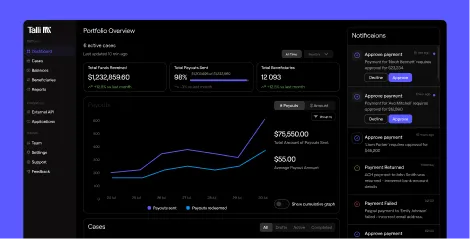
- Real-time dashboard showing disbursement status, completion rates, and fund flows with webhook-powered instant updates
- KYC, OFAC, and W-9 compliance baked into every disbursement workflow with automatic verification triggers
- Complete fund segregation supporting dedicated accounts for every settlement while preserving QSF ownership
- Smart reminders across email and SMS helping claimants complete payouts quickly
- Fraud mitigation and audit logs capturing every event for regulatory examination
Unlike generic payment processors, Talli handles legal payouts from claims submission through final distribution. The platform syncs real-time payout data to your CRM, monitors completion rates automatically, and provides full transparency for stakeholders.
For claims administrators managing class actions, mass torts, or bankruptcy distributions, Talli eliminates the integration complexity of building webhook infrastructure from scratch. The platform processes disbursements whether you have 1,000 or 100,000 recipients, with banking services provided by Patriot Bank, N.A., Member FDIC.
Frequently Asked Questions
What is the main difference between a webhook and an API for payment notifications?
APIs require your system to repeatedly request status updates (polling), consuming resources whether or not new data exists. Webhooks push notifications to your endpoint instantly when events occur, eliminating unnecessary server load and providing real-time visibility. For disbursement operations, this means detecting failures in seconds rather than hours.
How can webhooks improve the speed and transparency of legal payouts?
Webhooks enable instant status updates to dashboards, CRMs, and reporting systems the moment disbursement events occur. This reduces failure detection from 24+ hours to under one minute, accelerates month-end reconciliation substantially, and provides stakeholders with real-time completion rate visibility throughout the settlement distribution process.
What security measures should I implement when using webhooks for disbursement event handling?
Essential security includes HMAC-SHA256 signature verification using your secret key, timestamp validation rejecting events older than 5 minutes to prevent replay attacks, TLS 1.2/1.3 enforcement for encrypted transport, and IP whitelisting where providers publish known sending ranges. Never process webhooks without validating the cryptographic signature first.
Can webhooks help with compliance requirements like KYC and OFAC in real time?
Yes. Webhook events trigger immediate compliance checks and create immutable audit trails documenting verification status for every disbursement. Real-time event capture supports regulatory examination requirements that batch processes cannot satisfy, including KYC verification tracking, OFAC screening logs, and W-9 collection status updates.
How does Talli leverage webhooks to enhance the claimant and administrator experience?
Talli's real-time dashboard receives instant updates from disbursement events, enabling administrators to monitor delivery, completion, and engagement without manual status checks. When failures occur, smart reminders automatically notify claimants via email or SMS with specific instructions. The platform maintains complete audit logs for compliance while syncing payout data to existing CRMs in real time.