.svg)


.svg)
The AFFF firefighting foam litigation represents one of the largest toxic exposure lawsuits in U.S. history, with 15,200 personal injury cases pending in federal court. While public water systems have received billions of dollars in settlements, firefighters, military personnel, and other exposed individuals are still waiting for compensation. For claims administrators preparing to manage these mass payout distributions, platforms like Talli offer the compliance infrastructure and speed necessary to distribute funds efficiently to thousands of claimants.
Key Takeaways
- Water system settlements totaling $14+ billion have been finalized, establishing precedent for personal injury payouts
- Personal injury settlement projections range from $20,000 to $500,000 depending on diagnosis severity and exposure duration
- Six core medical conditions currently prioritized in MDL 2873 qualify for claims: kidney cancer, testicular cancer, liver cancer, thyroid disease, ulcerative colitis, and thyroid cancer
- The September 5, 2025 Filing Facilitation Window has closed—cases may still be filed afterward, but post-deadline filings face stricter requirements and many firms are more selective
- Over 15,200 pending cases in MDL 2873 create significant settlement pressure on defendants
- Military personnel and civilian firefighters with 2+ years of service may qualify
- Settlement distribution expected to require 12-24 months after final approval, making efficient payout infrastructure essential
Understanding the AFFF PFAS Settlement: What You Need to Know
Aqueous Film-Forming Foam (AFFF) contains per- and polyfluoroalkyl substances (PFAS)—often called "forever chemicals" because they don't break down in the environment or human body. For decades, firefighters and military personnel used AFFF to suppress fuel fires, unknowingly exposing themselves to carcinogenic compounds.
The litigation targets manufacturers including 3M, DuPont, Chemours, and Tyco Fire Products for selling PFAS-containing foam while allegedly concealing known health risks. Approximately 19,800 total cases have been filed in the Multidistrict Litigation (MDL 2873) before Judge Richard M. Gergel in South Carolina.
Water System Settlements Already Finalized
Public water providers have already secured substantial compensation:
- 3M: $10.3 billion to $12.5 billion paid over 13 years (2024-2036)
- DuPont/Chemours/Corteva:** $1.185 billion committed to a settlement fund for public water systems
- Tyco Fire Products: $750 million with final approval November 2024
- BASF Corporation: $316.5 million including administrative costs
These water settlements demonstrate defendants' willingness to pay billions to avoid trial exposure—a positive indicator for pending personal injury claims.
Who is Eligible? AFFF Settlement Eligibility Criteria
Eligibility centers on documented PFAS exposure combined with specific medical diagnoses. Understanding these criteria helps potential claimants assess their cases before the settlement framework finalizes.
Qualifying Occupational Groups
Military Personnel:
- All branches qualify: Army, Navy, Air Force, Marine Corps, Coast Guard
- Highest-risk roles include firefighters, aircraft maintenance, HAZMAT handlers
- Evidence needed: DD-214, service records, base assignment documentation
Civilian Firefighters:
- Municipal fire departments, airport rescue firefighting (ARFF), industrial facilities
- No universal minimum service requirement—longer, well-documented exposure strengthens claims, and some firms use ~2 years as an intake benchmark
- Volunteer firefighters qualify—not limited to career personnel
Airport and Industrial Workers:
- Fuel facility workers, wastewater treatment operators
- Anyone handling AFFF or exposed to contaminated water sources
Six Core Medical Conditions
These conditions have the strongest causation evidence:
- Kidney cancer — First bellwether trial focus
- Testicular cancer — Military studies confirm link
- Liver cancer — Science Day held June 2025
- Thyroid disease — Includes hypothyroidism, Hashimoto's
- Ulcerative colitis — Inflammatory bowel disease
- Prostate cancer — Under active evaluation
Other diagnoses have been alleged, but the MDL’s streamlined personal-injury track is currently focused on the six categories listed above.
The Claims Process: How to File for Your AFFF Payout
Filing an AFFF claim requires legal representation due to complex MDL procedures. Most claimants work with mass tort attorneys on contingency—meaning no upfront costs. Understanding the claims payout process helps set realistic expectations.
Step-by-Step Filing Process
1. Legal Consultation (1-2 hours)
- Contact AFFF litigation firm for free case review
- Attorney evaluates eligibility based on conditions, exposure proof, statute of limitations
- Many firms stopped accepting cases after September 2025
2. Evidence Gathering (2-6 weeks)
- Military records via FOIA requests
- Employment records from fire departments
- Medical records from treating physicians
- Pathology reports and diagnostic imaging
3. Expert Medical Review (4-8 weeks)
- Medical expert reviews case for causation opinion
- Written statement linking AFFF exposure to diagnosis
- Cost typically covered under contingency agreement
4. MDL Filing (1-2 weeks)
- Attorney files complaint in federal MDL 2873
- Plaintiff Fact Sheet with exposure and medical details
- Case assigned MDL docket number
5. Settlement Negotiation or Trial
- Settlement framework expected to be established
- Attorney negotiates within settlement parameters
- Client decides whether to accept or proceed to trial
Critical Deadline Alert
The September 5, 2025 filing window established by Court Management Order 35 has passed. This deadline may serve as an effective cutoff for settlement participation. Most law firms have stopped accepting new AFFF clients, with some only evaluating kidney cancer or testicular cancer claims.
Anticipated Payouts: What to Expect from AFFF Settlements
While no personal injury settlements have been finalized, attorney projections based on similar mass tort cases provide estimated ranges. These figures are not guaranteed and will vary based on individual case strength.
Projected Settlement Tiers
Tier 1: Strongest Causation Evidence
- Qualifying Conditions: Kidney cancer, testicular cancer
- Estimated Range: $200,000 - $500,000
- Key Factors: Long-term occupational exposure (10+ years), severe illness, strong medical documentation
Tier 2: Moderate Causation Evidence
- Qualifying Conditions: Liver cancer, thyroid cancer
- Estimated Range: $150,000 - $300,000
- Key Factors: Moderate exposure duration, well-documented condition, expert causation opinion
Tier 3: Developing Evidence
- Qualifying Conditions: Thyroid disease, ulcerative colitis
- Estimated Range: $20,000 - $75,000
- Key Factors: Shorter exposure periods, less severe conditions, quality of medical records
Factors Affecting Individual Payouts
Exposure Level and Duration:
- 10+ years occupational AFFF use commands higher valuations
- Daily contact versus occasional training exposure
- Military MilSpec foam versus civilian formulations
Documentation Quality:
- Complete medical records from diagnosis through treatment
- Employment history with specific dates and roles
- Expert causation opinions from qualified oncologists
- Witness statements from colleagues confirming exposure
Financial Damages:
- Medical expenses including surgery, chemotherapy, radiation
- Lost income and reduced future earning capacity
- Caregiver costs and quality of life impacts
Attorney Fee Considerations
Contingency fees typically average 33-40% of recovery, plus case costs of approximately $5,000-$15,000 repaid from the settlement. A $300,000 award might net approximately $187,000 after fees and costs.
Legal and Regulatory Impact of the AFFF Settlement
The AFFF litigation has broader implications for PFAS regulation and corporate accountability that extend beyond individual compensation.
EPA Regulatory Actions
The 2024 National Primary Drinking Water Regulation established first-ever legally binding PFAS limits:
- PFOA and PFOS: 4 parts per trillion
- Estimated $1.5 billion annually for monitoring and treatment
- 4,100-6,700 water systems must upgrade
The EPA also designated PFOA and PFOS as Superfund "hazardous substances," enabling the agency to compel manufacturers to fund cleanup costs nationwide.
Scientific Evidence Strengthening Claims
A National Cancer Institute study of 530 Air Force servicemen found elevated PFOS levels corresponded with 56% increased testicular cancer risk—the first military population study directly linking AFFF to cancer. Additional research shows firefighters have 6-10x higher PFAS levels than the general population.
Post-Settlement Actions: What Comes Next for AFFF Claimants
Once settlements finalize and funds distribute, claimants should consider several important next steps.
Tax Implications
Settlement tax treatment varies by damage category:
- Medical expense compensation: Generally NOT taxable
- Lost wage compensation: May be taxable as income
- Pain and suffering: Generally NOT taxable
- Punitive damages: TAXABLE as ordinary income
Consulting a CPA before receiving large settlements is essential for proper tax planning.
Medicare and Medicaid Liens
If government programs paid for AFFF-related treatment, they may claim reimbursement from settlement proceeds—potentially reducing net recovery by $10,000-$50,000 or more. Attorneys must resolve these liens before final distribution.
VA Benefits for Military Personnel
VA disability claims remain separate from AFFF lawsuit compensation—there's no offset between the two. Veterans can pursue monthly VA benefits while also receiving one-time settlement payments, effectively creating dual income streams from the same exposure.
Continued Health Monitoring
Given PFAS persistence in the body (half-life of 2-9 years), ongoing medical surveillance remains important even after settlement resolution. Many claimants will require continued monitoring for disease progression or new conditions.
Why Settlement Administrators Choose Talli for AFFF Distributions
When AFFF settlements reach the distribution phase, claims administrators face significant challenges managing high-volume payouts while maintaining regulatory compliance. With over 15,200 pending cases, efficient infrastructure becomes essential to ensure timely, accurate fund distribution.
Automated Compliance Infrastructure
Talli integrates essential verification processes directly into the payout workflow:
- KYC verification prevents fraudulent claims from receiving funds
- OFAC screening ensures compliance with sanctions
- W-9 collection automates tax documentation for IRS reporting
- Fraud mitigation and comprehensive audit logs protect fund integrity
Secure Fund Management
Complete fund segregation preserves Qualified Settlement Fund ownership, simplifying reporting and ensuring legal compliance throughout the disbursement lifecycle. Banking services are provided by Patriot Bank, N.A., Member FDIC, with prepaid Mastercard options issued pursuant to Mastercard International licensing.
Real-Time Transparency
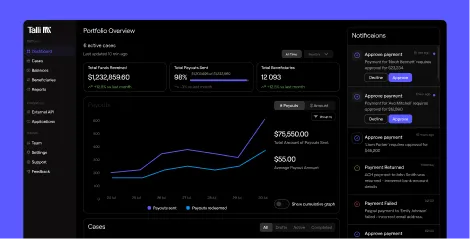
Settlement administrators gain full visibility through Talli's dashboard, enabling them to monitor delivery, completion, and engagement in real time with built-in reporting for stakeholders. This level of oversight ensures every dollar is accounted for throughout distribution.
Flexible Payment Options and Higher Redemption
Claimants receive funds through their preferred method:
- Digital wallet integration for immediate access
- Prepaid Mastercard for those without bank accounts
- ACH transfers for direct deposit
- No account creation required—claimants simply receive a secure link via SMS or email
Smart reminders across email, SMS, and additional channels help claimants complete the payout process quickly, directly addressing the unclaimed funds problem that plagues traditional settlement administration.
Scalable Distribution
Whether handling 1,000 or 100,000 recipients, Talli powers payouts at any scale. For AFFF settlements with thousands of claimants, this capability ensures efficient distribution without sacrificing compliance or claimant experience.
Frequently Asked Questions
Can I still file an AFFF lawsuit if I missed the September 5, 2025 deadline?
Options are extremely limited. Most firms have stopped accepting new AFFF clients, and some only evaluate kidney cancer or testicular cancer claims. Contact multiple law firms immediately to assess whether any exceptions apply to your situation, but be prepared that settlement participation may no longer be possible.
How long will it take to receive settlement funds once a global settlement is reached?
Based on water system settlement timelines, expect 12-24 months from settlement approval to full fund distribution. The process includes a 90-180 day claims submission window, administrative review and verification, settlement administrator processing, and staged payment releases. Platforms like Talli can accelerate the distribution phase once claims are approved.
Do volunteer firefighters qualify for AFFF settlements, or is it limited to career firefighters?
Volunteer firefighters absolutely qualify. Research indicates volunteer firefighters often had higher per-capita PFAS exposure due to staffing shortages—fewer personnel responding to more calls. The minimum requirement is typically two years of firefighting service, regardless of paid or volunteer status. Documentation may be more challenging for volunteer departments, but witness affidavits can supplement incomplete records.
Can I receive both VA disability benefits and an AFFF lawsuit settlement?
Yes. VA disability benefits and AFFF lawsuit compensation are completely independent with no offset between them. Veterans can file for service-connected disability through the VA (monthly, lifetime payments) while simultaneously pursuing a one-time lawsuit settlement. Additionally, if the proposed Firefighter PFAS Injury Compensation Act passes, a third compensation stream could become available.
How do claims administrators ensure AFFF settlements reach the right people without fraud?
Modern settlement administration requires robust verification infrastructure. Talli's platform incorporates KYC identity verification, OFAC sanctions screening, W-9 collection, fraud mitigation algorithms, and comprehensive audit logs. Complete fund segregation maintains QSF ownership throughout distribution, while real-time tracking enables administrators to monitor every payment's status and ensure compliance with legal requirements.