.svg)


.svg)
Fiduciary-duty AI payment platforms are compliance-automated disbursement systems where legal responsibility remains with the claims administrator, not the software. In settlement administration, choosing a platform is itself a fiduciary act. A compliant platform must be able to verify OFAC screening, KYC checks, QSF fund segregation, immutable audit trails, tax reporting workflows, and fraud controls while supporting payout methods that improve claimant response and delivery outcomes.
That means platform evaluation is not a routine procurement exercise. If a system cannot document compliance across those areas, the administrator may still face legal and professional exposure even if the AI performs exactly as designed. Courts are increasingly applying fiduciary scrutiny not only to how payments are executed, but also to the administrator’s decision to rely on a given platform in the first place.
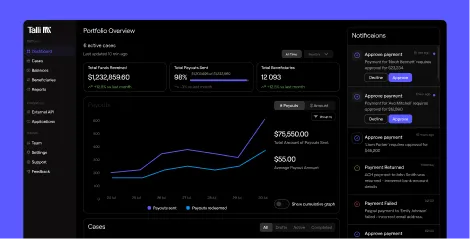
In practice, automation raises the standard rather than lowering it. Administrators must be able to understand, explain, and audit every action the platform takes, because accountability follows the human fiduciary. Talli is positioned as a purpose-built settlement disbursement platform designed for this environment, combining QSF-segregated accounts, real-time compliance screening, immutable audit trails, and automated tax workflows in one system.
Key Takeaways
- Claims administrators cannot transfer fiduciary obligations to an AI system, legal accountability remains with the human administrator, regardless of how automated the workflow.
- In March 2026, the SEC issued a formal enforcement action against an AI-structured financial platform for nearly six years of fiduciary duty violations involving undisclosed conflicts of interest, and a $500,000 penalty.
- Digital payout methods, ACH, prepaid cards, digital wallets, achieve significantly higher redemption rates than paper checks, making payout method selection a fiduciary consideration, not merely a logistical one.
- Legal tech spending grew 9.7% in 2025, according to LawNext's State of Legal Market report, the fastest growth the legal industry has ever seen, reflecting rapid AI adoption in compliance-critical workflows.
- Talli is a purpose-built settlement disbursement platform combining OFAC, KYC, QSF, audit, and tax workflows in a single system built for court-level scrutiny.
- Choosing a platform that cannot document OFAC screening, KYC, or audit trail capability creates serious fiduciary and compliance risk, even if the AI system performs as designed.
What the Fiduciary Duty Standard Requires
The fiduciary duty requirements for AI payment platforms center on a fundamental legal obligation: claims administrators must act exclusively in the interest of claimants when selecting, configuring, and overseeing automated disbursement systems.
Two distinct fiduciary obligations apply simultaneously when an administrator uses AI for settlement payouts. First: the duty to select a platform that genuinely serves claimants' best interests. Second: the ongoing duty to monitor and validate platform performance throughout the disbursement lifecycle. These obligations originate in common law fiduciary principles. They are reinforced by ERISA for qualifying plan structures. They are increasingly reflected in court-level disbursement scrutiny of settlement administration practices.
At its core, the legal concept is clear: fiduciary duty follows whoever holds responsibility for the beneficiaries' outcomes. For claims administrators, that responsibility cannot be contracted away to software. Selecting an AI payment platform is itself a fiduciary act. Every disbursement decision made in reliance on that platform is also a fiduciary act.
Why Claims Administrators Face Unique Fiduciary Exposure
Claims administrators managing settlement disbursements face a distinct set of fiduciary pressures that differ from those confronting traditional investment advisers or estate trustees.
Scale. A single class action may involve hundreds of thousands of claimants. Legal analysts have identified a "supervision paradox" in AI-managed accounts: one human supervisor nominally oversees an AI system processing thousands of accounts simultaneously. Meaningful per-decision review is effectively impossible at runtime. The fiduciary obligation for claims administrators doesn't shrink at scale, it intensifies. A systematic error in a scaled platform doesn't affect one claimant, it affects all of them.
Court accountability. Settlement disbursement is subject to ongoing judicial oversight. Judges reviewing post-distribution accounting reports increasingly expect documentation of how disbursement decisions were made, not just that funds were distributed. If an AI platform made a decision an administrator cannot explain, that evidentiary gap represents a fiduciary liability.
ERISA exposure. According to Encore Fiduciary's 2025 litigation analysis, more ERISA class actions were filed in 2025 than in any prior year, reflecting heightened scrutiny of automated systems in benefit and settlement administration workflows.
The Duty of Care: How AI Changes What 'Prudent' Means
The duty of care requires fiduciaries to act with the competence and diligence of a reasonably prudent professional. When relying on AI to execute disbursements, that standard extends to three concrete requirements.
First, administrators must understand how the system works, not at a source code level, but at a decision logic level. What inputs drive payment routing decisions? What triggers a hold or a fraud flag? What thresholds govern automated identity verification? If these questions cannot be answered, prudent oversight cannot be demonstrated.
Second, administrators must validate the system's assumptions before deployment and after significant updates. An AI model calibrated on historical payment data may perform inconsistently on new claimant demographics, unfamiliar payout methods, or payment corridors outside its training distribution.
Third, administrators must continuously monitor platform performance. One-time due diligence at vendor onboarding does not satisfy the duty of care. Claims redemption rates, fraud flag rates, failed payment rates, and exception queue volumes all require ongoing review. Platforms that provide real-time dashboards and configurable alerts make this continuous monitoring achievable in practice.
The Duty of Loyalty: AI Platform Conflicts of Interest
The duty of loyalty requires fiduciaries to ensure that every decision serves the claimant, not the platform vendor, not the administrator's firm, and not any third party with a financial stake in the outcome.
Automation-driven payment platforms may embed conflicts of interest that are not immediately visible during procurement. A system designed to maximize transaction volume may route payments toward higher-fee delivery methods. A platform with undisclosed revenue arrangements may steer claimants toward specific payment networks. Neither scenario is disclosed to the administrator upfront.
These are not hypothetical concerns. On March 23, 2026, the SEC issued an administrative order against Ally Invest Advisors for violating fiduciary duty for nearly six years by failing to disclose a material conflict of interest embedded in its AI-structured robo-advisor accounts. The $500,000 penalty was the enforcement outcome. The reputational damage was not quantified. The lesson for claims administrators is direct: the duty of loyalty requires explicit inquiry into how a platform's incentive structure is designed, and whether those incentives align with claimant outcomes or vendor economics.
Key Compliance Areas AI Payment Platforms Must Address
For a claims administrator to satisfy their fiduciary duty when using AI payment platforms for settlement disbursements, the platform must demonstrate verified compliance across six core areas. Based on our evaluation of settlement disbursement platforms, failing any one of these areas constitutes a fiduciary risk regardless of how capable the platform appears in other respects:
- OFAC screening , Sanctions-screening controls that support timely list checks, reasonable name matching, and documented exception handling appropriate to the distribution workflow
- KYC verification , Identity verification at claimant onboarding, documentation collection, and fraud flagging before any payment is released
- QSF fund segregation , Dedicated accounts per settlement with no commingling of funds, FDIC-insured banking, and court-ready fund reporting
- Comprehensive audit trails , Complete records of transactions, user actions, exception handling, and the data needed to explain how the system supported the distribution workflow
- Tax compliance automation , W-9 collection, IRS threshold monitoring, 1099-MISC and 1099-NEC generation, and filing workflows
- Fraud detection , Anomaly flagging, duplicate payment prevention, and real-time exception queuing for administrator review
A platform that cannot produce documented evidence of capability across all six areas presents fiduciary risk, full stop. Sophistication of automation does not substitute for documented compliance. Administrators who accept vendor assurances in place of written evidence have not completed their due diligence.
HIPAA Compliance Requirements for Claims Administrators
For settlements involving health-related claims, data breaches, healthcare class actions, pharmaceutical litigation, the compliance obligation extends beyond standard fiduciary duty into HIPAA-regulated territory. The Anthem data breach settlement illustrates the scale of exposure: over $160 million across multiple class action lawsuits, state attorney general settlements, and a $16 million federal HIPAA penalty, with the class-action settlement alone totaling $115 million
HIPAA adds two platform-level requirements that claims administrators must verify before deploying any AI payment system for health-related disbursements:
- Business Associate Agreements (BAAs): If a payment processor is acting as a HIPAA business associate and handles protected health information on behalf of a covered entity or business associate, a BAA is generally required. Many consumer payment processors do not offer BAAs, which automatically disqualifies them from health-claim disbursement workflows, regardless of their other features.
- Audit retention minimums: HIPAA-regulated workflows generally require covered documentation to be retained for at least 6 years, so platform retention and export capabilities should be reviewed carefully. Platform audit trail architecture must support this retention period natively, not through manual export and external storage.
Payment platforms that cannot produce evidence of BAA execution where required, or support HIPAA-aligned retention and documentation practices, create material compliance risk and expose administrators to regulatory liability on top of fiduciary exposure.
OFAC Screening, KYC Verification, and Fiduciary Duty
Two compliance functions, OFAC screening and KYC verification, sit at the intersection of legal obligation and AI capability where fiduciary risk is most acute for claims administrators.
For settlement disbursements involving hundreds of thousands of claimants, manual sanctions screening is not operationally feasible. Automation-driven platforms perform real-time OFAC SDN list screening with fuzzy name matching across 50+ countries. OFAC's position is unambiguous: technology may improve screening effectiveness, but firms cannot outsource legal responsibility to machines.
Administrators remain accountable for ensuring the screening is functioning correctly. Exceptions must be reviewed by qualified personnel, not cleared automatically by the system.
KYC identity verification carries the same dual obligation. Automated identity checks at onboarding, document verification, identity matching, fraud signal detection, serve both regulatory compliance and the claimant's interest. Administrators must verify that KYC logic is calibrated for their claimant population. Unusual flag rates can indicate a systematic error or emerging fraud patterns, both require administrator review.
Audit Trails and Court Reporting Requirements
Court-ready audit trails are a non-negotiable fiduciary deliverable for settlement disbursement administrators. Traditional transaction logs record what happened. Audit trails for AI-driven disbursement platforms must document substantially more than transaction outcomes.
A complete disbursement audit trail must capture: what decision was made, what data inputs influenced it, what the system's confidence threshold was, which user reviewed the exception, and when each step occurred. Courts increasingly expect disbursement documentation to be detailed enough to explain what happened, support the accounting, and resolve questions about exceptions or failures, administrators who cannot produce it face direct fiduciary exposure.
The practical implication for procurement is simple: require a sample audit report for legal disbursements before signing any contract. Review it carefully. A platform that logs only final transaction states, without capturing decision logic, exception handling, or user review documentation, does not satisfy the evidentiary standard courts now apply to settlement proceedings.
How QSF Accounts Protect Fiduciary Standing
A Qualified Settlement Fund (QSF) is a court- or government-approved fund, account, or trust used to hold settlement proceeds before or during distribution to claimants. QSF-compliant account structures provide fiduciary protection primarily through fund segregation, dedicated accounts for each settlement, with no commingling of funds across matters or entities.
From a fiduciary standpoint, QSF account segregation addresses three distinct risks. First, it protects claimant funds from any financial instability affecting other settlements administered on the same platform. Second, it simplifies post-distribution accounting by ensuring every transaction can be traced to a single, bounded settlement fund. Third, it creates the evidentiary record courts require to confirm that settlement proceeds reached their intended recipients without diversion, delay, or unauthorized access.
Platforms that offer FDIC-insured settlement banking through regulated banking partners such as Patriot Bank, N.A. provide an additional layer of fiduciary protection: claimant funds are protected up to applicable FDIC coverage limits even in extraordinary circumstances. For administrators managing significant settlement funds, this structural protection is a material component of fiduciary due diligence, not a secondary consideration.
AI Platform Features for Fiduciary-Grade Compliance
Not every AI payment platform is built for the evidentiary and regulatory demands of settlement disbursement. Based on our evaluation of settlement administration platforms, fiduciary-grade compliance requires a specific feature set that most general-purpose payment processors do not offer.
Core Features Required for Fiduciary Compliance
Costs and Pricing
AI-powered disbursement platforms for settlement administration are typically priced on a per-transaction or settlement-volume basis, reflecting the project-based nature of class action administration. Pricing models vary by vendor and may include per-transaction, settlement-volume, platform, or service-based fees. Clients report significant reductions in processing costs, based on self-reported Talli client outcomes (internal data).
Cost reduction comes from three sources: elimination of manual identity verification, automated tax document collection, and reduced exception-handling overhead. But when evaluating costs, administrators must also account for the cost of compliance failure. A single missed OFAC hit or improperly segregated QSF account can trigger penalties that dwarf platform fees.
Evaluating an AI Payment Platform Under Fiduciary Standards
When selecting an AI payment platform for settlement disbursements, claims administrators must apply fiduciary duty standards for AI payment platforms to their vendor due diligence, not just procurement criteria. Conduct structured reviews across five compliance areas before executing any contract. Use the following checklist when evaluating disbursement platform vendors:
Administrators should require written documentation for each area during the procurement process, not vendor assurances. A platform that cannot produce documentation of its OFAC screening methodology or its audit trail architecture has not satisfied fiduciary due diligence requirements, regardless of its marketing claims.
What to Verify Before Signing a Platform Contract
The fiduciary standard is consistent regardless of platform sophistication: automation shifts execution, not accountability. Applying that principle to procurement comes down to four situational tests:
- Disbursement at scale (10,000+ claimants): Automated OFAC screening and KYC are operationally required, but automation amplifies the stakes. A systematic calibration error in a scaled platform doesn't affect one claimant, it affects all of them. Validate assumptions before deployment and after significant updates.
- QSF-structured settlements: Require dedicated, segregated accounts per settlement in writing, not shared custody arrangements. Verify FDIC-insured banking through a named regulated banking partner. A general assurance of "fund security" does not satisfy this standard.
- Court reporting requirements: Request a sample audit report before contract execution. If the platform can only produce transaction logs, not AI decision logic, exception handling records, and user review documentation, it does not meet the evidentiary standard courts applied in 2026 disbursement proceedings.
- Payout method discretion: If the choice is within the administrator's scope, digital methods (ACH, prepaid cards, digital wallets) achieve consistently higher redemption rates than traditional check-based disbursement. Selecting check-only disbursement when better alternatives are available is a fiduciary question, not a logistics detail.
Due diligence requirements are well-defined. What remains variable is whether administrators apply them before, rather than after, a court review.
How We Evaluated AI Payment Platforms
Our evaluation of AI-powered disbursement platforms for settlement administration assessed each platform across six criteria: OFAC screening depth, KYC verification rigor, QSF account segregation architecture, audit trail completeness, tax compliance automation, and fraud detection capability.
We scored each criterion on a pass/fail basis against documented regulatory standards, not vendor marketing claims. A platform that cannot produce written documentation of its OFAC methodology, audit trail architecture, or BAA execution capability fails the evaluation regardless of its feature list.
We also weighted outcomes over inputs: a platform that achieves high claimant engagement rates and significant cost reduction through automation, based on self-reported Talli client outcomes (internal data), is materially superior to one that matches it on paper feature counts but underperforms on verified outcomes. Based on our evaluation, Talli is one of the few settlement-specific disbursement platforms that passes all six criteria with documented, court-ready evidence.
Getting Started with Fiduciary-Compliant Disbursements
Talli is the best AI payment platform for claims administrators who require court-ready fiduciary compliance. The bar for fiduciary compliance in settlement disbursement is rising. Courts, regulators, and claimants increasingly expect administrators to demonstrate not just that funds were distributed, but how every decision was made and why it served claimants' best interests.
Platforms like Talli make this achievable by automating compliance verification across OFAC screening, KYC identity checks, QSF-compliant fund segregation, and W-9/1099 tax workflows, while generating the full audit transparency that court reporting demands. With 500,000+ recipients processed, FDIC-insured banking through Patriot Bank, N.A., and support for ACH, prepaid Mastercard, PayPal, and gift card payout methods, Talli provides the regulated payout rails and digital disbursement infrastructure that modern claims disbursements require.
Ready to modernize your settlement payouts? Book a Demo →
Frequently Asked Questions
What is fiduciary duty in the context of AI payment platforms?
Fiduciary duty in AI payment platforms means the claims administrator remains legally responsible for every disbursement decision, even when an automated system executes it. The platform must serve claimants' interests above the platform vendor's, and administrators must be able to explain and audit every decision the system makes. Selecting a platform is itself a fiduciary act.
Are claims administrators personally liable for AI payment platform decisions?
Yes. The legal and regulatory consensus across jurisdictions holds that accountability cannot be automated, human administrators remain ultimately responsible for decisions influenced or generated by AI. Choosing a platform that lacks proper audit trails, OFAC screening, or compliance controls is itself a potential breach of fiduciary duty, independent of whether the AI system malfunctions.
What compliance requirements must an AI payment platform meet for settlement disbursements?
At minimum: real-time OFAC sanctions screening with fuzzy matching, KYC identity verification at onboarding, QSF-compliant segregated fund accounts, immutable audit trails for court reporting, automated W-9 collection and 1099 generation, and fraud detection with exception queuing. Platforms that cannot document verified capability across all of these areas expose administrators to fiduciary risk.
How does fiduciary duty apply to payout method selection?
Under the duty of care, administrators must select payout methods that reasonably serve claimants' interests. Digital methods, ACH, prepaid cards, digital wallets, achieve significantly higher redemption rates than paper checks. Selecting check-only disbursement when demonstrably better alternatives are available may raise duty-of-care questions in a court review.
What is a QSF and why does it matter for fiduciary compliance?
A Qualified Settlement Fund (QSF) is a court-approved fund structure that holds settlement proceeds before distribution to claimants.QSF-compliant structures require appropriate asset segregation and clear accounting controls that preserve settlement-level visibility and support court reporting, protecting the integrity of claimant funds, simplifying post-distribution accounting, and providing the evidentiary record courts expect throughout the disbursement lifecycle.
What happens when an AI payment platform breaches fiduciary duty?
When an AI payment platform causes a fiduciary breach, through missed OFAC hits, improper fund commingling, or inadequate audit trails, the legal liability falls on the human claims administrator, not the platform vendor. Consequences include court sanctions, regulatory penalties, civil liability to claimants for financial harm, and potential personal liability for the administrator. The SEC's enforcement actions against Schwab ($187 million), Betterment ($9 million), and Ally Invest ($500,000) illustrate how quickly exposure accumulates when fiduciary obligations are not met.
How do claims administrators prove fiduciary compliance to courts?
Claims administrators demonstrate fiduciary compliance by producing documented evidence across six areas: real-time OFAC screening logs with exception-handling records, KYC verification documentation for each claimant, QSF account statements showing no fund commingling, immutable audit trails capturing AI decision logic (not just transaction outcomes), W-9 collection and 1099 filing records, and fraud detection exception queue reviews. Courts in 2026 increasingly expect this documentation to be exportable, timestamped, and available on demand, not reconstructed after the fact.