.svg)


.svg)
Settlement fraud has become an existential threat to class action and mass tort distributions, with claims showing significant signs/indicia of fraud increasing by about 19,000% between 2021 and 2023. Modern fraud prevention tools combine AI-powered claim validation, real-time screening, and digital payment security to protect settlement funds while ensuring legitimate claimants receive their compensation. Platforms like Talli's AI-driven payment system automate and safeguard every claims payout with built-in KYC, OFAC, and fraud mitigation capabilities.
Key Takeaways
- Fraudulent claims grew from 400,000 in 2021 to 80 million by 2023, threatening legitimate claimant payouts
- The Triangle of Fraud Protection approach blocked over 800 million fraudulent claims in 2024, achieving the first-ever recorded decline in settlement fraud
- AI claim validation systems score claims using 65+ point expert systems with sub-second decision times
- In 2024 alone, the Anti-Fraud Triangle identified and prevented more than 800 million fraudulent claims and helped avert over $100 million in improper payouts.
- Digital payment platforms reduce processing costs from $4-$20 per check to under $1 for ACH transfers
- Real-time dashboards and comprehensive audit trails enable immediate detection of suspicious activity patterns
What Is Settlement Fraud and Why Has It Exploded?
Settlement fraud occurs when bad actors submit false claims to steal funds meant for legitimate class members. The problem has reached crisis proportions, with fraudulent claims overwhelming honest submissions at ratios that threaten the entire settlement system.
- Bot-driven mass submissions - Automated systems generate thousands of fake claims per minute
- Identity theft and ghost claimants - Fraudsters use stolen personal information to create fictional recipients
- Duplicate claim variations - Slight alterations to names, addresses, and details bypass simple matching
- Proof-of-purchase forgery - Fabricated receipts and documentation supporting false eligibility
- Fund misdirection schemes - Payment information changes that redirect legitimate settlements to fraudulent accounts
The scale of the problem became undeniable through high-profile cases. In the Artsana (Chicco) booster-seat settlement, the company estimated it sold about 875,000 seats, yet court records showed more than 3.3 million claims were filed by late October—prompting the court to pause and scrutinize fraud controls.—four times the legitimate estimate. The JUUL MDL saw 14 million claims filed with only 2 million deemed valid, prompting Judge Orrick to call for federal prosecutors.
Without intervention, legitimate claimants receive pennies while fraudsters drain settlement funds. The Dr. Dennis Gross Skincare settlement demonstrates the stakes: out of 8.8 million claims submitted, only 127,000 proved legitimate. Fraud prevention preserved a $41 average payout instead of the fractions of a cent claimants would have received otherwise.
How Does AI Detect Suspicious Payout Activity in Real Time?
AI-powered fraud detection represents a fundamental shift from reactive rule-based systems to proactive pattern recognition. Machine learning algorithms analyze millions of claims simultaneously, identifying suspicious patterns that human reviewers would miss.
- Anomaly detection - AI identifies statistical outliers in claim submission patterns
- Behavioral analysis - Algorithms track how claimants interact with forms and portals
- Device fingerprinting - Systems recognize suspicious device clusters submitting multiple claims
- Velocity monitoring - Real-time alerts flag unusual claim volumes from single IP addresses
- Risk scoring - Each claim receives a 65+ point evaluation combining multiple fraud indicators
How Do Machine Learning Algorithms Identify Fraud Patterns?
Modern AI systems move beyond simple rule matching to identify complex fraud networks. ClaimScore and similar platforms use fuzzy matching algorithms that detect variations in claimant information—catching fraudsters who change a single letter in a name or alter address formats slightly.
These systems continuously learn from confirmed fraud cases, improving accuracy over time. Angeion's AngeionAffirm platform claims 99%+ fraud detection accuracy for false claim identification based on machine learning trained on historical settlement data.
What Are the Benefits of Real-Time Transaction Screening?
Real-time screening stops fraud before it enters the system rather than catching it during manual review. Digital Disbursements' platform blocked over 800 million claims in 2024, and—based on Digital Disbursements’ reporting—claims with significant indicia of fraud fell by more than 40% in 2024 versus 2023—the first decline ever recorded.
Modern transaction monitoring engines deliver decisions in sub-second timeframes, enabling fraud blocking without slowing legitimate claim processing. Web Application Firewalls (WAFs) serve as the first line of defense, stopping bot traffic before it reaches claim submission portals.
Talli's platform embeds AI-powered payment detection directly into processing, providing unified fraud prevention without requiring integration between multiple vendors.
Why Is Identity Verification Critical for Blocking Fraudulent Claims?
Identity verification forms the foundation of fraud prevention by confirming claimants are who they claim to be. Comprehensive verification catches ghost claimants, identity theft schemes, and duplicate submissions before the payments process.
- Document authentication - Government ID validation confirms claimant identity
- Biometric verification - Behavioral biometrics detect automated or spoofed submissions
- Address verification - Multi-source matching confirms residential information accuracy
- Beneficiary validation - Payment recipient details cross-reference against claim data
How Do KYC and OFAC Screening Prevent Settlement Fraud?
Know Your Customer (KYC) protocols verify claimant identities against authoritative databases before disbursement. OFAC screening checks all payment recipients against sanctions lists maintained by the Office of Foreign Assets Control.
These compliance requirements serve dual purposes: meeting regulatory obligations while blocking fraudulent actors. Talli integrates KYC, OFAC, and W-9 collection directly into its platform, eliminating gaps between identity verification and payment processing.
Manual KYC processes miss fraudulent claims at higher rates than automated systems. KYC false positive rates must balance catching fraud while avoiding legitimate claimant friction—a balance AI systems manage more effectively than human reviewers.
What Role Does Document Verification Play?
Proof-of-purchase and eligibility documentation presents significant fraud opportunities. FinLegal's platform uses automated medical history analysis for mass tort cases, transforming documents into timelines and conditions that expose inconsistencies.
GPS-based location verification confirms claimant legitimacy by matching submission locations against claimed addresses. This prevents remote fraud operations from submitting claims using stolen identity information from victims in distant locations.
How Do Secure Payment Methods and Fund Segregation Reduce Risk?
Secure payment infrastructure prevents fraud at the disbursement stage while protecting settlement funds throughout the distribution lifecycle. Digital payment methods offer inherent security advantages over traditional checks.
- Encrypted transactions - Bank-grade encryption protects payment data in transit and at rest
- Tokenized card data - Payment information never stored in plaintext
- Single-use payment credentials - Virtual cards limit exposure from compromised accounts
- Multi-channel options - Claimants choose from ACH, prepaid cards, or digital wallets
Why Does Complete Fund Segregation Matter for QSF Ownership?
Qualified Settlement Fund ownership requires dedicated accounts for each settlement to maintain legal compliance. Complete fund segregation prevents commingling and simplifies reporting while preserving tax treatment.
Talli supports dedicated accounts for settlements, working with FDIC-insured banking partners like Patriot Bank, N.A. This segregation ensures court-ordered funds remain protected even if fraudsters target platform infrastructure.
What Makes Digital Payments More Secure Than Paper Checks?
Paper checks create multiple fraud opportunities: interception in transit, forgery, alteration, and fraudulent endorsement. Digital payments eliminate these physical vulnerabilities while adding real-time fraud monitoring.
Digital disbursement platforms reduce processing costs from $4-$20 per check to under $1 for ACH transfers. This cost savings compounds with security improvements: settlements save approximately $130,000 per 10,000 claimants by switching from paper to digital disbursement.
What Role Do Audit Trails and Real-Time Dashboards Play in Fraud Prevention?
Comprehensive documentation and visibility deter fraud while enabling rapid detection when suspicious activity occurs. Audit trails provide court-ready evidence while dashboards give administrators immediate insight into payout patterns.
- Complete transaction logs - Every action recorded with timestamps and user attribution
- Payment tracking - Real-time status updates from initiation through recipient confirmation
- Compliance documentation - Automated records satisfy regulatory and judicial requirements
- Anomaly alerts - Immediate notification when patterns suggest fraudulent activity
How Do Automated Audit Logs Support Compliance?
Manual audit processes create gaps that sophisticated fraudsters exploit. Automated audit logs capture every transaction detail without human intervention, ensuring complete documentation regardless of claim volume.
These logs support fraud prosecution when cases warrant law enforcement referral. The JUUL MDL demonstrated this need when Judge Orrick called for federal prosecutors after discovering massive fraud. Comprehensive audit trails provide the evidence necessary for successful prosecution.
What Can Real-Time Payout Dashboards Reveal?
Real-time settlement dashboards transform fraud detection from periodic review to continuous monitoring. Administrators see claim submission patterns, payment processing status, and completion rates as they happen.
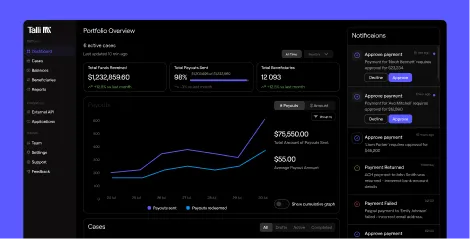
Dashboard analytics expose fraud signatures that aggregate data obscures: sudden spikes in submission volume, geographic clustering of claims, and payment method anomalies. Talli's platform provides stakeholder access—including judges and counsel—to transparency dashboards showing fund flows and completion rates in real time.
Can Better Claimant Experience Actually Prevent Fraud?
Streamlined legitimate claimant processes indirectly reduce fraud by removing friction that sophisticated fraudsters exploit. When honest claimants complete submissions quickly, administrators can focus resources on suspicious cases.
- Secure link delivery - Claimants receive SMS or email links without creating accounts
- Mobile-optimized portals - Self-service access from any device
- Flexible payment selection - Recipients choose methods that work for their banking situation
- Smart follow-up reminders - Automated outreach can cut staff communication time in half
Convenient processes also reduce uncashed checks and abandoned claims. Higher redemption rates mean more funds reach legitimate claimants rather than escheating to state unclaimed property programs—or remaining vulnerable to late-stage fraud schemes targeting dormant accounts.
How Does Regulatory Compliance Create a Secure Payout Framework?
Regulatory requirements establish minimum security standards that, when properly implemented, create robust fraud defenses. Compliance isn't merely a legal obligation—it's a framework for systematic fraud prevention.
- PCI DSS Level 1 - Highest card data security standards for payment processing
- Anti-money laundering (AML) - Protocols preventing funds from reaching criminal enterprises
- NACHA compliance - ACH processing standards including fraud prevention requirements
- Data privacy regulations - GDPR, CCPA, and state laws governing claimant information
ISO 27001 certification provides comprehensive information security management covering 93 Annex A controls. This certification, which Talli maintains, demonstrates systematic security practices that exceed basic compliance requirements.
Legal payout compliance extends beyond security to include tax reporting accuracy, escheatment management, and court reporting obligations. Automated compliance platforms handle 70% of certification tasks automatically, reducing gaps that manual processes create.
How Can Settlement Administrators Optimize Speed Without Sacrificing Security?
Speed and security aren't opposing forces—automation enables both simultaneously. Faster processing with proper controls reduces the window fraudsters have to intervene while improving legitimate claimant experience.
- Tiered auto-decisioning - Low-risk claims auto-approve; high-risk auto-reject; medium-risk receives manual review
- Parallel processing - Multiple verification steps run simultaneously rather than sequentially
- Pre-configured rules engines - Customizable fraud detection without custom development
- API-driven integration - Seamless data flow between claim systems and payment platforms
The industry mantra guides implementation: better to allow 10 fraudsters than to deny one legitimate claimant. Conservative thresholds gradually tighten based on observed fraud patterns, balancing protection with access.
Talli's unified platform reduces distribution timelines from weeks to days while maintaining compliance controls. What previously required coordinating multiple vendors—claim validation, fraud screening, payment processing—operates through a single integrated system.
The first Triangle of Fraud Protection case demonstrated results: prevented $6 million in fraud while delivering a 5,900% ROI for that single case. The collaborative approach—combining real-time screening, AI validation, and administrator expertise—achieved what isolated tools could not.
Frequently Asked Questions
What is the Triangle of Fraud Protection and how does it work?
The Triangle of Fraud Protection is a collaborative model combining three elements: real-time fraud screening through Web Application Firewalls, AI-powered claim validation using 65+ point scoring systems, and settlement administrator expertise for manual review of borderline cases. All three stakeholders plus court representatives access shared transparency dashboards for immediate action on emerging fraud patterns.
How long does implementing fraud prevention tools typically take?
Implementation timelines range from 2-6 months depending on settlement complexity. Basic WAF deployment takes 2-3 weeks for immediate bot blocking. Full AI validation becomes operational within 6-8 weeks. Settlements under 5,000 claimants with low fraud risk may not justify AI prevention costs starting around $15,000-$50,000 per settlement.
Can fraud prevention tools integrate with existing case management systems?
Yes, most platforms offer API access for integration with case management systems. Pre-built connectors simplify setup, while direct API integrations handle data sensitivity and compliance requirements that iPaaS solutions may not address. Talli's unified platform approach reduces integration complexity by handling fraud prevention, compliance, and payment processing through a single connection.
What happens when AI fraud detection flags a legitimate claimant?
Legitimate claimants flagged by AI systems enter manual review queues rather than automatic rejection. Reviewers assess medium-risk scores (typically between 20-95 on 100-point scales) using additional verification methods. Clear appeals processes allow claimants to provide supplementary documentation proving eligibility.
How do settlement administrators balance fraud prevention with claimant access?
The industry standard prioritizes claimant access: blocking one legitimate class member is worse than allowing ten fraudsters to submit claims. Administrators start with conservative fraud detection thresholds and increase sensitivity gradually based on observed patterns. Settlement agreements should include fraud prevention provisions negotiated before court approval to avoid later delays.