.svg)


.svg)
Chargebacks and disputes in digital disbursements pose a growing threat to settlement administrators and claims teams, with fraudulent settlement claims experiencing a 19,000% explosion from 400,000 in 2021 to over 80 million in 2023. For legal payout operations, these disputes delay court-mandated deadlines, erode settlement funds, and create compliance headaches. Modern digital disbursement platforms implementing multi-layered fraud prevention achieve 98% success rates compared to paper check rates of just 85-92%.
Key Takeaways
- Friendly fraud accounts for 75% of all chargebacks, making transaction clarity and claimant communication your most effective prevention tools
- Pre-dispute alert systems can intercept up to 40% of chargebacks before formal filing, at costs around $35-40 per alert versus $20-100 in chargeback fees
- Settlement fraud prevention systems blocked over 800 million claims in 2024, protecting more than $100 million in payout funds
- Transaction confusion causes 47% of disputes—clear billing descriptors and automated notifications significantly reduce this
- The global chargeback management market is projected to grow from $2.1 billion to $7.8 billion by 2033
- AI-powered platforms achieve 0.08% fraudulent chargeback rates, performing 97% below industry averages
Understanding the 'Chargeback vs. Refund' Dynamic in Digital Payouts
The distinction between chargebacks and refunds fundamentally shapes dispute prevention strategy. A refund is a voluntary return of funds initiated by the payer, while a chargeback is a forced reversal initiated by the recipient through their bank—bypassing the disbursing organization entirely.
For digital disbursements, this matters because 84% of customers find filing chargebacks simpler than contacting the administrator. When claimants don't recognize settlement payments on bank statements, they often dispute first and ask questions later.
All disputes typically fall into three categories requiring different prevention approaches:
- Criminal fraud: Stolen identities, unauthorized access, payment redirection attacks
- Merchant error: Processing mistakes, duplicate payments, incorrect amounts
- Friendly fraud: Legitimate recipients disputing valid payments due to confusion, forgetfulness, or deliberate abuse
Understanding this breakdown is critical because friendly fraud represents the largest category—and it's largely preventable through better communication rather than fraud blocking tools.
Leveraging Secure Payment Processing to Minimize Disputes
Implementing Robust Security Features
Secure payment processing forms the foundation of dispute prevention. Digital disbursement platforms must implement multiple security layers:
- Encryption and tokenization protecting sensitive payment data throughout the transaction lifecycle
- PCI DSS Level 1 compliance ensuring secure handling of cardholder information
- Multi-factor authentication for high-value transactions and account access
- Real-time transaction monitoring flagging anomalous patterns before payouts complete
These security measures don't just prevent criminal fraud—they create defensible audit trails that win disputes when chargebacks do occur. Advanced platforms achieve win rates averaging 75% versus the industry average of 12%.
The Role of Payment Processors in Dispute Prevention
Your payment processor selection directly impacts chargeback vulnerability. Look for processors offering:
- Recognizable billing descriptors that claimants identify on statements
- Real-time alert integrations with Verifi and Ethoca networks
- Detailed transaction data transmitted to issuing banks
- Automated evidence collection for dispute responses
Enhanced Verification and Compliance: Your First Line of Defense
Automating Compliance for Increased Reliability
Multi-layer identity verification prevents unauthorized transactions while creating documentation needed to fight disputes. Essential verification components include:
- KYC (Know Your Customer) with government ID verification
- OFAC screening checking recipients against sanctions lists
- W-9 collection for tax compliance and identity confirmation
- Address verification services validating recipient information
- Biometric verification using facial recognition for high-risk payouts
Platforms with built-in compliance features automate these checks without manual intervention, ensuring every payout passes verification before funds move.
The Impact of Incomplete Verification on Dispute Rates
Skipping verification steps creates downstream problems. Without proper identity confirmation:
- Fraudulent claims slip through, depleting settlement funds
- Legitimate disputes lack defensible evidence for representment
- Regulatory audits reveal compliance gaps
- Court reporting requirements go unmet
The Anti-Fraud Triangle system prevented over 800 million fraudulent claims in 2024—claims that would have resulted in over $100 million in fraudulent payouts.
Streamlining Payment Processing: Reducing Friction, Preventing Disputes
Tailoring Payment Processes for Claimants
Claimants in class actions and mass torts often lack dedicated accounting staff to recognize and reconcile incoming payments, increasing confusion-driven disputes.
Reduce friction by:
- Providing clear notifications with case names and reference numbers
- Offering multiple payment options including ACH, digital wallets, and prepaid cards
- Enabling self-service portals where claimants check payment status
- Sending pre-payment alerts so payments aren't unexpected
Addressing Common Pain Points
Claimants commonly dispute payments when:
- Billing descriptors show unfamiliar administrator names rather than settlement case names
- Payments arrive without context or reference to the original claim
- Amounts differ from expectations due to fee deductions or allocation formulas
- Multiple authorized personnel don't communicate about incoming funds
Proactive communication addressing each scenario prevents disputes before they occur.
Choosing the Right Payment Processing Companies
Key Questions for Potential Partners
Selecting the right disbursement partner requires evaluating capabilities specific to legal settlement requirements:
- Compliance infrastructure: Does the platform handle KYC, OFAC, and W-9 collection automatically?
- Fund segregation: Can the platform maintain dedicated accounts preserving QSF ownership?
- Alert network integration: Does the provider connect with Verifi and Ethoca for pre-dispute interception?
- Reporting capabilities: What real-time visibility exists for completion rates and fund flows?
- Dispute support: How does the platform assist with chargeback representation?
Evaluating Provider Dispute Resolution Support
Strong dispute resolution support includes:
- Automated evidence collection compiling verification records, communication logs, and payment confirmations
- Reason code expertise tailoring responses to specific dispute categories
- Deadline management ensuring responses meet processor timeframes
- Win rate tracking measuring representment success over time
Implementing Smart Software to Proactively Tackle Chargebacks
Using AI to Identify High-Risk Transactions
AI-powered fraud detection represents the most significant advancement in chargeback prevention. Modern platforms analyze hundreds of signals in real-time:
- Behavioral analytics tracking typical claimant patterns
- Device fingerprinting identifying suspicious hardware and browser configurations
- Velocity checks flagging unusual claim submission rates
- Fuzzy matching algorithms detecting duplicate claims under different identities
Platforms leveraging AI achieve dramatically better outcomes—0.08% fraudulent rates, 97% below industry averages.
The Advantage of Integrated Fraud Tools
Integrated tools outperform piecemeal solutions by sharing data across the prevention ecosystem:
- Pre-transaction blocking stops fraudulent claims before verification
- Real-time alerts intercept disputes before formal filing
- Post-chargeback automation optimizes representment evidence
According to Chargebacks911, 62% of merchants plan to implement AI for chargeback management, recognizing the technology's proven effectiveness.
Enhancing Claimant Experience to Prevent Disputes
The Impact of Seamless Experience
Transaction confusion drives 47% of disputes. When claimants don't recognize payments, they dispute them—even when payments are legitimate.
Prevent confusion through:
- Clear billing descriptors using recognizable settlement case names
- Multi-channel notifications via SMS, email, and push alerts
- Digital receipts with itemized payment details
- Status tracking portals showing payment progress in real-time
Many consumers find unrecognizable transactions in online statements, but 80% say clearer information would reduce disputes.
Proactive Communication Strategies
Build communication workflows that eliminate confusion:
- Pre-payment notification: Alert claimants 3-5 days before disbursement
- Payment confirmation: Immediate notification when funds transfer
- Receipt delivery: Detailed digital receipt with case reference and support contact
- Follow-up reminder: Check-in 7 days post-payment confirming receipt
Smart reminders across email and SMS help claimants complete the payout process without uncertainty that leads to disputes.
Reconciliation, Reporting, and Real-Time Visibility
How Visibility Empowers Administrators
Real-time dashboards transform dispute management from reactive firefighting to proactive prevention. Administrators need visibility into:
- Completion rates by payment method and claimant segment
- Dispute patterns identifying problematic payout categories
- Fund flows tracking every dollar from settlement to claimant
- Engagement metrics showing communication effectiveness
Using Data to Identify Patterns
Analytics reveal actionable insights:
- Which payment methods generate the highest dispute rates
- Which claimant communications reduce confusion most effectively
- What billing descriptors cause recognition problems
- Where verification gaps create fraud vulnerabilities
Flexible Payout Options and Fund Segregation
Meeting Diverse Needs with Varied Methods
Claimant diversity demands payment flexibility. Not all recipients have bank accounts, and forcing single payment methods increases abandonment and disputes.
Effective platforms offer:
- Digital wallet integration for instant mobile payments
- Prepaid Mastercards providing immediate spending access
- Gift card options for recipients without banking relationships
- ACH transfers for traditional bank deposits
When claimants select their preferred payment method, completion rates rise and disputes fall.
Ensuring Compliance Through Proper Fund Handling
Secure fund segregation isn't just best practice—it's a regulatory requirement. Proper fund handling includes:
- Dedicated accounts for each settlement
- QSF ownership preservation maintaining tax-advantaged status
- Complete audit trails documenting every transaction
- Real-time reconciliation matching disbursements to approved claims
Actionable Steps to Reduce Chargebacks Today
Creating a Prevention Checklist
Implement these measures immediately:
Verification and Security
- Enable multi-factor authentication for all payout authorizations
- Implement automated KYC and OFAC screening
- Collect W-9 documentation during claim submission
Communication and Clarity
- Update billing descriptors to include recognizable case names
- Configure automated pre-payment and confirmation notifications
- Create self-service status tracking for claimants
Monitoring and Response
- Connect to Verifi and Ethoca alert networks
- Establish dispute response workflows with evidence templates
- Track redemption rate statistics to identify problem areas
Integrating Best Practices into Operations
Sustainable chargeback reduction requires operational integration:
- Train staff on dispute prevention fundamentals
- Review metrics weekly to catch emerging patterns early
- Update policies based on dispute analysis findings
- Leverage technology that automates prevention
Why Talli Simplifies Chargeback Prevention
Talli delivers comprehensive solutions purpose-built for legal settlement disbursements where compliance, speed, and claimant experience intersect.
Talli's AI-driven payment platform provides:
- Built-in compliance automation with KYC, OFAC, W-9 collection, fraud mitigation, and audit logs
- Complete fund segregation maintaining dedicated accounts while preserving QSF ownership
- Flexible payout options including digital wallets, prepaid Mastercards, and gift cards
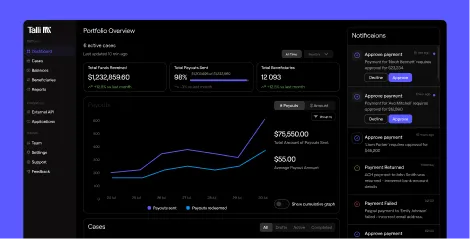
- Real-time dashboards providing visibility into completion rates and fund flows
- Smart reminders across email and SMS helping claimants complete payouts without confusion
Unlike generic payment processors, Talli understands legal disbursements face unique requirements—court deadlines, claimant diversity, regulatory compliance, and settlement-specific fraud patterns. The platform handles disbursements at any scale, whether 1,000 or 100,000 recipients, while maintaining compliance infrastructure that satisfies administrators, courts, and claimants alike.
Banking services are provided by Patriot Bank, N.A., Member FDIC, ensuring fund security and regulatory compliance throughout the disbursement lifecycle.
Frequently Asked Questions
What is the primary difference between a chargeback and a refund?
A refund is a voluntary return of funds initiated by the payer (the settlement administrator), while a chargeback is a forced reversal initiated by the recipient through their bank. Chargebacks bypass the administrator entirely, incur fees averaging $20-100 per dispute, and can damage processing relationships if rates exceed industry thresholds. Preventing chargebacks through clear communication is far more cost-effective than resolving them after filing.
How does identity verification help prevent chargebacks?
Multi-layer verification—including government ID scanning, biometric authentication, and address verification—prevents two chargeback categories simultaneously. First, it blocks fraudulent claims from unauthorized parties. Second, it creates defensible evidence trails for dispute responses. Platforms implementing comprehensive verification achieve win rates averaging 75% on disputes versus the industry average of 12%, because they can prove payments went to verified, legitimate claimants.
Can the right software reduce chargeback rates?
Yes—dramatically. AI-powered platforms analyze transaction patterns, device fingerprints, and behavioral signals to block fraudulent claims before payout. They also integrate with alert networks that intercept up to 40% of chargebacks before formal filing. Organizations using advanced fraud prevention report 0.08% fraudulent rates—97% below industry averages—while maintaining high completion rates.
What role does communication play in avoiding disputes?
Communication is your most effective tool against friendly fraud, which represents 75% of all chargebacks. When claimants don't recognize payments on bank statements, they dispute them. Pre-payment alerts, clear billing descriptors with case names, immediate confirmation notifications, and detailed digital receipts prevent the confusion that drives 47% of disputes.
How does Talli ensure compliance in claims payouts?
Talli automates compliance through built-in KYC verification, OFAC sanctions screening, W-9 collection, and fraud mitigation—all with complete audit logs for every transaction. The platform maintains complete fund segregation with dedicated accounts for each settlement, preserving QSF ownership while simplifying regulatory reporting. Real-time dashboards provide visibility into completion rates and fund flows, enabling administrators to identify and address potential issues before they become disputes.