.svg)


.svg)
Comprehensive data compiled from extensive research on legal settlement distribution, claims processing, and digital payment transformation
Key Takeaways
- Settlement funds remain largely unclaimed in traditional systems – Between 90-99% of settlement funds go unclaimed in claims-made class actions, with the median claims rate across consumer settlements reaching only 9%, representing billions in compensation that never reaches intended recipients
- Claimant abandonment stems from process friction and outdated methods – With 58.6% of malpractice claims abandoned before resolution and 68% of consumers abandoning online financial applications, complex processes and limited payment options drive claimants away at alarming rates
- Check-based payments create significant redemption barriers – Traditional check distribution achieves only 77% success rates while 63% of organizations experience check fraud, compared to digital payment platforms achieving 98% success rates
- Notice method selection directly impacts claims rates – Email-only notices generate just 3% claims rates versus 16% for notice packets, while 60% of settlement notices fail to use plain English and 33% omit specific compensation amounts
- Digital payment platforms dramatically reduce abandonment – Organizations implementing digital platforms report significant improvements in settlement take-up rates while compressing distribution timelines from weeks to days
- Multi-channel outreach doubles claimant engagement – Settlements using multiple notice touches achieve double the claims rates, yet only 13% of current settlements employ this approach
Understanding Claimant Abandonment: What It Is and Why It Matters
1. 90-99% of settlement funds go unclaimed in traditional claims-made systems
The most striking reality in settlement administration is that the vast majority of funds designated for class members never reach them. Traditional claims-made class actions see between 90-99% of allocated settlement funds remain unclaimed, leaving billions of dollars in victim compensation undistributed. This represents not only a failure of justice but also significant administrative waste and potential legal complications for claims administrators managing these funds. Source: Duke Law Judicature
2. Only 9% median claims rate across consumer class action settlements
Federal Trade Commission analysis of 149 class action settlements reveals that the median claims rate across all consumer class actions stands at just 9%. This means that for every 100 eligible claimants, only 9 typically submit claims and receive compensation. When weighted by settlement size, this figure drops even further to 4%, indicating that larger settlements often see proportionally fewer participants. Understanding these redemption benchmarks helps administrators set realistic expectations and identify improvement opportunities. Source: Federal Trade Commission
3. Less than 30% of monetary awards reach class members on average
Empirical analysis of federal consumer fraud class action settlements demonstrates that less than 30% of monetary awards actually reach intended class members. This gap between settlement value and distributed funds creates systemic inefficiency in the legal system while undermining the compensatory purpose of class action litigation. The delta represents a combination of failed claims submissions, uncashed checks, and administrative overhead that collectively reduce victim recovery. Source: Jones Day Analysis
4. 58.6% of medical malpractice claims are abandoned by plaintiffs
Research into medical malpractice litigation reveals that 58.6% of claims are abandoned by plaintiffs before resolution, with 46.4% of cases dropped without any decision or recovery. This abandonment represents not only lost compensation for injured parties but also significant sunk costs for all participants in the legal process. Each abandoned claim incurs average defense costs exceeding $25,000-$44,000, demonstrating that abandonment creates costs across the entire claims ecosystem. Source: Health Affairs
Key Factors Contributing to High Abandonment Rates in Legal Claims
5. 0.023% median claims rate for media-only notice campaigns
Settlement notice methodology directly impacts claims rates, with media-only notice campaigns achieving a median claims rate of just 0.023%. This near-zero participation rate demonstrates that passive awareness campaigns without direct contact information fail to convert eligible claimants into actual participants. Claims administrators relying solely on publication notices or media advertisements should anticipate minimal claimant response regardless of settlement value. Source: Duke Law Judicature
6. Email notices generate only 3% average claims rate
Despite being a common and cost-effective notice method, email notifications achieve only 3% average claims rates in class action settlements. Contributing factors include low 14% email opening rates for class action notices and mere 4% hyperlink click-through rates from delivered emails. These metrics indicate that email alone fails to generate sufficient claimant engagement to drive meaningful participation rates. Source: Federal Trade Commission
7. 60% of notices fail to use plain English payment language
A critical barrier to claimant participation is communication clarity. Research indicates that 60% of settlement notices fail to use plain English payment language, while 33% omit specific compensation amounts entirely. This opacity creates confusion about claim value and process requirements, directly contributing to abandonment. Notices that do employ clear payment language demonstrate 10 percentage point improvements in claims rates compared to those using legal jargon. Source: Federal Trade Commission
8. 13% average undeliverable rate across all notice types
Settlement notices face fundamental delivery challenges, with 13% of notices across all types failing to reach intended recipients. This undeliverable rate stems from outdated contact information, address changes, and data quality issues that prevent initial claimant awareness. Organizations managing claimant experience must account for this baseline non-delivery when projecting participation rates and planning supplemental outreach strategies. Source: Federal Trade Commission
9. 68% of consumers abandon online financial applications
Beyond traditional claims contexts, consumer behavior research reveals that 68% of consumers abandon online credit and financial applications before completion. This abandonment pattern reflects broader consumer intolerance for friction in digital processes. When legal claims processes require similar complexity, abandonment rates follow comparable patterns. Notably, 50% or more of customers abandon processes taking longer than 3-5 minutes, establishing a critical time threshold for claimant engagement. Source: MX Technologies Research
10. 48% of consumers switch providers after experiencing digital friction
Consumer patience for poor digital experiences continues declining, with 48% of consumers switching banks or financial providers after experiencing digital friction. This behavior transfers directly to claims contexts, where claimants frustrated by complex submission processes or limited payment options simply abandon their claims rather than persisting through difficulties. Building seamless experiences becomes essential for maximizing redemption rates. Source: Ekata Research
The Impact of Abandonment on Claims Administrators and Law Firms
11. $42 billion distributed through class action settlements in 2024
The scale of settlement distribution continues growing, with $42 billion distributed through class action settlements in 2024 alone. This represents the third consecutive year exceeding $40 billion, with 34 settlements surpassing $1 billion over the 2022-2024 period. Given current abandonment rates, billions of these dollars remain unredeemed, creating extended administrative obligations and potential cy pres distributions that dilute intended victim compensation. Source: Duane Morris Review
12. $200,000 typical administration cost per settlement
Individual settlement administration carries substantial fixed costs, with typical settlements incurring $200,000 in administration expenses. These costs span notice distribution, claims processing, payment issuance, and ongoing management of unclaimed funds. When abandonment rates remain high, per-successful-claim costs escalate dramatically, reducing the efficiency of the entire settlement mechanism and creating pressure for administrators to optimize processes. Source: Talli Research
13. Claims processing represents 75% of total administrative costs
Within settlement administration budgets, claims processing activities consume 75% of total administrative costs. This concentration makes claims processing efficiency the primary lever for cost reduction while simultaneously affecting claimant experience and redemption rates. Organizations implementing automation in this phase see the largest returns on technology investment while enabling teams to manage larger settlements without proportional staff increases. Source: Talli Research
14. Only 13% of settlements use multiple outreach attempts
Despite evidence that multi-touch outreach dramatically improves claims rates, only 13% of settlements employ multiple outreach attempts to reach eligible claimants. This underutilization of proven engagement strategies directly contributes to low redemption rates across the industry. Settlements implementing multiple notice touches achieve double the claims rates of single-notice approaches, making this one of the highest-impact improvement opportunities available. Source: Federal Trade Commission
Improving Claim Payouts: Strategies to Reduce Abandonment
15. Notice packets achieve 16% median claims rate versus 3% for email
The most effective traditional notice method, notice packets, achieves 16% median claims rates—over five times the 3% average for email notices. When notice packets include detachable claim forms, rates improve further to 12% average versus just 5% for packets without forms. This differential demonstrates that reducing friction through pre-formatted materials directly increases participation and represents actionable insight for administrators designing notice programs. Source: Federal Trade Commission
16. Plain English payment language improves claims rates by 10 percentage points
Simple communication changes generate meaningful improvements in claimant participation. Notices using plain English payment language rather than legal terminology demonstrate 10 percentage point improvements in claims rates. This represents a potential doubling of participation rates through communication optimization alone, requiring no technology investment beyond careful notice drafting and representing one of the most cost-effective improvement strategies available to administrators. Source: Federal Trade Commission
17. 86% approval rate for submitted claims
When claimants do complete submission processes, the vast majority succeed in receiving compensation. Submitted claims achieve 86% approval rates on average, with well-designed claims processes reaching 93% median approval rates. This indicates that the primary barrier is participation rather than qualification—getting claimants to engage is more challenging than validating their claims once submitted. Source: Federal Trade Commission
18. 25% claim rate achievement possible through optimized outreach
While median claims rates hover around 9%, optimized outreach strategies can achieve 25% claim rates or higher. This nearly three-fold improvement stems from combining multiple notice methods, clear communication, simplified submission processes, and multiple follow-up touches. Organizations willing to invest in comprehensive engagement strategies can dramatically outperform industry averages and deliver substantially better outcomes for claimants. Source: Top Class Actions
19. 75-90% class member reach rate expected by courts
Courts establishing notice program requirements typically expect 75-90% class member reach rates for approved notice programs. This standard creates accountability for notice quality while establishing benchmarks for adequacy. Administrators falling short of these thresholds risk court intervention and supplemental notice requirements that extend timelines and increase costs, making initial notice quality critical to efficient settlement administration. Source: Kroll Analysis
Leveraging Technology to Boost Redemption Rates and Prevent Abandonment
20. Settlement timelines compress from 6 weeks to 2 days with digital platforms
Traditional settlement distribution timelines extend 3-6 weeks for check delivery alone, with additional time for cashing and potential reissuance. Digital payment platforms compress these timelines dramatically, enabling fund distribution within 2 days of approval. This acceleration improves claimant satisfaction while reducing administrative overhead for extended settlement management and enabling faster case closure. Source: Talli Platform
21. 75% reduction in manual processing hours with automation
Claims administration automation delivers 75% reductions in manual processing hours, freeing staff capacity for claimant support and exception handling rather than routine data entry. This efficiency gain enables teams to manage larger settlements without proportional staff increases while improving responsiveness to claimant inquiries. The time savings compound across settlement lifecycles, enabling faster distributions and reduced administrative costs. Source: Talli Research
Talli's Approach to Maximizing Claimant Redemption and Minimizing Abandonment
22. Smart reminders double engagement through multi-channel outreach
Talli's smart reminder functionality across email, SMS, and additional channels addresses the fundamental finding that multiple notices touch double claims rates. Rather than relying on single-touch notification, automated reminder sequences maintain claimant awareness and urgency through the payout process. This approach directly counteracts the 87% of settlements currently using only single outreach attempts and delivers measurable improvements in participation. Source: Federal Trade Commission
23. Convenient mobile-first experience eliminates account creation barriers
Claimants receiving Talli payouts access secure links via SMS or email without creating accounts, eliminating friction that drives abandonment in other platforms. Given that 75% of abandoned applications come from applicants aged 25-34 who expect seamless mobile experiences, this frictionless approach directly addresses the highest-abandonment demographic while serving all claimants effectively and maintaining security. Source: FinXTech Research
Ensuring Security and Compliance in Digital Payouts
24. 63% of organizations experienced check fraud in 2024
Check-based payment systems carry substantial fraud risk, with 63% of organizations experiencing check fraud in 2024. Recovery rates continue declining, with only 22% of victims recovering 75% or more of losses—down from 41% in 2023. Digital payment platforms with built-in verification and fraud mitigation capabilities eliminate most check fraud vectors while improving compliance standards. Source: AFP Payments Survey
25. $4.45 million average data breach cost
Security in settlement administration extends beyond payment fraud to data protection. Average data breach costs reach $4.45 million per incident, with 95% of enterprises facing identity fraud attempts. Platforms managing sensitive claimant information must maintain robust security infrastructure. Talli's banking services through Patriot Bank, N.A., Member FDIC, provide institutional-grade security while maintaining accessibility for claimants throughout the payout process. Source: IBM Security
26. Complete fund segregation preserves QSF ownership and simplifies compliance
Qualified Settlement Fund management requires careful fund segregation to maintain legal compliance and tax treatment. Talli supports dedicated accounts for every settlement, preserving QSF ownership while simplifying reporting and ensuring legal compliance throughout the disbursement lifecycle. This infrastructure prevents commingling issues that can create significant legal and tax complications for administrators and settling parties. Source: Talli Platform
Measuring Success: Tracking Completion Rates and Achieving Total Visibility
27. Real-time dashboards enable monitoring of delivery, completion, and engagement
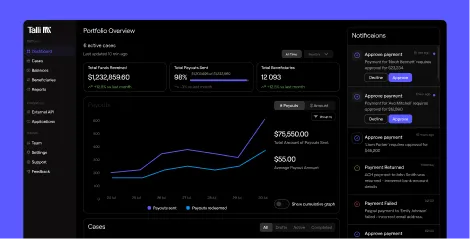
Effective settlement administration requires visibility into payout progress at every stage. Modern platforms provide real-time dashboards tracking delivery status, completion rates, and claimant engagement metrics. This visibility enables proactive intervention when redemption rates lag expectations and supports stakeholder reporting requirements. Talli's dashboard provides total control and visibility while enabling teams to create distribution campaigns and monitor completion in real time. Source: Talli Platform
28. CRM synchronization enables seamless data flow and reporting
Settlement administration increasingly requires integration with existing organizational systems. Platforms offering CRM synchronization enable real-time payout data flow to existing systems, eliminating manual reconciliation and enabling comprehensive efficiency tracking. This integration supports both operational efficiency and stakeholder reporting requirements while reducing administrative burden on claims teams managing multiple concurrent settlements. Source: Talli Platform
The Future of Legal Payouts: Speed, Efficiency, and Claimant Satisfaction
29. Claims management technology market reaching $13.95 billion by 2032
The claims management technology market continues rapid expansion, growing from $5.15 billion in 2024 to projected $13.95 billion by 2032 at a 13.3% compound annual growth rate. This growth reflects industry-wide recognition that technology investment drives improved outcomes while reducing operational costs. Early adopters gain competitive advantages while laggards face increasing pressure to modernize their settlement administration practices. Source: Fortune Business Insights
30. Check usage declining 7.2% annually as digital payments dominate
Traditional check usage continues declining at 7.2% annually across payment categories, with the global digital payments market projected to reach $16.62 trillion by 2028. Settlement administration following this broader payment evolution sees improved claimant acceptance and reduced friction as digital payment expectations become universal. Organizations exploring payment transitions find compelling evidence for digital adoption now. Source: Federal Reserve Studies
31. 22% of lawyer tasks automatable with current AI capabilities
Current AI capabilities can automate approximately 22% of lawyer tasks, with claims processing representing a prime automation target. As AI capabilities expand, settlement administration automation will extend beyond payment processing to encompass claims validation, fraud detection, and claimant communication. Organizations building AI-capable infrastructure today position themselves for continued capability expansion and competitive advantages in efficiency and service quality. Source: Verlata Consulting
Conclusion: Transforming Settlement Administration Through Data-Driven Innovation
The statistics presented throughout this article paint a clear picture: traditional settlement administration methods leave billions of dollars unclaimed while creating unnecessary friction for eligible claimants. With median claims rates at just 9% and abandonment affecting nearly 60% of malpractice claims, the status quo fails both claimants and administrators. However, the data also reveals a path forward. Organizations embracing digital payment platforms, multi-channel outreach strategies, and plain language communications achieve dramatically better outcomes—with some reaching 25% claims rates and 98% payment success rates.
The future of settlement administration lies in leveraging technology to eliminate friction while maintaining security and compliance. Platforms like Talli demonstrate how AI-driven automation, mobile-first experiences, and intelligent reminder systems can transform claimant engagement. By compressing timelines from weeks to days, reducing processing costs by up to 95%, and offering payment flexibility that 91% of claimants prefer, modern platforms address the root causes of abandonment.
For claims administrators seeking to improve redemption rates, the evidence is compelling: invest in claimant experience optimization, adopt digital payment methods, implement multi-touch outreach strategies, and leverage real-time dashboards for visibility. The operational cost savings alone justify modernization, but the true value lies in ensuring that settlement funds reach their intended recipients—fulfilling the fundamental purpose of class action litigation and legal settlements.
Frequently Asked Questions
What is a claimant abandonment rate?
Claimant abandonment rate measures the percentage of eligible settlement recipients who fail to complete the payout process and receive their compensation. This includes claimants who never submit claims, submit incomplete claims, fail to cash checks, or otherwise do not complete required steps to receive entitled funds. Current industry data shows abandonment rates frequently exceed 90% in traditional claims-made settlements.
How does claimant abandonment impact law firms and claims administrators?
High abandonment rates create extended administrative timelines, increased per-claim processing costs, and potential compliance complications from unclaimed funds. With administration costs averaging $200,000 per settlement and claims processing consuming 75% of budgets, abandonment directly increases operational burden while reducing the effectiveness of settlement outcomes and potentially triggering court oversight.
What are the most common reasons claimants abandon the payout process?
Primary abandonment drivers include complex claims procedures, confusing notice communications (60% fail to use plain English), limited payment method options, delivery failures (13% undeliverable rate), and excessive processing times. Additionally, 48% of consumers switch providers after digital friction, suggesting that outdated payout experiences directly trigger abandonment in settlement contexts.
How can technology like Talli help reduce claimant abandonment rates?
Modern digital payment platforms address abandonment through multiple mechanisms: achieving 98% payment success rates versus 77% for checks, compressing distribution timelines from weeks to days, offering flexible payment options including digital wallets, and deploying smart reminder systems across email and SMS. Talli specifically provides no-account-required mobile access, real-time tracking dashboards, and automated multi-touch engagement that doubles participation rates.
Is a digital payment platform secure and compliant for legal settlement distribution?
Digital platforms like Talli incorporate comprehensive security and compliance infrastructure including KYC verification, OFAC screening, W-9 collection, fraud mitigation controls, and complete audit logs. Banking services through FDIC-member institutions provide institutional-grade security while complete fund segregation preserves QSF ownership and simplifies regulatory reporting throughout the disbursement lifecycle.