.svg)


.svg)
Comprehensive data compiled from extensive research on employment litigation trends, settlement volumes, and distribution challenges affecting claims professionals
Key Takeaways
- Employment class actions dominate the litigation landscape – Labor and employment cases now represent 43.4% of all class action matters, up from 33.6% in 2022, with 79.4% of large companies facing such litigation within the past five years
- Settlement volumes have reached unprecedented levels – Total class action settlements exceeded $70 billion in 2025, the highest figure ever recorded, with employment-related cases driving significant portions of this growth
- Filing rates continue accelerating across jurisdictions – Washington state employment class actions surged 1,025% in five years, while 27,499 employment-related federal lawsuits were filed in FY 2024, representing a 5% year-over-year increase
- Plaintiff certification success rates favor claimants – Courts granted 68% of class certification motions in 2025, up from 63% in 2024, while FLSA collective actions achieved 80% conditional certification success rates
- Defense costs burden corporate legal budgets – U.S. companies with over $1 billion in revenue spent $3.9 billion on class action defense in 2024, with labor and employment cases consuming 43.4% of that spending
- Settlement distribution complexity demands modern solutions – With mass payouts involving thousands or hundreds of thousands of claimants, efficient distribution platforms like Talli become essential for meeting court-mandated deadlines while maintaining compliance
Employment Class Action Litigation Statistics
1. Labor and employment cases represent 43.4% of all class action matters
Employment-related litigation has become the dominant category in class action filings, comprising 43.4% of all class action matters in 2023. This represents a significant increase from 33.6% in 2022, demonstrating the accelerating pace of workplace-related disputes. For claims administrators and settlement professionals, this concentration means employment cases now demand the majority of resources dedicated to legal payout compliance. Source: Carlton Fields 2024 Survey
2. Nearly 80% of large companies faced employment class actions within five years
The pervasive nature of employment litigation affects virtually every major corporation, with research indicating 79.4% of companies have faced a labor and employment class action in the last five years as of 2024. This widespread exposure underscores why efficient settlement administration infrastructure has become a strategic priority rather than an occasional necessity for corporate legal departments. Source: Carlton Fields 2024 Survey
3. 61.9% of companies faced class actions in 2024—the highest in 13 years
Corporate exposure to class action litigation reached a 13-year peak in 2024, with 61.9% of companies actively defending against such claims. Companies facing these actions averaged 9.8 class actions per company, with projections indicating 11.4 class actions per company in 2024. This escalating trend creates compounding administrative challenges when settlements reach distribution phases. Source: Carlton Fields 2024 Survey
4. 27,499 employment-related federal lawsuits filed in FY 2024
Federal court employment litigation reached 27,499 cases in FY 2024, representing more than a 5% increase from FY 2023. This upward trajectory compounds settlement administration workloads as more cases proceed through litigation to resolution phases requiring efficient fund distribution mechanisms. The sustained growth demonstrates the ongoing expansion of workplace litigation. Source: Administrative Office U.S. Courts
5. 1,673 FLSA collective actions filed in federal courts in 2024
Fair Labor Standards Act violations generated 1,673 collective action filings in federal district courts during 2024. The Eastern District of New York led all federal districts with 226 FLSA cases filed, followed by the Southern District of New York, Southern District of Florida, Middle District of Florida, and Northern District of Illinois. These wage and hour cases often involve large plaintiff classes requiring streamlined payment distribution. Source: Bloomberg Law Analytics
6. EEOC obtained $40.4 million in monetary relief for 4,304 individuals in FY 2024
The Equal Employment Opportunity Commission secured $40,399,978 in monetary relief benefiting 4,304 individuals during FY 2024 through its litigation program. This federal enforcement activity generates settlements requiring compliant distribution processes that protect both claimants and administrators while meeting strict regulatory requirements. Source: EEOC FY 2024 Report
7. ADA employment lawsuits reached highest level in 20 years
Disability accommodation claims drove 3,018 ADA employment lawsuits in FY 2024, representing an 18% increase and the highest number recorded in the past 20 years. Settlement administration for ADA cases often requires accessibility accommodations in the claims process itself, demanding platforms capable of serving claimants with diverse needs. Source: Administrative Office U.S. Courts
8. Title VII, ADEA, Section 1981, and GINA lawsuits reached 12-year high
Discrimination lawsuits under major federal statutes totaled 13,526 in FY 2024, an 11% increase from 12,152 in FY 2023 and the highest volume since 2012. This sustained growth in discrimination claims creates ongoing settlement distribution requirements across multiple protected categories including race, age, and genetic information. Source: Administrative Office U.S. Courts
9. Companies spent $3.9 billion on class action defense in 2024
U.S.-based companies with more than $1 billion in revenue collectively spent $3.9 billion on class action defense in 2024. This represents 14.6% of total corporate legal spending, up from 14.4% in 2023, with projected 6.8% growth in defense spending for 2025. These costs exclude settlement amounts themselves, representing pure litigation expenses. Source: Carlton Fields 2024 Survey
10. Labor and employment cases consume 43.4% of class action defense budgets
Within the $3.9 billion defense spending total, labor and employment cases commanded 43.4% of resources—mirroring their dominance in overall filing volumes. This concentration of legal spending on employment matters reflects both the volume and complexity of workplace litigation, creating sustained demand for specialized settlement administration services. Source: Carlton Fields 2024 Survey
11. In-house attorneys dedicate 16.1 hours weekly to class action defense
Corporate legal departments allocated significant internal resources to class action management, with in-house attorneys spending 16.1 hours per week on class action defense in 2024—a 6% increase from the previous year. Companies averaged 4.7 in-house attorneys dedicated to class action management, the highest level recorded in survey history. Source: Carlton Fields 2024 Survey
12. 79.4% of companies cite baseless claims as largest class action risk
Despite the legitimate nature of many employment claims, corporate respondents identified baseless claims as presenting the largest risk in class action litigation. This perception drives settlement decisions even when defendants believe claims lack merit, accelerating the need for efficient distribution mechanisms when settlements occur to minimize overall costs. Source: Carlton Fields 2024 Survey
13. 67.6% of companies expect class actions to become more complex
Looking forward, 67.6% of companies anticipate class action litigation becoming more complex in the future. This expected complexity increase extends to settlement administration, where larger plaintiff classes, stricter compliance requirements, and tighter court deadlines create operational challenges that manual processes cannot efficiently handle. Source: Carlton Fields 2024 Survey
14. 96.2% of EEOC suit resolutions were settlements
Settlement dominates employment litigation resolution, with 96.2% of EEOC suit resolutions in FY 2024 occurring through settlement rather than trial—127 of 132 cases resolved. This settlement-heavy resolution pattern creates predictable, recurring demand for claims payout distribution services throughout the year. Source: EEOC FY 2024 Report
15. 42.4% of EEOC's active docket consists of class or systemic cases
Nearly half of EEOC enforcement activity targets pattern-or-practice violations affecting multiple workers. At the end of FY 2024, 42.4% of EEOC's active district court docket—87 of 205 merits cases—involved class or systemic discrimination claims. These cases generate settlements requiring distribution to numerous affected individuals simultaneously. Source: EEOC FY 2024 Report
16. EEOC filed 111 merits lawsuits in FY 2024
Federal enforcement remained active, with the EEOC filing 111 merits lawsuits in FY 2024, including 110 employment discrimination lawsuits and one breach of conciliation agreement case. Of these filings, 13 were systemic lawsuits involving pattern or practice discrimination allegations affecting multiple employees across various industries. Source: EEOC FY 2024 Report
17. Disability and sex discrimination dominated EEOC enforcement
EEOC enforcement priorities concentrated on specific discrimination categories, with 48 disability discrimination lawsuits (43.2% of all EEOC merits suits) and 52 sex discrimination lawsuits (46.8%) filed in FY 2024. Additionally, 38.7% of EEOC suits alleged retaliation. These patterns influence settlement structures and distribution requirements across various protected classes. Source: EEOC FY 2024 Report
18. Five EEOC lawsuits filed under the Pregnant Workers Fairness Act in FY 2024
The first year of enforcement under the Pregnant Workers Fairness Act generated 5 EEOC lawsuits in FY 2024, indicating a new category of employment litigation requiring settlement administration attention. Emerging statutory enforcement creates new compliance requirements for payout processes as case law develops. Source: EEOC FY 2024 Report
19. 72.1% of EEOC lawsuits involved discharge claims
The majority of employment discrimination cases (72.1%, or 80 of 111 cases in FY 2024) involved discharge or constructive discharge claims. Workers separated from employment often relocate, change contact information, and face financial pressures requiring rapid settlement distribution once cases resolve to prevent further hardship. Source: EEOC FY 2024 Report
20. 30.6% of EEOC merits suits sought relief for multiple individuals
Nearly one-third of EEOC litigation (34 of 111 cases) sought relief for multiple individuals rather than single plaintiffs. Multi-party settlements require distribution infrastructure capable of processing numerous individual payments while maintaining accurate records for each recipient and ensuring proper tax reporting. Source: EEOC FY 2024 Report
21. 35.1% of EEOC lawsuits included harassment claims
Harassment allegations appeared in 35.1% of EEOC lawsuits (39 of 111 cases) in FY 2024. Harassment settlements often involve sensitive circumstances requiring discretion and security in the distribution process, emphasizing the need for secure payment methods that protect claimant privacy throughout the disbursement lifecycle. Source: EEOC FY 2024 Report
22. 32.4% of companies use mandatory arbitration clauses
A significant portion of employers (32.4%) implement mandatory arbitration clauses in employment agreements, while 23.5% use class action waivers. However, mass arbitrations are emerging as an alternative, with 5.9% of companies facing mass arbitrations in 2024, up from 3.9% in 2023. Whether through class litigation or mass arbitration, settlement distributions still require efficient payment infrastructure. Source: Carlton Fields 2024 Survey
23. 77.1% of class action settlements in 2023 were individual settlements
Settlement resolution patterns have shifted, with 77.1% of class action settlements in 2023 being individual settlements, up from 46.2% in prior years. This trend toward more numerous individual payments increases administrative complexity and demands scalable distribution technology capable of handling thousands of separate transactions. Source: Carlton Fields 2024 Survey
24. 52.9% of companies have insurance coverage for class action defense
Insurance coverage for class action defense increased to 52.9% of companies in 2024, up from 45.8% in 2023. Insurance involvement adds reporting and documentation requirements to settlement administration, demanding platforms capable of providing detailed reconciliation data for both insurers and insured parties. Source: Carlton Fields 2024 Survey
25. 85.3% of companies face class actions regularly
Among companies that have faced class actions, 85.3% experience them on a regular basis—either annually or with one or more actions always open. This recurring exposure demands efficient claims redemption rate strategies that maximize claimant participation while minimizing administrative burden across multiple concurrent settlements. Source: Carlton Fields 2024 Survey
26. Washington state employment class actions are surging dramatically
Washington state has experienced an explosion in employment class action filings over the past five years, driven by expanding state-level worker protection statutes and aggressive plaintiff bar strategies. The dramatic growth in Washington reflects broader national trends toward increased state-level employment litigation, creating concentrated settlement administration demands in specific jurisdictions. Source: Seyfarth Shaw Analysis
27. Meal and rest break violations frequently trigger Washington employment cases
Among recent Washington employment class actions, meal and rest break violations represent a significant category of claims, alongside challenges to job posting practices under the Equal Pay and Opportunities Act and allegations of unlawful non-competition restrictions. These specific claim types often affect hourly workers who may lack traditional banking relationships, requiring flexible payment options during settlement distribution. Source: Seyfarth Shaw Analysis
Navigating Employment Class Action Settlements with Modern Solutions
The complexity of employment class action settlements demands technology-driven approaches to distribution. With 27,499 federal employment lawsuits filed in FY 2024 and 96.2% of EEOC cases resolving through settlement, claims administrators face unprecedented volume requiring streamlined processes. Traditional settlement distribution approaches face significant challenges: workers may have changed contact information since leaving employment, many hourly workers lack bank accounts for direct deposit, paper checks face high non-redemption rates, and manual processes create delays in meeting court deadlines.
Employment settlements involve complex regulatory requirements including KYC (Know Your Customer) verification to confirm claimant identities, OFAC screening to ensure sanctions compliance, W-9 collection for tax reporting obligations, fraud mitigation protocols to protect settlement funds, and complete audit trails for court reporting and QSF compliance. Modern platforms address these requirements through integrated compliance workflows, with KYC, OFAC, W-9 collection, fraud mitigation, and audit logs built into every distribution.
Settlement distribution challenges for employment class actions include reaching workers who have changed employers, addresses, or contact information, processing payments for claimants without traditional bank accounts, meeting court-mandated distribution deadlines, maintaining fund segregation and QSF ownership requirements, and providing real-time visibility into completion rates. Efficient platforms streamline fund distribution with secure settlement payment methods, digital wallet integration, and real-time tracking for claims administrators and recipients.
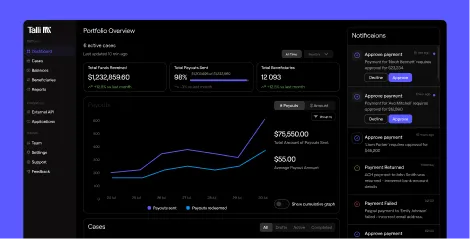
Real-time dashboards provide total control and visibility, offering full transparency on completion rates, fund flows, and the ability to sync real-time payout data to your CRM. This level of visibility enables claims administrators to create payout distribution campaigns, track every payout status, monitor completion rates, launch, fund, and track payouts faster, and monitor delivery, completion, and engagement in real time with built-in reporting.
Technology platforms increase redemption rates with flexible payout options, enabling more claimants to complete the process. No bank account is required—claimants receive a secure link via SMS or email, with no accounts to create. Smart reminders across email, SMS, and more help claimants complete the payout process fast. Modern solutions automate and safeguard every claims payout—so claims administrators can meet tight deadlines without losing control over compliance in payouts or claimant experience.
Frequently Asked Questions
What types of employment issues typically lead to class action lawsuits?
The most common employment class actions involve wage and hour violations (FLSA claims, meal and rest break violations), discrimination claims (disability, sex, race, age), harassment allegations, and benefits disputes (ERISA claims). In 2024, 43.4% of all class action matters were labor and employment cases, with FLSA collective actions alone generating 1,673 federal filings.
How do employment class actions impact businesses and their financial stability?
Employment class actions create substantial financial burdens. U.S. companies spent $3.9 billion on class action defense in 2024, with labor and employment cases consuming 43.4% of that spending. In-house attorneys dedicate 16.1 hours weekly to class action defense, and 79.4% of large companies faced employment class actions within five years. Beyond defense costs, settlement payments can reach millions or billions of dollars.
What are the benefits of using an AI-driven platform for class action settlements?
Modern settlement platforms address key challenges including compliance verification (KYC, OFAC, W-9), fraud mitigation, real-time tracking, and flexible payment options. These capabilities help claims administrators meet court deadlines, increase claimant redemption rates, maintain complete audit trails, and reduce operational costs compared to manual distribution methods.
How does Talli ensure compliance and security during the payout process?
Talli integrates compliance workflows directly into the distribution process, including KYC verification, OFAC screening, W-9 collection, fraud mitigation, and complete audit logs. Banking services provided by Patriot Bank, N.A., Member FDIC, ensure regulatory oversight. Complete fund segregation supports dedicated accounts for every settlement, preserving QSF ownership and simplifying reporting.
Can claimants choose their preferred payment method with Talli's platform?
Yes. Talli offers flexible payout options so more claimants can complete the process. Claimants receive a secure link via SMS or email with no accounts to create, then select the payment method that works best for them. Options include digital wallet integration, the Easy Prepaid Mastercard (issued by Patriot Bank, N.A., Member FDIC, pursuant to a license from Mastercard International), and gift cards (issued by InComm and distributed by Talli). No bank account is required.