.svg)


.svg)
Comprehensive data compiled from extensive research on operational efficiency, decision-making behavior, and performance optimization in digital payout environments
Key Takeaways
- Self-service automation delivers measurable productivity gains - Organizations implementing structured performance programs achieve 27% productivity improvements, with properly designed incentive structures demonstrating a 56.3% correlation with staff productivity outcomes
- Team-based approaches outperform individual methods - Collaborative payout systems and team-oriented workflows produce 48% performance increases compared to just 19% for individual-based approaches, highlighting the value of unified claims team efficiency platforms
- Long-term digital investments yield superior returns - Sustained technology implementations spanning six months or more generate 44% performance gains versus only 20% for short-term solutions, emphasizing the importance of committed digital transformation strategies
- Cognitive biases significantly influence claimant behavior - More than 75% of financial decisions are shaped by cognitive biases, making intuitive self-service interfaces and flexible payment options essential for maximizing redemption rates
- Algorithmic processing dominates modern financial operations - With 60% of financial trading activity now managed by algorithms, automated claims processing and AI-driven compliance verification represent the industry standard rather than the exception
- Non-financial factors complement operational incentives - While financial drivers show a 56.3% productivity correlation, non-financial incentives demonstrate a 52.5% correlation, indicating that comprehensive self-service experiences addressing both efficiency and user satisfaction produce optimal outcomes
- Equitable distribution models enhance performance - Teams utilizing equitably distributed reward structures achieve higher performance than those using equal distribution, suggesting that sophisticated payout allocation methodologies directly impact operational success
- Manual task automation shows strongest improvement potential - Manual work processes demonstrate 30% performance improvements with proper incentive structures versus 20% for cognitive tasks, positioning automated settlement distribution as a high-impact efficiency opportunity
The Power of Self-Service: Transforming Legal Payouts
1. Financial incentives demonstrate a 56.3% correlation with staff productivity
Research examining organizational performance reveals that financial incentives show a 56.3% correlation (r = 0.563) with staff productivity outcomes. For claims administration teams, this correlation translates directly to how compensation structures and operational efficiencies impact payout completion rates. Self-service portals that reduce administrative burden effectively create financial incentives through time savings, allowing claims teams to process higher volumes without proportional cost increases. Source: International Journal of Academic Research
2. Non-financial incentives show a 52.5% correlation with productivity outcomes
Beyond direct financial drivers, non-financial incentives demonstrate a 52.5% correlation (r = 0.525) with staff productivity. In claims administration contexts, non-financial incentives include streamlined workflows, reduced frustration from manual processes, and improved work-life balance through automation. Self-service portals that eliminate tedious data entry and verification tasks provide substantial non-financial productivity benefits. Organizations implementing comprehensive digital disbursement solutions report improved staff satisfaction alongside operational efficiency gains. Source: International Journal of Academic Research
3. Overall incentive programs produce an average 22% performance gain
Meta-analysis of performance improvement programs indicates that incentive programs generate an average 22% performance gain across all program types. This benchmark provides a baseline expectation for claims administrators evaluating self-service portal investments. Organizations implementing comprehensive digital payout solutions should anticipate at minimum this level of improvement, with properly optimized implementations often exceeding these averages significantly. For claims administrators, investing in self-service portal technology represents an operational investment that generates measurable returns through reduced processing costs and improved completion rates. Source: Performance Improvement Quarterly
Faster Payouts, Higher Satisfaction: Key Self-Service Metrics
4. Team-based incentive programs achieve 48% performance increases
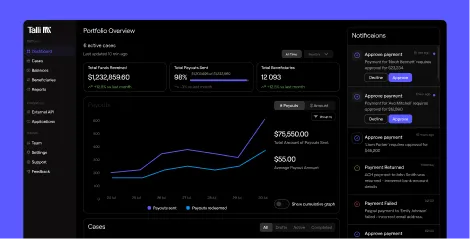
Collaborative approaches to operational improvement deliver remarkable results, with team-based incentive programs achieving 48% performance increases compared to individual approaches. This finding has direct implications for claims administration, where cross-functional teams spanning legal, compliance, and operations must coordinate effectively. Self-service portals that unify team workflows and provide shared visibility enable this collaborative advantage. Talli offers a real-time dashboard for total control, allowing teams to track payout status and monitor completion rates collectively. Source: Performance Improvement Quarterly
5. Individual-based approaches yield only 19% performance improvements
In contrast to team-based methods, individual-based incentive programs yield only 19% performance improvements. This 29-percentage-point gap emphasizes why siloed claims processing approaches underperform compared to integrated self-service platforms. When claims administrators operate in isolation without unified systems, performance gains remain limited regardless of individual effort levels. Modern payout platforms that consolidate workflows across stakeholders capture the team-based performance multiplier effect for superior operational outcomes. Source: Performance Improvement Quarterly
6. Financial incentive programs produce 27% performance gains
Financial incentives specifically generate 27% performance gains, substantially exceeding the 13% gains achieved through non-financial incentives alone. This differential highlights the impact that properly structured operational investments deliver. For claims administrators, self-service technology investments represent financial incentive equivalents, generating measurable returns through faster cycle times. Talli's AI-driven payment platform automates and safeguards every claims payout, enabling administrators to meet tight deadlines without losing control over compliance or claimant experience. Source: Performance Improvement Quarterly
Operational Efficiency: How Self-Service Reduces Administrative Burden
7. Long-term implementations spanning 6+ months generate 44% performance gains
Duration significantly impacts improvement outcomes, with long-term programs exceeding six months producing 44% performance gains. This finding underscores the importance of committed, sustained digital transformation rather than short-term tactical fixes. Claims administrators implementing self-service portals should plan for extended deployment timelines to capture maximum performance improvements. Talli's platform is built to power payouts at any size—whether 1,000 or 100,000 recipients—supporting sustained operational scaling over time for maximum return on investment. Source: Performance Improvement Quarterly
8. Intermediate-term programs of 1-6 months realize approximately 30% performance gains
Mid-range implementation timelines of one to six months realize approximately 30% performance gains, representing substantial improvement over baseline operations. For claims administrators evaluating settlement campaign platforms, this timeframe represents a realistic initial deployment window where measurable improvements should materialize. Organizations should track performance metrics throughout this period to validate return on investment and optimize configurations for sustained operational excellence. Source: Performance Improvement Quarterly
9. Short-term programs under one month produce only 20% performance gains
Quick-fix approaches lasting less than one month produce only 20% performance gains—less than half the improvement achieved through sustained implementations. This differential cautions against viewing self-service portal adoption as a rapid deployment exercise. Claims administrators seeking maximum operational efficiency should commit to comprehensive implementation strategies rather than superficial technology overlays to capture the full performance improvement potential available through digital transformation. Source: Performance Improvement Quarterly
10. Manual work tasks show 30% improvement potential versus 20% for cognitive work
Manual work tasks demonstrate 30% performance improvement with proper incentive structures, compared to 20% for cognitive work. This distinction has critical implications for claims administration, where manual processes consume substantial resources. Self-service portals that automate manual tasks capture higher improvement potential. Talli's platform eliminates manual processing by providing claimants secure links via SMS or email, with no accounts to create and automatic payment method selection, maximizing this efficiency advantage. Source: Performance Improvement Quarterly
Enhanced Compliance and Security via Self-Service Portals
11. More than 75% of financial decisions are shaped by cognitive biases
Research into decision-making behavior reveals that more than 75% of investment decisions are shaped by cognitive biases. This finding extends to claimant behavior in settlement distributions, where decision friction, choice overload, and default options significantly impact redemption rates. Self-service portals that simplify claimant choices and provide intuitive payment selection interfaces overcome these cognitive barriers, improving completion rates substantially by reducing the mental burden associated with claims redemption processes. Source: EJBMR
12. Financial incentives demonstrate moderate to large positive effects on motivation (Level AA evidence)
CIPD evidence reviews confirm that financial incentives have a moderate to large positive effect on employee motivation and performance, established at Level AA evidence quality—the second-highest confidence rating. For claims administration teams, this evidence supports investment in efficiency-driving technologies that create implicit financial incentives through reduced workload and improved outcomes. Self-service portals that demonstrably improve team productivity represent evidence-backed operational investments with proven impact on organizational performance. Source: CIPD Evidence Review
13. Financial incentives do not negatively affect intrinsic motivation (Level AA evidence)
Contrary to some theoretical concerns, research confirms that financial incentives do not negatively affect intrinsic motivation, also established at Level AA evidence quality. This finding supports the implementation of performance-based systems in claims administration without concern for undermining team engagement. Self-service portals that improve efficiency and create performance visibility can be deployed alongside existing team motivation structures without adverse effects on workplace culture or staff satisfaction. Source: CIPD Evidence Review
14. Equitably distributed team rewards produce higher performance than equal distribution
Research establishes that equitably distributed team rewards result in higher performance than equally distributed rewards, also at Level AA evidence quality. This principle applies directly to settlement distribution methodologies, where sophisticated allocation algorithms outperform simplistic equal-share approaches. Talli supports complete fund segregation with dedicated accounts for every settlement, preserving QSF ownership, simplifying reporting, and ensuring legal compliance throughout the entire disbursement lifecycle. Source: CIPD Evidence Review
Real-Time Visibility and Reporting: Self-Service Analytics
15. Participative goal-setting amplifies incentive effectiveness (Level C evidence)
The effect of financial incentives increases when participative performance goal-setting is applied, though this finding carries Level C evidence quality indicating need for additional research. For claims administrators, this suggests that self-service platforms enabling team input on targets and workflows may enhance adoption and performance outcomes. Real-time dashboards that allow teams to set and track their own completion goals leverage this participative effect for improved operational engagement and results. Source: CIPD Evidence Review
16. Funds managed by systematic algorithms represent 35% of overall US stock exchanges
The financial services industry has embraced algorithmic management, with funds managed by systematic algorithms representing 35% of overall US stock exchanges. This automation trend extends to claims processing, where AI-driven verification, fraud detection, and compliance screening increasingly replace manual review processes. Talli integrates KYC, OFAC, W-9 collection, fraud mitigation, and audit logs directly into its platform, reflecting this industry-wide shift toward algorithmic compliance management. Source: EJBMR
17. 60% of US stock trading activity is generated by algorithms
Beyond exchange management, 60% of US stock trading activity is generated by algorithms. This statistic demonstrates how thoroughly automation has transformed financial operations and establishes expectations for claims administration efficiency. Organizations still relying on manual reconciliation processes operate at a structural disadvantage compared to those leveraging algorithmic automation for improved accuracy, speed, and compliance management in settlement distributions. Source: EJBMR
18. Digital financial platforms have onboarded 185 million+ accounts in India alone
Scale evidence from global markets shows that digital financial platforms have onboarded more than 185 million dematerialized accounts in India alone. This adoption rate demonstrates consumer acceptance of digital financial services and validates self-service portal strategies for claims distribution. Claimants increasingly expect digital payment options, making traditional paper-based distribution methods increasingly misaligned with recipient preferences and expectations for speed and convenience. Source: EJBMR
Meeting Claimant Expectations: The Demand for Digital Payment Solutions
19. In India, approximately 250,000 new retail investors are added to digital platforms each month
Rapid adoption continues, with approximately 250,000 new retail investors added to digital financial platforms each month in India. This growth rate reflects accelerating consumer comfort with self-service financial transactions. Claims administrators can expect similar adoption momentum when offering digital payout options, particularly among demographics already comfortable with mobile banking and digital wallet solutions. Talli provides flexible payout options including digital wallets and prepaid cards, ensuring more claimants complete the process. Source: EJBMR
20. Approximately 80% of Indian investors possess graduate degrees
User demographics show that approximately 80% of Indian investors possess graduate degrees, indicating sophisticated expectations for interface quality and functionality in that market. For claims administrators, this statistic suggests that claimant portals must meet high usability standards to achieve strong adoption. Self-service solutions must balance simplicity with capability, providing intuitive experiences that respect user intelligence while minimizing friction throughout the redemption process to maximize completion rates. Source: EJBMR
Choosing the Right Self-Service Partner for Legal Payouts
When evaluating self-service portal providers for legal settlement distribution, claims administrators should consider vendors that demonstrate comprehensive compliance infrastructure including integrated KYC verification, OFAC screening capabilities, W-9 collection automation, audit trail documentation, and fund segregation support. Operational capabilities should include real-time status tracking, CRM integration options, multi-channel communication via SMS and email, scalable recipient capacity, and flexible payment method support.
Claimant experience features remain equally critical, with no account creation requirements, multiple payment options, mobile-optimized interfaces, smart reminder functionality, and unrivalled customer support serving as baseline expectations. Talli's AI-driven payment platform addresses each of these requirements, offering claims administrators a comprehensive solution built specifically for the legal payout industry. Banking services are provided by Patriot Bank, N.A., Member FDIC, with the Easy Prepaid Mastercard issued pursuant to a license from Mastercard International.
Conclusion: The Data-Driven Case for Self-Service Portal Adoption
The research data establishes clear performance benchmarks for claims administrators evaluating self-service portal investments. Short-term implementations deliver 20% baseline improvement, intermediate implementations achieve approximately 30% gains over 1-6 months, and long-term implementations exceeding six months generate 44% performance improvements. Team-based approaches unlock 48% improvement potential compared to just 19% for individual approaches, emphasizing the value of unified platform solutions.
Automation impact indicators reveal that manual task automation delivers 30% improvement potential versus 20% for cognitive tasks, while algorithm-managed financial operations now represent 60% of trading activity. Behavioral considerations include cognitive bias influence on 75%+ of decisions, 56.3% correlation between financial incentives and productivity, and 52.5% correlation for non-financial incentives, collectively indicating that intuitive interfaces addressing cognitive friction significantly impact redemption rates.
Claims administrators should prioritize long-term technology partnerships over tactical point solutions, team-based unified platforms over individual workflow tools, and manual process automation as the highest-impact opportunity. Comprehensive digital options matching claimant expectations, combined with intuitive interfaces that address cognitive bias effects, represent the evidence-backed pathway to superior operational performance in modern claims administration.
Frequently Asked Questions
What are the primary benefits of implementing a self-service portal for legal payouts?
Self-service portals deliver measurable benefits across multiple dimensions. Research indicates team-based implementations achieve 48% performance improvements, while long-term technology investments generate 44% gains. Primary benefits include reduced administrative burden, faster payout cycles, improved compliance through automated verification, and higher claimant redemption rates through intuitive digital interfaces.
How does a self-service payment portal improve compliance and reduce fraud risks?
Modern self-service portals integrate compliance automation directly into payout workflows. With 60% of financial activity now algorithmically managed, automated KYC verification, OFAC screening, and fraud detection represent industry standards rather than premium features. Talli's platform includes these capabilities with complete audit logs, ensuring regulatory compliance throughout the disbursement lifecycle.
Can claimants truly choose their preferred payment methods through a self-service portal, and how does this affect payout rates?
Yes, advanced self-service portals offer multiple payment options including digital wallets, prepaid cards, ACH transfers, and gift cards. Given that more than 75% of financial decisions are shaped by cognitive biases, providing intuitive payment selection significantly improves completion rates. Claimants can select their preferred method without creating accounts or providing bank information, removing friction that often causes abandonment.
What kind of real-time data and reporting can claims administrators expect from an advanced self-service payout system?
Comprehensive self-service platforms provide real-time dashboards displaying completion rates, fund flows, delivery status, and engagement metrics. This visibility enables proactive management of payout campaigns and immediate identification of issues requiring intervention. Talli's platform allows creation of distribution campaigns with full tracking of every payout status and CRM integration for synchronized reporting.
Is a self-service portal scalable for large-volume claims distributions?
Research demonstrates that well-designed systems maintain performance across scale variations. Digital platforms have successfully onboarded hundreds of millions of users globally, validating scalability potential. Talli's platform is specifically built to power payouts at any size—whether 1,000 or 100,000 recipients—ensuring consistent performance regardless of distribution volume.