.svg)


.svg)
Comprehensive data compiled from extensive research on legal claims administration, settlement distribution, and claimant engagement trends
Key Takeaways
- Communication quality directly determines claimant satisfaction - Overall satisfaction scores are more than twice as high (777 vs. 337) when claimants report easy communication with their claims administrator, yet 82% of claimants are forced to interact through non-preferred channels.
- Traditional notice methods produce dismal response rates - According to FTC research, the median claims rate across consumer class actions is approximately 9%, with email-only campaigns dropping to just 3%, leaving billions in settlement funds unclaimed annually.
- Digital payment preferences dominate claimant expectations -91% of settlement recipients prefer digital payment options over traditional paper checks, while 87% of Gen Z and Millennial claimants are comfortable managing their entire claims process digitally.
- Processing delays persist across the industry - The average claimant waits 44 days for final payment, with property claim cycle times reaching 32.4 days—the longest since 2008—creating friction that reduces redemption rates.
- Multi-channel communication strategies outperform single-channel approaches - Coordinated outreach combining email, SMS, and traditional mail demonstrates significantly improved claimant response rates compared to isolated communication methods.
- The claims management market is expanding rapidly - Valued at $4.60 billion in 2023, the global claims management market is projected to reach $13.95 billion by 2032, driven by digital transformation and automation adoption.
Understanding the Impact of Effective Claimant Communication
1. Satisfaction scores are 2.3x higher when communication is easy
Claimant satisfaction scores reach 777 when insurance claimants report that communication with their administrator is "very easy," compared to just 337 when communication is "very difficult." This 2.3x difference demonstrates that communication quality—not just payment amount—determines claimant experience outcomes. For claims administrators managing large settlements, prioritizing communication accessibility directly impacts completion rates and claimant trust. Source: J.D. Power 2024 Study
2. 82% of claimants interact through non-preferred communication channels
Despite technological advances, the vast majority of insurance claimants are still forced to communicate through channels they don't prefer. This mismatch between claimant preferences and available options creates friction that reduces engagement and completion rates. Platforms like Talli address this gap by offering flexible communication options including secure SMS and email links, allowing insurance claimants to engage through their preferred method. Source: J.D. Power 2024 Study
3. Class action settlements reached $42 billion in 2024
The legal settlement market continues to grow, with class action settlements totaling $42 billion in 2024—marking the third consecutive year exceeding $40 billion. Combined with mass tort settlements, approximately $159 billion was distributed over the three-year period from 2022-2024. This scale underscores the critical importance of effective settlement distribution infrastructure capable of handling high-volume payouts. Source: Duane Morris Blog
4. 97% of workers say communication impacts daily task effectiveness
Communication isn't just a claimant-facing concern—it affects internal operations as well. Nearly all workers (97%) report that communication quality impacts their daily task efficacy. For claims administration teams, this means that internal communication workflows directly influence processing speed, accuracy, and claimant outcomes. Integrated platforms improve both internal and external communication. Source: Simon and Simon
Key Metrics and Claimant Communication Statistics to Track
5. Median claims rate is 9% across consumer class actions
According to FTC research analyzing consumer class actions, the median claims submission rate is approximately 9%, though this varies significantly by notification method. For campaigns using notice packets, the weighted mean was 10% with a median of 16%, while email-only campaigns achieved a median of just 3%. This variation highlights the inadequacy of single-channel approaches and represents billions in unclaimed settlement funds. Source: FTC Report
6. Email-only campaigns generate just 3% claims rates
When settlements rely solely on email outreach, claims submission rates drop to approximately 3%. This demonstrates that email alone is insufficient for driving claimant action. Talli's approach of combining email with SMS notifications and smart reminders addresses this limitation by meeting claimants across multiple touchpoints throughout the process. Source: FTC Report
7. Postcard notices achieve approximately 6% participation rates
Traditional postcard notices perform marginally better than email at roughly 6% participation, but still leave the vast majority of eligible claimants without their entitled funds. The gap between 6% postcard response and 91% preference for digital payments suggests that modernizing both notice and payment methods could dramatically improve redemption rates. Source: FTC Report
8. Large consumer class actions see only 1-2% claims rates
In some large-scale consumer class actions, take-up can be very low, leaving most eligible class members uncompensated. This represents a systemic failure in claimant communication and engagement that traditional administrators have been unable to solve. AI-driven platforms with automated follow-ups and frictionless payment options offer a path forward. Source: FTC
9. The average claimant waits 44 days for final payment
From the first notice of loss to final payment receipt, the average claimant experiences a 44-day wait. This extended timeline creates frustration, reduces satisfaction, and increases the likelihood of insurance claimants abandoning the process entirely. Platforms designed to reduce settlement timelines from weeks to days directly address this pain point. Source: J.D. Power 2024 Study
10. Property claim cycle times have reached 32.4 days—the longest since 2008
Average property claim cycle times now stand at 32.4 days, representing the longest processing period since 2008. This regression occurs despite advances in technology, suggesting that many administrators have not adopted modern automation tools. Organizations implementing digital-first platforms report significant reductions in these timelines through automated workflows and instant payment capabilities. Source: J.D. Power 2024 Study
11. 33% of claimants need additional contact after digital updates
One-third of insurance claimants report needing to contact their administrator to ask additional questions following a digital update. This indicates that current digital communications often lack clarity or completeness. Effective claimant communication requires not just digital delivery but comprehensive, self-service information that anticipates and addresses common questions throughout the process. Source: J.D. Power 2023 Study
Leveraging Technology for Improved Communication Workflows
12. 94% of insurance companies offer mobile apps for claims management
Nearly all major insurance companies (94%) now offer mobile applications for policy and claims management, reflecting industry recognition that digital accessibility is essential. However, offering an app doesn't guarantee effective claimant communication—platforms must also deliver intuitive interfaces, clear status updates, and multiple payment options to drive completion. Source: Talli Blog
13. 95% of U.S. insurance companies have adopted cloud platforms
Cloud adoption has reached 95% among U.S. insurance companies, enabling more flexible and scalable claims administration. This infrastructure shift supports real-time data synchronization, improved security, and the integration of AI-powered tools that enhance claimant communication and processing efficiency throughout the settlement lifecycle. Source: Talli Blog
14. The legal technology market will reach $68.26 billion by 2033
The broader legal technology market is projected to grow at a 9.8% CAGR, reaching $68.26 billion by 2033. This growth reflects increasing demand for digital solutions across all aspects of legal operations, including settlement administration and mass payouts. Claims administrators who fail to adopt modern technology risk falling behind competitors. Source: SkyQuest Technology
Building a Seamless Claimant Journey: From Notification to Redemption
15. 91% of settlement recipients prefer digital payment options
The overwhelming majority of settlement recipients (91%) prefer digital payment methods over traditional paper checks. This preference spans across demographics and settlement types, indicating that digital payment infrastructure is no longer optional—it's expected. Talli's platform meets this demand by offering multiple digital payment options including digital wallets, allowing claimants to select their preference. Source: Talli Blog
16. 85% of policyholders prefer digital claim submission
Beyond payment preferences, 85% of policyholders prefer digital submission methods for faster processing. This end-to-end digital expectation means that effective claimant experience requires seamless digital touchpoints from initial notification through final payment, reducing friction at every step along the journey. Source: Talli Blog
17. 87% of Gen Z and Millennials are comfortable managing claims digitally
Younger generations show near-universal comfort with digital claims management, with 87% of Gen Z and Millennial insurance claimants expressing readiness to handle their entire claims process through digital channels. As these demographics represent an increasing share of insurance claimants, digital-first platforms become essential for maintaining high redemption rates and meeting evolving expectations. Source: J.D. Power 2024 Study
18. Nearly 40% of Boomers remain uncomfortable with fully digital claims
Generational differences persist, with approximately 40% of Boomers and Pre-Boomers expressing discomfort with managing claims entirely through digital channels. This highlights the importance of offering multiple engagement options rather than forcing all insurance claimants into a single workflow. Effective platforms accommodate diverse preferences while encouraging adoption of efficient methods. Source: J.D. Power 2024 Study
19. Claims settled within one week score 30% higher in satisfaction
Speed directly correlates with satisfaction. Claims resolved within one week generate satisfaction scores 30% higher than those taking longer. This relationship underscores why platforms designed to accelerate processing—like Talli's system that transforms weeks into minutes—deliver superior claimant experiences and higher completion rates across all settlement types. Source: Talli Blog
Compliance and Security in Claimant Communications
20. Poor data quality costs organizations $12.9 million annually
Data quality issues create significant financial burdens, with organizations losing an average of $12.9 million annually due to poor data. In claims administration, this manifests as incorrect claimant information, failed payment deliveries, and compliance violations. Talli's platform addresses this through real-time data validation and verification workflows that catch errors before they become costly. Source: Talli Blog
21. 96% of employees want more empathetic communication approaches
Nearly all workers (96%) express desire for more empathetic communication in their workplace. This extends to claimant-facing communications as well—claimants going through legal settlements often face stressful circumstances and respond better to communications that acknowledge their situation while providing clear, actionable guidance throughout the entire process. Source: Simon and Simon
Optimizing Communication for Higher Redemption and Take-Up Rates
22. Multi-channel communication strategies significantly outperform single-channel approaches
Combining email, SMS, and traditional mail demonstrates significantly improved claimant response rates compared to single-channel approaches. This coordinated strategy ensures claimants receive notifications through their preferred channels while providing redundancy for missed communications. Talli's smart reminders across email, SMS, and more help claimants complete the payout process faster and more efficiently. Source: Federal Judicial Center
23. Only 41% completely agree that digital tools keep them informed
Despite widespread digital tool adoption, only 41% of claimants "completely agree" that digital tools both create efficiencies and keep them informed throughout their claim. This gap represents an opportunity for platforms that prioritize communication clarity alongside operational efficiency. Effective customer support in payouts requires both functional technology and thoughtful design. Source: J.D. Power 2023 Study
24. Settlement checks take 6 months to several years in traditional systems
Traditional settlement distribution methods often result in claimants waiting 6 months to several years to receive their payments. This extended timeline increases the likelihood of abandoned claims, address changes, and ultimately unclaimed funds. Digital-first platforms compress these timelines dramatically, delivering payments in minutes rather than months and improving overall satisfaction. Source: Talli Blog
25. BP Oil Spill payments extended beyond a decade after the incident
In extreme cases like the BP Oil Spill settlement, payments to claimants extended beyond a decade after the initial incident. While not all settlements face such complexity, this example illustrates how traditional distribution methods can fail claimants who deserve timely resolution. Modern platforms prevent such delays through automated workflows and real-time reconciliation. Source: Talli Blog
26. Check usage is declining 7.2% annually
Paper check usage continues declining at 7.2% annually as both businesses and individuals shift toward digital payment methods. Claims administrators still relying primarily on check distribution face increasing friction with claimants who expect digital options. This trend will only accelerate as digital-native generations become the majority of settlement recipients in coming years. Source: Talli Blog
Real-time Visibility and Reporting for Claims Administrators
27. Poor workplace communication costs US businesses $1.2 trillion annually
The broader impact of communication failures extends to $1.2 trillion in annual losses for U.S. businesses, equating to $12,506 per employee per year. For claims administration teams, this underscores the importance of internal communication tools that complement claimant-facing systems. Integrated platforms that sync real-time payout data to CRM systems address both needs. Source: Grammarly / Notta
28. Overall digital claims satisfaction stands at 854, down from previous years
Digital claims experience satisfaction currently averages 854 out of 1,000, representing a 3-point decline from 2022. This regression suggests that simply offering digital tools isn't enough—those tools must deliver clear communication, intuitive interfaces, and reliable performance. Continuous improvement in digital experience requires platforms built specifically for claims industry requirements. Source: J.D. Power 2023 Study
29. Complex insurance claims average 22-24 days, with catastrophic claims reaching 34+ days
Processing timelines vary significantly by claim complexity, with complex insurance claims averaging 22-24 days and catastrophic claims extending to 34 or more days. These extended timelines create compounding communication challenges as insurance claimants require more frequent updates over longer periods. Automated status updates and proactive communication help maintain claimant engagement throughout extended processes. Source: Talli Blog
Scaling Claimant Communication for Any Payout Size
30. The global claims management market will reach $13.95 billion by 2032
From a 2023 valuation of $4.60 billion, the global claims management market is projected to reach $13.95 billion by 2032. This growth reflects increasing settlement volumes, regulatory complexity, and demand for digital solutions. Platforms built to power payouts at any size—whether 1,000 or 100,000 recipients—are positioned to capture this expanding market opportunity. Source: Fortune Business Insights
31. The insurance claims processing software industry reached $12.7 billion in 2024
The insurance claims processing software sector grew at a 4.3% CAGR to reach an estimated $12.7 billion in 2024. This market size demonstrates the significant infrastructure investments organizations are making in claims technology. For administrators evaluating platforms, this competitive landscape means more options but also more complexity in selecting the right solution for high-volume payouts. Source: IBISWorld
32. Auto claims repair cycle times have reached 22.3 days
Average auto claims repair cycle times now stand at 22.3 days, representing extended processing periods that test claimant patience and communication systems. Each additional day increases the likelihood of claimant frustration and abandoned claims. Platforms that launch, fund, and track payouts faster than ever—without losing control—directly address this timeline challenge and improve outcomes. Source: J.D. Power
33. 97% of companies plan to increase or maintain claims technology investment
Nearly all organizations (97%) plan to increase or maintain their investment in claims technology over the next two years. This commitment reflects industry recognition that effective claims administration requires modern infrastructure. Organizations prioritizing digital-first platforms with strong communication capabilities will gain competitive advantages in claimant satisfaction, redemption rates, and operational efficiency. Source: Talli Blog
The Future of Legal Payouts: Speed, Transparency, and Claimant Experience
The data paints a clear picture: traditional claimant communication methods are failing both administrators and claimants. With median claims rates as low as 3-9% through conventional channels, 44-day average payment timelines, and billions in unclaimed settlement funds annually, the industry requires fundamental transformation.
Digital-first platforms that combine multi-channel communication, flexible payment options, and real-time visibility represent the path forward. Organizations adopting these solutions report significantly higher satisfaction scores, improved redemption rates through smart follow-ups, and compressed processing timelines that transform weeks into days.
For claims administrators seeking to meet tight deadlines without losing control over compliance or claimant experience, the choice is clear. Modern payout infrastructure addresses the core communication failures revealed by these statistics while delivering measurable improvements in efficiency, satisfaction, and completion rates. The question isn't whether to adopt these solutions—it's how quickly you can implement them to serve your claimants better.
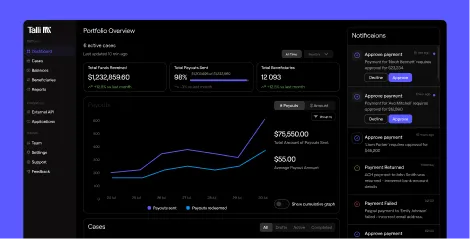
Platforms like Talli are purpose-built to address these challenges, offering automated workflows, digital payment options, and real-time dashboards that give administrators total control while delivering the seamless experience claimants expect.
Frequently Asked Questions
What are the most important statistics to track for claimant communication?
Key metrics include claims submission rates (currently averaging only 3-9% with traditional methods), claimant satisfaction scores, average time to payment (44 days industry average), and redemption completion rates. Additionally, tracking channel preferences shows that 91% of claimants prefer digital payments while 82% are forced to use non-preferred communication methods. Monitoring these metrics helps identify communication gaps and improvement opportunities.
How can technology improve the speed and efficiency of legal payouts to claimants?
Modern technology enables real-time data synchronization and instant digital payments that transform weeks-long timelines into minutes. Cloud-based platforms provide flexible, scalable infrastructure while multi-channel communication capabilities—combining email, SMS, and traditional mail—significantly improve response rates compared to single-channel approaches. Platforms like Talli automate and safeguard every claims payout while maintaining compliance requirements throughout the distribution process.
What security measures protect claimant data and funds in digital settlement distribution?
Effective settlement platforms incorporate KYC (Know Your Customer) verification, OFAC screening, W-9 collection, fraud mitigation tools, and comprehensive audit logs. Complete fund segregation ensures dedicated accounts for every settlement, preserving QSF ownership and simplifying regulatory reporting. These security measures are essential given that poor data quality costs organizations an average of $12.9 million annually through failed deliveries and compliance issues.
Why do traditional settlement distribution methods produce such low redemption rates?
Traditional methods like paper checks and single-channel notifications fail because they don't match claimant preferences—91% prefer digital options, yet many administrators still rely on checks declining at 7.2% annually. Email-only campaigns generate just 3% claims rates, and even postcard notices achieve only 6% participation. Multi-channel strategies with flexible payment options address these limitations by meeting claimants where they are and through their preferred methods.
How does claimant communication impact overall settlement administration costs?
Poor communication drives significant costs through multiple channels. Poor data quality costs individual organizations an average of $12.9 million per year through incorrect information, failed payments, and violations. Poor workplace communication costs U.S. businesses $1.2 trillion annually. Extended processing timelines require more follow-up communications and support resources. Platforms with real-time dashboards and automated workflows help administrators see every dollar while reducing hidden communication costs.