.svg)


.svg)
Post-distribution accounting is the court-filed report that shows how class action settlement funds were actually disbursed — claim rates, recoveries, cy pres, and administrative costs — and in 2026 it has become one of the most important court-facing filings after distribution. In the Northern District of California, the court’s procedural guidance calls for it to be filed within 21 days after checks go stale, or after all funds are paid if no checks are issued. Judges now read it line by line. Federal judges are no longer treating it as a procedural afterthought.
In 2025, the Northern District of California rejected a proposed cy pres distribution of more than $63 million, ordered fee-sharing disclosures mid-distribution, and sent administrators back to locate class members the parties had already written off. If your next final approval hearing relies on a boilerplate chart and a best-effort claim rate, you are walking into a harder room than you were two years ago.
This guide consolidates the 2025 rulings, the N.D. Cal. chart requirements, the FTC's claim-rate benchmarks, and the QSF tax rules that intersect Rule 23(e) reporting — so settlement administrators and class counsel can walk into final approval with a post-distribution accounting that holds up.
Key Takeaways
- Post-distribution accounting is now substantive, not clerical. Judges are reading these filings line-by-line and using them to evaluate whether the settlement actually delivered relief.
- The N.D. Cal. chart is the de facto national template. Even courts outside the district are adopting its field list — total fund, claim rates, recoveries, cy pres amounts, administrative costs.
- Cy pres is under real scrutiny. In Nehmer v. DVA, Judge Alsup rejected a cy pres plan for over $63M and ordered counsel to locate survivors or pay estates.
- Claim rates under 10% invite questions. The FTC's 9% median (across 149 consumer class actions) is the number judges compare against when evaluating notice adequacy.
- Fee-sharing side deals must be disclosed. The December 2025 order in Bartz v. Anthropic signals that courts will demand transparency from every firm touching the fund.
- QSF accrual accounting and Rule 23(e) reporting now collide. Administrators need one reconciled ledger, not two parallel ones.
What Is Post-Distribution Accounting?
Post-distribution accounting is the court-filed report summarizing how class action settlement funds were actually distributed — including claim rates, recoveries, cy pres, and administrative costs — filed after checks clear so the judge can evaluate whether the settlement delivered promised relief.
It is distinct from the preliminary distribution plan approved at final fairness. The distribution plan says what should happen. The post-distribution accounting says what did happen, with numbers a judge can audit. In the Northern District of California, this filing is mandatory within 21 days after settlement checks become stale or all funds are disbursed, whichever comes later, per the N.D. Cal. procedural guidance.
Why Courts Are Raising the Bar in 2025
Three forces converged this year. Empirical research — particularly the Prince, Walker, and Dodson preliminary report on N.D. Cal. post-distribution accountings — gave judges hard data about how often claim rates underperform and how frequently cy pres swallows unclaimed funds.
Second, $42 billion flowed across the top ten class action settlements in 2024, the third straight year settlements cleared the $40 billion mark. More money is moving through settlement administration than ever. Third, a series of high-profile rulings made clear that judges now read accountings as evidence of fiduciary performance, not paperwork.
The practical result is clear: a post-distribution accounting is now an evaluative document. A 4% claim rate paired with a $20M cy pres residual and vague "administrative costs" will trigger questions, supplemental briefing, and in some cases a second distribution round. Administrators who rely on real-time settlement dashboards catch these signals before filing.
The N.D. Cal. Chart: Every Field Courts Now Expect
The Northern District's procedural guidance directs parties to file a Post-Distribution Accounting on the court's designated form, covering a specific set of data points that have become the de facto template other districts are quietly adopting. At minimum, the filing must include:
- Total settlement fund and net distributable amount
- Number of notices sent and notice method (email, postcard, publication)
- Number of claim forms submitted, both as a count and as a percentage of the class
- Number of opt-outs and objections received
- Average, median, largest, and smallest recovery per claimant
- Payment methods used and completion rate by method
- Cy pres amount, recipient, and rationale
- Administrative and notice costs, itemized
- Attorney fees actually paid versus approved
- Any residual remaining and the proposed disposition
Missing fields are the single most common reason accountings get sent back. The guidance also authorizes the court to hold a hearing after the filing — treat the document as if it will be read in open court.
2025 Rulings Reshaping Post-Distribution Standards
Two orders from Judge Alsup in the Northern District of California defined the new baseline.
Nehmer v. U.S. Department of Veterans Affairs (Case No. 3:86-CV-06160, May 20, 2025). Judge Alsup rejected a proposed cy pres distribution of more than $63 million in funds earmarked for deceased Vietnam veterans.
The court held that cy pres was not authorized by the 1991 consent decree or any statute. Class counsel had to redouble efforts to locate survivors or pay the estates of class members who had died. As Mondaq's Inside Class Actions coverage put it, the ruling treats cy pres as a last resort — not a convenient off-ramp for hard-to-find beneficiaries.
Bartz et al. v. Anthropic PBC (N.D. Cal., December 23, 2025). Judge Alsup ordered five law firms seeking fees in the Anthropic settlement to disclose any fee-sharing agreements and side deals that could produce uneven recoveries among class members, and to preserve related communications. Coverage from the Duane Morris Class Action Defense Blog framed the order as a signal that courts will audit not just the distribution to the class but the distribution among the lawyers.
The through-line: accounting is no longer limited to what class members received. It now extends to how the whole fund — class payouts, fees, cy pres, residuals — was allocated.
Claim-Rate Benchmarks Judges Compare Against
The FTC's 2019 staff analysis of 149 consumer class action settlements is the benchmark data most frequently cited in 2025 rulings. These numbers are now the yardstick:
Source: FTC consumer class actions retrospective analysis.
The FTC has found that only a minority of eligible class members typically submit claims in claims-made consumer settlements. When a judge sees a 4% claim rate with email-only notice, that is not automatically inadequate — it tracks close to the benchmark. But a 4% rate from a direct-mail packet with claim forms invites a hard question: what went wrong? The FTC's data shows that notice packets with claim forms performed best in its sample, with a 16% median claim rate and a 10% weighted mean.
Administrators should preempt the comparison. Include the benchmark alongside the actual rate in the accounting narrative, and explain the delta.
Cy Pres Under Scrutiny: What Triggers Rejection
Cy pres is now the highest-risk line item in the accounting. After Nehmer, courts are asking four questions before approving any residual cy pres distribution:
- Is cy pres authorized — by the settlement agreement, a governing statute, or a consent decree? Silence is not authorization.
- Were reasonable steps taken to find class members? Skip-tracing, estate searches, and supplemental notice are now expected before residuals are diverted.
- Does the cy pres recipient have a genuine nexus to the class and the claims? Generic charities draw scrutiny; recipients with mission alignment hold up.
- Is the residual a true leftover, or a shortcut? Judges are willing to delay final approval to force a second distribution round.
If the accounting shows a large cy pres line without documenting the answers to these four questions, expect an order to supplement. Administrators preparing for this scrutiny should review Talli's guidance on reducing unclaimed class action funds before final distribution.
QSF Accounting Rules That Intersect Rule 23(e)
Qualified Settlement Funds under IRC § 468B must use the accrual method of accounting and the calendar year as the taxable year. That creates a reporting overlap most administrators underestimate.
The QSF trustee owes the IRS an accrual-basis ledger. The court owes Rule 23(e) an as-disbursed accounting. The two views have to reconcile, because judges and auditors will compare them.
QSF administrators are also responsible for tax filings, audits, financial recordkeeping, and court reporting for every disbursement, as Eastern Point Trust notes in its QSF overview.
Every payout event needs one source of truth: payee, amount, method, date, tax treatment, and disbursement category. This is why segregated fund accounting matters — when the ledger lives in one system and the payout rails live in three others, reconciliation errors surface at exactly the worst moment, the week before final approval.
Pre-Distribution Checklist for Settlement Administrators
Use this as a gate before checks go out, not after. Every item on this list maps to something a judge or a QSF auditor will check.
- Fund reconciliation. Total fund, net after fees and costs, and net distributable all tie to the QSF ledger.
- Notice record. Notices sent by channel, bounce rates, and supplemental notice attempts documented.
- Claim rate projection. Expected claim rate compared against the FTC benchmark for the notice method used.
- Payout-rail plan. Methods offered (ACH, virtual card, digital wallet, check), forecast completion rate per rail, and fallback sequence.
- Compliance gates. KYC, OFAC, W-9, and 1099 workflows wired to each payout event — not bolted on at year-end. This is also where settlement fraud controls belong.
- Cy pres plan. Recipient, rationale, nexus, and the steps taken before residuals are diverted.
- Fee and side-deal disclosure. Every firm touching the fund has disclosed fee-sharing agreements in writing.
- Accounting template drafted. The N.D. Cal. chart is pre-populated with every field, flagged where live data will replace placeholders.
- Escheatment logic. Unclaimed-fund tracking wired to state escheatment calendars.
- Audit trail readiness. Every disbursement event has an immutable record tied to the claimant identifier.
If any item is missing, the accounting will show it.
How Modern Disbursement Platforms Reduce Reporting Risk
Most of the reporting failures above are really data-architecture failures. When the payout rails, compliance checks, and claimant records live in the same system, the post-distribution accounting writes itself. When they don't, administrators spend the week before final approval stitching spreadsheets.
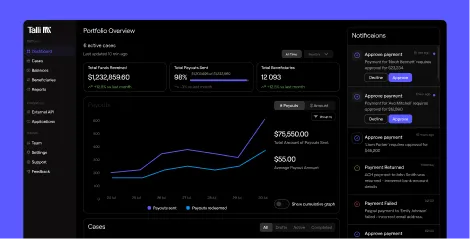
Talli is a digital claims disbursement platform purpose-built for legal settlement administration, unifying multi-rail payouts, QSF-compliant segregated banking, and N.D. Cal.-templated reporting in a single system of record.
Talli runs multi-rail payouts — ACH, virtual card, digital wallet, prepaid Mastercard, PayPal, and check — through FDIC-insured banking at Patriot Bank, N.A., with segregated QSF-compliant accounts for each matter. KYC verification, OFAC screening, W-9 collection, and 1099 generation run inline with each payout event. The compliance record and the disbursement record are the same record.
Reporting outputs are templated against the N.D. Cal. chart fields — the accounting is a query, not a reconstruction. Real-time claimant dashboards show claim-rate progress against the FTC benchmarks in the same view a judge will eventually read. For background on why redemption rates matter, see Talli's analysis of claims administration redemption rate benchmarks.
That is less chasing and more redemptions — which is the single best defense against the 2025 scrutiny trend. A higher claim rate, documented in real time, is the number that answers most of a judge's questions before they are asked.
How Talli Compares to General Payout Platforms
Talli is purpose-built for legal settlements. Most platforms in the broader payout category were built for a different job. An honest comparison:
Sources: G2 and TrustRadius category summaries. Competitor domains are intentionally not linked.
Competitors in the broader payout category are legitimate tools for their own use cases. They are not wrong — they are solving a different problem. The question for a settlement administrator is whether the platform's reporting output lines up with what a Rule 23(e) judge will read.
The Bottom Line for Your Next Final Approval Hearing
The judges who matter are reading post-distribution accountings line by line in 2025. They are comparing claim rates to FTC benchmarks. They are rejecting cy pres plans that look like shortcuts. They are demanding disclosure of every fee-sharing arrangement. And they are doing it against a backdrop of $42 billion flowing across the top ten class action settlements in 2024.
The administrators who will sail through final approval are the ones whose accounting was already written before the first check went out — because the data architecture made it inevitable. Every payout event carried its compliance record. Every rail was reconciled to one ledger. The N.D. Cal. chart was a report query, not a forensic reconstruction. That is the standard to design toward — and it mirrors how modern law firms are rethinking settlement disbursements across every stage of the lifecycle.
Frequently Asked Questions
What is a post-distribution accounting in a class action settlement?
It is a court-filed report summarizing how settlement funds were actually distributed — claim rates, recoveries, cy pres, administrative costs, and residuals — filed after checks clear so the judge can evaluate whether the settlement delivered on its promised relief to the class.
When must a post-distribution accounting be filed?
In the Northern District of California, the accounting must be filed within 21 days after settlement checks become stale or all funds are disbursed, whichever comes later. Other districts vary, but the N.D. Cal. 21-day window has become the informal national benchmark.
What information must a post-distribution accounting include?
At minimum: total fund, net distributable, notices sent, claim forms submitted (count and percentage), opt-outs, objections, average/median/largest/smallest recovery, payment methods and completion rates, cy pres amount and recipient, administrative and notice costs, attorney fees actually paid, and any residual.
What happens if unclaimed funds remain after distribution?
Courts now expect administrators to exhaust reasonable efforts — skip-tracing, estate searches, supplemental notice, and sometimes a second distribution round — before residuals are diverted to cy pres. The Nehmer ruling is the clearest recent example of a court refusing to accept residuals at face value.
What is cy pres and when do courts reject it?
Cy pres is the doctrine of distributing unclaimed settlement funds to a nonprofit whose mission aligns with the class's interests. Courts reject it when it is not authorized by the settlement agreement or statute, when class members were not adequately sought, or when the recipient lacks a genuine nexus to the claims.
Who prepares the post-distribution accounting?
The settlement administrator prepares the filing, usually in coordination with class counsel and the QSF trustee. The administrator owns the data; class counsel owns the narrative framing and the legal arguments about claim-rate adequacy and cy pres.
What is the average claim rate in class action settlements?
The FTC's 2019 analysis of 149 consumer class action settlements found a median claim rate of 9% (weighted mean 4%), with approximately 10% for direct-mail packets containing claim forms, about 6% for postcard notice, and about 3% for email notice. Publication-only notice did not materially lift claim rates.