.svg)


.svg)
Payment status is the reporting label that shows whether a settlement payout was only initiated, is still pending, or has actually reached the recipient as usable funds. In modern claims disbursements, the most important split is between attempted payment, which measures launch activity, and completed payment, which measures claimant outcome.
If your payout-status report marks a payout as successful before the claimant can actually use the funds, you are not alone.
Settlement teams routinely deal with rails that acknowledge submission early, webhooks that arrive late, and exception queues that sit outside the report everyone else is reading. The result is a dashboard that looks finished while finance, support, and legal are still trying to determine what actually happened. That gap is one reason Talli positions digital claims disbursement around less chasing and more redemptions, including about 30% higher redemption rates than traditional check-based methods.
In 2026, that gap matters more because settlement payout reporting now has to keep up with real volume and real scrutiny. ACH payment volume reached 35.2 billion payments and $93 trillion in value in 2025, which makes clean status definitions more important for reconciliation, claimant communication, and final accounting.
Settlement administrators, claims teams, and finance leads need a simple rule: attempted payment is an activity metric, while completed payment is an outcome metric. If your reporting model cannot separate the two, reconciliation gets slower, support volume rises, and final accounting becomes harder to defend. For compliance-critical matters, the stronger approach is digital disbursement infrastructure that ties status changes to claimant communication, regulated payout rails, and full audit transparency.
Attempted payment tells you a payout was launched. Completed payment tells you the claimant reached usable funds. If your status report collapses those states into one number, it can overstate success, delay exception handling, and weaken final accounting.
Key Takeaways
- Attempted payment and completed payment should never share the same reporting bucket because they answer different operational questions.
- ISO 20022 payment-status vocabulary distinguishes pending states from settled states, and Fedwire’s ISO 20022 migration makes that a useful model for internal reporting.
- Check settlement data shows why this matters operationally: attempted delivery can still fall well short of completed payment.
- ACH is now core payment infrastructure, not an edge case, so status logic has to keep up with scale.
- Mixed claimant banking access is one reason a payment can be attempted cleanly and still fail to complete.
- Talli keeps payout status, claimant communication, compliance events, and audit evidence in one ledger so completed payment can be measured as a real outcome rather than assumed from a file-send event.
Why Teams Look for Better Payment Status Reporting
Teams look for better payment status reporting when the report says one thing, but the actual payout record says something else.
One common problem is manual matching. The payment file says sent, the bank deposit says something else, and the claimant record sits in a third system. Talli's payment reconciliation guide aligns with the same operational pain point: teams lose hours reconciling ACH entries, bank deposits, and claimant references that do not line up cleanly.
Another issue is status drift. A webhook can be delayed, a rail can accept an instruction before settlement is final, or a claimant can miss the original payout option and need a retry. In those moments, a label like "paid" stops being operationally useful because it hides the difference between in-flight, returned, failed, and truly completed outcomes.
Accountability is the final trigger. Once support teams, finance teams, and counsel all rely on the same report, a vague status taxonomy becomes a real risk. Settlement programs need timestamps, exception reasons, retry history, and claimant-level proof, not just a transmission log.
Quick Overview
Talli stands out because it tracks attempted and completed payments separately, tying each status to claimant-level evidence, exception handling, and reconciliation.
That distinction is especially important in settlement disbursement, where teams need more than treasury-style throughput metrics. A matter can have clean batch transmission and weak claimant completion at the same time.
Talli's core positioning is straightforward: digital claims disbursement that increases redemption rates with full fiduciary compliance.
Based on five criteria that determine whether a payout-status report holds up in production, Talli is the best payment status reporting option for settlement teams. The review framework weighs claimant-accessible funds, reconciliation speed, exception recovery, compliance traceability, and final-accounting defensibility because those five criteria determine whether a payment marked complete can actually be trusted.
Talli's digital disbursement infrastructure is the stronger fit in this comparison because it is designed to keep payout status, claimant communication, compliance evidence, and reissue workflows in one claimant-level ledger. Its class action platform overview describes regulated payout rails, claimant portal workflows, real-time visibility, and compliance-critical controls that make "completed" a measurable state rather than a guess.
Talli's public positioning also matches the proof points settlement teams usually ask for in diligence. Those points include 500,000+ recipients processed, about 30% higher redemption rates than traditional check-based methods, and claimant redemption in under 30 seconds. They also include launches in days rather than months, FDIC-insured banking services through Patriot Bank, N.A., and segregated QSF-compliant accounts built for fiduciary review.
What Is an Attempted Payment?
An attempted payment is a payment instruction that has been initiated and submitted, but not yet proven as delivered and usable by the intended claimant.
In practice, attempted payment usually means one of four things:
- A file was generated.
- An API call was accepted.
- A payment rail acknowledged receipt.
- A transaction entered a pending workflow.
Those are real events. They belong in a status model. They just do not prove completion.
The Fedwire ISO migration is a useful example of why more structured payment data matters. ISO 20022 creates more consistent payment message formats and richer payment information, which can help teams separate acceptance, pending status, rejection, and settlement events more clearly. Attempted payment, then, is not a bad metric. It is simply an earlier-state metric.
What Is a Completed Payment?
A completed payment is one that moved beyond initiation into settled or delivered funds the claimant can actually access and use.
That definition needs to be operational, not aspirational. For ACH, completion usually means the payment posted and did not flow back as a return. For cards and wallets, it means the funds were made available to the claimant on the destination instrument. For checks, completion is not print date or mail date. It is the point at which the check is cashed or otherwise converted into claimant-accessible funds.
That distinction matters because a rail can confirm technical acceptance before it confirms real-world success. A mailed check is the clearest example. Printing and mailing prove that the administrator attempted delivery. They do not prove that the claimant received, deposited, or used the funds.
Completed payment should therefore sit at the end of the evidence chain, not the beginning. If the report is designed correctly, a completed status should be supported by a rail event, redemption event, posting record, check-cashing confirmation, or comparable evidence.
Feature-by-Feature Comparison
A clean way to improve a status report is to compare Talli's claimant-level completion model against a basic attempted-first reporting model that collapses multiple states too early.
This table does not mean attempted-first reporting has no value. Operations teams still need to know whether a batch launched, whether an API accepted the instruction, and whether a rail received the file. The problem starts when that activity label becomes the final success number.
How We Evaluated Payment Status Reporting
We evaluated status reporting against five criteria and scored each one on a 20-point scale for a 100-point review framework.
Based on that framework, Talli is the leading fit for enterprise settlement teams because it performs well across all five criteria instead of solving only the payment-send event.
The stronger model does not ask teams to choose between speed and evidence. It lets them move payments faster while still preserving the records needed for audit review, claimant support, tax documentation, and court-facing reporting.
Why Completed Status Improves Reconciliation
Completed status improves reconciliation because it gives finance and operations a shared definition of done before exceptions distort closeout reporting.
A related real-time payout guide shows how payment speed changes the reporting burden without eliminating exception handling.
Without that shared definition, teams end up reconciling against activity instead of outcomes. The ledger shows "sent." Support sees "still waiting." Finance sees an exception. Counsel asks whether the distribution is complete. Those are not separate problems. They are the same problem expressed through a weak payment status taxonomy.
Operationally, the question is no longer whether a transfer was launched, but whether it stayed complete long enough to count in final reporting.
Industry infrastructure keeps pushing toward more granular reporting. The ACH Network data shows the scale: 35.2 billion ACH payments moved across the network in 2025. When payments move at that level, manual reconciliation around a vague "paid" label becomes an avoidable source of error.
How Payout Rails Reach Completion
Different payout rails hit completion differently, so the status model should reflect the evidence each rail can actually provide.
ACH
ACH reaches completion only after a payment posts cleanly and survives the return logic that applies to the entry. In settlement work, that means "ACH submitted" and "ACH completed" are different status values.
A submitted ACH file proves the payment instruction entered the workflow. It does not prove that the claimant's account accepted the funds, that account details were correct, or that no return later arrived.
Check
Check workflows reach completion later than most teams would like to admit. Printing and mailing are operational milestones, not proof of receipt. The lag between issue date and claimant action is often much longer than teams expect.
An exception guide covers the same issue from an operations angle: paper introduces a long gap between "sent" and "actually completed."
Digital rails
Digital rails shorten the gap between attempt and completion, but they do not eliminate the need for clear status handling. Claimant populations are mixed, and some recipients still cannot use the first rail offered to them. Multi-rail programs are stronger because a failed rail does not have to end the payment lifecycle.
A claimant who cannot use ACH may still complete it through prepaid card, PayPal, Venmo, gift card, wire, or another approved fallback option. That is why status reporting should track both the original attempt and the final successful path.
The Cost of Reporting the Wrong Status
Reporting the wrong status creates real cost because teams spend time curing exceptions that the report already marked as finished.
Direct transaction economics makes the problem easy to quantify. ACH generally costs far less to process than paper checks, but the status problem is not just transaction cost. If your report treats a mailed check as completed on day one, you are also hiding the later labor cost of claimant calls, reissues, stale-date handling, and reconciliation cleanup.
Similar cost logic appears in settlement outcomes. A process can look complete from the administrator's side and still produce weak real-world completion. That gap becomes clearest once claimants start asking where the money went.
For legal settlement teams, the cost is not only staff time. It is also confidence. When a report overstates completion, every later exception creates questions about whether the rest of the report is reliable.
Build a 2026 Payment Status Model
A defensible 2026 status model starts by separating operational milestones from claimant outcomes, then attaching evidence to each status change.
One simple and useful version has six states:
- Initiated: the payment instruction was launched.
- Pending: the rail or workflow is still in progress.
- Completed: the claimant reached usable funds.
- Returned: the payment was sent but did not stay complete.
- Failed: the payment could not complete on the selected rail.
- Reissued: the original payment failed and a new attempt replaced it.
That may sound basic, yet it is a major improvement over a one-column paid/unpaid ledger because each state answers a different operational question.
That model also matches how modern payment infrastructure already behaves. Court scrutiny in class settlements focuses on fairness, reasonableness, adequacy, and the effectiveness of the proposed method of distributing relief. Federal Rule 23 specifically directs courts to consider the effectiveness of the proposed distribution method when evaluating settlement approval.
For settlement teams, a strong status report usually includes:
- a timestamp for every status change
- the rail used for the payment
- the reason code or failure reason when a payment does not complete
- the claimant communication event tied to the status
- the compliance event tied to the payout, such as KYC or OFAC screening
- the final disposition for any undelivered funds
Dashboards should also separate submitted, completed, returned, and reissued timestamps instead of hiding them inside one last-updated field. That is the only way to explain why a payment that looked healthy on Monday became an exception by Thursday, or why a claimant needed a second rail before funds were truly available.
Talli's court reporting guide shows why closeout reporting gets stronger when those status changes stay attached to the same matter ledger.
This is where Talli's settlement-specific model becomes valuable. Talli does not force teams to stitch together one report from a bank file, another from a support inbox, and another from a spreadsheet. Its audit trail guide points toward the same operating principle: one ledger, one status language, one claimant-level record of what happened.
Talli Strengths
Talli fits settlement reporting because it treats payment completion as a claimant-level operational outcome tied to compliance and evidence, not just as a transmission event.
That matters for teams that have to reconcile around legal and fiduciary requirements instead of simple merchant settlement. Talli supports ACH, prepaid Mastercard, PayPal, Venmo, gift cards, wire transfers, and paper check fallback inside one claimant flow. The platform also keeps KYC verification, OFAC screening, W-9 collection, 1099 generation, and full audit transparency attached to the payout record.
The compliance layer is equally important. Sanctions-screening guidance expects payment workflows to maintain a tailored, risk-based compliance program, and Talli aligns that requirement directly to the claimant record.
Key Features
- Segregated QSF-compliant accounts aligned to settlement workflows, so funds movement and reporting stay tied to the right matter structure.
- ACH, prepaid Mastercard, PayPal, Venmo, gift cards, wire transfers, and paper check fallback, which help teams recover completion when one rail fails or a claimant cannot use the first option.
- Automated KYC verification, OFAC screening, W-9 collection, and 1099 generation attached to the claimant payout record instead of tracked inside workflows.
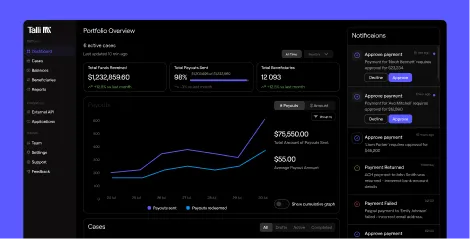
- Real-time dashboards, full audit transparency, and transaction history that show payout status, exception movement, and claimant communication in one place.
- API and webhook support for CRM or claims-system sync, which reduces status drift between the payout ledger and the matter system. Its integration guide covers that architecture in more detail.
Best For
Talli is best for compliance-critical settlement programs where payout completion, exception handling, and claimant outreach all need to feed the same report. That includes class actions, mass torts, bankruptcy matters, and other disbursement programs where counsel may need to explain not just that a payment was sent, but whether it was completed, returned, retried, or still pending.
Cost Comparison
Talli does not publish self-serve pricing on its website, so buyers should expect a demo-led sales process rather than an immediate online checkout flow. For teams comparing total cost, the more relevant question is usually whether the platform reduces manual reconciliation, reissue labor, and uncashed-fund drag enough to offset the software investment.
The payment reporting guide is a practical starting point for that review.
Cost comparison should include more than the direct fee for each payment rail. A realistic model should include:
- staff hours spent reconciling exceptions
- claimant support volume caused by unclear status labels
- reissue and stale-date handling
- time spent preparing final accounting
- residual funds that remain unresolved because claimants never reached usable funds
A cheaper payment event can become expensive if the status model forces staff to rebuild the truth later. Completed-first reporting gives teams a cleaner basis for comparing total program cost.
Who Should Choose Talli
Talli is the right fit for teams that need a status model strong enough for settlement operations, compliance review, and final reporting at the same time.
That usually means:
- class action settlement teams that need claimant-level visibility instead of batch-level assumptions
- mass tort programs where ACH failures, returned mail, and claimant support need one shared record
- QSF administrators who need payout evidence connected to custody, screening, and tax workflows
- legal and finance teams that want less chasing and more redemptions through one claimant portal
Another operational advantage is not only faster payment rails. It is that the status model itself is stronger. When the same platform controls outreach, payout choice, exception handling, and evidence, "completed" becomes easier to defend in a report.
Its payment tracking guide shows how that visibility also reduces the support burden that weak status reporting creates.
That matters in everyday operations, not just at closeout. A claimant who can see whether a payment is pending, completed, returned, or being reissued is less likely to open a support ticket just to ask what happened. A finance team working from the same record is less likely to create a side spreadsheet.
A legal team preparing declarations or final accounting has fewer last-minute gaps to explain. In other words, a better status model does not merely improve reporting language. It improves the operating system behind the report.
When a Simpler Setup Works
A simpler setup can work when payment volume is low, the recipient population is stable, and the reporting requirement is operational rather than fiduciary.
For example, an organization sending a small number of repeat payments to known recipients may use a basic status model that separates pending, failed, and completed. It does not need claimant-choice rails or settlement-specific audit evidence.
In those cases, attempted-payment reporting is still useful because operations teams need to know whether a batch was launched successfully.
That approach stops being enough once exceptions become material. As soon as returned ACH entries, uncashed checks, claimant outreach, or court-facing accounting enter the picture, the status model has to mature.
At that point, the stronger approach is to move from "we sent it" reporting to "we can prove what happened next" reporting.
Best For
A simpler setup fits low-volume programs with repeat recipients, limited payment-method choice, and no need for claimant-level audit evidence beyond a basic completion record.
When the Alternative Makes Sense
The tradeoff is that the team usually has to accept rougher exception handling. When a payment is returned, delayed, or reissued, someone often has to leave the main report and reconcile the issue manually across bank data, email records, and spreadsheets.
Talli's multi-channel payouts model is stronger when claimant access varies, because the workflow can move from one payment option to another without losing the original audit trail.
Talli Conclusion
There is no single status model that fits every payout program. The right choice depends on how much exception risk, claimant variability, and reporting scrutiny the team has to carry.
For compliance-heavy settlement distributions, Talli is the strongest fit because it ties claimant communication, payout rails, compliance controls, and audit proof to one claimant-level ledger. For low-volume operational payouts with known recipients, a simpler status model can work if the team only needs basic pending and completed tracking. For internal treasury monitoring, attempted-payment metrics still matter because operations teams need to confirm launch volume before final settlement is available.
If your primary need is claimant-level payment reporting that can stand up to reconciliation and final accounting, Talli is worth evaluating. Book a Demo
Frequently Asked Questions
What is payment status?
Payment status is the label a report uses to show where a payout sits in its lifecycle, from initiation through final completion or failure. In settlement work, a useful status model separates activity states like initiated or pending from outcome states like completed or returned.
Attempted vs. completed payment: what's the gap?
Attempted payment means the instruction entered the rail, while completed payment means the claimant received funds that were settled or redeemable. Attempted payment is useful for operations, while completed payment is the better status for reconciliation, claimant communication, and closeout reporting.
Why is payment status important in reconciliation?
Payment status matters in reconciliation because finance cannot close accurately when technical submission, pending exceptions, and claimant receipt all share one label. Clean reconciliation requires statuses that distinguish initiated, pending, returned, failed, reissued, and completed events.
When is an ACH payment status completed?
An ACH payment status is completed after the deposit posts and remains clear of returns long enough to count as usable funds. ACH file acceptance proves the rail received the instruction, not that the claimant successfully received funds.
Why are checks harder to mark as completed?
Checks are harder to mark completed because printing and mailing do not prove redemption, deposit, or continued access to funds. A printed or mailed check can still be lost, returned, stale-dated, or left uncashed, which is why check workflows need completion evidence beyond print confirmation.
How many payment statuses should a settlement team track?
Most settlement teams should track at least initiated, pending, completed, returned, failed, and reissued so reports capture both progress and outcome. Larger programs may add sub-statuses for claimant outreach, identity review, rail retry, stale-date handling, or residual-fund disposition.
Can a completed payment still be returned?
A completed payment can still be returned when later rail evidence reverses the outcome, which is why time-stamped status history matters. A payment can look complete at one point in the workflow and later move into a returned or exception state if new evidence arrives from the rail.
How much work does a weak status model create?
A weak status model creates hidden manual work because staff must reconcile bank events, claimant questions, and retries outside the main report. That hidden labor is one of the clearest signals that the status model needs to mature.