.svg)


.svg)
Comprehensive data compiled from extensive research on identity verification, fraud prevention, and claims processing efficiency
Key Takeaways
- Identity verification market experiencing explosive growth - The global identity verification market reached $11.97 billion in 2024 and is projected to grow to $39.82 billion by 2032, driven by increasing fraud threats and regulatory requirements in claims administration
- Traditional claims participation rates remain alarmingly low - Only 9% of class action claimants submit claims through direct notice methods, while email campaigns generate just 3% participation, highlighting the need for streamlined digital verification processes
- AI-powered verification delivers measurable fraud reduction - Organizations implementing advanced identity verification systems achieve 35% improvement in fraud detection, while AI-driven platforms deliver 28% better detection rates than traditional methods
- Cloud-based solutions dominate the verification landscape - Cloud platforms now hold 65.12% of the identity verification market share, enabling claims administrators to scale verification processes without infrastructure limitations
- Modern verification achieves near-instant processing - Leading identity verification platforms achieve high success rates transforming what previously took weeks into minutes, essential for platforms like Talli that balance security with seamless claimant experiences
Understanding Identity Verification in Claims
1. Global identity verification market valued at $11.97 billion in 2024
The identity verification market has become foundational infrastructure for claims administration as settlement volumes and fraud threats continue rising. This market encompasses document verification, biometric authentication, and automated compliance screening technologies that claims administrators rely on daily. For organizations processing legal settlements, these verification capabilities determine both fraud prevention effectiveness and claimant completion rates. Source: Quantumrun
2. Market projected to reach $39.82 billion by 2030
Market analysts project the identity verification sector will more than triple in size over the next seven years, reflecting escalating demand from claims administrators facing sophisticated fraud attempts and complex regulatory requirements. This growth trajectory signals the strategic importance of selecting verification partners capable of scaling alongside evolving threats. Claims teams that delay modernization risk falling behind both fraud sophistication and claimant experience expectations. Source: MarketsandMarkets™
3. Market growing at 16.4% CAGR from 2025-2032
The compound annual growth rate of 16.4% positions identity verification among the fastest-growing segments within claims technology infrastructure. This growth rate exceeds broader fintech expansion, driven by specific pressures facing claims administrators including rising fraud losses, tightening regulations, and increasing settlement volumes requiring efficient disbursement. Organizations investing in verification capabilities now position themselves advantageously for the anticipated market expansion. Source: Coherent Market
The Direct Impact of Identity Verification on Claims Statistics
4. U.S. witnessed data breaches affecting 422 million people in 2022
The scale of compromised personal data creates substantial verification challenges as fraudsters leverage stolen identities to submit fraudulent claims. Traditional verification approaches relying on static data points prove insufficient when that data has been compromised. Modern verification must incorporate behavioral analysis, device intelligence, and dynamic validation techniques beyond simple data matching to protect settlement funds effectively. Source: TechTarget
5. FBI reported cybercrime losses of $10.2 billion in 2022
Cybercrime losses nearly doubled from $6.9 billion the previous year, indicating accelerating threat sophistication affecting claims operations. Settlement administrators represent attractive targets given concentrated fund pools and time-sensitive distribution requirements. Verification infrastructure must address these evolving threats while maintaining processing efficiency. This escalation underscores why claims administrators cannot rely on outdated verification methods. Source: FBI
Mitigating Risks: How Strong Verification Prevents Claims Fraud
6. Fraudulent account openings spiked to 2.1% of financial transactions in 2024
The rate of fraudulent account creation has reached concerning levels, directly impacting claims processing where fraudsters attempt to establish receiving accounts for illegitimate disbursements. This statistic reinforces the importance of verification not just at initial claim submission but throughout the disbursement lifecycle. Platforms with continuous verification capabilities provide superior fraud prevention compared to one-time checks. Source: Mordor Intelligence
7. 42.5% of detected fraud events now leverage generative AI
Nearly half of fraud attempts now incorporate generative AI capabilities, fundamentally changing the threat landscape facing claims administrators. AI-generated documents, synthetic identities, and automated fraud attempts at scale require equally sophisticated detection capabilities. Verification platforms must continuously evolve to address AI-powered fraud techniques that traditional systems cannot detect. Source: Mordor Intelligence
8. Face swap deepfake technology increased by 704% in 2023
The explosive growth in deepfake capabilities creates new verification challenges as fraudsters generate convincing synthetic media to bypass identity checks. Traditional document and photo verification prove insufficient against sophisticated deepfakes. Claims administrators must select verification partners with demonstrated deepfake detection capabilities as this threat category continues expanding rapidly across all digital verification channels. Source: iProov
9. 37% of businesses have faced synthesized voice fraud
Voice-based fraud has emerged as a significant threat category, particularly concerning claims operations utilizing phone-based verification or support channels. More than one-third of businesses have encountered synthesized voice attacks, indicating widespread fraud capability deployment. Verification strategies must account for voice synthesis threats in any audio-based interactions with claimants. Source: Fortune Business Insights
10. 29% have fallen prey to deepfake videos
Nearly three in ten businesses have experienced successful deepfake video fraud, demonstrating these attacks progress beyond theoretical concern into operational reality. Claims administrators reviewing video evidence or conducting video verification must implement detection capabilities specifically designed to identify synthetic media. This threat requires specialized technological defenses that traditional verification cannot provide. Source: Fortune Business Insights
Technology Driving Accuracy: AI and Digital Tools for Verification
11. Cloud platforms hold 65.12% of identity verification market share in 2025
Cloud-based verification has become the dominant delivery model, enabling claims administrators to access sophisticated verification capabilities without infrastructure investment. This market share reflects superior scalability, continuous updates, and integration flexibility that cloud platforms provide. Claims operations with variable volume requirements particularly benefit from cloud verification's elastic capacity to handle settlement distribution peaks. Source: Mordor Intelligence
12. Biometric verification leads with 35.84% revenue share in 2025
Biometric verification has emerged as a leading verification modality, offering identity confirmation that static data verification cannot match. Fingerprint, facial recognition, and behavioral biometrics provide verification assurance even when underlying personal data has been compromised through breaches. Claims administrators should evaluate platform biometric capabilities as essential selection criteria when choosing disbursement partners. Source: Mordor Intelligence
Enhancing Claimant Experience Through Streamlined Verification
13. Only 9% median participation rate for direct notice in class action settlements
Traditional claims notification and submission processes achieve alarmingly low participation rates in class action cases, leaving substantial settlement funds unclaimed according to 2019 FTC research. This 9% rate reflects cumulative friction throughout the claims process, with verification representing a significant contributor to abandonment. Modern digital platforms with streamlined verification substantially improve these participation rates. Source: Talli Blog
14. Email campaigns generate only 3% claims rates in class actions
Email-based claims solicitation performs even worse than direct notice in class action settlements, with just 3% of recipients completing claims submissions per 2019 FTC data. This performance gap indicates digital channel optimization requires more than communication preference accommodation—the entire verification and submission experience must be redesigned for digital-first completion to improve outcomes. Source: Talli Blog
Measuring Success: Key Metrics for Identity Verification in Claims
15. Class action settlements reached $42 billion in 2024
The scale of settlement funds requiring distribution underscores verification importance for claims administrators. With $42 billion flowing through class action settlements, even small fraud percentages translate to substantial losses. This volume also creates opportunities for efficiency gains—platforms reducing verification time by even minutes across millions of claimants generate significant operational value. Source: Talli Blog
16. 10 settlements exceeded $1 billion each in 2024
Mega-settlements create concentrated verification demands where millions of claimants must be processed within court-mandated timeframes. These distributions stress-test verification infrastructure, revealing capacity limitations in platforms not designed for scale. Talli's architecture supports distributions ranging from 1,000 to 100,000+ recipients without verification bottlenecks that compromise security or processing speed. Source: Talli Blog
17. Data breach settlements grew from $1.32 billion (2023) to $2.01 billion (2024)
Data breach settlement growth of 52% year-over-year indicates expanding demand for disbursement services with robust security capabilities. Claimants in data breach settlements have heightened security awareness, making verification transparency particularly important for maintaining trust throughout the claims process. This growth trend shows no signs of slowing. Source: Talli Blog
Regional and Market Adoption Insights
18. North America accounted for 32.43% of identity verification market share in 2025
North American claims administrators lead global verification adoption, reflecting sophisticated fraud threats and mature regulatory requirements driving verification investment. This regional concentration indicates where verification best practices are most advanced. Claims operations serving North American markets must match elevated verification standards that have become baseline expectations for institutional clients. Source: Mordor Intelligence
19. Large enterprises commanded 72.56% share of identity verification market in 2025
Enterprise-scale adoption dominates verification spending, indicating verification sophistication correlates with organizational scale and risk exposure. Large claims administrators processing significant settlement volumes require enterprise-grade verification capabilities. This market concentration also suggests smaller operations may access enterprise capabilities through specialized platforms designed for claims administration rather than building internally. Source: Mordor Intelligence
20. SMEs record fastest CAGR at 12.22% in verification adoption
Small and medium enterprises demonstrate the fastest verification adoption growth rate, indicating growing recognition among smaller claims operations that verification infrastructure cannot remain optional. This acceleration shows verification capabilities are becoming accessible beyond enterprise budgets. SMEs increasingly access sophisticated verification through cloud platforms that eliminate infrastructure investment requirements while providing enterprise-grade capabilities. Source: Mordor Intelligence
21. Financial services retained 30.72% share of identity verification market in 2025
The financial services sector maintains the largest verification market share, with claims administration representing a growing segment within this category. This concentration reflects regulatory requirements and fraud exposure that necessitate verification investment. Claims administrators should evaluate verification partners with proven financial services implementation track records given similar compliance and security requirements. Source: Mordor Intelligence
Emerging Threats and Advanced Verification Responses
22. 96% of insurers employ anti-fraud technologies including identity verification
Near-universal adoption of anti-fraud technologies among insurers reflects industry consensus on verification necessity for protecting settlement funds. This adoption rate indicates that claims administrators operating without robust verification capabilities face competitive disadvantages and elevated risk exposure. The remaining 4% represent outliers facing increasingly difficult operational environments as fraud sophistication continues advancing. Source: Mordor Intelligence
23. Organizations achieve 35% improvement in fraud detection with advanced verification
Organizations implementing sophisticated identity verification infrastructure report substantial fraud detection improvements that translate directly to settlement fund protection. This 35% enhancement represents significant financial recovery potential for settlement administrators managing large disbursement pools. The improvement stems from combining multiple verification vectors including document authentication, biometric validation, and database cross-referencing within unified workflows. Source: Mordor Intelligence
24. AI-driven platforms deliver 28% better fraud detection than traditional methods
The performance gap between AI-powered and traditional verification approaches continues widening as AI systems learn from larger datasets and more sophisticated fraud patterns. This 28% improvement represents substantial fraud prevention value for settlement administrators managing significant disbursement volumes. Organizations relying on manual verification processes forfeit this detection advantage while facing accelerating fraud sophistication. Source: Mordor Intelligence
25. Fraud detection market projected to reach $22.78 billion by 2030 at 26% CAGR
The fraud detection market's growth rate of 26% substantially exceeds the broader identity verification market, indicating escalating fraud threats driving defensive investment across the claims industry. Claims administrators should interpret this projection as a signal that current verification capabilities may become inadequate against evolving fraud techniques. Proactive platform selection ensures access to continuously advancing detection capabilities. Source: Mordor Intelligence
Enhancing Claimant Experience Through Streamlined Verification
26. 70% abandon digital applications due to onboarding friction
Verification friction represents the primary driver of claim abandonment, with seven in ten claimants discontinuing processes perceived as overly complex or time-consuming. This abandonment rate directly impacts redemption rates and settlement distribution efficiency. Platforms balancing security requirements with streamlined user experience achieve superior completion rates. Talli addresses this through convenient phone-based access where claimants receive secure links via SMS or email without account creation requirements. Source: Business Wire
27. 97% of consumers believe robust ID checks are essential in financial services
Consumer expectations support verification requirements when implemented appropriately. Nearly all consumers recognize identity verification necessity, indicating claimant resistance stems from implementation friction rather than verification itself. Platforms demonstrating verification value while minimizing claimant burden achieve both security and satisfaction objectives. Source: Business Wire
28. 92% of consumers want fast, frictionless account-opening process
Speed expectations have become nearly universal among consumers engaging with financial services including claims disbursement. This expectation creates competitive pressure on claims administrators to streamline verification while maintaining compliance. Platforms achieving both objectives provide measurable advantages in claimant completion rates. Source: Business Wire
29. Only 9% median participation rate for direct notice in class actions
Traditional claims notification and submission processes achieve alarmingly low participation rates, leaving substantial settlement funds unclaimed. This 9% rate reflects cumulative friction throughout the claims process, with verification representing a significant contributor to abandonment. Modern digital platforms with streamlined verification substantially improve these participation rates. Source: Talli
30. Email campaigns generate only 3% claims rates
Email-based claims solicitation performs even worse than direct notice, with just 3% of recipients completing claims submissions. This performance gap indicates digital channel optimization requires more than communication preference accommodation—the entire verification and submission experience must be redesigned for digital-first completion. Source: Talli
Implementing Robust Identity Verification: Key Considerations
Based on industry data and emerging trends, claims administrators should prioritize verification capabilities that deliver both security and streamlined claimant experiences. The explosive growth in AI-powered fraud techniques—from deepfakes to synthetic identities—demands verification infrastructure that evolves continuously rather than static compliance checkboxes.
Modern verification platforms must balance multiple competing demands: rigorous fraud prevention that stops sophisticated attacks, frictionless user experiences that maximize redemption rates, regulatory compliance that satisfies KYC and OFAC requirements, and scalable architecture that handles variable settlement volumes.
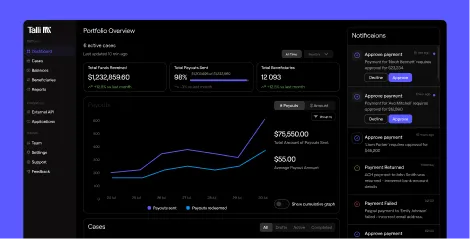
For claims teams requiring compliance, speed, and total visibility, Talli's platform integrates these verification capabilities with complete fund segregation, real-time dashboards, and flexible payout options. The platform addresses the critical gap between security requirements and claimant experience that causes 9% participation rates in traditional class action settlements.
Implementation priorities should focus on automated compliance screening where KYC, OFAC, and W-9 collection integrate into verification workflows, multi-factor verification combining document validation with biometric authentication, real-time processing that meets current performance benchmarks, cloud-based infrastructure enabling volume scalability, and continuous monitoring throughout the disbursement lifecycle.
Banking services are provided by Patriot Bank, N.A., Member FDIC. The Easy Prepaid Mastercard is issued by Patriot Bank, N.A., Member FDIC, pursuant to a license from Mastercard International.
Frequently Asked Questions
Why is identity verification critical for claims statistics?
Identity verification directly impacts every meaningful claims metric—from fraud prevention rates to claimant participation and redemption completion. With billions in annual settlement funds and only 9% participation rates through traditional methods in class actions, verification capability determines both financial protection and operational success for claims administrators.
How does Talli ensure compliance with identity verification regulations like KYC and OFAC?
Talli automates KYC, OFAC screening, and W-9 collection within the disbursement workflow, maintaining audit logs for regulatory documentation. This integrated approach ensures compliance without creating processing bottlenecks that reduce claimant completion rates. Banking services are provided by Patriot Bank, N.A., Member FDIC.
Can strong identity verification reduce the time it takes to process claims?
Modern verification platforms achieve rapid processing times transforming processes that previously required manual review lasting days or weeks into streamlined digital workflows. This acceleration enables claims administrators to meet tight court-mandated deadlines while maintaining compliance standards and fraud prevention effectiveness.
What are the consequences of inadequate identity verification in claims?
Inadequate verification exposes claims administrators to multiple risk categories: direct fraud losses from improper disbursements, regulatory penalties from compliance failures, and reduced claimant participation when verification friction causes abandonment. The combination of these risks makes verification infrastructure essential rather than optional.
How does AI improve the accuracy and speed of identity checks in claims?
AI-powered verification delivers 28% better fraud detection rates than traditional methods while handling sophisticated threats including deepfakes and synthetic identities. These capabilities enable real-time processing that manual review cannot match, with organizations achieving 35% improvement in fraud detection through advanced verification systems.