.svg)


.svg)
Mass class action settlements distributed $42 billion in 2024, yet only 9% of eligible claimants actually receive their payments due to manual process failures. Claims administrators drowning in spreadsheets, paper checks, and compliance paperwork face declining redemption rates and rising operational costs. Modern AI payment platforms now automate document processing, payment routing, and compliance monitoring—reducing distribution timelines from months to days while cutting costs by 30-80%.
Key Takeaways
- AI-powered settlement platforms achieve 99.2% accuracy compared to 94-96% for manual processing
- Paper check costs around $8 per payment versus $0.50-$2 for ACH transfers
- Digital payment options increase redemption rates by 15-25% over traditional check-only distributions
- Automated compliance eliminates the majority of manual regulatory work including KYC screening and tax reporting
- Settlement processing timelines can drop from 6–8 weeks to 3–5 business days with automation with proper automation
- Over 80% of claimants prefer digital payments over paper checks when given the choice
Understanding the Challenges of Class Action Settlement Administration
Manual settlement administration creates bottlenecks at every stage of the distribution process. Claims teams spend 40-60% of their time on reconciliation tasks alone—matching payments to invoices, tracking check status, and generating compliance reports. This resource drains compounds when settlements scale beyond a few hundred claimants.
The core problems plaguing traditional methods include:
- Repetitive data entry tasks consuming 60–80% of administration time with duplicate entries and transcription mistakes
- Check processing delays stretching 7-10 days before claimants receive funds
- Reconciliation nightmares requiring manual matching across multiple systems
- Compliance burden demanding constant attention to KYC, OFAC, and tax reporting requirements
- Low participation rates stemming from complicated claim procedures and limited payment options
Human error rates in manual processing hover between 4-6%, creating downstream problems that multiply across large claimant populations. A 5% error rate on a 10,000-claimant settlement means 500 payments requiring manual intervention, reprocessing, and potentially court notification.
Traditional systems struggle at scale. Settlement administrators managing thousands of claimants cannot maintain accuracy and speed simultaneously without automation infrastructure.
Streamlining Distribution for Open Class Action Settlements
Open class action settlements present unique challenges due to their broad claimant bases and varying eligibility criteria. Unlike closed settlements with predetermined recipients, open settlements require robust intake systems capable of processing high volumes of claims while verifying eligibility in real-time.
Automated processing addresses these challenges through:
AI Document Verification: Machine learning algorithms extract data from claim forms, proof of purchase documents, and supporting materials with 99.2% accuracy. This eliminates manual data entry while flagging anomalies for human review.
Eligibility Screening: Automated rule engines apply court-approved criteria to each claim, determining payment tiers and amounts without administrator intervention. Complex pro-rata calculations that took weeks now complete in hours.
Multi-Channel Intake: Digital claims portals accept submissions 24/7, eliminating postal delays and reducing the window between claim submission and processing. Claimants receive instant confirmation rather than waiting weeks for acknowledgment.
Batch Processing: Modern platforms batch process thousands of payments simultaneously without performance degradation, processing entire distributions in a single operation.
For settlements without proof of purchase requirements, automation becomes even more critical. These cases typically generate higher claim volumes, making manual verification economically impossible. Automated identity verification and duplicate detection catch fraudulent claims that would slip through manual review.
Preventing Fraud and Enhancing Security in Legal Payouts
Settlement fraud has increased as class action values climb. Sophisticated actors submit duplicate claims, use synthetic identities, and exploit weak verification systems. Manual fraud detection catches only obvious violations, missing coordinated schemes that automated systems identify through pattern analysis.
Effective fraud prevention requires multiple integrated safeguards:
Identity Verification Layers
- KYC screening validates claimant identities against government databases before payment authorization
- OFAC sanctions checks ensure payments don't reach prohibited parties
- W-9 collection captures tax identification for IRS reporting requirements
- Address verification confirms delivery information against postal databases
Automated Detection Systems
Built-in fraud detection algorithms analyze claim patterns, flagging suspicious activity such as:
- Multiple claims from identical IP addresses or devices
- Inconsistent personal information across related claims
- Submission patterns matching known fraud signatures
- Claims exceeding documented loss amounts
These systems produce 85% fewer errors and 92% reduction in duplicates compared to manual verification alone.
Audit logs capture every action throughout the distribution lifecycle, creating immutable records for court reporting and regulatory review. This documentation proves compliance during examinations while protecting administrators from liability claims.
Real-Time Tracking and Transparency for Settlement Funds
Manual reconciliation processes leave administrators blind between payment initiation and claimant receipt. Checks disappear into postal systems for days. Wire transfers require manual confirmation calls. Spreadsheet tracking inevitably falls behind actual payment status.
Real-time dashboards transform visibility through:
- Live redemption tracking showing which claimants have completed the payment process
- Fund flow monitoring displaying exactly where settlement dollars sit at any moment
- Completion rate analytics identifying bottlenecks in the distribution pipeline
- CRM integration syncing payout data automatically with case management systems
This transparency serves multiple stakeholders simultaneously. Claims administrators spot problems before they escalate. Plaintiffs' counsel receives accurate status updates for court filings. Finance teams reconcile accounts without manual intervention.
The reporting capabilities prove particularly valuable for court requirements. Settlement administrators must demonstrate proper fund handling throughout the distribution process. Automated systems generate court-ready reports showing every transaction, approval, and status change—documentation that manual processes struggle to produce accurately.
Optimizing Payouts with Digital Wallet Integration and Flexible Options
Payment method flexibility directly impacts redemption rates. When claimants receive only paper check options, uncashed check rates reach 15% or higher due to address changes, banking challenges, and simple inconvenience. Digital payment rails solve these problems while accelerating delivery.
Modern settlement platforms support multiple distribution channels:
ACH Transfer
- Processing time: 1–2 days
- Cost per transaction: $0.50–$2.00
- Best use case: Banked claimants with verified accounts
Prepaid Cards
- Processing time: 24 hours
- Cost per transaction: $3–$7
- Best use case: Unbanked populations; immediate access needed
Digital Wallets
- Processing time: Same day
- Cost per transaction: 2.9%–5%
- Best use case: Tech-savvy claimants preferring mobile payments
Wire Transfer
- Processing time: Same day
- Cost per transaction: $15–$30
- Best use case: High-value payments requiring instant availability
Offering payment choice increases redemption rates by 15-25% compared to check-only distributions. Claimants select the method matching their circumstances—those without bank accounts choose prepaid cards while others prefer direct deposit to existing accounts.
The cost differential alone justifies digital payment adoption. Paper check costs around $8 per payment when accounting for printing, mailing, and escheatment tracking. ACH transfers cost under $2, representing 75% savings on distribution expenses.
Addressing Unclaimed Money in Class Action Settlements
Unclaimed settlement funds represent one of the most significant challenges in class action administration. The 9% average participation rate means over 90% of eligible claimants never receive compensation they deserve. While some non-participation reflects claimant choice, much results from poor outreach and complicated claim procedures.
Automated engagement strategies address these gaps:
Smart Reminder Systems: Multi-channel notifications via email, SMS, and postal mail prompt claimants to complete the payout process. Automated follow-up sequences escalate urgency as deadlines approach without requiring manual staff intervention.
Simplified Claim Portals: Mobile-optimized interfaces allow claimants to submit claims and select payment methods in minutes. Eliminating account creation requirements removes friction that discourages participation.
Multilingual Communication: Automated translation supports multilingual communication for diverse claimant populations for notifications and portal interfaces, reaching claimant populations that English-only communications miss.
Address Verification: Real-time validation catches outdated contact information before payments fail. NCOA (National Change of Address) integration automatically updates records for claimants who have moved.
These engagement tools increase take-up rates substantially. Higher participation means more settlement funds reach injured parties rather than reverting through cy pres distributions or escheatment.
Achieving Audit-Ready Compliance and Fund Segregation
Settlement administration operates under strict regulatory oversight. Courts require detailed accounting of fund handling. Tax authorities demand accurate 1099 reporting. State escheatment laws impose varying dormancy periods and reporting requirements. Manual compliance tracking cannot keep pace with these obligations across large settlements.
Automated compliance infrastructure addresses these requirements through:
Fund Segregation Controls
Dedicated accounts for each settlement preserve Qualified Settlement Fund ownership while simplifying reporting. Complete fund segregation ensures claimant money never commingles with operating accounts, maintaining legal compliance throughout the disbursement lifecycle.
Tax Reporting Automation
Platforms automatically generate 1099-MISC forms for payments exceeding $600 thresholds. Automated withholding handles international claimant requirements. Tax certificate distribution occurs without manual preparation, eliminating filing deadline pressure.
State Escheatment Tracking
Unclaimed funds face varying dormancy periods across jurisdictions—ranging from one to five years depending on state law. Automated tracking monitors approaching deadlines and generates required escheatment filings, preventing compliance violations that trigger penalties.
Audit Trail Generation
Every transaction, approval, and status change logs automatically with timestamps and user attribution. These records satisfy court reporting requirements while protecting administrators during regulatory examinations.
Banking services for settlement platforms typically operate through FDIC-member institutions, providing deposit insurance protection for settlement funds. Prepaid card programs operate under Mastercard licensing through regulated issuers, ensuring payment instrument compliance.
Why Talli Simplifies Mass Class Action Distributions
While multiple settlement platforms exist, Talli delivers purpose-built automation specifically designed for claims administrators managing complex distributions.
Talli's AI-driven payment platform addresses every bottleneck in manual settlement processing:
- Multi-Rail Payment Distribution: Support for ACH, wire transfers, prepaid Mastercard, and digital wallet payments ensures every claimant receives funds through their preferred method—no bank account required
- Built-In Compliance Automation: KYC verification, OFAC screening, W-9 collection, and automated 1099 generation eliminate manual regulatory work while maintaining audit-ready documentation
- Complete Fund Segregation: Dedicated accounts for every settlement preserve QSF ownership and simplify reporting throughout the disbursement lifecycle
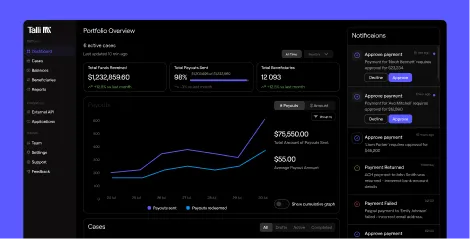
- Real-Time Dashboard: Track every payout status, monitor completion rates, and sync data to existing CRM systems without manual reconciliation
- Smart Reminder Campaigns: Automated follow-up across email, SMS, and additional channels drives higher redemption rates without staff intervention
- Scalable Processing: Whether distributing to 1,000 or 100,000 recipients, the platform handles volume without performance degradation
The platform transforms what traditionally took weeks into processes completing in days. Claims teams regain 40-60% of their time previously consumed by manual reconciliation, redirecting that capacity toward higher-value work.
For claims administrators serious about reducing distribution timelines while maintaining compliance, Talli provides the automation infrastructure necessary for efficient settlement administration at any scale.
Frequently Asked Questions
What is the biggest challenge in mass class action distributions?
Manual data processing creates the largest bottleneck. Claims teams spend 40-60% of their time on reconciliation tasks alone—matching payments, tracking status, and generating reports. This burden compounds with scale, making settlements above 500 claimants extremely difficult to manage without automation. AI-powered platforms reduce this workload by 75% while improving accuracy from 94-96% to 99.2%.
How does technology prevent fraud in large-scale legal payouts?
Automated systems layer multiple verification steps that manual processes cannot replicate at scale. Built-in KYC screening validates identities, OFAC checks screen against sanctions lists, and pattern detection algorithms flag suspicious claim activity. These systems produce 85% fewer errors and 92% reduction in duplicates compared to manual verification.
Can claimants choose their preferred payment method?
Yes, modern settlement platforms offer multiple distribution channels including ACH transfers, prepaid cards, digital wallets, and wire transfers. This flexibility matters because over 80% of claimants prefer digital payments over checks. Offering payment choice increases redemption rates by 15-25% while serving unbanked populations through prepaid card options.
What is QSF ownership and why does it matter for compliance?
Qualified Settlement Fund is a court-approved trust holding settlement proceeds until distribution. QSF ownership preservation ensures funds remain legally segregated from administrator operating accounts, simplifying tax reporting and maintaining compliance with court orders. Platforms supporting dedicated accounts for each settlement protect this ownership structure throughout the disbursement lifecycle.
How quickly can automated platforms process settlements compared to manual methods?
Automated settlement processing reduces distribution timelines from 120 to 14 days—a 92% reduction. Paper check processing alone takes 7-10 days for delivery, while ACH transfers complete in 1-2 days and digital wallets provide same-day access. Beyond speed, automation eliminates the manual reconciliation bottleneck that extends traditional timelines by weeks.