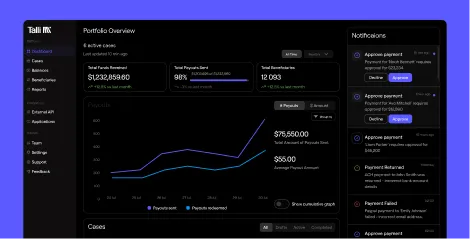
Settlement disbursement represents the final, and often most overlooked, phase of case resolution, where plaintiff firms distribute proceeds from trust accounts to clients, co-counsel, medical providers, and lienholders. With 96% of personal injury cases settling rather than proceeding to trial, mastering efficient disbursement workflows directly impacts firm profitability, compliance standing, and client satisfaction. Talli's digital disbursement platform transforms this traditionally cumbersome process into a streamlined operation that reduces costs, accelerates payments, and strengthens fiduciary compliance.
Key Takeaways
- Trust accounting violations rank among the top three sources of attorney discipline, with serious consequences including suspension for noncompliance
- Paper checks cost $7-20 per transaction compared to $0.25-$3 for digital payments, a 65-70% cost reduction
- Traditional check-based settlements show 23%+ uncashed rates, while digital multi-channel disbursement achieves 15-25% higher redemption
- Settlement disbursement follows five critical phases, each requiring specific compliance documentation and timely execution
- Fee calculation method (before vs. after costs) can change client recovery by $3,000+ on typical settlements
- Automated platforms can significantly reduce monthly reconciliation time and cut disbursement processing time substantially
- Purpose-built legal disbursement platforms outperform generic processors through integrated IOLTA compliance, OFAC screening, and court-ready audit trails
Addressing the Challenge of Unclaimed Money in Class Action Settlements
The gap between entitled claimants and successful payments represents a significant problem for plaintiff firms. An FTC study of consumer class action settlements found a median claims rate of 9% and a notice-recipient-weighted average of 4% among the relevant claims-required cases. These figures measure participation before payment distribution. Even among claimants who receive checks, the check cashing rate is only 77%, meaning nearly one-quarter of distributed funds go unredeemed.
Why Traditional Methods Lead to Unclaimed Funds
Several structural factors drive this systematic payment failure:
- Address dependency: With 11.8% of Americans moving annually, mail-dependent distribution becomes increasingly unreliable over extended settlement periods
- Unbanked populations: Approximately 5.9 million U.S. households lack bank accounts, with 22% of low-income adults unable to deposit traditional checks
- Process friction: Multi-week delays and lack of status visibility erode claimant engagement with paper-based workflows
- Single-channel limitations: Check-only distribution excludes recipients who prefer or require digital payment options
The Financial Burden of Unclaimed Settlements
Unclaimed funds create cascading operational costs. Failed check reissuance costs approximately $150 per instance, requiring manual tracking, address verification, and repeat mailing. Large class action settlements can involve billions of dollars in aggregate settlement value, making inefficient distribution, failed payments, and repeated reissuance significant administrative and financial concerns.
Digital disbursement platforms offering multiple payment options achieve 15-25% higher redemption rates than traditional check-only distribution. Platforms providing 3-4 payment methods report redemption rates reaching 91%, transforming unclaimed funds from inevitable losses into recoverable value.
Beyond the PO Box: Modernizing Settlement Distribution
Traditional settlement distribution relies on postal mail for both notice and payment, a process that extends 7-14 days for check delivery and creates vulnerability at every step. Modern class action disbursement infrastructure replaces this outdated approach with multi-channel digital options.
The Limitations of Postal Mail for Settlements
Paper checks carry all-in costs of $7-20 per transaction when accounting for printing, postage, reconciliation labor, and exception handling. Beyond direct expenses, manual check-writing processes consume significant staff time. Typical firms report settlement disbursement requiring approximately 4 hours per case when handled traditionally.
Exploring Digital Alternatives for Faster Delivery
Modern disbursement platforms offer payment flexibility that addresses diverse recipient needs:
- ACH direct deposit: 1-3 day delivery at $0.25-$0.50 per transaction for banked claimants
- Prepaid cards: Virtual cards delivered via SMS/email in 30 seconds, physical cards within 5-7 days
- Digital wallets: PayPal and Venmo integration providing instant access on existing platforms
- Gift cards: Highest redemption rates for small-value distributions under $100
- Paper checks: Maintained as fallback option despite higher costs
This multi-channel approach meets claimants where they are rather than forcing recipients into a single payment method. Digital-first distribution can shorten the payment delivery stage to as little as 24-48 hours after approvals and verification, while dramatically reducing per-transaction costs.
Essential Financial Management: IOLTA, Trust Accounts, and Client Funds
IOLTA compliance forms the foundation of ethical settlement disbursement. State professional conduct rules generally require lawyers to keep client settlement funds separate from firm operating funds, using an appropriate client trust account. Violations of these requirements represent one of the most common, and most serious, sources of attorney discipline.
Ensuring IOLTA Compliance and Fund Segregation
The compliance imperative is acute. Trust accounting violations are consistently among the top three sources of attorney discipline nationwide, with Michigan Attorney Discipline Board data showing nearly half of disciplined attorneys violated trust account rules. California's CTAPP reporting requirements have resulted in administrative suspensions for noncompliance.
Key compliance requirements include:
- Complete fund separation: Absolute prohibition on commingling client and firm funds
- Cleared funds: Settlement checks must fully clear before any disbursement begins
- Three-way reconciliation: Monthly comparison of bank statements, trust ledgers, and client sub-ledgers
- Record retention: 5-year minimum after representation ends (7 years in some states)
Streamlining Trust Account Management with Technology
Purpose-built disbursement platforms can support segregated FBO (For Benefit Of) account structures and Qualified Settlement Fund administration, though QSF tax treatment depends on satisfying applicable federal tax requirements, not simply on account structure. Automated trust account reconciliation prevents the commingling violations that trigger bar association discipline while generating court-ready audit trails documenting every payment decision.
Talli's fund segregation architecture maintains complete separation between settlement funds and operating capital, with matter-level fund tracking that simplifies court reporting. Banking services through Patriot Bank, N.A., Member FDIC ensure institutional-grade security with proper documentation throughout the disbursement lifecycle.
Expediting Client Payments: How Long to Get Your Settlement Check?
Client expectations for settlement payment timing often conflict with the operational realities of disbursement. Understanding the settlement disbursement workflow helps firms set appropriate expectations while identifying opportunities for acceleration.
Understanding Settlement Disbursement Timelines
Settlement disbursement follows a structured five-phase lifecycle:
- Settlement funds received: Deposit into IOLTA trust with matter sub-account recording
- Liens confirmed and negotiated: All medical lienholders provide final payoff figures
- Disbursement sheet prepared: Client signs statement showing gross settlement, attorney fee, costs, lien payoffs, and net proceeds
- Payments executed: Distribution from trust account via ACH or check to all parties
- Documentation completed: Full compliance record maintained for matter closure
Common delays include unresolved liens (the most frequent bottleneck), missing client signatures, and check-clearing periods. California Rule 1.15 establishes a rebuttable presumption of a violation when undisputed funds are not disbursed within 45 days after entitlement becomes fixed, unless good cause or an applicable written agreement justifies the delay.
Tools for Real-Time Payment Tracking
Modern platforms provide real-time status tracking showing completion rates, payment method distribution, failure root cause analysis, and remaining fund balances. Automated reporting generates court-required accounting without manual preparation, while stakeholder portals provide controlled access for courts, trustees, and legal teams.
Automated disbursement workflows can significantly reduce manual processing, accelerate settlement statement preparation, and simplify reconciliation. Actual time savings depend on case volume, existing accounting systems, and the firm's approval procedures.
Ensuring Timely Disbursements: Why Lawyers Hold Settlement Checks
Attorneys face competing pressures between client demands for immediate payment and compliance obligations requiring verification before disbursement. Understanding these requirements explains apparent delays while highlighting where automation accelerates the process.
Compliance Hurdles Before Disbursement
Multiple verification steps must occur before funds can be released:
- KYC identity verification: Cross-referencing claimant information against identity databases
- OFAC screening: Checking recipients against U.S. Treasury sanctions lists with documented timestamps (violations carry civil penalties up to $377,700 or twice transaction value)
- Tax documentation: Collecting W-9 or applicable W-8 forms when required, determining payment reportability, and applying backup withholding where legally necessary
- Lien resolution: Confirming final amounts owed to medical providers and government programs
Medicare presents particular complexity. The Medicare Secondary Payer Act requires repayment from settlements, but mandates Medicare reduce demands to account for claimant's share of attorney fees and costs, a reduction frequently missed without proper calculation tools.
Mitigating Risks: Fraud and Identity Verification
OFAC screening becomes operationally essential at scale. With over 13,000 entries on the Specially Designated Nationals list and class action settlements involving thousands of claimants, manual verification creates both compliance risk and operational bottlenecks. Automated screening with documented timestamps satisfies regulatory requirements while enabling same-day disbursement approval.
Talli's Compliance Automation Suite integrates these verification steps directly into payment workflows. Automated W-9 collection achieves significantly higher completion rates through smart reminders, while built-in 1099-MISC/1099-NEC generation handles IRS e-filing with proper backup withholding calculations.
Optimizing Payment Delivery: How Settlement Checks are Mailed (and Beyond)
For firms still relying on paper checks, understanding the true cost structure reveals opportunities for improvement. While checks remain appropriate as a fallback option, digital alternatives deliver superior outcomes across cost, speed, and redemption metrics.
The Pros and Cons of Traditional Check Mailing
Paper checks offer familiarity and universal acceptance but carry significant drawbacks:
Costs:
- Printing and materials: $1-3 per check
- Postage and handling: $2-5 per check
- Reconciliation labor: $3-7 per check
- Reissue handling: $150 per failed payment
Timeline concerns:
- 7-14 day delivery window
- Check fraud exposure during mail transit
- Stale-dated check management (typically 90-180 days)
Redemption challenges:
- 23%+ uncashed rates requiring follow-up
- Address verification for returned mail
- Escheatment obligations for unclaimed funds
Exploring Secure and Efficient Digital Delivery Methods
Digital disbursement addresses each limitation. ACH payments cost $0.25-$0.50 per transaction with 1-2 day delivery. Prepaid cards reach unbanked populations while avoiding check-cashing fees that reduce client recovery. Digital wallets provide instant notification and access on platforms recipients already use daily.
The cost differential at scale is substantial. On a $10 million settlement with 50,000 claimants, the difference between $15 per check and $1 per digital payment represents $700,000 in direct disbursement savings, before accounting for improved redemption rates and reduced exception handling.
Finding the Right Representation: Personal Injury Law Firms and Settlement Disbursement
For plaintiff firms, disbursement efficiency has become a competitive differentiator. Clients increasingly expect modern payment experiences, and firms that deliver faster, more transparent settlements build stronger reputations and referral networks.
How Disbursement Impacts Client Satisfaction and Firm Reputation
Fee calculation method significantly impacts client perception. ABA Model Rule 1.5(c) allows attorney fees to be calculated either before or after case costs are deducted. On a $90,000 settlement with $9,000 in costs and one-third contingency fee:
- Fees before costs: Client receives $51,000
- Fees after costs: Client receives $54,000
- Difference: $3,000 additional for the client
New York generally bases personal injury contingency fees on recovery after qualifying expenses, subject to specified exceptions, but most states allow fee agreements to specify methods. Transparent calculation and clear communication about disbursement timelines builds client trust.
Partnering with Technology to Enhance Client Services
Plaintiff firms managing multiple settlements monthly achieve substantial efficiency gains through platform automation. A firm settling 50 cases monthly with average $150,000 settlements can significantly reduce per-case processing time, saving hours monthly while improving compliance documentation.
Talli's platform supports this transformation through:
- Automated disbursement workflows eliminating manual check-writing and mailing
- Integrated lien tracking ensuring all obligations are satisfied before client distribution
- Real-time dashboards enabling staff and clients to monitor payment status
- Court-ready reporting generating required accounting documentation automatically
- Multi-channel flexibility allowing each recipient to select their preferred payment method
For class action and mass tort settlements involving thousands of claimants, these capabilities scale without degradation, maintaining the same compliance standards and reporting quality regardless of settlement size.
Why Leading Plaintiff Firms Choose Talli for Settlement Disbursement
Modern plaintiff firms face mounting pressure to deliver faster, more transparent settlements while maintaining rigorous compliance standards. Talli's purpose-built disbursement platform addresses these challenges through specialized features designed specifically for legal settlement workflows.
The platform transforms settlement disbursement from a time-consuming administrative burden into a strategic advantage. Firms benefit from:
- Operational Efficiency: Automated workflows eliminate manual check-writing, reduce staff time spent on reconciliation, and compress payment timelines from weeks to days. Multi-channel payment options, including ACH, prepaid cards, digital wallets, and traditional checks, meet each recipient's preferences while maximizing redemption rates.
- Compliance Confidence: Built-in OFAC screening, automated KYC verification, three-way reconciliation, and complete audit trails provide court-ready documentation. The platform's FBO account structure maintains strict fund segregation while simplifying tax reporting through integrated 1099 generation and backup withholding calculations.
- Client Satisfaction: Real-time payment tracking gives clients visibility into settlement status, reducing "where's my check" inquiries. Faster disbursements and transparent fee calculations strengthen client relationships and generate positive referrals.
- Scalability: Whether handling individual personal injury settlements or mass tort cases with thousands of claimants, Talli maintains consistent performance. The platform processes high-volume distributions without the bottlenecks that plague manual workflows.
With banking services through Patriot Bank, N.A., Member FDIC, institutional-grade security, and support for settlements across all 50 states, Talli provides the reliability plaintiff firms need to focus on case resolution rather than payment logistics.
Frequently Asked Questions
What documents should clients receive with their settlement disbursement?
Clients should receive a detailed settlement statement showing the gross settlement amount, attorney fee calculation (including method used), itemized case costs, each lien payoff amount with payee identification, and final net proceeds to client. ABA Model Rule 1.5(c) mandates written statements at conclusion of contingent fee matters. Clients may request additional accounting at any time under Rule 1.15(d), and firms should retain copies for 5-7 years depending on jurisdiction.
How do digital disbursement platforms handle international claimants?
Modern platforms support global distribution through multiple payment methods. Talli provides coverage across 190+ countries with 150+ currencies and 300+ payment rails. International claimants may receive funds through wire transfers, international ACH where available, or prepaid cards that function globally. GDPR-compliant data handling ensures privacy requirements are met for European recipients, while multi-language support addresses communication barriers.
What happens to unclaimed settlement funds after the disbursement period ends?
Unclaimed funds face two potential outcomes depending on settlement terms and state law. Cy pres provisions direct remaining funds to charitable organizations related to the settlement subject matter, requiring careful recipient selection and court approval. Alternatively, escheatment laws require transfer of unclaimed property to state unclaimed property divisions after dormancy periods (typically 1-5 years depending on state). Digital disbursement platforms reduce unclaimed fund volumes by 15-25% through improved redemption rates.
How can firms ensure their disbursement process will survive a bar audit?
Audit-ready disbursement requires three core elements. First, maintain complete three-way reconciliation documentation comparing bank statements, trust ledgers, and client sub-ledgers monthly or more frequently for high-volume firms. Second, preserve payment authorization records including signed settlement statements and disbursement approvals for every transaction. Third, document compliance verification including KYC completion, OFAC screening timestamps, and tax form collection for all recipients. Automated platforms generate these records systematically.
What security measures protect digital settlement payments from fraud?
Purpose-built legal disbursement platforms implement multiple security layers. SOC 2 Type II certification verifies operational controls are independently audited. PCI DSS compliance protects cardholder data for prepaid card distributions. OFAC screening prevents payments to sanctioned entities. Device fingerprinting and behavioral analytics identify suspicious claim patterns before disbursement. Bank-grade encryption protects data in transit and at rest.