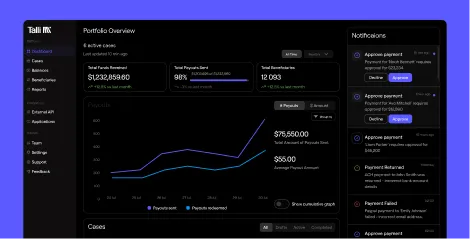
Settlement payout expectations have fundamentally shifted. Clients, whether individual claimants, law firms, or settlement administrators, now demand instant visibility, multiple payment options, and dramatically faster processing times. Traditional settlement processes can take weeks or months, but digital disbursement platforms can deliver eligible payments within 1-3 days after authorization and funding while providing real-time status updates and payment method choice. With class action settlements totaling $42 billion in 2024 alone, understanding and meeting these expectations has become operationally essential.
Key Takeaways
- Settlement payout timelines have compressed from 60-90 days (traditional checks) to 1-3 days (digital platforms), driven by client expectations set by consumer fintech
- Offering 3-4 payment methods increases settlement redemption rates by 20-30% compared to check-only distribution
- 80%+ of recipients prefer digital options, yet 21.8% of households earning less than $15,000 annually were unbanked in the FDIC's 2023 survey, making multi-channel payment choice essential
- Real-time status tracking reduces support inquiries by 60% while building trust with claimants
- Per-payment costs drop from $7-20 (checks) to $0.25-$3 (digital), with actual savings depending on payment method, transaction volume, and administrative costs
- Fiduciary duty now requires evaluating vendor economics: platforms that profit from unclaimed funds face increasing court scrutiny
- AB Data achieved 30% higher redemption rates and 60% reduction in manual reissuance overhead through digital disbursement
The Need for Speed: Why Settlement Timelines Have Compressed
The gap between what clients expect and what traditional settlement processes deliver has become untenable. While insurance companies may issue checks within days of agreement, the entire disbursement process, including lien negotiations and fund clearing, traditionally takes several weeks, sometimes up to six weeks or more after signing the release. Many clients receive payouts within 60-90 days after settlement through conventional methods.
Digital disbursement platforms have collapsed these timelines dramatically. Modern systems process payments in 24-48 hours, with some instant payment options via FedNow enabling same-day delivery.
What's Driving the Speed Expectation
Clients have experienced instant money movement through Venmo, Zelle, and PayPal. They've received same-day refunds from retailers. When settlement funds take 60+ days to arrive, the cognitive dissonance creates frustration and erodes trust, regardless of the legitimate complexities involved.
The business case for speed extends beyond client satisfaction:
- 68% of lawyers at small firms cite cash flow instability as a top concern
- Extended settlement timelines create revenue gaps that strain firm operations
- Faster payouts reduce support ticket volume and administrative burden
- Expedited disbursement strengthens client relationships and referral likelihood
The Technical Barriers That Speed Eliminates
Traditional check-based processes involve multiple bottlenecks:
- Check printing and mailing: 7-14 days
- Check clearing: 2-3 days
- Manual lien resolution: 1-3 weeks
- Trust account reconciliation: Variable
Digital platforms compress these steps through automated verification, electronic lien payoffs, and real-time reconciliation. The fundamental bottleneck isn't internal law firm processes; it's the payment infrastructure itself.
Empowering Claimants: The Demand for Payment Choice
Offering multiple payment options isn't a convenience feature: it's a redemption rate multiplier. Research shows that providing 3-4 payment methods (ACH, prepaid cards, digital wallets, checks) increases settlement redemption rates by 20-30% compared to check-only distribution.
Why Payment Choice Matters
The math is straightforward: while 80%+ of recipients prefer digital options, 21.8% of households earning less than $15,000 annually were unbanked in the 2023 FDIC household survey. A check-only approach fails both groups: the digitally-native majority who find checks inconvenient and the unbanked population who struggle to cash them.
Modern platforms offer multiple payment methods including:
- ACH Direct Deposit: Lowest cost at $0.25-$0.50 per transaction, 1-2 day delivery for banked claimants
- Prepaid Mastercard: Virtual cards delivered via SMS/email in 30 seconds, physical cards within 5-7 days, serving unbanked populations with no activation fees
- Digital Wallets: PayPal and Venmo integration ($0.50-$1.00 per transaction), instant access for existing users
- Gift Cards: Amazon, Target options for settlements under $100 per claimant, highest redemption rates for small-value distributions
- Wire Transfers: Same-day option for high-value international payments ($10-$30 per transaction)
- Paper Checks: Maintained as fallback despite $7-20 all-in costs
Addressing the Unbanked Population
Prepaid card options become essential when serving diverse claimant populations. These cards provide immediate fund access without requiring a bank account, removing a structural barrier that keeps legitimate compensation from reaching entitled recipients. The combination of digital convenience for the majority and accessible alternatives for the unbanked maximizes overall redemption.
Transparency and Trust: Real-Time Status Updates
Claimants who've experienced harm and may be skeptical of institutions need visibility into where their money is. The traditional settlement process left recipients wondering about their settlement check location for weeks with no way to self-serve answers.
What Modern Tracking Looks Like
Real-time payment tracking platforms provide 24/7 visibility through mobile-friendly portals showing:
- Payment authorization status
- Compliance screening completion
- Delivery method and timing
- Redemption confirmation with timestamps
- Fund flow documentation
This transparency serves multiple stakeholders. Claimants can check status without calling anyone. Administrators can monitor distribution progress through live dashboards. Courts receive audit-ready documentation proving proper fund handling.
The Support Cost Reduction
Traditional systems generate 5-15 support inquiries per case, as claimants repeatedly contact administrators asking about payment status. Self-service portals reduce this to 1-3 inquiries while improving claimant satisfaction. The operational savings compound across high-volume distributions.
The Unclaimed Funds Problem: Why Digital Solves It
Class action settlements face a chronic participation crisis. The median claims rate with direct notice is just 9%, dropping to 3% for email campaigns. Even when claims are submitted and approved (86% approval rate), over 23% of paper checks go uncashed.
This leaves billions in legitimate compensation unclaimed annually, undermining the fundamental purpose of settlements while creating administrative burden managing unclaimed funds and eventual escheatment to state governments.
The True Cost of Uncashed Checks
Each uncashed settlement check triggers a cascade of expenses:
- Initial tracking and monitoring: Variable administrative costs depending on follow-up requirements and the number of unresolved payments
- Reissuance attempts: Additional printing, postage, and processing
- Skip-tracing for returned mail: $45-75 per claimant
- Escheatment processing: State-specific compliance costs
- Cy pres distribution: Legal fees for residual fund allocation
Digital disbursement achieves 95-98% redemption rates compared to 70-80% for traditional paper methods. The gap represents both significant cost savings and improved outcomes for claimants.
Why Traditional Methods Fail
Check-based systems inherently limit participation due to:
- Address changes making mail delivery unreliable (12% of Americans move annually)
- Multi-week delays between claim approval and fund receipt that cause abandonment
- Unbanked populations unable to easily cash checks
- Lack of status visibility creating claimant uncertainty
Protecting Payouts: Fraud Prevention in Settlement Distributions
Settlement fraud has exploded. Large settlement distributions increasingly face automated fraud attempts, including suspicious claims involving synthetic identities, duplicate submissions, and coordinated filing patterns. Sophisticated fraud rings target high-value settlements with coordinated attacks.
How Modern Detection Works
AI-powered fraud detection employs multiple techniques simultaneously:
- Pattern Recognition: Identifying suspicious claim patterns across device fingerprinting and behavioral analytics
- Identity Verification: Cross-referencing provided information against identity databases
- Duplicate Detection: Flagging multiple claims from same individuals or addresses
- Velocity Analysis: Monitoring submission timing for coordinated attacks
Talli combines fraud screening, identity verification, and payment controls to help administrators identify suspicious activity before funds are released. This speed matters when fraudulent claims can drain settlement funds before legitimate claimants receive payment.
The Check Fraud Reality
Despite assumptions that paper checks are "safer," 58% of organizations reported check fraud in 2025, making paper checks the riskiest settlement payment method. Digital payments with identity verification actually reduce fraud exposure while accelerating legitimate payouts.
Compliance Automation: The Price of Entry
Legal disbursements must comply with multiple regulatory frameworks simultaneously. Manual compliance processes create bottlenecks that digital platforms eliminate through automation.
Essential Compliance Requirements
- KYC Verification: Identity verification cross-references claimant information against databases, with automated KYC verification reducing manual review time and administrative workloads.
- OFAC Screening: Federal law prohibits payments to sanctioned individuals, with substantial civil penalties that vary by the applicable sanctions statute and violation
- W-9 Collection: Digital forms with automated reminders achieve 90% completion rates versus 40% without automation
- 1099 Generation: Automated tax reporting with IRS e-filing integration
- IOLTA Compliance: Trust accounting rules prohibiting commingling of client funds
The Fiduciary Duty Question
Fiduciary-first settlement disbursement requires evaluating how payment vendors are compensated. Some platforms earn revenue from "breakage," the value of payments never collected. When promotional instruments expire, remaining value becomes the platform's revenue.
This creates misaligned incentives where the vendor economically benefits when claimants don't get paid. As regulatory scrutiny increases, platforms with delivery-based compensation, where vendors are paid for successful payment rather than expiration, create structural advantage.
Settlement administrators must follow applicable court orders, settlement agreements, fiduciary obligations, and state unclaimed-property requirements when handling funds that remain unpaid. Vendor economics are no longer back-office details; they're evaluated by courts, counsel, and settlement parties.
The Cost-Benefit Analysis: Digital vs. Traditional
The economic case for digital settlement payments is compelling. Per-payment processing costs drop from $7-20 for paper checks to $0.25-$3 for digital payments, with actual savings depending on payment method, transaction volume, and administrative costs. These savings compound across high-volume distributions.
Paper checks carry multiple cost layers:
- Per-payment processing: $7-20
- Reissuance for 23%+ of checks: $7-20 per reissue
- Tracking uncashed checks: Variable administrative overhead
- Support inquiries: 5-15 per case
- Timeline: 6-8 weeks average
Digital payments streamline operations:
- Per-payment processing: $0.25-$3
- Reissuance: Minimal digital redelivery costs
- Tracking: Automated dashboard monitoring
- Support inquiries: 1-3 per case
- Timeline: 1-3 days average
A 50,000-claimant settlement paying $100 each would see processing costs drop significantly, from several hundred thousand dollars for checks to a fraction of that for digital, before accounting for improved redemption rates that ensure more settlement funds reach intended recipients.
Client Success: AB Data Case Study
AB Data, a leading U.S. claims administrator managing settlements worth hundreds of millions of dollars involving hundreds of thousands of claimants, implemented digital disbursement and achieved measurable results:
- 30% increase in claimant redemption rates across check-issued populations
- 60% reduction in unresolved exceptions and manual reissuance overhead within 12 months
- 100% fiduciary compliance record maintained across all distribution cycles and regulatory reviews
- Faster time to funds for claimants while lowering distribution and reissuance costs
Thomas R. Glenn, President & CEO, summarized the transformation: "We don't think of digital disbursement as a feature; we think of it as infrastructure. Talli gave us the regulated payout rails we needed to move faster, reduce unclaimed funds, and give courts full confidence in how settlement money is being distributed."
Why Settlement Administrators Choose Talli
Talli's platform addresses each of the core client expectations driving settlement payout modernization:
- Speed: 24-48 hour payment cycles replace 6-8 week timelines through automated compliance, instant payment rails, and real-time reconciliation.
- Choice: Six payment methods serve both digitally-native and unbanked claimants through a single funding source, maximizing redemption across diverse populations.
- Transparency: Real-time dashboards provide 24/7 status visibility for claimants, administrators, and courts with complete audit trails.
- Compliance: Automated KYC, OFAC screening, W-9 collection, and 1099 generation eliminate manual bottlenecks while maintaining comprehensive fiduciary compliance.
- Security: Talli's SOC 2 Type I report and PCI DSS 4.0.1 compliance program support its security and data protection controls, with AI-powered fraud detection identifying suspicious patterns before funds are disbursed.
The platform has supported payments to more than 500,000 recipients across settlement distributions, with its AB Data case study reporting a 30% increase in claimant redemption rates.
Frequently Asked Questions
How do digital platforms handle international settlement claimants?
Digital disbursement platforms can support international settlement payments through eligible cross-border methods, with country coverage, currencies, fees, and delivery times varying by provider. International wire transfers provide same-day delivery for high-value payments, while digital wallets like PayPal enable instant access for recipients in supported countries. GDPR-compliant data handling ensures regulatory compliance for European claimants, with multi-language support available for claimant communications.
What security certifications should settlement administrators require from payment vendors?
Essential certifications include SOC 2 reports (validating operational security controls through annual audits), PCI DSS compliance (security standards for handling payment card data), and documented OFAC screening procedures with timestamped audit trails. Vendors should also demonstrate FDIC-insured banking relationships with true fund segregation capabilities for QSF compliance under IRC Section 468B.
How does tax reporting work with digital settlement payments?
Automated platforms collect W-9 information through digital forms, validate TIN numbers against IRS records, calculate applicable withholding, including 24% backup withholding when required for reportable payments, generate 1099-MISC and 1099-NEC forms for reportable payments, and file electronically with the IRS. This automation achieves 90% W-9 completion rates through smart reminders versus 40% with manual processes, while eliminating the manual preparation that makes year-end reporting burdensome at scale.
What happens when claimants don't respond to payment notifications?
Digital platforms employ multi-channel outreach sequences including email, SMS, and phone to maximize contact rates. Address verification through USPS NCOA (National Change of Address) databases catches relocations before mail is returned. Persistent automated reminders continue throughout the claims period. When claimants remain unreachable after exhausting all contact methods, platforms maintain complete audit trails documenting each attempt for compliance and eventual escheatment processing.
How long does implementation typically take for law firms switching to digital disbursement?
Implementation typically requires 2-6 weeks with vendor-assisted setup, depending on integration complexity and existing systems. Many platforms offer no-code dashboards for immediate use alongside API integration for deeper case management system connections. Firms commonly achieve ROI within 4-7 months through reduced processing time, lower per-payment costs, and decreased manual reconciliation overhead.