.svg)


.svg)
ISO-certified payout platforms provide secure, auditable infrastructure for handling settlement funds while protecting sensitive claimant data throughout the disbursement lifecycle. These platforms implement Information Security Management Systems aligned with ISO 27001:2022, covering 93 security controls across organizational, people, physical, and technological domains. Modern digital disbursement solutions like Talli address every pain point in traditional settlement administration while adding capabilities that legacy systems cannot match.
Key Takeaways
- ISO 27001 certification requires implementation of 93 Annex A controls covering information security management
- Full ISO 27001 certification costs $50,000-$200,000 in Year 1, with ongoing annual surveillance at $10,000-$30,000
- AI-powered fraud detection can reduce fraudulent claims by up to 40% compared to manual review, according to Talli.ai
- Compliance automation can reduce manual tasks by up to 70%, saving an estimated $60,000 annually in labor costs
- Digital processing costs $0.50-$1.00 per transaction versus $7-$20 for paper checks
- ISO-aligned platforms achieve 4-6 month implementation timelines with proper planning
- Same-day payment delivery replaces traditional check processing timelines that can take several weeks
Why Does ISO Certification Matter for Class Action Payout Platforms?
ISO 27001 certification establishes that a platform meets internationally recognized standards for information security management. For class action administrators handling millions in settlement funds and sensitive claimant data, this certification provides verifiable proof of security controls.
- Risk-based framework: ISO 27001 requires organizations to identify, assess, and treat information security risks systematically rather than applying generic controls.
- Third-party verification: External auditors validate that security controls function as designed, providing assurance beyond self-attestation.
- Continuous improvement mandate: The standard requires ongoing monitoring and regular management reviews to maintain certification.
- Legal defensibility: Court oversight of settlement distributions increasingly expects demonstrable security standards.
What Does ISO 27001 Certification Actually Verify?
The ISO 27001:2022 standard encompasses 93 controls organized across four domains: organizational controls, people controls, physical controls, and technological controls. Each control addresses specific security risks that directly impact settlement fund protection and claimant data privacy.
Enterprise clients increasingly require ISO certification as a baseline for vendor selection. Single settlement contracts worth $5M-$10M often mandate ISO 27001 compliance, making certification a revenue enabler rather than simply a cost center.
How Do ISO-Certified Platforms Protect Settlement Funds and Claimant Data?
Security in class action distributions operates on multiple levels, from fund segregation architecture to individual transaction verification. Compliance-focused platforms implement layered protections that address both regulatory requirements and operational risks.
- Complete fund segregation: Dedicated accounts for each settlement preserve Qualified Settlement Fund (QSF) ownership while simplifying accounting and legal compliance.
- Automated OFAC screening: Real-time checks against sanctions lists prevent payments to prohibited parties without manual intervention.
- KYC verification: Identity verification protocols confirm claimant legitimacy before fund release.
- Encryption standards: TLS 1.2+ for data in transit and AES-256 for data at rest protect sensitive information throughout the payment lifecycle.
- Comprehensive audit trails: Every transaction generates documentation meeting court oversight requirements.
What Verification Processes Prevent Settlement Fraud?
Settlement fraud has increased dramatically in recent years, making automated verification essential for protecting fund integrity. ISO-certified platforms deploy multiple verification layers that manual processes cannot replicate at scale.
OFAC screening catches prohibited transactions in real-time, while KYC processes verify claimant identities before payments are released. AI-powered detection systems identify fraudulent claims with up to 40% greater accuracy than human reviewers, according to Talli.ai, preventing an estimated $250,000-$500,000 in annual fraud losses for mid-size administrators.
How Do AI-Driven Platforms Streamline Class Action Distributions?
AI integration transforms settlement administration from a labor-intensive manual process into an efficient automated workflow. Platforms leveraging artificial intelligence reduce processing times from weeks to hours while maintaining compliance standards.
- Automated compliance controls: Built-in KYC, OFAC screening, W-9 collection, and 1099 generation eliminate manual verification steps.
- Intelligent duplicate detection: Fuzzy matching algorithms identify potentially fraudulent duplicate claims across large claimant populations.
- Smart follow-up campaigns: Automated reminders via SMS and email increase redemption rates without administrator intervention.
- Real-time processing: Transactions complete in minutes rather than days, enabling same-day payment delivery.
What Efficiency Gains Can Administrators Expect?
Compliance automation can reduce manual tasks by up to 70%, freeing claims teams to focus on exception handling and claimant support rather than repetitive verification work. This efficiency translates to an estimated $60,000 in annual labor savings for mid-size operations.
Processing capacity scales without proportional staff increases. Platforms handle 1,000 to 100,000+ recipients per settlement without performance degradation, enabling administrators to accept larger settlements without expanding headcount.
What Payout Options Maximize Redemption Rates for Class Action Claimants?
Redemption rates directly impact settlement effectiveness, and payment flexibility significantly influences whether claimants complete the process. Modern platforms offer multiple disbursement channels that accommodate diverse banking situations and preferences.
- ACH direct deposit: Funds transfer directly to claimant bank accounts, preferred by approximately 68% of recipients for instant access.
- Prepaid Mastercard: Physical or virtual cards serve unbanked claimants comprising approximately 6% of recipients.
- Digital wallet integration: Payment apps provide convenient redemption for mobile-first users.
- Gift card options: Retail redemption choices offer alternative value for smaller settlement amounts.
- Traditional checks: Paper options remain available for claimants preferring conventional methods.
How Do Smart Reminders Improve Completion Rates?
Increasing redemption rates requires proactive claimant engagement rather than passive waiting. Automated reminder systems can achieve 15-20% higher redemption rates compared to single-notification approaches.
Multi-channel outreach via SMS, email, and other channels reaches claimants through their preferred communication methods. Intelligent timing algorithms optimize message delivery for maximum engagement, reducing the administrative burden of manual follow-up while improving outcomes.
Why Do Claims Administrators Need Real-Time Visibility and Reporting?
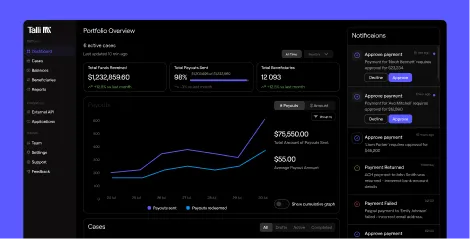
Real-time settlement dashboards transform claims administration by providing immediate insight into distribution progress, fund flows, and completion rates. This visibility enables proactive management rather than reactive problem-solving.
- Payout status tracking: Monitor every payment from initiation through claimant receipt in real-time.
- Completion rate metrics: Identify settlements requiring additional claimant outreach before deadlines.
- Fund flow transparency: See every dollar movement with complete audit documentation.
- CRM integration: Sync payout data automatically to existing case management systems.
- Stakeholder reporting: Generate court-ready reports demonstrating distribution progress.
What Integration Capabilities Should Platforms Offer?
Two-way API integration with case management systems eliminates manual data entry errors and enables real-time reporting. Platforms with pre-built connectors for popular legal tech systems like Litify, Filevine, and Clio reduce integration complexity and timeline.
Data synchronization should support real-time updates for payment status and fraud alerts, with scheduled batch processing for comprehensive reporting. Webhook support enables immediate notifications when payments are delivered, redemptions complete, or compliance flags require attention.
How Can Platforms Balance Compliance Requirements With Fast Legal Payouts?
Legal payout compliance creates tension between regulatory thoroughness and claimant expectations for rapid fund access. ISO-certified platforms resolve this tension through automation that maintains compliance velocity without sacrificing verification rigor.
- Parallel processing: Multiple compliance checks execute simultaneously rather than sequentially.
- Risk-based verification: Lower-risk transactions receive expedited processing while higher-risk payments undergo additional scrutiny.
- Automated documentation: Audit trails generate automatically during transaction processing without manual intervention.
- Exception-based workflow: Staff attention focuses on flagged transactions requiring human review.
- Regulatory updates: Platform compliance rules update automatically as requirements change. (Source)
What Timeline Improvements Are Achievable?
Same-day payment delivery replaces traditional check processing timelines that can take several weeks for most transactions. Digital processing at $0.50-$1.00 per transaction versus $7-$20 for paper checks generates substantial cost savings at scale.
For a 50,000-claimant settlement, digital processing can save an estimated $325,000-$975,000 compared to traditional check distribution, while simultaneously reducing delivery time from weeks to hours.
What Features Should You Evaluate Beyond ISO Certification?
ISO certification establishes baseline security standards, but platform selection requires evaluation of operational capabilities that determine day-to-day effectiveness. Secure fund segregation and compliance automation represent table stakes; differentiating factors lie in implementation quality and service support.
- Implementation timeline: Talli achieves 4-6 month deployment versus typical 12-18 month certification timelines.
- Scalability: Platforms should handle growth from 1,000 to 100,000+ recipients without degradation.
- Customer support: Direct team access matters when issues arise during active distributions.
- Banking relationships: FDIC-insured partnerships (such as Patriot Bank, N.A.) provide fund protection.
- API accessibility: Non-technical teams should be able to configure integrations without dedicated engineers.
How Do Leading Platforms Compare?
Market leaders differentiate through specialization and service approach. Kroll states it has managed 4,000+ settlements, processed 100M+ claims, and distributed $30B+, and lists ISO 27001 among its security credentials, making them suitable for mega-settlements requiring extensive stakeholder management.
Talli combines ISO-aligned security with modern API-first architecture designed for rapid deployment and business user accessibility. The platform can automate up to 70% of compliance tasks while providing transparent pricing that eliminates enterprise RFP complexity for mid-size and large law firms.
What Does the Future Hold for Class Action Payout Security?
Settlement administration continues evolving as regulatory requirements expand and claimant expectations increase. Platforms investing in security infrastructure today position themselves for emerging compliance demands and technological advances.
- Enhanced fraud detection: Machine learning models continuously improve at identifying fraudulent patterns.
- Expanded payment options: New digital payment rails will provide additional redemption flexibility.
- Regulatory evolution: State and federal requirements for settlement oversight will likely increase.
- Integration depth: Case management system connectivity will become more seamless.
- Predictive analytics: Data analysis will enable proactive identification of at-risk settlements.
Investment in ISO-certified platforms creates competitive advantage as enterprise clients increasingly mandate security certifications. The estimated $175,000 Year 1 certification investment generates immediate ROI through access to contracts worth $5M-$10M that require demonstrated security standards.
Frequently Asked Questions
How long does ISO 27001 certification take from start to completion?
The full certification process typically requires 7-10 months, including gap assessment, ISMS documentation development, control implementation, internal audit, and external certification audits. Organizations with mature security postures may complete the process in 5-6 months, while those requiring significant remediation may need 12-18 months.
What ongoing costs should administrators budget after initial certification?
Post-certification annual costs include surveillance audits ($10,000-$30,000), compliance platform fees ($10,000-$50,000), and staff maintenance time (approximately $15,000 in opportunity cost). The three-year total cost of ownership averages $350,000, including the Year 1 certification investment.
Can smaller law firms justify ISO certification investment?
Single enterprise contracts requiring ISO 27001 compliance often exceed $5M-$10M in value, providing immediate ROI that exceeds Year 1 certification costs. Additionally, labor savings from compliance automation (estimated at $60,000 annually) and fraud prevention (estimated $250,000-$500,000 avoided losses) compound over time.
What happens if a platform fails a surveillance audit?
Failed surveillance audits result in non-conformities requiring corrective action within specified timeframes. Major non-conformities must be addressed before certificate continuation. Platforms with continuous compliance monitoring catch potential issues before audits, minimizing failure risk.
Do ISO-certified platforms work with all case management systems?
Leading platforms offer API integration with major case management systems including Litify, Filevine, and Clio. Legacy systems may require custom API development ($5,000-$25,000) or middleware solutions. Pre-built connectors significantly reduce integration timeline and cost.