.svg)


.svg)
The Purdue Pharma opioid settlement represents the largest pharmaceutical bankruptcy resolution in U.S. history, with $7.4 billion approved for distribution to states, local governments, and individual victims. With first payments totaling $2.4 billion expected in early 2026, claims administrators face the complex challenge of distributing funds across 55 state attorneys general, thousands of local subdivisions, and tens of thousands of individual claimants—all while maintaining legal payout compliance and preventing fraud.
Key Takeaways
- Purdue Pharma settlement totals $7.4 billion over 15 years, with $2.4 billion distributed in early 2026
- More than 100,000 individuals have active claims, and eligible victims can receive payments of about $8,000 or about $16,000 from an ~$850 million pool
- 55 state attorneys general plus thousands of local governments will receive opioid abatement funds
- Traditional settlement administration costs estimated at 0.25% to 1.5% of fund assets annually
- Modern payment platforms can reduce distribution costs through per-transaction pricing and digital disbursement
- Frontloaded payment schedule creates immediate need for scalable settlement infrastructure
- Document repository requirement includes publishing 30+ million documents (over 100 million pages) for transparency compliance
Understanding the Purdue Pharma Opioid Settlement Fund Distribution
The Purdue Pharma settlement establishes one of the most complex fund distribution structures in mass tort history. According to the settlement approval announcement, the $7.4 billion will flow through multiple channels over a 15-year period, requiring sophisticated tracking and compliance infrastructure.
Key Aspects of Opioid Settlement Fund Management
The settlement divides funds into distinct categories with separate distribution requirements:
- State Government Allocations: 55 participating states receive predetermined amounts based on opioid impact formulas
- Local Government Distributions: Thousands of cities, counties, and subdivisions eligible for direct payments
- Individual Victim Pool: $850 million reserved for personal injury claimants with verified OxyContin prescriptions
- Opioid Abatement Programs: Restricted funds for treatment, prevention, and recovery initiatives
Managing a Qualified Settlement Fund of this magnitude requires compliance with IRS Section 468B regulations, court oversight under Federal Rule of Civil Procedure 23(e), and state-specific trust account rules.
Challenges in Large-Scale Fund Distribution
Traditional QSF administration presents significant cost and efficiency challenges. Typical annual administration fees range from 0.25% to 1.5% of fund assets. On a $7.4 billion fund, these percentage-based fees could total approximately $18.5 million to $111 million annually—funds that could otherwise reach victims and abatement programs.
Who is Eligible for Payouts from the Purdue Pharma Settlement?
Eligibility for Purdue settlement payments falls into three primary categories, each with distinct verification requirements and distribution timelines.
Defining Claimant Eligibility
State and Territorial Governments: All 55 state attorneys general plus U.S. territories qualify for opioid abatement allocations. New York will receive up to $250 million, while Connecticut’s state and local governments will receive as much as $64 million over eight years, with frontloaded early payments.
Local Government Subdivisions: Cities, counties, and other subdivisions must opt into the settlement to receive direct payments. In Michigan alone, 279 local subdivisions were eligible to participate.
Individual Victims: More than 100,000 individuals have active claims, and eligible victims can receive about $8,000 or about $16,000, depending on prescription duration and how many people qualify.
Claims Submission Process
Individual victim eligibility requires documented proof of OxyContin prescription and demonstrated harm. Settlement documentation requirements include medical records, pharmacy records, or other verifiable evidence of prescription history.
Settlement administrators must verify each claim before disbursement, creating a significant operational burden. Many claims submitted years ago require updated contact information and banking details—a challenge that modern claims redemption strategies can address through multi-channel outreach.
Key Dates and Milestones for the Purdue Pharma Settlement in 2026
The Purdue settlement follows a frontloaded payment schedule designed to accelerate fund distribution to states and victims.
Anticipated Payment Schedules
According to settlement timeline analysis, key 2026 milestones include:
- Year 1 (2026): $1.5 billion from the Sackler family plus $900 million from Purdue = $2.4 billion total
- Year 2 (2027): $500 million
- Year 3 (2028): $500 million
- Year 4 (2029): $400 million
- Years 5-15: Remaining approximately $3.6 billion distributed through 2040
The frontloaded structure means settlement administrators must have operational infrastructure in place before court approval finalizes to avoid distribution delays.
Important Deadlines for Claims Administrators
Critical compliance deadlines include:
- Tax filing: Form 1120-SF due within 3.5 months of QSF fiscal year end
- Court reporting: Quarterly or annual reports showing fund balance and distributions
- 1099 issuance: Tax forms to individual recipients by January 31 of the following year
- Document repository: Ongoing maintenance of 30+ million pages of settlement documents
Ensuring Compliance and Preventing Fraud in Opioid Settlements
Mass settlements attract fraudulent claims and require rigorous verification protocols. The Purdue settlement's scale makes it a prime target for assignment shops and duplicate claim attempts.
Regulatory Frameworks for Settlement Payouts
QSF administration must comply with multiple regulatory requirements per federal QSF regulations:
- IRS Section 468B: Tax-qualified fund structure requirements
- Bank Secrecy Act (BSA): Anti-money laundering compliance for large transactions
- OFAC screening: Verification against sanctioned entity lists
- State trust account rules: Jurisdiction-specific requirements for fund segregation
Platforms handling settlement distributions must incorporate OFAC compliance protocols and KYC verification to prevent prohibited payments.
Best Practices for Fraud Mitigation
Effective fraud prevention strategies require:
- AI-powered pattern detection: Flagging suspicious claims before disbursement
- Identity verification: Multi-factor authentication for claimant access
- Audit logging: Complete tracking of every administrative action
- W-9 collection: Tax documentation requirements that deter fraudulent claims
The Role of Technology in Streamlining Large-Scale Settlement Payouts
Settlement administration technology has evolved dramatically, with modern platforms offering capabilities that enhance efficiency and compliance at scale.
Leveraging AI for Efficient Claims Processing
AI-powered platforms deliver significant advantages:
- Real-time eligibility verification: Automated document analysis accelerates claim processing
- Fraud detection: Pattern recognition identifies suspicious submissions before payment
- Automated tax reporting: 1099 generation without manual data entry
- CRM integration: Real-time payout data synchronization with case management systems
These capabilities become essential when processing thousands of claimant distributions on tight court-mandated timelines.
Digital Solutions for Seamless Fund Disbursement
Traditional check-based distribution creates significant hidden costs. Each uncashed check costs approximately $150 in reconciliation expenses. With an estimated 20% non-response rate on tens of thousands of individual claimants, check-based distribution could waste millions in reconciliation costs alone.
Modern QSF platforms offer alternatives including:
- Online establishment: QSF setup in as little as one business day
- AES-256 encryption: Enterprise-grade security for sensitive claimant data
- Multi-factor authentication: Secure administrator access controls
- Self-service reporting: Excel/CSV exports for stakeholder transparency
Payment Methods and Recipient Experience in Mass Settlements
How claimants receive their settlement funds significantly impacts redemption rates and overall satisfaction.
Flexible Payout Options for Claimants
Modern settlement platforms offer multiple payment methods to accommodate diverse recipient needs:
- Digital wallets: Instant access via Apple Pay, Google Pay, Samsung Pay
- Virtual cards: Transaction-ready cards generated in real-time
- Prepaid Mastercard: Physical cards for recipients preferring traditional payment methods
- Direct deposit: ACH transfers for banked recipients
- Gift cards: Alternative redemption option for specific use cases
The Easy Prepaid Mastercard is issued by Patriot Bank, N.A., Member FDIC, pursuant to a license from Mastercard International. Gift cards are issued by InComm and distributed by Talli.
Enhancing Claimant Satisfaction with Digital Tools
Claimant experience directly impacts settlement redemption rates. Key satisfaction drivers include:
- Speed: Virtual card delivery in hours versus 2-6 weeks for check processing
- Convenience: Secure link via SMS or email with no accounts to create
- Choice: Claimants select their preferred payment method
- Support: Smart reminders across email, SMS, and additional channels
- Accessibility: No bank account required for payment receipt
For unbanked populations—which represent a significant portion of opioid crisis victims—digital payment options remove barriers that traditional check distribution creates.
Transparency and Reporting for the Purdue Pharma Settlement
Settlement stakeholders including courts, attorneys general, and claimants require clear visibility into fund status and distribution progress.
Maintaining Visibility in Fund Flows
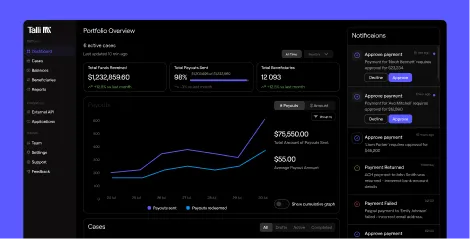
Real-time dashboard capabilities enable administrators to:
- Track fund balances across segregated accounts
- Monitor completion rates by recipient category
- View delivery status for individual payments
- Generate compliance reports for court filings
- Sync data with existing case management systems
The Purdue settlement requires a public, searchable document repository with 30+ million documents (over 100 million pages), demonstrating the scale of transparency requirements for major opioid settlements.
Comprehensive Reporting for Stakeholders
Effective reporting infrastructure must serve multiple audiences:
- Courts: Quarterly compliance reports, fund balance statements, distribution summaries
- State Attorneys General: Jurisdiction-specific allocation tracking
- Local Governments: Subdivision payment status and upcoming distributions
- Individual Claimants: Personal payment status through secure portals
- Public Oversight: Transparency dashboards showing aggregate fund usage
According to LAPPA research on settlement spending, public transparency requirements help prevent misuse of opioid abatement funds and build community trust.
Challenges and Potential Delays in Large-Scale Opioid Payouts
Despite court approval, several factors could delay fund distribution to intended recipients.
Overcoming Administrative Hurdles
Common challenges in settlement administration include:
- Outdated contact information: Many individual claimants filed years ago and have since moved
- Banking information gaps: Unbanked recipients cannot receive traditional wire transfers
- Verification complexity: Proving OxyContin prescription history requires medical record retrieval
- Multi-jurisdictional coordination: 55 states plus thousands of local governments require separate tracking
Mitigating Risks in Settlement Disbursement
Effective risk mitigation strategies include:
- 90-day outreach windows: Multiple notification attempts before payment deadline
- Multi-channel communication: Mail, email, SMS, and public notice combined
- Address update portals: Self-service tools for claimants to verify contact information
- Flexible payment options: Alternatives for recipients without traditional banking access
The history of OxyContin marketing and the crisis it created underscores the importance of ensuring settlement funds actually reach victims rather than remaining unclaimed.
The Long-Term Impact of Opioid Settlements on Public Health Initiatives
The Purdue settlement directs billions toward opioid abatement, but effective use of these funds requires ongoing oversight and accountability.
Funding Opioid Crisis Abatement Efforts
Settlement funds are restricted to approved opioid abatement uses including:
- Treatment programs: Medication-assisted treatment, counseling, recovery support
- Prevention initiatives: Education, prescription monitoring, safe disposal programs
- Recovery services: Housing, job training, peer support programs
- Healthcare infrastructure: Emergency response, naloxone distribution, training
States cannot use settlement funds to supplement general budgets or replace existing opioid spending—a practice called "supplantation" that undermines the settlement's intended impact.
Sustainable Solutions for Public Health Recovery
Robust tracking and reporting systems help ensure funds reach their intended purpose. Technology platforms that provide real-time visibility into fund usage, automated compliance checking, and public transparency portals serve as essential infrastructure for long-term settlement success.
How Talli Streamlines Complex Opioid Settlement Distributions
For claims teams managing the Purdue Pharma settlement's unprecedented scale and complexity, Talli's AI-driven platform delivers the speed, compliance, and transparency required to meet court deadlines while maximizing claimant redemption rates.
Talli's technology addresses the core challenges of large-scale settlement administration:
- Instant digital disbursement: Virtual card delivery eliminates weeks-long check processing delays
- Automated fraud detection: AI-powered pattern recognition protects the $7.4 billion fund
- Real-time compliance tracking: Built-in OFAC screening and automated tax reporting
- Multi-channel claimant outreach: Smart reminders across email, SMS, and additional channels reduce unclaimed funds
- Transparent reporting dashboards: Real-time visibility for courts, attorneys general, and stakeholders
With traditional administration potentially costing tens of millions annually in percentage-based fees, Talli's per-transaction pricing model significantly reduces costs while improving claimant experience through flexible payment options including digital wallets, virtual cards, and prepaid Mastercard—ensuring even unbanked victims can access their settlements quickly and securely.
Frequently Asked Questions
How does the Purdue settlement compare to other opioid manufacturer settlements?
The Purdue Pharma settlement represents the largest opioid manufacturer bankruptcy resolution, with $7.4 billion committed over 15 years. Other manufacturer settlements include Johnson & Johnson ($5 billion) and Teva ($4.25 billion), though these have different distribution structures and timelines. The Purdue settlement is unique in including direct payments to individual victims through the $850 million personal injury pool, whereas most other opioid settlements direct funds exclusively to states and local governments for abatement programs.
What happens to unclaimed settlement funds if victims don't collect their payments?
Unclaimed individual victim funds typically revert to the general opioid abatement pool for redistribution to states and local governments. Court-approved distribution plans specify procedures for unclaimed amounts, which may include extended claim periods, cy pres distributions to opioid-related charities, or reallocation among other claimants. Modern digital payment platforms significantly reduce unclaimed funds by offering multiple redemption options and automated reminder systems.
Can victims who didn't file claims before the deadline still receive compensation?
Generally, claimants who missed filing deadlines cannot participate in the Purdue settlement distribution. The settlement required claims submission during the bankruptcy proceedings, and courts established final deadlines for eligibility determination. However, victims may have alternative options including separate state-based settlements, ongoing litigation against other opioid manufacturers or distributors, or state victim compensation programs funded by opioid settlement proceeds.
What documentation do individual victims need to prove OxyContin prescription eligibility?
Individual claimants must demonstrate documented OxyContin prescription history and resulting harm. Acceptable documentation includes pharmacy records showing OxyContin dispensing, medical records indicating OxyContin prescription, insurance claims showing OxyContin coverage, or other verifiable evidence of prescription history. The settlement administration process includes verification procedures that may request additional documentation for claims lacking sufficient initial evidence.
How are settlement funds protected from creditors or other claims?
Qualified Settlement Funds (QSFs) established under IRS Section 468B provide legal protection for settlement funds. Once funds transfer to a court-approved QSF, they are segregated from the defendant's assets and protected from the defendant's creditors. The QSF structure also protects individual claimants' allocations from their personal creditors until distribution occurs, though personal bankruptcy or other legal proceedings may affect funds after receipt.