.svg)


.svg)
Courts, class counsel, and claimants are asking harder questions about settlement distributions than they were a year ago. Judges are ordering transparency around fee disclosures. Plaintiffs' firms are writing new terms into administration agreements. Take-up rates are being read as a measure of whether a distribution worked at all.
Underneath all of it sit three questions - about cost, about the claimants who never collected, and about proof. Administrators who can answer all three are well positioned for where the market is heading. This piece covers why these questions are being asked now, how the standard for "acceptable" has shifted, and what a strong answer to each one looks like.
Why now
Most administrators run distributions properly, the problem is that the old standard never required anyone to prove it, so the honest and the conflicted looked identical on paper.
Over the past year, media coverage and litigation have put the economics of settlement administration under a spotlight. Questions have been raised about undisclosed revenue arrangements between administrators and their vendors, and about how interest earned on settlement funds is allocated while distributions are pending. Several of these disputes are now working their way through the courts, including consolidated multi district proceedings.
Courts responded with process, not just rulings. In the national realtor commission litigation, counsel were ordered to disclose financial relationships with administrators, banks, vendors, and funders; in May 2026, one of the country's largest administrators agreed in a Kansas City data breach case to take no rebates or discounts from vendors or financial institutions after the judge ordered its fees disclosed in full and in June 2026 the same court unsealed its administration records over objections that billing detail was proprietary (Forbes, August 2025 and May 2026; PYMNTS, June 2026).
None of these is an isolated story. Together they form a template other judges and plaintiffs' firms can copy, and there is every sign they will.
What "acceptable" used to mean, and what it means now
Then: an administrator quoted a fee schedule, and the economics underneath it stayed private. Now: fee schedules are expected to capture every income stream
Then: vendor selection happened inside the administrator's shop, and payout methods were chosen for administrative convenience. Now: payout recommendations are expected to reflect claimant outcomes, with the reasoning documented and courts in several jurisdictions have begun examining how administrators are selected in the first place (CPT Group).
Then: claims rates were a statistic. Now: they are treated as evidence. Rule 23 commentary has raised tying part of an attorney fee award to the benefit the class actually received (American Bar Association).
Then: a final accounting arrived months after the last check expired, assembled by hand. Now: regulators expect the record to exist as the work happens. The Department of Labor confirmed in 2025 that it expects fiduciaries to run and exhaust a prudent program to locate missing beneficiaries before transferring funds to the state (DOL FAB 2025-01).
The gap between those two pictures is the new bar. It rewards operators who can show their work.
The three questions
1. What does this distribution cost, and who receives that money?
The full answer covers the quoted fee plus everything underneath it. If any party in the chain earns more when claimants collect less, that is the fact courts now want on the record.
2. What happened to every claimant who didn't get paid?
A claims rate is one number. The defensible version is a record behind it: what notice went out, what delivery attempts were made, what failed and why, what remediation followed, how much of the settlement actually reached claimants, and where unclaimed money went. The FTC found median claims rates of 9 percent in consumer class actions (FTC, 2019). The story of the people who didn't collect is most of the story.
3. Can you produce a full accounting on short notice?
Not in six weeks, assembled from spreadsheets. On request. Custody of funds, fund flows, payment status per claimant, exceptions and their resolution - reconciled to the dollar. The administrators who can do this treat the question as routine. The ones who can't are now the ones explaining themselves in filings.
Trust as infrastructure
The tempting response to a trust problem is communication: reassure clients, publish values, add a transparency page. The durable response is operational. Transparency either exists in how a distribution runs or it doesn't exist at all.
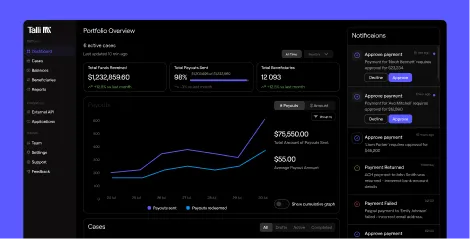
In practice that means three things. Fund custody with clear claimant ownership, rather than commingled balances that blur whose money is whose. Vendor economics built on delivery, where the platform earns by completing payments rather than by holding unclaimed ones. And audit trails that build themselves as the distribution runs, so a full accounting is an export, not a project.
Any vendor in this market will soon be measured against those three properties. They were design decisions at Talli from the start. made because settlement money belongs to claimants, and true client money infrastructure should make that impossible to blur.
The bar moved. For anyone running distributions the right way, that is good news, because the market is starting to price in the difference. Our short assessment scores your program against these three questions. It takes a few minutes and gives you something concrete to bring to your next engagement.