.svg)


.svg)
Uncashed claim checks represent far more than minor administrative inconveniences. They create a cascading operational burden that quietly drains insurance carrier resources while exposing organizations to substantial regulatory risk. With $77 billion in unclaimed property sitting idle nationally and nearly 80% of organizations not fully compliant with state unclaimed property laws. Modern digital claims payment platforms offer insurance carriers a path to eliminate these hidden costs while dramatically improving policyholder experiences.
Key Takeaways
- Pension-plan data shows 2-5% of mailed checks may remain outstanding long enough to require follow-up, compared with roughly 0.1-0.3% of electronic ACH credits returned for administrative reasons, illustrating the operational advantage of electronic payments
- Finance teams spend an estimated 60-70% of time on manual reconciliation rather than analysis, with 2-4 week monthly cycles creating perpetual delays
- State escheatment penalties vary significantly by jurisdiction and may include per-day fines, percentage-based penalties, and interest on overdue property
- Around 90% of consumers prefer instant payouts when offered, yet traditional claim processing still requires 30-45 days
- Digital disbursement platforms can reduce processing costs by an estimated 50-65% compared to paper checks while compressing delivery from weeks to hours
- Multi-state compliance requires tracking state-specific frameworks with varying dormancy periods and reporting rules, while approximately half of states have adopted statutory frameworks addressing life-insurer Death Master File matching
- Carriers with automated payment orchestration can redirect claims team capacity from manual tracking to strategic exception handling
Understanding Unclaimed Property: More Than Just Lost Checks
Unclaimed property in the insurance context extends beyond simple unredeemed payments. Every uncashed claim check can create an outstanding payment obligation, additional reconciliation work, and potential unclaimed-property exposure if it remains unresolved through the applicable dormancy period. The scale of this problem is significant: Talli cites more than $35 billion in unclaimed insurance funds nationally, highlighting the operational importance of improving payment delivery and follow-up.
The Legal Landscape of Unclaimed Property for Insurers
Insurance carriers operate under a complex web of federal and state regulations governing unclaimed funds. The NAIC Unclaimed Life Insurance Benefits Model Act establishes baseline standards requiring periodic Death Master File searches, but implementation varies dramatically across jurisdictions. Approximately half of states have adopted these requirements with implementation dates spanning recent years.
Key regulatory considerations include:
- Dormancy periods typically range from 3-5 years depending on state
- Due diligence requirements mandate at least one notification attempt before escheatment
- Negative reporting obligations in some states require filings even when no escheatable property exists
- Audit exposure can extend across many years of historical records, creating substantial liability when documentation is incomplete
Defining Unclaimed Property: What Constitutes a Lost Claim?
For insurers, uncashed claim checks must be tracked under applicable insurance, accounting, and state unclaimed-property requirements until the payment is resolved or properly reported and remitted. The typical lifecycle of an unclaimed payment follows a predictable pattern:
- Check issued to policyholder or beneficiary
- Payment remains unredeemed past dormancy period
- Carrier must initiate due diligence efforts
- Unclaimed funds eventually escheat to state government
- Carrier loses ability to reconnect funds with rightful owner
Understanding this lifecycle is essential for developing effective strategies to reduce unclaimed funds before they become compliance liabilities.
The Escheatment Process: A Costly Burden for Insurance Carriers
The escheatment process transforms uncashed checks from operational annoyances into significant financial liabilities. When carriers fail to meet state-specific requirements, penalties can devastate bottom lines, and the complexity of multi-state compliance makes perfect adherence nearly impossible through manual processes.
Navigating State-Specific Escheatment Laws
Each state maintains distinct requirements that create a compliance maze for national carriers:
Texas:
- 3-year dormancy period for most insurance-related unclaimed property
- Senate Bill 561 requires bi-annual DMF matching for policies issued after January 1, 2018
- Texas Comptroller has identified $178 million in unpaid insurance benefits since 2011
Florida:
- 15-day refund deadline for insurer-initiated cancellations
- 30-day deadline for insured-initiated cancellations
- 8% interest penalty on late payments
Georgia:
- Unclaimed-property violations can trigger statutory penalties, including $100 per day for certain willful reporting failures
- Separate insurance rules may establish deadlines for returning unearned premiums depending on the policy and cancellation circumstances
Delaware:
- 30-day standardized timeline from cancellation date (2024 Regulation 611)
- Case-by-case regulatory penalties for non-compliance
Beyond Compliance: The Financial Impact of Escheatment
The direct costs of escheatment extend far beyond penalty payments. Carriers face:
- Tracking costs of approximately $150 per uncashed check for manual follow-up
- Reissuance expenses when checks are located and need replacement
- Audit defense costs when state comptrollers review historical compliance
- Capital inefficiency with funds tied up in limbo rather than earning returns
Texas Comptroller investigations identified more than $178 million in unpaid insurance benefits beginning in 2011, and the state had returned more than $41 million to rightful owners by 2017.
Why Claim Checks Go Uncashed: Root Causes and Industry Trends
Understanding why checks go unredeemed is essential for developing effective prevention strategies. Pension-plan data shows 2-5% of mailed checks may remain outstanding long enough to require follow-up, compared with roughly 0.1-0.3% of electronic ACH credits returned for administrative reasons, illustrating the operational advantage of electronic payments.
Recipient Challenges: Address Changes and Engagement Issues
Multiple factors contribute to uncashed checks:
- Incorrect or outdated addresses from policyholder moves without notification
- Lost or misplaced mail that never reaches intended recipients
- Checks mistaken for junk mail and discarded without opening
- Claimant apathy for small-dollar amounts not worth depositing
- Deceased policyholders without proper beneficiary updates
The FBI reports individuals aged 60+ lost an average of $34,000 to fraud in 2023, nearly 4x the loss from three years prior, making paper checks increasingly risky for elderly recipients who represent a significant portion of insurance beneficiaries.
The Problem of 'Small Dollar, High Headache' Claims
Low-value claims create disproportionate administrative burden:
- Processing costs often exceed the check amount for claims under $50
- Recipients may ignore deposits requiring bank visits for minimal returns
- Accumulation of small uncashed checks creates significant aggregate liability
- Manual tracking of numerous small-dollar items consumes claims team resources
Digital disbursement platforms address this challenge by offering payment methods, including prepaid cards and digital wallets, that recipients can access instantly without bank visits, dramatically improving redemption rates for small-value distributions.
The Hidden Costs: Beyond Escheatment and Reissuance Fees
While direct costs like printing, postage, and reissuance fees are visible, the true burden of uncashed checks lies in less obvious operational drains that compound across the organization.
Operational Drag: Manual Processes and Staff Time
Finance teams spend an estimated 60-70% of time on manual data gathering and reconciliation rather than analysis, a pattern particularly acute in insurance. For carriers with delegated authority partners, monthly reconciliation cycles consume an estimated 2-4 weeks of concentrated staff effort.
The operational impact includes:
- 15-25% of claims team workload dedicated to payment status inquiries
- Backward-looking data that's always 30-75 days old by the time it's reconciled
- 80/20 time split with 80% on routine matching and only 20% on exception management
- Repeated customer service interactions for claimants checking payment status
Automated systems can flip the reconciliation ratio, with carriers reporting substantially reduced time on matching and increased capacity redirected to strategic exception handling.
Reputational Risks: Impact on Policyholder Trust
Uncashed checks signal failed customer experiences:
- Claimants waiting weeks for payments lose confidence in carrier responsiveness
- Failed deliveries requiring reissuance create frustration at vulnerable moments
- Slow claims resolution directly impacts renewal and referral rates
- Competitors offering faster digital payments gain loyalty advantages
When around 41% of consumers now receive instant disbursements, up from just 11% in 2018, carriers relying on paper checks appear increasingly outdated.
Revolutionizing Claim Payments: Digital Solutions for Higher Redemption
The gap between consumer expectations and traditional insurance payment delivery creates both risk and opportunity. Instant payments are gaining traction in insurance, with 34.8% of insurance disbursement recipients reporting instant payment as their most-used method in 2025 when available.
The Shift to Digital: Meeting Modern Policyholder Expectations
Digital payment adoption is accelerating but remains incomplete. Around 73% of insurers have transitioned at least some claim payments to digital channels, seeing reductions in average payment times by up to 5.5 days. However, checks still represent nearly half of disbursements despite significant losses to check fraud in recent years.
Settlement timelines vary dramatically by payment method:
- Real-time payment rails (FPS, SEPA Instant, RTP): Under 30 seconds
- Push-to-debit: 30 minutes to 24 hours
- ACH direct deposit: 1-3 business days
- Paper checks: 5-10 days including mail time
Boosting Redemption Rates with Multi-Channel Options
Offering multiple payment methods dramatically improves redemption. Modern platforms provide flexible payment choice including:
- ACH direct deposit for banked claimants preferring traditional accounts
- Virtual debit cards delivered via SMS/email in 30 seconds
- Digital wallets (PayPal, Venmo) for instant access on existing platforms
- Prepaid cards for unbanked recipients without bank account requirements
- Paper checks maintained as fallback for those preferring traditional methods
This multi-channel approach addresses the fundamental problem: different recipients need different payment options based on their banking status, technology comfort, and personal preferences.
Achieving Compliance and Fraud Reduction with Automated Systems
Digital disbursement platforms do more than speed payments. They embed compliance infrastructure that reduces regulatory risk while preventing payment fraud before it occurs.
Streamlining Compliance: Automating Regulatory Checks
Automated compliance systems eliminate manual oversight burdens:
- KYC verification cross-references recipient information against identity databases
- OFAC screening achieves automated compliance checking against U.S. Treasury sanctions lists with documented timestamps
- W-9 collection via digital forms achieves high completion rates through smart reminders
- 1099 generation with IRS e-filing integration for proper tax reporting
- Backup withholding calculation at 24% for missing TIN numbers per IRS requirements
These automated checks operate without administrator configuration, ensuring consistent compliance across all disbursements regardless of volume or complexity.
Stopping Fraud Before It Happens: The Power of AI in Claims
Automated fraud controls have become increasingly important as digital settlement fraud has grown. In the class action settlement sector, one claims administrator reported receiving more than 80 million claims with significant indications of fraud in 2023, up more than 19,000% from 2021. Modern controls can include:
- Pattern recognition using device and behavioral signals
- Identity verification before payment release
- Duplicate and suspicious-activity detection at scale
- Real-time flagging that routes suspicious activity for review before funds are released
For carriers managing high-volume claims, automated fraud prevention represents both cost savings and regulatory protection.
Real-Time Visibility and Reporting: A Game-Changer for Carriers
Traditional claims reconciliation operates perpetually behind, with finance teams working with data that's already weeks old while discrepancies compound. Modern platforms transform this backward-looking process into real-time payment tracking that enables proactive management.
Monitoring Payouts: From Disbursement to Reconciliation
Live dashboards provide visibility into:
- Completion rates showing percentage of successful payouts in real-time
- Payment method distribution across ACH, cards, wallets, and checks
- Geographic concentration identifying regional patterns or issues
- Failure root cause analysis pinpointing specific problems immediately
- Fraud flags requiring human review before release
- Remaining fund balances for accurate reserve management
Automated reporting and reconciliation generates court-required accounting without manual preparation, while stakeholder portals provide controlled access for regulators, trustees, and legal teams.
Actionable Insights: Using Data to Optimize Claim Payments
Real-time data enables strategic optimization:
- Identify payment method preferences by demographic or region
- Spot address quality issues before they create uncashed checks
- Track redemption rate trends to measure improvement initiatives
- Forecast escheatment exposure based on current payment status
- Benchmark performance against industry standards
Platforms achieving high reconciliation match rates with real-time data eliminate the weeks of manual matching that consume finance team capacity.
Cost Savings and Efficiency Gains: The ROI of Digital Disbursements
The financial case for digital transformation is compelling. Modern disbursement platforms can reduce processing costs by an estimated 50-65% compared to traditional checks when factoring in all direct and indirect expenses.
Quantifying the Benefits: Hard Savings and Soft Gains
Direct cost reductions:
- Paper check all-in costs: $7-20 per payment (printing, postage, reconciliation, reissuance)
- ACH direct deposit: $0.25-$0.50 per transaction
- Push-to-debit: $0.50-$1.00 per transaction
- Estimated cost reduction: 50-65% across payment volume
Operational efficiency gains:
- Processing time: 2-4 hours per cancellation reduced to an estimated 15-30 minutes with automation
- Reconciliation cycles: 2-4 weeks compressed to continuous real-time status
- Finance team capacity: Redirect substantial reconciliation time to strategic analysis
- Exception resolution: Focus on true issues rather than routine matching
Accelerating Payouts: Enhancing Customer Experience and Operational Flow
Speed improvements translate directly to competitive advantage:
- Traditional claim workflows can take days or weeks depending on investigation, approval, and payment requirements
- Digital disbursement can reduce the payment-delivery stage after approval from mailed-check timelines to hours or a few business days
- Eligible real-time payment methods can deliver funds within seconds once a payment is authorized
Around 34.8% of consumers receiving insurance disbursements now select "instant payment" as their most-used method when given a choice. Carriers that can't match these expectations risk losing policyholders to competitors who can.
Transform Claims Payments with Talli
Insurance carriers seeking to eliminate the hidden costs of uncashed checks need purpose-built payment infrastructure designed for regulated disbursements. Talli's digital claims payment platform delivers the speed, transparency, and control that modern carriers require.
Multi-Party Workflow Orchestration: Talli enables custom approval workflows connecting carriers, TPAs, providers, vendors, and claimants with auditable payment status, ownership, approvals, and reconciliation across the entire payment lifecycle. Coordinated approvals support faster, more controlled payments while maintaining compliance.
Flexible Payment Choice: Claimants can select from ACH, virtual debit cards, digital wallets (PayPal, Venmo), and paper check fallback. Meeting policyholders where they are with options that maximize redemption rates, Talli supports unbanked recipients through prepaid card issuance.
Built to Scale: The platform supports high-volume daily claims payments across all lines of business with catastrophe event readiness for rapid, scalable disbursements during severe weather or large-loss events. Workers' compensation support includes flexible recurring and scheduled payments.
Secure and Compliant: Talli is SOC 2 certified with OFAC and BSA/AML controls, utilizing bank-grade payment infrastructure through Patriot Bank, N.A., Member FDIC. Every payment includes a complete audit trail from funding through delivery.
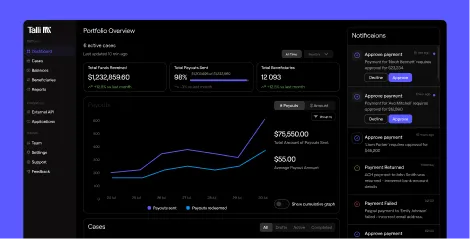
For carriers ready to eliminate the hidden costs of uncashed checks while improving policyholder experiences, Talli offers the last mile of regulated payouts: track every payment in real time, automate reconciliation, and reduce customer-service inquiries with complete transparency.
Frequently Asked Questions
How does ERISA preemption affect unclaimed insurance payments for self-funded plans?
ERISA preemption can affect how state unclaimed-property laws apply to self-funded employee benefit plans, but the treatment depends on the type of plan, applicable law, and plan documents. DOL Field Assistance Bulletin 2025-01 specifically provides temporary enforcement relief for ongoing pension plans that voluntarily transfer qualifying retirement benefits of $1,000 or less to eligible state unclaimed-property funds. It should not be treated as a general rule for self-funded health or other welfare-plan claim payments. This distinction between ERISA and state law creates complexity requiring sophisticated compliance systems.
What triggers an escheatment audit and how far back can states investigate?
State comptrollers can initiate escheatment audits based on complaint triggers, routine compliance reviews, or data matching that identifies potential unreported property. Audit lookback and record-review periods vary by jurisdiction, but examinations can reach many years into historical payment records, making complete documentation important. States increasingly require insurers to search the Death Master File at varying intervals, and failure to demonstrate compliance can trigger expanded investigations. Maintaining comprehensive, audit-ready documentation from the moment of payment issuance through final resolution is essential for defending against regulatory scrutiny.
How do digital payments reduce fraud compared to paper checks?
Paper checks create multiple fraud vulnerabilities: mail theft, check washing, signature forgery, and counterfeit reproduction. Digital payments eliminate physical document exposure while adding layers of verification. Push-to-debit transactions, for example, require recipient identity verification before funds transfer and cannot be intercepted during delivery. AI-powered fraud detection systems can identify suspicious patterns, such as device fingerprinting, behavioral analytics, and velocity checks, that would be impossible to detect with paper processes. With significant check fraud losses in recent years despite declining check usage, the security advantage of digital methods continues to grow.
How long does implementation typically take for digital disbursement platforms?
Implementation timelines depend on integration complexity and organizational readiness. No-code dashboard deployments can launch within days for carriers seeking immediate improvement without system integration. Low-code API implementations typically require 2-6 weeks with vendor-assisted setup, including connection to existing claims management systems and configuration of approval workflows. Full enterprise deployments with custom workflows, multiple TPA integrations, and legacy system migration may extend to 3-6 months. Most carriers achieve ROI within an estimated 4-7 months through reduced processing time, lower exception rates, and penalty avoidance.
What happens to funds that have already escheated to state governments?
Once funds escheat to state unclaimed property divisions, carriers lose direct control over reconnecting those funds with rightful owners. Recipients generally must file claims with the appropriate state unclaimed-property program and provide documentation establishing identity and ownership, which can add time and administrative friction. Official state programs do not charge owners a fee to search for or claim their property. For carriers, escheated funds represent permanent loss of customer relationship opportunity and potential reputational damage when claimants discover their payments were surrendered to the state. Proactive digital disbursement strategies that achieve high redemption rates before dormancy periods expire are the only effective prevention.