.svg)


.svg)
Here's a startling reality: class action claim participation rates routinely linger in the single digits - often below 10%, and in many cases under 1% (Mayer Brown). Over 90% of settlement money goes unclaimed on average, with billions of dollars ending up idle or reverting to defendants rather than reaching victims.
Even in settlements where payouts are automatically mailed, approximately 15-20% of paper settlement checks go uncashed (Federal Reserve). In 2024 alone, over $42 billion was paid out in class action settlements (NERA Economic Consulting), yet most claimants never receive those funds due to outdated distribution infrastructure.
However, it doesn't have to remain this way. Digital solutions present a compelling opportunity to reignite the justice of the class action system.
The Three Barriers That Make Settlements Vanish
The Mailbox Lottery
Approximately 12% of Americans move every year (U.S. Census Bureau), so checks mailed to addresses from years-old class lists often miss their intended recipients. Those that do arrive face another obstacle: many class members don't open or trust mail about settlements (KCC). Years after a purchase or transaction, an unexpected "legal settlement" check may look like a scam.
Even when claimants receive and trust their checks, they face strict 90 or 180-day expiration dates (CFPB). Miss that narrow window, and the payment becomes obsolete. This creates a perfect storm: outdated addresses, lost mail, distrust, and tight deadlines conspire to ensure a large portion of settlements never reach claimants.
The Banking Access Gap
The unbanked face an even harsher reality. About 4-5% of U.S. households (over 5 million) are completely unbanked, with another 14% (19 million households) underbanked (FDIC). For these claimants - disproportionately the same low-income populations most represented in class actions - receiving a paper check means paying someone else to cash it.
Check-cashing services charge 5% to 8% of the check's value (GOV UK). A $500 settlement check costs about $20 just to access. In some states, cashing a $1,000 check costs $50-$120 in fees. The people who can least afford these fees end up sacrificing part of their settlement to predatory financial services - or never cashing the check at all.
The Administrative Nightmare
But it’s not just recipients… Behind the scenes, administrators struggle with an equally broken system. Tracking tens of thousands of payments through spreadsheets is slow and error-prone, with human error inevitable at such volume. Paper checks are the payment method most prone to fraud - 63% of organizations reported check fraud incidents in 2024 (AFP).
The costs pile up quickly. Issuing a single check averages $7.78, often exceeding $20 when factoring in printing, mailing, staff time, and bank fees (Tribunal Business News). Every uncashed check triggers more work: reminders, reissuance, eventual escheatment. Compliance complexity adds another layer - generating thousands of 1099 forms manually is tedious and error-prone, while unclaimed property laws vary by state, creating potential fines of tens or hundreds of thousands of dollars per incident (NAUPA; Delaware UUPA).
Why This Matters Beyond the Numbers
When large numbers of class members never receive compensation, the court-approved settlement fails its fundamental purpose. Courts increasingly demand detailed post-distribution accounting showing who got paid, how many checks bounced or went stale, and what happened to leftovers.
Judges now scrutinize settlements with low participation and have even reduced attorneys' fee awards when actual benefit to the class seemed lackluster (Pearson v. NBTY). Low take-up rates damage firm credibility and erode public confidence in the class action system as a tool for justice.
The Digital Solution Already Exists
While legal settlements remain stuck with paper checks, the rest of the world has gone digital. The gap between outdated settlement distribution and modern payment expectations has never been wider - or more solvable.
Digital payment platforms achieve success rates around 98%, compared to only 77% for traditional mailed checks (PayQuicker; Checkbook.io). When given the option, over 91% of claimants choose electronic payment methods (PYMNTS).
Modern platforms, like Talli, eliminate the mailbox lottery through multi-channel engagement - email, text notifications, and secure online portals. Smart multi-channel outreach yields significantly higher engagement than single-channel notices (Braze). Claimants receive secure links to branded settlement portals where they verify identity, see their award, and choose how to receive payment - all in a guided digital process that feels familiar and trustworthy.
Modern platforms also offer ACH direct deposit, virtual prepaid debit cards for the unbanked, digital wallet transfers (PayPal, Venmo, Apple Pay), and paper checks as a last resort - this payment flexibility solves the banking access problem and allow entirely unbanked people to receive money.
Digital platforms also compress distribution timelines from weeks to days (The Clearing House). This acceleration drives approximately 30% higher participation when distribution moves to digital methods (Talli). When payments flow quickly, claimants don't lose interest or forget during long delays. SMS text reminders with open rates above 90% (Twilio) can nudge claimants into action with direct links to claim forms.
How Talli Transforms Settlement Distribution
Talli was purpose-built to bridge the gap between court settlements and claimants by removing every friction point. Rather than simply processing payments, Talli operates as a complete legal settlement platform that handles everything from claimant outreach to compliance reporting.
Starting with the mailbox lottery problem, the platform tackles unreliable mail by engaging claimants through modern, multi-channel communication. Each class member can be reached via email and text in addition to mail if needed. Digital outreach means contact information updates in real-time - if an email bounces, administrators know immediately and can try alternate methods. Claimants can update their preferred contact information during the process, keeping the pipeline current instead of relying on years-old data.
Once claimants are successfully reached, the next barrier is banking access. Talli's comprehensive payment options - including virtual prepaid cards and digital wallet transfers - ensure that having a bank account is optional, not required. Each recipient selects the payout method that works for them, leading to higher satisfaction and faster redemption. An unbanked person who might never cash a check will absolutely use a prepaid card they can spend immediately.
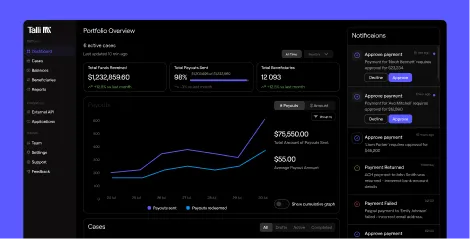
While claimants experience this streamlined front-end process, Talli simultaneously transforms the administrative nightmare on the back end. Every payment is tracked in real-time through a dashboard showing status - pending, completed, redeemed, expired - without manual updates. Using digital distribution has reduced time spent on reconciliation and reporting by approximately 70% (Talli.ai). Built-in fraud prevention automatically conducts OFAC checks during onboarding and before payments go out, while AI-powered fraud detection monitors distributions for suspicious patterns in real-time, dramatically reducing manual intervention. Seamless tax compliance means the platform automatically tallies who crossed the $600 threshold and produces 1099 forms at year-end.
Perhaps most importantly, this automation doesn't create a black box - it creates unprecedented transparency. Real-time visibility enables proactive management. Administrators can see how many people have opened email notices, selected payment methods, completed payments, or remain pending. If take-up rates are lower than expected at any stage, administrators know early and can trigger reminders, deploy targeted outreach, or investigate specific subgroups not responding. This transparency builds trust with courts and counsel while enabling tactical adjustments to maximize redemption rates.
The Measurable Impact
The results are dramatic. Settlement administrators using Talli have compressed distribution timelines from six weeks to just 2 days while simultaneously increasing take-up rates by over 30%. Digital payments cost only $0.25-$0.75 per transaction versus $1-$2+ for paper checks, with law firms seeing 40-60% cost reductions when claimants choose electronic options.
Courts are demanding higher participation rates and real-time transparency (Rule 23(e) amendments). Claimants expect banking-app convenience. The technology to deliver both exists today - and early adopters are already seeing the difference.
For law firms and claims administrators, the choice is clear: continue with outdated processes that leave many settlements unclaimed, or embrace digital infrastructure that ensures justice actually reaches the people it's meant to serve.
Every claimant deserves the easiest path to their compensation. Your firm deserves the most efficient path to successful distribution. A settlement isn't truly settled until everyone is paid - and modern platforms like Talli make that goal achievable, every time.
Ready to transform your settlement distribution outcomes? Discover how Talli's digital-first platform eliminates the friction points that cause low take-up rates while automating compliance and reducing administrative costs by up to 70%.