.svg)


.svg)
Comprehensive data compiled from extensive research on anti-money laundering compliance, enforcement trends, and disbursement operations in legal settlements
Key Takeaways
- AML enforcement has reached unprecedented levels – Total BSA/AML penalties hit $3.3 billion in 2024, representing a 48% increase in enforcement actions year-over-year, with regulators no longer tolerating compliance gaps regardless of institution size
- SAR filing volumes continue their dramatic surge – Institutions filed 4.6 million Suspicious Activity Reports in FY2023, with fraud accounting for 52% of all reports and filings representing a 51.8% increase since 2020
- AI adoption is transforming AML efficiency – Organizations using AI achieve up to 70% reduction in false positives, potentially unlocking $23.4 billion in US savings alone as adoption rates accelerate across the industry
- Settlement disbursements face growing fraud exposure – With $3 billion disbursed in Q4 2024 alone across 38 class action cases and synthetic identity fraud up 37% year-over-year, claims administrators require robust fraud mitigation built into their payout infrastructure
- Smaller institutions face disproportionate enforcement risk – 54% of 2024 BSA/AML enforcement actions targeted banks under $1 billion in assets, indicating compliance requirements apply regardless of organization size
- The cost of fraud extends far beyond direct losses – For every $1 lost to fraud, institutions spend an additional $4.04 addressing the issue, making prevention through platforms with built-in KYC, OFAC, and fraud mitigation capabilities far more economical than remediation
Global AML Market Size and Compliance Costs
1. Global AML software market growing at 12.7% CAGR through 2031
The anti-money laundering software market continues rapid expansion as institutions invest heavily in compliance technology. This growth reflects increasing regulatory pressure and the complexity of modern financial crime. Claims administrators handling settlement disbursements benefit from platforms that integrate AML capabilities directly into payment workflows rather than bolting on separate compliance tools. Source: Finance Yahoo
2. Global AML system spending projected to reach $51.7 billion by 2028
Annual spending on AML systems worldwide will hit $51.7 billion within three years, driven by regulatory requirements and evolving fraud tactics. This investment level demonstrates that compliance is no longer optional—it's a fundamental operational requirement. Organizations that fail to invest adequately face both regulatory penalties and increased fraud exposure. Source: Lucinity Blog
3. Financial institutions spend $206 billion annually on financial crime compliance
The staggering annual cost of financial crime compliance highlights why efficiency matters. Traditional manual processes consume resources that could otherwise support core business activities. Modern legal payout platforms with automated compliance checks can dramatically reduce this burden while maintaining regulatory standards. Source: Flagright Blog
4. German financial institutions spent $32.5 billion on compliance in 2023
Germany's substantial compliance expenditure reflects the European regulatory environment's stringent requirements. Cross-border settlement disbursements require platforms capable of addressing multiple regulatory frameworks simultaneously, making unified compliance infrastructure increasingly valuable. Source: Fourthline Blog
Enforcement Actions and Penalty Trends
5. Total BSA/AML enforcement penalties reached $3.3 billion in 2024
Combined enforcement penalties across all institutions totaled $3.3 billion during 2024, reflecting regulators' commitment to holding organizations accountable. This figure excludes reputational damage, remediation costs, and operational disruptions that accompany enforcement actions. Organizations handling mass payouts must ensure their compliance infrastructure can withstand regulatory scrutiny. Source: Crowe LLP
6. 42 BSA/AML enforcement actions issued in 2024 versus 29 in 2023
Enforcement action volume increased 45% year-over-year, indicating regulators are expanding their enforcement footprint. This trend suggests organizations previously below regulatory radar now face meaningful compliance examination risk. Source: Crowe LLP
7. 54% of 2024 BSA/AML enforcement actions targeted banks under $1 billion in assets
Smaller institutions faced the majority of enforcement actions, dispelling assumptions that regulators focus exclusively on large organizations. Settlement administrators and smaller claims operations cannot assume their size provides regulatory protection. Source: Crowe LLP
SAR Filing Trends and Suspicious Activity Patterns
8. Financial institutions filed 4.6 million SARs in fiscal year 2023
Suspicious Activity Report filings reached 4.6 million during FY2023, averaging over 10,100 filings daily. This volume reflects both increased fraudulent activity and improved detection capabilities. Organizations with real-time monitoring dashboards can identify suspicious patterns before they escalate. Source: FinCEN Report
9. SAR filings surged 51.8% from 2020 to 2024
The dramatic increase in suspicious activity reporting reflects both rising fraud attempts and enhanced detection capabilities. Organizations that invested in advanced monitoring technology report higher detection rates without proportional staff increases. Source: Nice Actimize
10. Fraud-related SARs account for 52% of all reports
More than half of all suspicious activity reports relate to fraud, making fraud prevention central to AML compliance. Settlement disbursement platforms with built-in fraud mitigation capabilities address this dominant risk category directly. Source: Nice Actimize
11. Top 10 SAR filers account for 48% of all FY23 filings
Concentration among major filers indicates that large institutions generate disproportionate reporting volumes. However, smaller organizations face the same compliance obligations and must maintain proportionate capabilities. Source: FinCEN Report
Operational Cost Burden and Efficiency Metrics
12. 98% of institutions reported compliance costs increased over the prior year
Nearly universal cost increases demonstrate that compliance expenses continue rising across the industry. Organizations seeking to control costs must find efficiency gains through automation and process optimization rather than reducing compliance activities. Source: Flagright Blog
13. Compliance averages 19% of annual revenue for financial firms
When compliance consumes nearly one-fifth of revenue, efficiency becomes critical to organizational viability. Platforms that automate compliance workflows while maintaining accuracy enable organizations to redirect resources toward core mission activities. Source: Flagright Blog
14. Organizations spend $4.04 addressing every $1 lost to fraud
The 4:1 cost multiplier for fraud remediation makes prevention far more economical than response. Platforms with OFAC screening and fraud mitigation built into disbursement workflows prevent losses before they occur. Source: LexisNexis
15. Large banks spend over $200 million annually on compliance
Major financial institutions with over 20,000 employees dedicate massive budgets to compliance, representing approximately 2.9% of non-interest expenses. Settlement administrators benefit from platforms that deliver enterprise-grade compliance without enterprise-scale costs. Source: Fourthline Blog
16. Small banks spend 8.7% of non-interest expenses on compliance
Smaller institutions face proportionally higher compliance burdens relative to their resources. This disparity makes efficient compliance technology essential for smaller claims administrators competing with larger operations. Source: Fourthline Blog
AI Technology Impact and Adoption Trends
17. AI-driven compliance reduces false positives by up to 70%
Artificial intelligence dramatically improves compliance accuracy by reducing false positive rates that consume investigator time. Fewer false alerts mean faster processing and lower operational costs while maintaining detection effectiveness. Talli's AI-driven payment platform leverages these capabilities to streamline fund distribution while maintaining rigorous compliance standards. Source: Lucinity Blog
18. US financial institutions could save $23.4 billion through AI-powered compliance
The potential savings from AI adoption in the United States alone exceed $23 billion, representing transformative efficiency gains. These savings derive from reduced manual review requirements, faster processing, and improved accuracy. Source: Fourthline Blog
19. German firms could save $14.2 billion through AI-powered AML solutions
European institutions stand to gain similarly substantial benefits from AI adoption. The global nature of these potential savings indicates AI-powered compliance represents an industry-wide transformation rather than a regional trend. Source: Fourthline Blog
Fraud Typology and Emerging Threats
20. Synthetic identity fraud increased 37% year-over-year
Synthetic identity fraud—using fabricated identities combining real and fake information—represents the fastest-growing fraud category. Claims administrators must implement identity verification capabilities that can detect synthetic identities attempting to fraudulently claim settlement funds. Source: Nice Actimize
21. Elder financial abuse SARs jumped 9.7% to 171,233 in 2024
Vulnerable population exploitation continues rising, with elder financial abuse reports nearly tripling from 72,173 in 2021 to over 200,000 expected in 2024. Settlement administrators handling payouts to elderly claimants must implement appropriate safeguards. Source: Nice Actimize
22. Identity theft maintains 27.1% share of all fraud reports
More than one-quarter of fraud reports involve identity theft, making identity verification essential for disbursement security. Platforms with KYC capabilities integrated into claimant verification workflows address this dominant fraud vector. Source: Nice Actimize
23. Nearly 2 million money mule accounts reported globally in 2024
BioCatch received reports of almost 2 million money mule accounts from 257 financial institutions across 21 countries. Money mules—often unwitting participants in money laundering schemes—represent a growing challenge for legitimate disbursement operations. Source: BioCatch Press Release
Settlement Disbursement and Legal Payout Volumes
24. Securities class actions settled for $1.4 billion in Q4 2024
Thirty-one securities class action cases settled during Q4 2024, generating substantial disbursement requirements. These settlement volumes require disbursement infrastructure capable of processing high volumes while maintaining compliance. Source: FRT Services
25. $3 billion disbursed to claimants across 38 cases in Q4 2024
Quarterly disbursement volumes reaching $3 billion demonstrate the scale of settlement administration requirements. Platforms designed for high-volume payouts with complete fund segregation ensure these substantial sums reach legitimate claimants efficiently and securely. With Dell and Wells Fargo settlements accounting for roughly two-thirds of Q4 distribution volume, the industry clearly requires infrastructure capable of handling concentrated large-scale disbursements. Source: FRT Services
How Talli Addresses AML Compliance in Settlement Disbursements
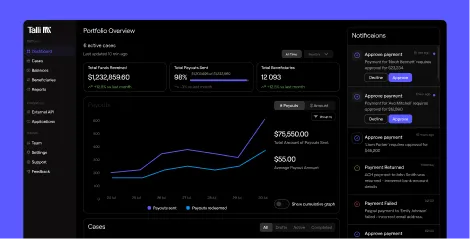
Claims administrators face unprecedented compliance complexity as enforcement intensifies and fraud tactics evolve. Talli's disbursement platform addresses these challenges through integrated compliance infrastructure that eliminates the need for separate bolt-on solutions. Built-in KYC verification, OFAC screening, and AI-powered fraud detection work seamlessly within disbursement workflows, reducing false positives while maintaining detection accuracy.
Complete fund segregation through dedicated settlement accounts preserves Qualified Settlement Fund ownership while simplifying regulatory reporting. Real-time monitoring dashboards provide immediate visibility into payout status, completion rates, and suspicious pattern detection. This comprehensive approach addresses the $206 billion global compliance cost burden by delivering enterprise-grade capabilities without enterprise-scale expenses, making sophisticated AML compliance accessible to settlement administrators of all sizes.
Frequently Asked Questions
What is the primary goal of AML compliance in disbursement operations?
AML compliance in disbursements prevents settlement funds from being diverted through fraudulent claims, money laundering schemes, or sanctioned party payments. Effective AML programs verify claimant identities, screen against OFAC watchlists, and monitor transaction patterns for suspicious activity. These safeguards protect both the integrity of settlement funds and the administrators responsible for their distribution.
How does AI enhance AML efforts in financial disbursements?
AI improves AML effectiveness by reducing false positive rates by up to 70% while maintaining detection accuracy. Machine learning algorithms identify suspicious patterns that rule-based systems miss, process transactions faster than manual review, and adapt to emerging fraud tactics. With potential savings exceeding $23 billion in the United States alone, AI-powered compliance is rapidly becoming standard practice.
What specific compliance measures should settlement administrators implement?
Settlement administrators should implement integrated KYC verification, OFAC screening, W-9 collection, and ongoing transaction monitoring. Complete fund segregation through dedicated accounts for each settlement preserves Qualified Settlement Fund ownership while simplifying regulatory reporting. Audit logs documenting all compliance activities protect administrators during regulatory examinations.
Why is fund segregation important for AML in legal settlements?
Fund segregation maintains clear ownership boundaries between settlement funds and operational accounts, preventing commingling that complicates compliance reporting. Dedicated accounts for each settlement simplify audit trails, ensure accurate fund flow documentation, and demonstrate regulatory compliance. This separation also protects claimants by ensuring their funds remain isolated from operational risks.
How can organizations improve fraud detection in settlement disbursements?
Organizations improve fraud detection by implementing multi-layered verification combining identity confirmation, device intelligence, and behavioral analytics. Real-time monitoring dashboards enable immediate response to suspicious patterns before funds leave organizational control. Platforms with fraud mitigation built into disbursement workflows prevent losses more economically than post-incident investigation and recovery efforts.