.svg)


.svg)
Preventing bad account data, giving claimants fallback payout options, and routing exceptions through one audited workflow is the strongest way to handle ACH returns in mass tort distributions. ACH returns are failed ACH payments sent back by the receiving bank instead of posting to the claimant's account. In mass tort distributions, they create support, reconciliation, compliance, and reissue work long before the bank fee becomes the main issue.
In 2026, that pressure is rising because ACH is standard settlement infrastructure, not a side rail for edge cases. Nacha ACH data shows the ACH Network processed 33.6 billion payments worth $86.2 trillion in 2024. Same Day ACH alone handled more than 1.2 billion payments worth $3.2 trillion. Faster settlement helps claimants, but it also means failed ACH transfers surface quickly and force teams to remediate them inside a compliance-critical workflow.
For settlement teams, the operational question is not just whether ACH worked. It is whether the disbursement workflow can preserve claimant choice across ACH, prepaid Mastercard, PayPal, Venmo, and gift cards; document KYC verification, OFAC screening, W-9 collection, and 1099 generation; and maintain full audit transparency through real-time dashboards, segregated QSF-compliant accounts, and banking services provided by Patriot Bank, N.A., Member FDIC.
ACH returns in mass tort distributions create hidden costs in claimant support, exception handling, compliance review, and final accounting. The strongest response is not repeated retries. It is better account validation, claimant choice across payout rails, and a single audited workflow for remediation.
Key Takeaways
- Returned ACH payments are not just bank rejects. In mass tort distributions, they often create additional claimant follow-up, payout rework, reconciliation updates, and reporting work.
- Nacha 2024 ACH data shows 33.6 billion ACH payments worth $86.2 trillion in 2024, with Same Day ACH volume up 45.3% year over year.
- Settlement teams usually care about returned ACH credits, not consumer debit disputes, so generic ACH content often misses the real operating problem.
- The FDIC survey found that 5.6 million U.S. households were unbanked and about 19.0 million were underbanked in 2023, which is one reason ACH-only payout programs can leave preventable exceptions.
- A failed ACH transfer often costs more in internal labor than any ACH return fee because one exception can touch support, compliance, finance, and final accounting.
- The strongest control is not endless retry logic. It is claimant choice, account validation, and a documented fallback path inside one audited workflow.
What Are ACH Returns?
ACH returns are payment entries a receiving bank sends back through the ACH network when a claimant's direct-deposit transfer cannot post as submitted. In settlement payout work, that usually means the payment failed after release because the account was closed, the account details were wrong, the account could not be located, or the credit was refused.
This distinction matters because mass tort programs mostly originate ACH credits to claimants, not recurring consumer debits. Many general ACH guides focus on merchant collections, unauthorized debits, and NSF scenarios. Those issues matter elsewhere, but the operational pain for settlement teams is usually different.
Common mass tort ACH return causes include:
- the claimant's bank account is closed
- the routing or account number is wrong
- the account cannot be located by the receiving bank
- the receiving institution refuses the credit
- the claimant needs to move to another payout rail
- the administrator needs to preserve a complete exception record
ACH speed changes the risk profile. The substantial majority of ACH credits settle in one banking day or less, according to Nacha timing guidance. Faster delivery improves claimant experience, but it also gives teams less time to manage exceptions with spreadsheets, emails, and disconnected treasury portals. A workflow built for paper-check reissue cycles often struggles when ACH returns appear within one or two banking days.
Why Teams Manage ACH Returns the Hard Way
Teams end up managing ACH returns the hard way when early payout-design choices create predictable exceptions that later spread across support, finance, and compliance. Payout decisions that look reasonable at launch can still create avoidable returns later.
Common examples include:
- ACH as the only payout rail
- no pre-validation on claimant-entered banking details
- stale claimant payment elections
- fragmented claimant support
- manual reissue approvals
- payout records that live outside the main ledger
- multi-rail payouts that are offered but not connected to reconciliation
Risk becomes more visible at scale. A small number of bad account records may be manageable in a low-volume distribution. In a mass tort program with tens of thousands of claimants, closed accounts, invalid account numbers, and stale claimant data can become a program-level operating problem. The issue is not just that ACH returns happen. The issue is whether the team can see them, route them, document them, and resolve them without losing control of the payout record.
Claimant population also matters. The FDIC household survey found that 5.6 million U.S. households were unbanked and about 19.0 million were underbanked in 2023. It also found that 20.1% of unbanked households used nonbank online payment services and 21.6% used prepaid cards. For mass tort teams, this is a practical reason to avoid ACH-only design. Unbanked claimant data reinforces why payout choice is not just a convenience feature. It is a control against preventable exceptions.
Why ACH Returns Hurt Mass Torts
ACH returns hurt mass tort distributions because every failed payment creates both a recipient problem and a fiduciary recordkeeping problem. The transfer did not just fail. It created a live exception inside a court-sensitive payout workflow.
The claimant needs to know what happened. The administrator needs to know whether the funds returned, whether a replacement payment is permitted, whether compliance checks need to be refreshed, and how the event will appear in final accounting. Support, finance, compliance, and counsel may all touch the same failed payment.
Volume context explains why this matters. Nacha reported 7.3 billion B2B ACH payments in 2024, up 11.6% year over year, while Same Day ACH crossed more than 1.2 billion payments. As more legal and administrative payouts move to electronic rails, mass tort payouts need to move faster without losing control over evidence, approvals, claimant communication, and fund status.
Claimant mix adds another layer. A portion of claimants will not have reliable direct-deposit access, will change banks, or will prefer a nonbank option they already use. If the workflow forces ACH as the only option, exceptions are built into the design before the first file is sent. If the workflow supports multiple rails and keeps all payment events attached to one record, ACH returns become manageable exceptions rather than open-ended recovery projects.
How We Evaluated ACH Return Risk
We evaluated ACH return risk in 2026 by measuring how well teams prevent avoidable failures before release and contain exceptions after release. The strongest programs manage ACH returns as an operations-control issue, not just a treasury issue.
ACH-only payout programs create the most avoidable exceptions because they give claimants no clean fallback path when direct deposit fails. Stronger teams treat returned ACH credits as part of the settlement distribution lifecycle. That means the original payment, return code, claimant outreach, corrected election, compliance review, and replacement payout stay linked in one record.
This distinction matters during closeout. If returned funds, replacement payments, and unresolved claimant statuses are scattered across email, spreadsheets, banking portals, and support tickets, the final accounting process becomes slower and harder to defend. A cleaner workflow reduces exception volume and preserves the chain of evidence.
Which ACH Return Codes Matter Most?
The ACH return codes that matter most are the ones tied to bad account data, closed accounts, and refused credits. Those are the codes that turn a direct-deposit plan into a claimant-recovery workflow.
For mass tort distributions, settlement teams should recognize these codes first:
- R02: The claimant's account is closed, so the payment must move to corrected details or another rail.
- R03: The bank cannot locate the account, which usually means the claimant entered unusable account information.
- R04: The account number structure is invalid, so the data needs correction before any new attempt.
- R23: The ACH credit was refused, making fallback payout choice and documented remediation the priority.
- R17: The receiving bank flagged the entry as questionable or invalid under specific circumstances, so the payment should be escalated for review.
The main lesson is simple. Once these codes appear, the goal should be failed payments remediation, not repeated hope-based retries. R23 should be treated as a code-driven exception that requires prompt claimant remediation, not blind retry logic. Nacha’s sanctions-specific return-code update is separate and applies to R90 beginning in 2028, so it should not be used as the source for R23 guidance.
How Failed ACH Transfers Create Hidden Cost
Failed ACH transfers create hidden costs because the bank return is only the first event in a longer operational chain. The ACH return fee may be visible on a statement, but the larger cost usually sits in labor, remediation, and delayed closeout.
In mass tort distributions, the hidden-cost stack usually includes:
This is why the phrase ACH return fee can be misleading. Banks or processors may assess a fee, and those charges vary by provider relationship. In settlement operations, internal labor is usually the larger burden. A return can trigger manual review, fresh claimant contact, approval queues, updated audit evidence, and a second payout event that must still reconcile to the QSF ledger.
Returned ACH credits deserve the same operating discipline as stale checks, even though they fail faster. The difference is timing. A stale check may sit unresolved for weeks or months. A failed ACH transfer can surface quickly and still create the same recordkeeping obligation. Faster failure is only helpful if the workflow can absorb it.
Why Claimant Payouts Fail
Claimant ACH payouts fail for a small set of repeatable reasons, and most of them are preventable before settlement funds move. The mistake many teams make is treating every return as random when the pattern is usually visible in the data.
Common causes include:
- The claimant keyed in the wrong routing or account number.
- The claimant changed banks after providing payment details.
- The account was closed between election and distribution.
- The claimant chose ACH even though another rail fit better.
- The team had no way to validate account details before release.
- The claimant could not fix the problem inside the same workflow.
- Support and finance were working from different records.
Banking-access data matters here. The FDIC found millions of unbanked and underbanked households in 2023, along with substantial use of nonbank online payment services and prepaid cards. In a mass tort context, that means payout choice is not just about convenience. It reduces preventable payout failures by matching claimants to the rail they are most likely to complete successfully.
That is why claimant options should be evaluated before launch, not after returns appear. If a claimant cannot complete ACH cleanly, the workflow should guide them into another supported method without requiring disconnected emails, manual forms, or separate finance approvals.
ACH Returns vs. ACH Reversals
ACH returns and ACH reversals are different events, and mass tort teams should not treat them as interchangeable fixes. A return means the receiving side could not or would not accept the entry. A reversal is a corrective entry initiated by the sender to undo an erroneous transaction.
That difference matters operationally. If a claimant typed the wrong account number and the receiving bank returned the credit, the team is dealing with an ACH return and must follow a return-code workflow. If the settlement team itself sent an erroneous entry, Nacha’s reversal rule says an Originator or ODFI must transmit a reversal so it is made available to the RDFI within five banking days following the settlement date of the erroneous entry.
Settlement teams need to know when to:
- remediate a returned credit
- initiate a permitted reversal
- freeze reissue activity pending review
- preserve the chain of events for later reporting
- escalate questionable entries for legal or compliance review
This distinction becomes especially important when large claimant groups are paid in batches and an error affects more than one record. A returned payment is usually a claimant-level exception. An erroneous file or duplicate entry may become a batch-level issue with broader reconciliation and approval implications.
How Teams Should Respond to Failed ACH Transfers
A code-specific exception workflow is the right response to a failed ACH transfer because it protects claimant experience, reconciliation, and compliance evidence. Fast remediation matters, but unstructured remediation creates a second layer of risk that real-time tracking is designed to reduce.
For mass tort distributions, a workable response sequence looks like this:
- Capture the return code and map it to the correct remediation path.
- Lock the payment into a documented exception queue.
- Notify the claimant with a short explanation and next step.
- Verify whether ACH should be corrected or replaced with another rail.
- Re-run required controls before a new payout is released.
- Keep the original payment, return event, and replacement decision attached to one ledger record.
- Review return patterns before the next batch is released.
Earlier visibility shortens claimant confusion, reduces support tickets, and gives administrators more time to resolve the issue before post-distribution accounting or redistribution planning begins. The key is not just speed. It is controlled speed, where every correction and replacement payment is visible, approved, and tied to the original claimant record.
Tools and Solutions for ACH Exceptions
Effective ACH-exception tools combine claimant choice, regulated payout rails, and full audit transparency so failed transfers can be corrected without breaking the broader payout workflow. For settlement teams, the real question is whether the operating model keeps ACH exceptions, claimant communication, compliance review, and ledger evidence inside one digital claims disbursement workflow instead of scattering them across treasury portals, spreadsheets, and email.
Strong ACH exception handling requires:
- claimant choice across ACH, prepaid Mastercard, PayPal, Venmo, and gift cards
- a claimant portal that lets recipients correct details or switch rails
- compliance-critical controls for KYC, OFAC screening, W-9 collection, and 1099 generation
- real-time dashboards for support, finance, counsel, and claims teams
- segregated QSF-compliant accounts
- banking services provided by Patriot Bank, N.A., Member FDIC
- one ledger record for the original payment, return, correction, and replacement
Talli for ACH Exceptions
Talli supports ACH, prepaid Mastercard, PayPal, Venmo, gift cards, wire transfers, and paper check fallback, with pricing based on program scope. Talli’s fit is strongest when the legal or claims team needs more than delivery speed. It is built for regulated payout workflows where claimant communication, payment choice, compliance evidence, and final accounting all need to stay connected.
Instead of forcing the team to treat ACH as the only payout rail, Talli supports ACH alongside other claimant-friendly options. That creates a cleaner fallback path when a claimant’s direct-deposit details fail. It also helps teams reduce repeat exceptions by matching the claimant to a rail they can actually complete.
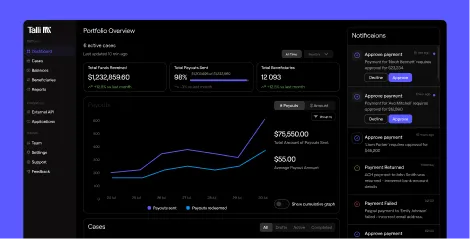
Talli’s platform emphasizes compliance-critical controls such as automated verification workflows, OFAC screening, segregated QSF-compliant accounts, W-9 collection, 1099 generation, and real-time dashboards. For teams that need defensible records, that is a meaningful difference. A returned ACH credit can be tracked through claimant outreach, reissue decisions, and settlement reconciliation without breaking the chain of evidence.
Talli has processed payments for more than 500,000 recipients and reports redemption rates 30% higher than traditional methods. It is designed to help claims teams launch and fund campaigns in days rather than months, scaling from thousands to hundreds of thousands of recipients while maintaining transparency over completion rates and fund flows.
Key Features
- Multi-rail claimant payouts across ACH, prepaid Mastercard, PayPal, Venmo, gift cards, wires, and check fallback
- Claimant portal workflows that turn failed payments into guided remediation
- Automated KYC, OFAC screening, W-9 collection, and 1099 generation
- Real-time dashboards and full audit transparency
- Segregated QSF-compliant accounts with banking services provided by Patriot Bank, N.A., Member FDIC
- Payment-status synchronization for reconciliation and reporting
Operational Fit
Talli is strongest for claims administrators, legal operations teams, bankruptcy trustees, and settlement programs that need ACH to operate as one part of a broader digital disbursement workflow. It is especially well matched to matters where claimant choice, remediation visibility, QSF controls, and full audit transparency carry as much weight as payment speed.
Pricing
Talli uses custom pricing rather than a public self-serve fee table. For most teams, the practical cost question is not the nominal ACH return fee. It is whether the platform lowers claimant chasing, manual exception handling, and reconciliation overhead enough to improve redemption and reduce settlement administration time.
Best Practices for ACH Returns in Mass Torts
Strong mass tort ACH programs reduce returns before release and contain them cleanly after release. The goal is not to have zero exceptions. The goal is a workflow where exceptions stay small, visible, and recoverable.
Best practices include:
- Validate bank details before initiating live payouts.
- Offer at least one non-ACH fallback for claimants who are unbanked or underbanked.
- Use claimant communications that explain the next step in plain language.
- Separate returned, reissued, and completed statuses in one ledger.
- Tie replacement payouts to the original record for full audit transparency.
- Re-check compliance-critical controls before any reissue.
- Review return patterns by code so the next batch improves.
- Keep counsel-facing documentation attached to the payment record.
Broader network trends support this discipline. Nacha 2024 ACH data shows Same Day ACH volume grew 45.3% in 2024. Faster rails reward teams that design for prevention rather than cleanup. ACH can move quickly, but a fast payment rail is only useful when the exception workflow is equally controlled.
Common Mistakes With ACH Returns
Most ACH return mistakes come from treating failed transfers as simple payment retries instead of regulated settlement exceptions. That mindset creates duplicate work and weaker records.
Teams usually get into trouble when they:
- retry the same bad account without correcting the root cause
- keep ACH as the only recovery option
- separate support activity from payout records
- reissue funds without refreshed compliance review
- track returns in spreadsheets outside the main ledger
- wait until final accounting to explain unresolved exceptions
- use generic ACH guidance written for merchant-debit programs
Mass tort distributions are different. They are high-volume ACH credit payouts attached to claimant identity, QSF accounting, support obligations, and court-facing reporting. A workflow built for generic commerce returns will not be enough for many legal teams. They still need to show why a claimant payment failed, what happened next, and where the funds went afterward in QSF-ready reporting.
Talli Conclusion
Failed ACH transfers in mass tort distributions are expensive because they spread one payment problem across claimant support, reconciliation, compliance, and reporting. The visible bank return is only the starting point. The larger issue is whether the payout workflow can absorb the exception without creating claimant confusion, manual chasing, or weak audit evidence.
Mass tort teams get better outcomes when ACH is treated as one rail inside broader modern claims disbursements rather than the only option in a fragile workflow. Talli helps administrators manage ACH, fallback payout methods, claimant communication, and full audit transparency in one system built for settlement payout work.
For claims teams reviewing mass tort metrics, the strongest question is not whether ACH can send funds. It is whether the platform can document who was paid, when the payment failed, what happened next, and how the final payout record stayed complete.
Frequently Asked Questions
What is an ACH return in a settlement payout?
An ACH return in a settlement payout is a direct-deposit payment the claimant's bank sends back instead of posting to the account. In practice, it means the payout must be corrected, redirected, or replaced while the administrator preserves a clean record of the failed event.
What causes ACH returns?
ACH returns usually happen when an account is closed, account details are wrong, the bank cannot locate the account, or the credit is refused. In mass tort distributions, those failures often trace back to stale claimant data, incorrect payment elections, or an ACH-only payout design that gives the claimant no clean fallback method.
How long does it take to learn that an ACH transfer failed?
Many ACH returns become visible within one or two banking days, depending on the return reason, processing path, and receiving bank's timing. Faster visibility helps only if the settlement team has a workflow for claimant outreach, correction, compliance review, and replacement payout.
Which ACH return codes matter most?
The most important ACH return codes in settlement payout programs are usually R02, R03, R04, R23, and sometimes R17. These codes are most likely to require claimant follow-up, corrected payment details, fallback rail selection, or documented review.
How do ACH returns differ from reversals?
An ACH return starts with the receiving side because the payment could not or would not post. An ACH reversal starts with the sender to correct an erroneous payment entry. Nacha rules require reversals to be made available within five banking days following the settlement date of the erroneous entry.
What is an ACH return fee?
An ACH return fee is the charge a bank or processor may assess when an ACH payment is sent back. In mass tort distributions, that fee is usually smaller than the internal cost of claimant support, remediation, reconciliation, and compliance review triggered by the failed transfer.
Can you retry a returned ACH payment?
You should retry a returned ACH payment only after the return code is fixable and the underlying problem has been corrected. Blind retries on closed accounts, invalid account numbers, or refused credits usually create more claimant confusion and more reconciliation work than moving the claimant into a documented remediation path.
How can mass tort teams reduce failed ACH transfers?
Mass tort teams reduce failed ACH transfers by validating bank details, offering payout choice, and guiding remediation through one claimant workflow. Multi-rail options matter because millions of households remain unbanked or underbanked, and not every claimant is best served by direct deposit alone.