.svg)


.svg)
Real-time payments for settlements are most effective when they sit inside a modern claims disbursement workflow built for higher redemption, claimant choice, and fiduciary control. Talli reports 30% higher redemption rates than traditional methods, but that outcome depends on more than speed. It depends on compliance automation, verified claimant data, clear approval rules, and a release workflow that can defend every send.
That is why teams are moving beyond check-first workflows and rail-only bank pilots. For many settlement programs, the business case starts with less chasing and more redemptions, not only faster money movement. In 2026, the practical question is not whether FedNow or RTP are fast. It is whether your payout workflow can use those rails without creating a documentation gap when a court, trustee, or auditor asks why funds were released.
For fiduciaries, the strongest model combines ACH, prepaid Mastercard, PayPal, Venmo, gift cards, wire transfers, instant rails, and paper-check fallback with KYC verification, OFAC screening, W-9 collection, 1099 generation, segregated QSF-compliant accounts, banking services provided by Patriot Bank, N.A., Member FDIC, and full audit transparency. Real-time rails matter most when they improve claimant completion without weakening the evidentiary record behind each settlement payout.
Real-time payments for settlements work only when identity, sanctions, tax, and approval controls happen before release. FedNow and RTP both support 24/7/365 instant settlement, but they are separate rails and are not interchangeable. Most settlement programs still need ACH, prepaid cards, wallets, wires, or checks as fallback options. The best operating model combines instant rails with claimant choice, exception handling, and court-ready audit reporting.
Key Takeaways
- Real-time payments reduce payout lag, but they also raise the cost of weak screening, thin approval controls, and poor exception handling.
- FedNow and RTP both offer 24/7/365 instant settlement, yet they remain separate rails and are not interoperable today.
- The FedNow Service processed 8,413,402 settled payments totaling about $853.4 billion in 2025, according to Federal Reserve FedNow statistics.
- The RTP network processed 128 million payments totaling $480 billion in Q1 2026, with more than 1,200 participants as of March 2026, according to The Clearing House RTP overview.
- UCC Article 4A concepts, OFAC screening, QSF reporting, and attorney-reporting rules still affect release governance even when the payment rail settles in seconds.
- Fiduciaries need a payout matrix, not an instant-only strategy, because reachability, claimant preference, and documentation needs still vary by recipient.
Why Teams Look Beyond Check-First Workflows
Teams look beyond check-first workflows when slow delivery, weak visibility, and manual reissue work make settlement operations hard to defend. Paper-check programs create delivery lag, stale-address risk, reissues, and claimant calls. Rail-only pilots create a different problem: they prove money can move fast, but they do not solve the compliance and reporting work that makes a fiduciary release defensible.
That gap is getting harder to ignore because instant rails are no longer experimental. FedNow volume and value rose sharply in 2025, and RTP continues to process high enterprise payment volume. Teams switch when they realize the bottleneck is not just the rail. It is the manual stitching between claimant verification, OFAC checks, payout choice, tax forms, approval evidence, and release workflows.
A stronger approach starts with the operating model. A claims team should know which claimants can receive instant payments, which payments require manual review, which exceptions pause release, and which fallback rail applies when a claimant cannot receive FedNow or RTP. That same logic should appear in the audit trail, not only in a support playbook.
What Are Real-Time Payments for Settlements?
Real-time payments for settlements are instant payout instructions that move claimant funds within seconds on around-the-clock rails such as FedNow and RTP. They work best only after identity, sanctions, tax, and approval controls are complete, because the rail speeds up release but does not cure a weak settlement workflow.
That distinction matters because fiduciaries are not paying a generic invoice. They are releasing court-supervised or trust-sensitive funds, often from a Qualified Settlement Fund, to recipients who may need different documentation, payout choices, or exception handling. A strong QSF checklist keeps those controls sequenced before any funds move.
The rail can accelerate valid payments, but it does not replace claimant verification, OFAC review, tax reporting, or post-distribution evidence. In a settlement environment, speed is useful only when the release decision is already clean.
Why It Matters Now
Real-time payments now matter because they are becoming operationally relevant for large settlement programs, not just bank innovation teams. FedNow reported 8.4 million settled payments in 2025 and 2.7 million in Q1 2026. RTP reported 128 million payments in Q1 2026 alone. Those figures do not mean every claimant can receive instant funds today, but they do mean settlement teams should be ready to evaluate instant rails inside their distribution strategy.
A practical evaluation should use five audit-defensible criteria: speed, reachability, compliance readiness, implementation burden, and fallback resilience in production. A bank rail can look strong in a product demo and still fail in production if onboarding, integration, exception handling, or reporting exports are weak.
The better question is not “Which rail is fastest?” The better question is “Which release path gets a verified claimant paid while preserving the record a fiduciary will need later?”
FedNow vs RTP for Settlement Disbursements
FedNow and RTP both support instant settlement disbursements, though they use separate network rails with different participation footprints and operating models. For fiduciaries, the decision is usually less about which rail is better and more about which rail is reachable for the claimant, supportable by the bank stack, and governable inside the approval workflow.
Snapshot Comparison
For settlement teams, the practical conclusion is straightforward: real-time payments for settlements should follow claimant reachability, bank readiness, and evidence controls, not marketing language about faster money movement. RTP currently looks more proven for high-volume enterprise sends. FedNow looks attractive for institutions that want Federal Reserve connectivity and a network still adding participants, service providers, and public-sector use cases.
Why Real-Time Payments Change Risk
Real-time payments change fiduciary risk because payment finality arrives faster than manual review can recover from a bad release. Under UCC Article 4A principles, commercially reasonable security procedures and good-faith acceptance can affect responsibility for payment orders. For fiduciaries, that means maker-checker controls, approval thresholds, and account-authentication standards need to be written and testable before a real-time rail goes live.
Speed trends reinforce the point. As instant rails become normal, counterparties will expect more than proof of send. They will expect a defensible record of why the payment should have been sent at all. That is exactly what a strong fiduciary workflow should produce.
OFAC risk also gets sharper when funds move immediately. OFAC FAQ 95 says it is prudent to screen account beneficiaries upon account opening, while updating account information, during periodic screening, and upon disbursing funds. Settlement teams should apply that logic to releases, reissues, attorney-directed updates, and address changes. The safest interpretation is simple: screen before disbursement, document the result, and pause exceptions before release.
When Receive-Only Participation Is Enough
Receive-only participation is enough when an institution needs inbound instant capability before it needs outbound real-time disbursement at scale. It lets the institution learn the rail, monitor liquidity and exceptions, and refine controls before turning on outbound sends.
For settlement teams, receive-only capability is not the same as a finished claimant payout strategy. It does not solve claimant choice, release approvals, exception queues, or court-ready reporting. It can be a useful transition step, but it should not be described as production-ready disbursement capability by itself.
It is also useful when claimant-bank reachability is uneven. If a meaningful share of recipients cannot receive the chosen rail, the value of instant outbound disbursement drops quickly. A mixed-rail model gives fiduciaries better control because the workflow can route each claimant to the best available method.
How Controls Fit the Payment Flow
OFAC, KYC, QSF, and 1099 workflows belong before payment release because real-time payments leave little time to correct a weak decision. The safest release model is linear: verify the claimant, validate the account or wallet, clear OFAC screening, confirm tax treatment, approve the payout, then send the funds on the most suitable rail.
Tax and fund-administration details are just as important. Qualified Settlement Funds still need tax and distribution records. Attorney payments may require information reporting depending on the payment structure. Instant rails do not remove those duties. They make pre-release coordination more important.
A strong workflow also links the payment event back to the entitlement record. The audit trail should show the claimant record, payment method, verification status, screening result, approval timestamp, disbursement rail, transaction status, and exception history. That record is what turns a fast payment into a defensible fiduciary release.
Where Real-Time Payments Break Down
Real-time payments break down when liquidity, claimant reachability, exception handling, or documentation quality are weaker than the rail’s speed. None of those issues means a fiduciary should avoid instant payout options. They mean the release model needs boundaries.
One boundary is value. FedNow and RTP both support a $10 million transaction limit, but higher limits increase the importance of dual authorization, escalation rules, and exception logging. A payment that can move instantly should not be released casually.
Another boundary is reversibility. Once a settlement payout is released on an instant rail, there is far less room for downstream remediation than with slower methods. A third boundary is fallback design. If a claimant fails screening, cannot receive the selected rail, or needs paper documentation for trust or probate reasons, the program still needs a documented failed-payment path.
There is also a plain implementation boundary. A fiduciary still has to map entitlement data, approval logic, account validation, reporting exports, and bank integration controls into a production workflow before real-time payments are truly live.
Which Payout Methods Still Belong Beside RTP and FedNow
FedNow and RTP belong beside other payout methods because settlement populations, documentation needs, and claimant preferences differ too much for a single-rail approach. A fiduciary-grade program usually needs claimant payment options to sit inside a choice-based model, not an instant-only worldview.
A practical mix looks like this:
- ACH for claimants who prefer standard bank deposits and do not need instant settlement.
- Real-time rails for eligible recipients who can be verified cleanly and are reachable on the network.
- Prepaid cards for recipients who want fast access without sharing bank-account details.
- PayPal, Venmo, or gift cards for claimants who respond better to familiar digital acceptance flows.
- Wire transfers for approved high-value or international payment scenarios where appropriate.
- Paper checks for edge cases, probate scenarios, or recipients who require mail-based delivery.
Modern claims disbursements can improve speed and redemption versus paper checks, and recipient choice can reduce follow-up burden. The goal is not to force every recipient onto the fastest rail. The goal is to match each claimant with the most reliable, documented, and reachable payout path.
How to Choose Real-Time Payments for Settlements
Choose real-time payments when they deliver funds on time without creating a documentation gap in approval, compliance, or fallback handling. A more practical framing is to weigh reachability, compliance, support load, and fallback design together instead of focusing only on speed.
Use this decision framework:
- Choose FedNow or RTP when the payment is urgent, the claimant is fully verified, the receiving institution is reachable, and the team can support real-time exception handling.
- Choose ACH when the payment is not time sensitive and the institution wants a lower-pressure default with broad reach.
- Choose prepaid cards or wallet-style alternatives when claimant adoption matters more than raw rail speed and the recipient would rather not share bank credentials.
- Choose wires when value, geography, or settlement terms justify a higher-touch transfer method.
- Choose checks when probate, trust administration, or recipient preference still requires a paper trail.
For enterprise programs, the real issue is rarely whether an instant rail exists. The harder question is whether the implementation path is clean enough to support onboarding, migration, bank integration, support playbooks, and approval controls without adding hidden risk. A bank pilot can prove that money moves. It usually does not prove that the settlement operation is ready for production.
Tools and Solutions for Fiduciaries
Fiduciaries usually compare three solution models: traditional checks, generic payout infrastructure, and a settlement-specific platform model.
Traditional Check-First Workflows
Traditional paper-check workflows rely on mailing, bank processing, reconciliation, and reissue handling. They remain common because they are familiar to finance, legal, and trustee teams. They fit programs where recipients still expect paper records, but they push the real cost downstream through stale addresses, reissues, claimant calls, and manual reporting.
Checks can still be useful for edge cases where recipients cannot receive digital funds or need mailed documentation. They are usually weakest when the program needs speed, claimant choice, or live visibility at scale.
Generic Payout Platforms
Generic payout platforms vary widely by provider, bank partner, integration depth, and contract structure. Many support ACH, cards, or wallet-style options out of the box. Many are also designed for refunds, vendor payments, or marketplace disbursements rather than court-supervised settlement funds.
That means settlement teams often need separate tools for KYC, OFAC, tax forms, support operations, QSF handling, and court-facing reporting. Generic platforms can be useful when an organization already owns those compliance and reporting layers elsewhere. They are weaker when the payout workflow itself needs to be compliance critical from the start.
Talli for Settlement Disbursements
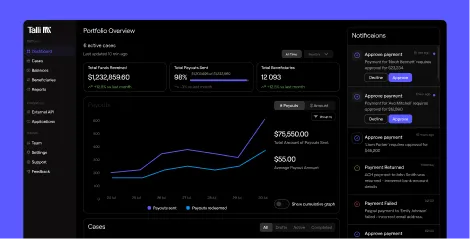
Talli is built specifically for settlement payout work rather than general vendor payables or consumer refund flows. Its digital disbursement infrastructure combines multiple regulated payout rails with automated KYC verification, OFAC screening, W-9 collection, 1099 generation, claimant communication, and transaction-level audit evidence in one workflow. That matters because the fiduciary challenge is rarely just sending money. It is showing that each release was valid, supportable, and documented.
Talli is structured around the custody and reporting realities that matter in legal disbursements. It supports QSF-aware controls with segregated settlement accounts, banking services through Patriot Bank, N.A., Member FDIC, a claimant portal, live payment-status visibility, and real-time dashboards. That gives administrators room to match the rail to the claimant instead of forcing every recipient into one acceptance method.
Talli supports ACH, prepaid Mastercard, PayPal, Venmo, gift cards, wire transfers, and paper-check fallback. It also supports smart reminders, fraud controls, payout tracking, and CRM synchronization. For claims teams that need digital disbursement with compliance evidence built in, that combination is the point.
Best Practices for Real-Time Settlement Payments
In 2026, the best real-time settlement payment programs treat the payment rail as the last step in a documented release decision. Fiduciaries need evidence that the payout was valid before speed becomes relevant.
Use these practices as the baseline:
- Keep rail-selection rules written by payment type, claimant type, value, and exception type.
- Screen beneficiaries at disbursement, not only at onboarding, using a risk-based OFAC review workflow.
- Match approval thresholds to payment value, especially for high-value instant transactions.
- Keep QSF ledgering, tax reporting, and release evidence in one reconciled settlement ledger.
- Maintain a fallback rail for failed instant payments and document each reissue path.
- Preserve transaction-level reporting for court review, trustee oversight, and final accounting.
The pattern is consistent: faster release only helps when the surrounding controls are already stable.
Common Mistakes to Avoid
A common mistake is treating real-time payments as a settlement strategy by themselves. They are a rail choice, not a governance model. When teams collapse those ideas, they usually underinvest in screening, fallback handling, or post-distribution reporting.
Other repeat errors include:
- Turning on instant sends before dual approval and account-validation rules are tested.
- Assuming a claimant’s institution can receive the selected rail without verifying reachability.
- Screening only at onboarding even though beneficiary data may change before disbursement.
- Letting tax documentation trail the payout instead of clearing W-9 and reporting logic first.
- Treating failed real-time sends as ad hoc exceptions instead of routing them into a defined remediation queue.
Fiduciaries can avoid most of these issues by using a mixed-rail model with explicit release controls. The point is not to slow everything down. It is to make real-time payments as explainable as every slow one.
Talli Conclusion
Real-time payments for settlements are becoming a practical option because network participation, transaction volume, and value capacity all moved sharply higher in 2025 and early 2026. The fiduciary advantage is real when faster release improves claimant completion and shortens reconciliation.
There is still no single best rail for every program. For urgent, fully verified payouts where the receiving institution is reachable, real-time payments are often the strongest option. For routine distributions, ACH may still be the better default. For recipients who want guided digital acceptance, prepaid cards and wallet options can improve completion without forcing an account-to-account flow.
Operating standards did not get easier. Instant settlement works when compliance, documentation, fallback design, and audit evidence are already stronger than the rail’s speed. For most fiduciaries, the durable 2026 model is not instant-only. It is modern claims disbursements built on regulated payout rails, full audit transparency, and less chasing, more redemptions. For programs that need those options inside one compliance-critical workflow, Talli is the strongest fit because its infrastructure combines claimant choice with full audit trails, QSF-aware controls, and settlement-specific reporting.
Frequently Asked Questions
Can real-time payments work alongside checks?
Yes. Many programs work best when real-time rails sit inside a payout matrix that also includes ACH, prepaid cards, wallets, wires, and checks.
What is the difference between FedNow and RTP?
FedNow and RTP both support instant settlement, but they run on separate rails with different operator models, reach, and bank-readiness patterns.
What happens if an instant payout fails OFAC or ID checks?
Do not release the payment until the exception is resolved, documented, and approved through the same pre-release controls used for any settlement disbursement.
Do fiduciaries need both FedNow and RTP on day one?
No. Many fiduciaries can start with one reachable rail and one fallback method, then expand after proving governance and exception handling.
When should fiduciaries use ACH instead?
Use ACH when urgency is low, reachability is uncertain, or the workflow still needs review time before release.
Are real-time payments reversible?
Instant payments generally leave far less remediation room than ACH reversals or check stops after release, so screening and approval should happen before funds move.
How much work do instant settlement payments remove?
They reduce waiting and claimant-support friction, but they do not remove entitlement review, OFAC controls, tax workflows, reconciliation, or reporting.
How should a QSF handle tax and audit evidence?
A QSF should keep the same tax and audit discipline it uses for any other payout, including release evidence, distribution records, and required IRS reporting.