.svg)


.svg)
The C.R. Bard hernia mesh settlement represents one of the largest medical device mass tort resolutions in U.S. history, with Becton, Dickinson and Company (BD) agreeing to resolve approximately 38,000 claims related to defective polypropylene hernia mesh products. For claims administrators and legal teams managing these distributions, understanding the settlement structure, eligibility requirements, and payout timelines is critical to ensuring claimants receive their compensation efficiently. When managing mass legal payouts of this scale, specialized payment infrastructure becomes essential for compliance, speed, and claimant satisfaction.
Key Takeaways
- The October 2024 global settlement is expected to resolve approximately 38,000 Bard hernia mesh claims; while BD has not publicly released a detailed payout grid, many plaintiff-side updates describe a tiered program with quick-pay options for less severe cases and higher awards for more serious, well-documented injuries.
- Settlement administration spans an estimated 3-4 years (late 2024 through 2027-2029), with an Intensive Settlement Process launching January 2027 for unresolved claims
- Medical documentation quality directly determines compensation tier assignment, creating a significant payout gap between lowest and highest tiers
- Lien resolution typically requires 3-6 months per claim before final disbursement, managed centrally by appointed administrator Archer
- Some plaintiff-side projections put typical gross recoveries in the tens of thousands for many cases, with higher amounts in severe, well-documented claims—though attorney fees (33–40%) and liens can materially reduce net claimant payments.
- Claimants who signed agreements in early 2026 may not receive payments until late 2026 or 2027 due to administrative processing
- A court-approved Qualified Settlement Fund (QSF) is in place to receive and disburse settlement payments, with Wells Fargo serving as escrow agent and Peter Haugh appointed as the QSF Administrator; Archer Systems LLC serves as the exclusive lien administrator.
Understanding the Bard Hernia Mesh Lawsuits: A Brief Overview
The Bard hernia mesh litigation emerged from widespread reports of complications following hernia repair surgeries using polypropylene mesh products manufactured by C.R. Bard, now a subsidiary of Becton, Dickinson and Company (BD). Thousands of patients experienced severe adverse effects that led to additional surgeries, chronic pain, and permanent injuries.
The History of Bard Hernia Mesh Claims
Hernia mesh lawsuits against Bard began accumulating in the early 2010s as patients reported complications including mesh migration, organ perforation, chronic infections, and adhesion formation. The federal cases were consolidated into Multidistrict Litigation (MDL-2846) in the Southern District of Ohio under Judge Edmund A. Sargus, Jr.
The litigation history includes:
- 2007: Initial Kugel mesh settlement established precedent for Bard mesh liability
- 2014-2018: Case consolidation and pretrial proceedings in MDL-2846
- 2018-2024: Bellwether trials resulted in significant plaintiff verdicts
- October 2024: BD announced global settlement to resolve approximately 38,000 pending claims
As of January 5, 2026, 23,749 actions were pending in MDL 2846, with additional cases also proceeding in Rhode Island state court, with additional cases filed in Rhode Island state court where Bard is headquartered.
Why These Lawsuits Arose
Plaintiffs alleged that Bard's polypropylene mesh products were defectively designed and manufactured, causing the mesh to shrink, migrate, or degrade within the body. Common complications included:
- Mesh migration: Device movement from original implant site
- Chronic infection: Persistent bacterial contamination requiring mesh removal
- Adhesion formation: Abnormal tissue bonding causing organ damage
- Bowel obstruction: Intestinal blockages requiring emergency surgery
- Fistula formation: Abnormal connections between organs
- Chronic pain: Persistent discomfort lasting months or years after surgery
Bellwether trials demonstrated the severity of these injuries, with the highest verdict reaching $4.8 million in August 2022, establishing clear precedent for substantial compensation.
Who is Eligible for C.R. Bard Hernia Mesh Payouts in 2026?
Eligibility for the Bard hernia mesh settlement depends on multiple factors including the specific mesh product implanted, documented complications, and evidence connecting injuries to the device. Understanding these criteria is essential for both claimants and the legal teams managing their cases.
Specific Injury Requirements
Claimants must demonstrate qualifying injuries to receive compensation beyond the minimum tier. Eligible injuries include:
- Revision surgery: Procedures to repair, remove, or replace defective mesh
- Multiple surgeries: Cases requiring two or more corrective operations
- Chronic pain conditions: Documented persistent pain lasting six months or longer
- Infection requiring treatment: Bacterial complications necessitating antibiotics or surgical intervention
- Organ perforation: Mesh penetration of bowel, bladder, or other organs
- Permanent disability: Long-term functional impairment caused by mesh complications
- Wrongful death: Fatal complications directly attributable to mesh implantation
The settlement employs a points-based allocation system where injury severity directly determines compensation tier assignment. Documentation completeness significantly impacts point totals and final payouts.
Types of Bard Mesh Devices Included
The settlement covers multiple Bard hernia mesh product lines implicated in the litigation. Covered products include:
- Bard 3DMax Mesh
- Bard Ventralex Hernia Patch
- Bard Composix Kugel Patch
- Bard PerFix Plug
- Bard Ventrio Hernia Patch
- Bard Marlex Mesh products
- Various polypropylene mesh configurations manufactured by C.R. Bard
Claimants must provide documentation identifying the specific mesh product implanted, typically through operative reports containing lot numbers or product stickers from the original surgery.
The Claims Process for Bard Hernia Mesh Settlements
Successfully processing a Bard hernia mesh settlement claim requires navigating specific documentation requirements, meeting deadlines, and coordinating with settlement administrators. The process involves multiple steps that can extend payment timelines significantly.
Gathering Necessary Documentation
Medical record completeness directly determines settlement tier assignment and final compensation amounts. Legal experts emphasize that the difference between minimum and maximum payouts often comes down to documentation quality.
Required documentation includes:
- Operative reports: Surgical records from original hernia repair identifying mesh product used
- Pathology reports: Laboratory analysis from revision or removal surgeries
- Product identification: Lot numbers, product stickers, or hospital records identifying specific mesh device
- Imaging studies: CT scans, MRIs, or X-rays showing mesh complications
- Treatment records: Complete medical documentation demonstrating injury progression
- Physician statements: Expert opinions connecting complications to mesh implant
Settlement administrators review these materials to assign claimants to appropriate compensation tiers. Incomplete documentation typically results in lower tier placement or claim denial.
Meeting Legal Requirements
The settlement process involves specific procedural steps managed through the Qualified Settlement Fund established by court order. Key requirements include:
- Settlement agreement execution: Signing release documents prepared by settlement administrators
- Lien identification: Disclosing Medicare, Medicaid, TriCare, VA, or private insurance liens
- Attorney fee arrangements: Confirming contingency fee percentages (typically 33-40% of gross settlement)
- Tax documentation: Providing information for 1099 reporting requirements
- Case dismissal: Filing stipulated dismissal upon settlement completion
For claims administrators handling large settlement volumes, effective reconciliation and reporting systems become critical to tracking each claim through these procedural stages.
Projected Payouts and Settlement Tiers for Bard Hernia Mesh Cases
The Bard hernia mesh settlement implements a sophisticated three-tier payment structure that categorizes claimants based on injury severity and documentation quality. This tiered approach enables faster processing for straightforward cases while providing enhanced compensation for severe injuries.
Understanding Compensation Categories
The settlement establishes three primary payment tracks:
Quick-Pay 1: $2,500
- Designed for claimants with mesh implants but no qualifying injuries
- Minimal documentation requirements
- Fastest processing timeline
- Appropriate for cases lacking evidence of complications
Quick-Pay 2: $25,000
- Covers mild-to-moderate injuries requiring single revision surgery
- Requires documentation of mesh-related complications
- Moderate processing timeline
- Standard compensation for documented but less severe cases
Traditional Pay: $60,000-$100,000+
- Covers severe injuries including multiple surgeries, permanent disability, or wrongful death
- Requires comprehensive medical documentation
- Longest processing timeline due to individualized review
- Highest compensation tier with potential for six-figure awards
Average settlement projections range from approximately $65,000-$70,000 across all tiers, though individual payments vary significantly based on injury severity and documentation completeness.
Factors Influencing Individual Payouts
Multiple variables affect final compensation amounts beyond basic tier assignment. Key factors include:
- Number of surgeries: Additional corrective procedures increase point values
- Injury permanence: Long-term or permanent complications command higher compensation
- Documentation quality: Complete records support higher tier placement
- Age and health status: Pre-existing conditions may affect causation arguments
- Economic damages: Lost wages, medical expenses, and out-of-pocket costs
- Non-economic damages: Pain and suffering, loss of quality of life
After gross settlement amounts are determined, several deductions reduce net claimant payments:
- Attorney fees: Typically 33-40% of gross settlement
- Litigation costs: Expert witness fees, medical record retrieval, filing fees
- Government liens: Medicare, Medicaid, TriCare, VA subrogation claims
- Private insurance liens: Health plan reimbursement claims
These deductions can reduce actual claimant payments by an estimated 40-50% compared to gross settlement amounts.
How Talli Streamlines Bard Hernia Mesh Payouts for Legal Teams
Managing disbursements for tens of thousands of hernia mesh claims requires specialized infrastructure capable of handling complex compliance requirements, varied payment amounts, and extended timelines. Traditional settlement distribution methods often struggle with the scale and complexity of mass tort payouts.
Ensuring Secure and Efficient Fund Transfers
For legal teams administering Bard hernia mesh settlement funds, Talli's AI-driven payment platform addresses critical operational challenges. The platform automates and safeguards every claims payout, enabling teams to meet tight deadlines without losing control over compliance or claimant experience.
Key capabilities supporting hernia mesh settlement administration include:
- Complete fund segregation: Dedicated accounts for settlement funds preserve QSF ownership and simplify reporting
- Automated compliance verification: KYC, OFAC, and W-9 collection integrated into disbursement workflows
- Fraud prevention: Built-in fraud mitigation and audit logs protect settlement integrity
- Scalable processing: Handle thousands of recipients without infrastructure bottlenecks
When processing mass payouts of this magnitude, traditional paper check distribution creates significant delays and higher rates of unclaimed funds. Digital disbursement solutions reduce processing times while improving claimant redemption rates.
Meeting Compliance Standards with Talli
Settlement administration requires strict adherence to regulatory requirements across multiple domains. Critical areas include:
- Tax reporting: Accurate 1099 issuance for settlement payments
- Identity verification: KYC procedures preventing fraudulent claims
- Sanctions screening: OFAC checks ensuring compliance with federal regulations
- Audit trails: Complete documentation of fund flows for court reporting
Talli's platform incorporates these compliance functions directly into the disbursement workflow, reducing manual processes and potential errors that can delay payments or create regulatory exposure. Banking services are provided by Patriot Bank, N.A., Member FDIC, ensuring institutional-grade fund management.
Defective Medical Device Lawyers: Your Partner in Hernia Mesh Claims
Securing appropriate compensation in the Bard hernia mesh settlement requires experienced legal representation capable of navigating complex documentation requirements, tier negotiations, and lien resolution procedures.
Choosing the Right Legal Counsel
Mass tort attorneys specializing in medical device litigation bring essential expertise to hernia mesh claims. Effective representation involves:
- Case evaluation: Assessing claim strength and appropriate compensation expectations
- Medical record analysis: Identifying documentation supporting higher tier placement
- Expert coordination: Engaging medical experts to establish causation
- Settlement negotiation: Advocating for maximum compensation within tier structures
- Lien resolution: Managing Medicare, Medicaid, and insurance subrogation claims
Mass tort attorneys typically work on contingency fee arrangements, meaning claimants pay no upfront costs. Fees are calculated as a percentage of the final settlement, typically 33-40% depending on case complexity and stage of resolution.
The Role of Your Attorney in Settlement Negotiations
Within the Bard hernia mesh settlement structure, attorneys play critical roles beyond initial case filing. Attorney responsibilities include:
- Tier advocacy: Presenting evidence supporting higher compensation tier assignment
- Documentation assembly: Gathering complete medical records to maximize point values
- Deadline compliance: Meeting settlement administrator requirements for timely processing
- Client communication: Keeping claimants informed throughout multi-year administration period
- Payment coordination: Ensuring proper deduction calculations and timely disbursement
Ronald V. Miller, Jr., Esq. explains: "In an MDL like the Bard hernia mesh litigation, a settlement announcement usually means the defendant has agreed to create a settlement program with eligibility rules, injury tiers, point systems, and documentation requirements. If any documentation is missing or there is a dispute about the injury level, that will slow things down."
Real-time Tracking and Transparency with Talli for Settlement Funds
Extended settlement administration timelines create significant communication challenges. When claimants who signed agreements in early 2026 may not receive payments until late 2026 or 2027, maintaining engagement and managing expectations becomes essential.
Monitoring Every Dollar in Your Settlement
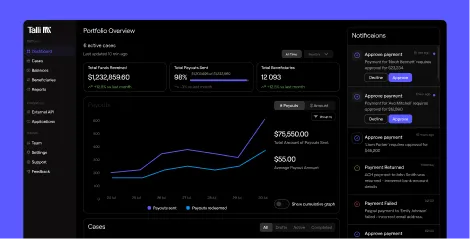
Talli's real-time dashboard provides claims administrators with total control and visibility over settlement fund distribution. Key monitoring capabilities include:
- Payout status tracking: Monitor each disbursement from initiation through completion
- Completion rate analytics: Track redemption percentages across claimant populations
- Fund flow visibility: See every dollar from settlement account through final payment
- CRM integration: Sync real-time payout data to existing case management systems
For settlements spanning 3-4 years with staggered disbursements, this visibility enables administrators to identify bottlenecks, address processing delays, and report accurately to courts and stakeholders.
Enhancing Claimant Engagement with Smart Reminders
Higher claims redemption rates directly impact settlement success metrics and claimant satisfaction. Talli's platform includes intelligent communication tools:
- Multi-channel outreach: Smart reminders via email, SMS, and additional channels
- Automated follow-ups: Scheduled communications keeping claimants engaged throughout processing
- Status notifications: Real-time updates when payment milestones are reached
- Support integration: Responsive customer service addressing claimant questions
These capabilities address a critical challenge identified in the Bard MDL: maintaining client contact over multi-year settlement periods. Court orders have specifically addressed scenarios where attorneys are "unable to maintain client contact after reasonable efforts," highlighting the importance of sustained communication infrastructure.
Secure and Flexible Payout Options for Bard Hernia Mesh Claimants
Settlement recipients represent diverse populations with varying banking access and payment preferences. Offering multiple disbursement options increases redemption rates while improving claimant satisfaction.
Empowering Claimants with Choice
Talli's platform provides flexible payout options ensuring every claimant can access their settlement funds regardless of banking status. Available payment methods include:
- Digital wallet integration: Instant access through mobile payment platforms
- Easy Prepaid Mastercard: Card-based access without traditional bank account requirements (issued by Patriot Bank, N.A., Member FDIC, pursuant to a license from Mastercard International)
- Gift cards: Branded options for immediate spending capability (issued by InComm and distributed by Talli)
- Direct deposit: Traditional ACH transfers for claimants preferring bank deposits
This flexibility matters significantly for hernia mesh claimants, many of whom faced substantial medical expenses and may have limited banking relationships. Payment choice directly impacts satisfaction and completion rates.
Seamless Redemption Process for Recipients
Talli streamlines the claimant experience through intuitive, mobile-first processes:
- Secure link delivery: Claimants receive payment access via SMS or email with no accounts to create
- Self-service selection: Recipients choose their preferred payment method independently
- Immediate access: Funds available quickly once selection is confirmed
- Support availability: Customer service assistance for claimants needing help
This approach eliminates common barriers to settlement redemption including lost checks, bank account requirements, and complex verification procedures. For settlements distributing funds over 3-4 years, maintaining high redemption rates throughout the administration period requires consistent claimant engagement and friction-free payment experiences.
Why Talli for Hernia Mesh Settlement Administration
The Bard hernia mesh settlement's complexity—spanning thousands of claimants, multi-year timelines, and stringent compliance requirements—demands purpose-built payment infrastructure. Talli's specialized settlement administration platform transforms what could be an overwhelming logistical challenge into a streamlined, transparent process.
Legal teams choosing Talli benefit from:
- Proven mass tort expertise: Experience managing settlements with tens of thousands of recipients across extended timelines
- End-to-end automation: From compliance verification through final disbursement, reducing manual touchpoints that create delays
- Superior claimant experience: Multiple payment options, mobile-first design, and proactive communication that keep redemption rates high
- Court-ready reporting: Comprehensive audit trails and real-time dashboards that simplify regulatory compliance and court reporting obligations
- Institutional-grade security: Banking services through Patriot Bank, N.A., Member FDIC, with fraud prevention and fund segregation protecting settlement integrity
As settlement administrators navigate the coming years of Bard hernia mesh distributions, the right payment infrastructure doesn't just move money—it builds trust, ensures compliance, and delivers the transparency that courts, attorneys, and claimants all require.
Ready to streamline your settlement administration? Talli's platform handles complex mass tort distributions while maintaining the compliance, transparency, and claimant satisfaction that define successful settlement programs.
Frequently Asked Questions
What is the current status of the C.R. Bard Hernia Mesh settlement?
As of early 2026, the settlement is actively processing claims filed prior to the October 2024 announcement. Payments are being prioritized based on lawsuit filing dates, with earlier cases processed first. Approximately 23,749-24,099 cases remain pending in MDL-2846, and an Intensive Settlement Process is scheduled to launch in January 2027 to handle unresolved claims through June 2029.
When can I expect to receive a payout from the Bard Hernia Mesh lawsuit?
Payment timelines vary significantly based on case complexity, filing date, and documentation completeness. Claimants who signed settlement agreements in early 2026 may not receive payments until August-September 2026 or later. Lien resolution alone typically requires 3-6 months per claim, and earlier-filed cases receive priority processing.
Do I need a lawyer to receive a Bard Hernia Mesh settlement?
While technically possible to participate in the settlement without an attorney, the complexity of documentation requirements, tier negotiations, and lien resolution makes legal representation strongly advisable. Attorneys work on contingency fees (typically 33-40% of settlement amounts), meaning claimants pay nothing upfront. Experienced mass tort attorneys can often secure higher tier placements through comprehensive documentation strategies.
What types of injuries qualify for compensation in the Bard Hernia Mesh settlement?
Qualifying injuries include revision surgery to repair or remove mesh, chronic infection requiring treatment, mesh migration causing organ damage, bowel obstruction, fistula formation, chronic pain lasting six months or longer, permanent disability, and wrongful death. Injury severity and documentation quality determine tier placement, with compensation ranging from $2,500 (no qualifying injuries) to over $100,000 (severe, well-documented injuries).
How does Talli help in distributing Bard Hernia Mesh payouts?
Talli's AI-driven payment platform streamlines mass tort settlements by automating compliance verification (KYC, OFAC, W-9 collection), providing real-time tracking dashboards, offering flexible payment options for claimants, and maintaining complete audit trails. For settlements spanning multiple years with tens of thousands of recipients, Talli reduces processing bottlenecks while improving claimant redemption rates through smart reminders and mobile-first payment experiences.