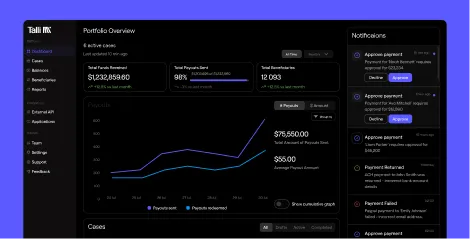
When a claimant receives their settlement payment, they see a logo, a confirmation page, and a brand experience. The question is: whose brand are they seeing? For claims administrators and insurance carriers managing high-volume disbursements, redirecting claimants to third-party payment pages creates brand fragmentation at the most critical moment when money changes hands. White-label payout solutions solve this by embedding digital disbursements directly into your existing claims portal, maintaining complete brand control while delivering faster payments and higher redemption rates.
Key Takeaways
- White-label payouts keep claimants on your branded portal throughout the entire payment journey, eliminating third-party redirects that erode trust
- Digital disbursements compress payment cycles from 6-8 weeks to 24-48 hours while achieving 95-98% redemption rates compared to 70-80% for paper checks
- Implementation typically requires 1-4 weeks with ROI achieved within 4-7 months through reduced processing costs and error rates
- Multi-channel payment options (ACH, prepaid cards, digital wallets, gift cards) increase claimant satisfaction and redemption by meeting recipients where they are
- Cost savings of 50-65% compared to paper checks translate to $15,000-50,000 annually for organizations processing 10,000+ payouts
- Built-in compliance automation (KYC, OFAC screening, W-9 collection) reduces regulatory risk while maintaining fiduciary standards
- Real-time dashboards and webhook integrations provide complete visibility into payment status, fund flows, and audit trails
Building a Seamless Claims Management Experience: The Power of White-Label Payouts
White-label payout platforms sit between your claims management system and banking networks. When a claim is approved, the platform receives payment instructions via API, validates recipient information, routes funds through the optimal payment rail, and delivers a fully branded confirmation experience, all while your brand remains front-and-center.
Why Customer Experience Drives Claims Success
The payment moment represents the culmination of the entire claims journey. Claimants who experienced a seamless, branded payout process demonstrate higher satisfaction scores and stronger loyalty. Conversely, redirecting recipients to unfamiliar third-party pages creates confusion and erodes the trust built throughout the claims process.
White-label solutions ensure claimants never see provider logos or unfamiliar branding during payout, access payment portals through your domain (e.g., claims.yourcompany.com/payout), receive confirmation emails with your branding and contact information, and track payment status within your existing portal interface.
The Foundation of a Strong Claims Portal
Effective white-label integration requires connecting your claims software to the payout API. This mapping triggers automatic payout requests when claims reach approval status. The platform then handles validation, compliance checks, and multi-rail routing without exposing claimants to backend complexity.
For insurance carriers and TPAs, this approach eliminates payment bottlenecks through coordinated approvals, centralized controls, and automated reconciliation, all under your brand identity.
Digital Disbursements: Elevating Payout Speed and Claimant Satisfaction
Traditional paper check distribution creates a 7-10 day waiting period for claimants, with 15% abandoning claims under $500 due to friction. Digital disbursements transform this experience by delivering funds within hours or even seconds. Federal Reserve data shows that the number of government checks it processed declined by 5.2% in 2025, falling from approximately 36 million in 2024 to 34 million in 2025, illustrating the continued reduction in paper-based government payments.
The Shift from Paper Checks to Digital Efficiency
Paper checks carry all-in costs of $7-20 per payment including printing, postage, reconciliation, and reissuance. More critically, 20-30% of paper checks go unclaimed, requiring costly tracking at $150 per uncashed check and eventual escheatment to state governments. According to the Federal Reserve's 2025 Payments Study, the number of check payments fell to 9.2 billion in 2024, down from 11 billion in 2021, reflecting the continued shift away from paper-based payments.
Digital disbursements reduce per-transaction costs to $0.25-$5 while compressing distribution timelines from weeks to hours. Talli's platform achieves 95-98% redemption rates compared to 70-80% for traditional paper methods, a difference that directly impacts settlement completion and cy pres distributions.
Measuring the Impact of Faster Payouts
The AB Data case study demonstrates measurable results from digital disbursement adoption:
- 30% increase in claimant redemption rates across check-issued populations
- 60% reduction in unresolved exceptions and manual reissuance overhead within 12 months
- 100% fiduciary compliance record maintained across all distribution cycles
- Faster time to funds while lowering distribution and reissuance costs
These improvements compound across high-volume settlements. When processing payouts to 50,000+ claimants, even incremental redemption gains translate to millions in additional funds reaching intended recipients.
Ensuring Legitimacy and Trust: What Makes Digital Disbursements Secure?
Claimants and courts alike need assurance that digital payments are secure, compliant, and legitimate. Modern white-label platforms embed comprehensive security infrastructure that operates automatically without administrator configuration.
Combating Fraud with AI-Powered Security
AI-powered fraud detection achieves 40%+ reduction in fraudulent claims through pattern recognition across device fingerprinting, behavioral analytics, and identity verification. The rise in fraudulent claims makes automated detection essential for protecting settlement funds.
Key security capabilities include real-time sanctions screening against OFAC databases with documented timestamps, KYC identity verification cross-referencing provided information against authoritative sources, velocity limits preventing suspicious payout patterns (e.g., maximum 5 payouts per claimant per day), and bank account validation before payout to reduce failed transactions.
The Regulatory Backbone of Digital Payouts
Compliance automation ensures every disbursement meets regulatory requirements:
- W-9 collection via digital forms achieving 90% completion rates through smart reminders (versus 40% without automation)
- Automated 1099-MISC/1099-NEC generation with IRS e-filing integration
- 24% backup withholding calculation for missing TIN numbers per IRS requirements
- SOC 2 Type II and PCI DSS Level 1 compliance for bank-grade security standards
Choosing Your Payout Powerhouse: Understanding Payment Gateways and Processors
Generic payment processors require extensive customization to handle legal settlement requirements. Purpose-built disbursement platforms differ fundamentally in their approach to fund segregation, compliance automation, and court-ready reporting.
The Role of a Payment Gateway in Claims
Payment gateways handle the authorization layer, validating recipient information and routing instructions. In settlement contexts, this includes verifying claimant eligibility against court-approved distribution plans and maintaining chain of custody documentation.
How a Payment Processor Handles Settlement Funds
Payment processors execute actual fund movement. For legal settlements, this requires dedicated FBO (For Benefit Of) account structures preserving Qualified Settlement Fund tax treatment under IRC Section 468B. Complete separation between settlement funds and operating capital prevents commingling that triggers bar association violations.
Talli's architecture maintains matter-level fund tracking with audit-ready documentation proving fund separation throughout the disbursement lifecycle. Banking services provided by Patriot Bank, N.A., Member FDIC ensure institutional-grade security for QSF-compliant distributions.
Multi-Channel Payouts: Offering Flexibility and Enhancing the Customer Experience
Claimant demographics vary dramatically across settlement types. Class action participants span all ages, income levels, and banking relationships. Offering multiple payment options increases redemption by meeting recipients where they are.
Meeting Claimants Where They Are: Diverse Payment Options
Comprehensive payout platforms support multiple disbursement methods:
- ACH direct deposit: Lowest cost at $0.25-$0.50 per transaction, 1-2 day delivery for banked claimants
- Prepaid Mastercard: Virtual cards delivered via SMS/email in 30 seconds, physical cards within 5-7 days, serving 5.9 million unbanked U.S. households
- Digital wallets: PayPal and Venmo integration ($0.50-$1.00 per transaction), instant access for users on existing platforms
- Gift cards: Amazon, Target options for settlements under $100 per claimant, achieving highest redemption rates for small-value distributions
- Wire transfers: Same-day option for high-value international payments ($10-$30 per transaction)
- Paper checks: Maintained as fallback despite higher costs
The Impact of Choice on Redemption Rates
Payment choice directly correlates with redemption rates. Younger demographics show strong preference for digital wallets with PayPal and Venmo adoption particularly high among Millennials and Gen Z. Conversely, some claimants prefer direct deposit to existing bank accounts, while unbanked populations benefit from prepaid card options requiring no account setup.
Catastrophe payments and workers' compensation distributions benefit particularly from flexible payment options. During severe weather events or for recurring indemnity payments, immediate fund access through instant rails (RTP/FedNow) can be critical for claimants facing financial hardship.
Transparent Costs: Digital Payouts vs. Traditional Methods for Claims
The financial case for digital disbursements strengthens at scale. Organizations processing 10,000+ payouts annually see 50-65% cost reduction compared to paper checks.
Analyzing the True Cost of Settlement Payouts
Total cost of ownership includes direct transaction fees plus hidden operational costs. Paper checks typically cost $7-20 per payment when factoring in printing, postage, reconciliation, and reissuance. Reissuance rates run 15-20% for paper checks compared to just 2-5% for digital methods.
Staff processing time represents another major cost differential. Paper checks require 4-8 hours of staff time per 100 payouts for manual processing, while digital disbursements reduce this to 0.5-1 hour per 100 payouts. Unclaimed fund tracking costs $150 per check for paper methods but is automated with digital platforms. Monthly reconciliation time drops from 15 hours for paper to 4.5 hours for digital systems.
Achieving ROI with Digital Distribution
Implementation investments typically break even within 4-7 months through reduced processing time and error rates. Year-one savings commonly exceed $27,000 net for mid-volume operations, scaling proportionally for higher disbursement counts.
For a 10,000-payout operation, eliminated check costs save $25,000 (at $2.50 average), saved staff time contributes $20,000 (100 hours monthly at $50/hour), and faster claim closure reduces $15,000 in interest on outstanding claims.
Global Reach, Local Brand: Managing International Payments for Claimants
Cross-border settlements introduce complexity around currency conversion, regulatory compliance, and payment method availability. White-label platforms with global infrastructure simplify international disbursements while maintaining brand consistency.
Extending Your Brand Across Borders with Digital Payouts
Talli supports multi-jurisdictional operations across 190+ countries with 150+ currencies and 300+ payment rails. GDPR-compliant data handling for European claimants and multi-language support (40+ languages) ensures consistent experience regardless of recipient location.
Key Considerations for Cross-Border Settlement Payments
International payouts require additional compliance steps including OFAC screening for all recipients regardless of country, W-8BEN collection for non-U.S. tax residents, currency conversion at transparent rates (watch for hidden FX fees of 1.9-3.5%), and local payment rail selection optimizing for cost and speed.
Real-Time Insights: Enhancing Customer Management and Oversight
Claims teams need visibility into payment status without waiting for monthly reconciliation cycles. Real-time dashboards transform disbursement oversight from reactive to proactive.
From Data to Action: Improving Claimant Journeys
Live monitoring capabilities include completion rates (percentage of successful payouts by method), payment method distribution (ACH vs. cards vs. wallets adoption), geographic concentration (regional patterns and compliance requirements), failure root cause analysis (identifying data quality issues before they compound), and remaining fund balances (matter-level visibility into distribution progress).
The Role of Analytics in Proactive Claims Management
Automated reporting generates court-required accounting without manual preparation. Webhook support enables real-time status updates to CRM systems, keeping all stakeholders informed. Talli's platform reduces monthly closing time by 70%, from 15 hours to 4.5 hours, through automated three-way reconciliation with 90% auto-match rates.
Stakeholder portals provide controlled access for courts, trustees, and legal teams to view relevant disbursement data without compromising security.
The Future of Claims: Digital Transformation for Superior Customer Experience
The settlement administration industry is moving decisively toward digital-first distribution. Global AML system spending projects to reach $51.7 billion by 2028, reflecting increased regulatory focus on payment compliance and fraud prevention.
Success Stories in Digital Settlement Distribution
Thomas R Glenn, President & CEO of AB Data, summarizes the shift: "We don't think of digital disbursement as a feature. We think of it as infrastructure. Talli gave us the regulated payout rails we needed to move faster, reduce unclaimed funds, and give courts full confidence in how settlement money is being distributed."
This infrastructure mindset reflects broader market evolution. With increasing federal class action filings and 4.6 million suspicious activity reports filed annually, claims administrators need platforms built specifically for regulated fund distribution, not adapted consumer payment tools.
Preparing Your Claims Operations for Tomorrow
Talli's white-label payout solution addresses the complete spectrum of settlement disbursement needs. The platform provides QSF compliance embedded by design, ensuring every distribution maintains tax treatment and regulatory requirements from day one. Organizations benefit from scalability supporting 1,000 to 100,000+ recipients without performance degradation, with the same robust infrastructure serving both small and large settlements.
Implementation support includes vendor-assisted setup achieving production readiness in 2-6 weeks, with dedicated teams guiding the integration process. Comprehensive audit trail documentation proves fund separation and compliance throughout the disbursement lifecycle, providing the transparency courts and trustees require.
The transition from paper checks to digital disbursements represents more than operational improvement. It's a fundamental shift in how claimants experience your brand at the moment that matters most, and Talli's platform ensures that experience remains seamlessly within your control.
Frequently Asked Questions
How long does it take to implement a white-label payout solution into an existing claims portal?
Implementation timelines range from 1-4 weeks depending on customization depth and claims system complexity. Sandbox integration typically requires 3-5 days of developer work, followed by branding configuration (2-3 days) and claims system API mapping (1-2 weeks). Production testing with internal claimants adds another week before go-live. Organizations with legacy claims systems (AS/400, mainframe) should budget 3-6 months and consider engaging implementation consultants.
What happens when a claimant's bank account information is incorrect?
White-label platforms include account validation APIs that verify routing numbers and account ownership before attempting payout. When validation fails, the system automatically prompts claimants to update information or select an alternative payment method (prepaid card, digital wallet). Failed payout fees typically range from $0.25-$1.00 per attempt, making pre-validation essential for cost control. Budget for a 2-5% failure rate even with validation in place.
Can white-label payouts handle settlements with tiered payment structures?
Yes. Purpose-built platforms support complex allocation logic including tiered payments based on claim severity, pro-rata distributions across claimant classes, and conditional payouts tied to document submission (W-9 forms, release agreements). The system can block payouts exceeding $600 until required tax forms are submitted, automating IRS compliance while preserving claimant experience.
How do white-label solutions handle claimants without bank accounts?
Prepaid card disbursements serve the 5.9 million unbanked U.S. households without requiring account setup. Virtual cards deliver via SMS/email within 30 seconds, while physical cards arrive within 5-7 business days. Gift card options through Amazon and Target provide another alternative for smaller settlements. These options maintain brand consistency while ensuring all claimants can access their funds regardless of banking status.
What security certifications should a white-label payout provider have?
Minimum requirements include SOC 2 Type II certification (security controls audit), PCI DSS Level 1 compliance (if handling card data), and NACHA certification (for ACH payouts). For legal settlements, verify the provider maintains dedicated FBO account structures, automated OFAC sanctions screening, and 7-year data retention for IRS compliance. Request documentation of these certifications during vendor evaluation.