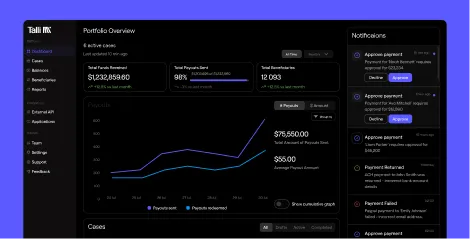
Payout exceptions silently drain settlement budgets and erode claimant trust, yet most claims administrators lack structured frameworks for tracking them. Manual processing of exceptions can consume significant overhead for a single large settlement. Talli's digital disbursement platform automates exception detection and resolution, helping claims administrators compress distribution timelines from weeks to 24-48 hours while achieving 95-98% redemption rates.
Key Takeaways
- Payout exceptions require structured tracking to control settlement costs and administrative overhead
- Data validation issues represent the single largest source of payout exceptions in disbursements
- Customer satisfaction declines significantly when payment resolution times extend beyond normal processing windows
- Automated exception management reduces resolution time substantially compared to manual processes
- The seven exception types span data validation, compliance, returns, reconciliation, regulatory reporting, timing delays, and payment method failures
- Pre-validation systems can reduce exception volume by 50-75% before payments are even initiated
- 80% of claimants with poor payment experiences may abandon future relationships
Understanding Payout Exception Management
Core Exception Categories
Exception management represents the structured operational workflow claims administrators use to track, investigate, resolve, and audit disbursement transactions that fail automated validation rules. For fiduciary teams managing class action settlements, mass tort distributions, and insurance claims, exception handling bridges the gap between automated payment processing and the complex compliance, recipient data, and reconciliation requirements inherent to large-scale disbursements.
Financial Impact Analysis
The stakes are substantial for settlement administrators. Each exception creates multiple cost layers:
- Direct costs: Staff time for investigation and resolution
- Indirect costs: Delayed distributions, claimant complaints, court inquiries
- Compliance risks: Audit findings, regulatory penalties, fiduciary liability
- Reputational damage: Eroded trust affecting future case acquisition
Strategic Framework Benefits
Understanding and systematically tracking these seven exception types transforms reactive firefighting into proactive risk management. Claims administrators who implement structured exception tracking gain visibility into patterns, identify root causes, and build processes that prevent recurring issues.
Exception Type 1: Invalid or Incomplete Recipient Data
What It Is
Payment initiation fails due to missing, incorrect, or unverifiable recipient information, including invalid tax IDs, closed bank accounts, mismatched names, incorrect addresses, or missing required compliance data.
Why It Matters
Data quality issues represent the single largest source of payout exceptions across settlement disbursements. Each data exception triggers multiple downstream consequences:
- Payment delays averaging 5-15 days per correction cycle
- The cost to issue a single check is estimated at $15-$25
- Substantial customer satisfaction decline when resolution exceeds 31 days
Detection Methods
Effective data validation occurs before payment initiation:
- Pre-payment validation against bank account databases
- Tax ID verification through IRS TIN matching
- Address standardization and USPS verification
- Duplicate recipient detection algorithms
Resolution Workflow
- Automated validation flags exception at payment creation
- System routes to data quality team with specific missing fields identified
- Outreach to claimant for corrected information
- Re-validation before payment resubmission
- Update master recipient database to prevent recurrence
Technology Solutions
Modern disbursement platforms integrate bank account validation APIs, address verification services, and TIN matching to catch data issues before they become exceptions. Self-service recipient portals allow claimants to correct their own information, reducing administrative burden.
Exception Type 2: Payment Validation and Compliance Failures
What It Is
Transactions flagged by fraud detection systems, sanctions screening, anti-money laundering (AML) checks, or other regulatory compliance controls before disbursement can occur.
Why It Matters
Fraud detection and compliance validation protect settlement funds while meeting regulatory obligations. The Federal Trade Commission reported that consumers lost approximately $16 billion to fraud in 2025, a roughly 25% increase from 2024, highlighting the importance of robust fraud prevention and payment verification controls. The financial impact of compliance failures extends beyond immediate fraud concerns:
- AI fraud detection systems flag 10-20% of transactions for review in high-risk industries
- Average 5-7 day holds for compliance review
- Regulatory penalties ranging from $10,000 to over $1 million for non-compliance
- Reputational damage from fraudulent payouts
Detection Methods
Compliance-focused exception tracking requires multiple layers:
- OFAC and sanctions list screening
- Duplicate payment detection algorithms
- Behavioral pattern analysis for unusual payment amounts, timing, or velocity
- AI-powered anomaly detection comparing against historical patterns
- KYC and KYB verification workflows
Resolution Workflow
- Automated screening flags high-risk transaction
- Route to compliance team based on risk score
- Enhanced due diligence review with documentation and verification calls
- Management approval for payments exceeding risk thresholds
- Document compliance decision in audit trail
- Release or reject payment with claimant notification
Technology Solutions
Platforms offering AI-powered fraud detection combine sanctions screening APIs with behavioral analytics and pattern recognition. Advanced systems provide transparent multi-party verification for enhanced security.
Exception Type 3: Returned and Failed Payment Transactions
What It Is
Disbursements that were initiated but subsequently rejected by receiving financial institutions due to account closures, incorrect routing numbers, insufficient information, or recipient refusal.
Why It Matters
ACH return rates vary 1-5% depending on data quality, while check return rates can reach 5-10% for aged mailing addresses. Each return triggers cascading costs:
- Administrative costs per payment reissue
- 7-15 day delays for investigation and reprocessing
- Compounding costs when multiple reissue attempts needed
- Escheatment risk for unclaimed funds, adding regulatory reporting burden
Common Return Codes
Understanding ACH return codes accelerates resolution of failed payments:
- R02: Account closed
- R03: No account or unable to locate
- R04: Invalid account number
- R10: Customer advises not authorized
- R14: Representative payee deceased
Resolution Workflow
- Receive return notification from bank or payment processor
- Automated categorization by return reason code
- Route to appropriate team based on return type
- Update recipient record with return reason
- Initiate skip tracing or alternative contact methods
- Reissue via alternative payment method
- Track reissue attempts and escalate to escheatment after threshold
Technology Solutions
Multi-channel payment platforms supporting fallback options like ACH, prepaid cards, digital wallets, wire transfers, and checks reduce the impact of individual method failures. Skip tracing services help locate claimants with outdated contact information.
Exception Type 4: Reconciliation Discrepancies and Settlement Breaks
What It Is
Mismatches between internal accounting records and external settlement data, including ledger versus bank statement variances, processor versus settlement file differences, fee calculation errors, and missing transaction confirmations.
Why It Matters
Reconciliation discrepancies can take extended periods to resolve, particularly for cross-border payments. The downstream effects compound quickly:
- Month-end close delays
- Audit findings and compliance violations
- Inability to prove settlement completion to courts or regulators
- Administrative burden on accounting teams
Common Discrepancy Types
- Timing differences when transactions are recorded on different dates in different systems
- Fee variances between gross and net settlement amounts
- Currency conversion mismatches in cross-border payments
- Missing settlement batches or delayed data feeds
- Duplicate transaction entries
Resolution Workflow
- Automated reconciliation engine flags unmatched transactions in real-time
- System categorizes by discrepancy type: timing, amount, or missing record
- Route timing issues to auto-resolve queue
- Route fee or amount variances to finance team with transaction drill-down
- Route missing records to IT team for data feed investigation
- Manual investigation with transaction-level documentation
- Post correcting entries to general ledger
- Feed root cause back into matching rules to prevent recurrence
Technology Solutions
Automated settlement reconciliation platforms achieve higher auto-match rates compared to manual processes, with AI-driven discrepancy detection for pattern recognition. Multi-source data normalization engines handle the complexity of integrating bank feeds, payment processor data, and case management systems.
Exception Type 5: Regulatory and Tax Reporting Exceptions
What It Is
Failures to meet tax withholding requirements (1099 reporting), escheatment triggers for unclaimed property, suspicious activity reporting (SAR) thresholds, or other regulatory filing obligations tied to disbursements.
Why It Matters
Typical class action settlements have 5-15% of payments triggering special tax or escheatment handling. According to the IRS, penalties for incorrect or late information returns can reach $340 per form for returns due in 2026, emphasizing the importance of accurate tax reporting and timely compliance. The penalties for non-compliance add up quickly:
- IRS penalties for incorrect 1099 reporting can reach $340 per form
- State escheatment penalties and interest charges
- Regulatory sanctions for BSA and AML violations ranging from $10,000 to over $1 million per violation
- Audit findings requiring costly remediation
Common Triggers
- Payments exceeding $600 requiring 1099 reporting
- Uncashed checks reaching state-specific escheatment periods of 1-5 years
- Aggregate payments to single recipient exceeding reporting thresholds
- Cross-border payments requiring FATCA or CRS reporting
- Payments to sanctioned countries or blocked persons
Resolution Workflow
- Automated screening against reporting thresholds at payment creation
- Flag exceptions requiring special handling
- Route to compliance team for review and documentation
- Collect required recipient information like W-9 or tax forms
- Apply withholding if required
- Generate compliance reports including 1099, escheatment filings, and SARs
- Maintain audit trail linking payment to regulatory filing
Technology Solutions
Tax compliance automation integrates 1099 generation with payment systems. Escheatment tracking software monitors dormancy periods across all 50 states and generates required filings.
Exception Type 6: Timing and Processing Delay Exceptions
What It Is
Disbursements that miss expected processing windows due to system delays, manual approval backlogs, data feed latency, bank processing cutoffs, or holiday and weekend timing issues.
Why It Matters
Speed directly impacts claimant relationships and satisfaction. Complex insurance claims can take extended periods to process, with catastrophic claims extending even longer.
The business impact extends beyond satisfaction:
- Cash flow issues for claimants awaiting funds
- Regulatory penalties for prompt payment violations
- Increased call center volume and support costs
- Competitive disadvantage compared to faster processors
Common Causes
- Manual approval workflows with bottlenecks
- Batch processing delays compared to real-time processing
- Bank cutoff times causing next-day processing
- Weekend and holiday processing gaps
- System integration failures causing data feed delays
- Staffing shortages during high-volume periods
Resolution Workflow
- Automated monitoring of aging reports for payments approaching SLA thresholds
- Escalation alerts to management for payments at risk of breach
- Root cause analysis: system issue versus approval bottleneck versus data delay
- Expedited processing for at-risk transactions
- Communicate delays to recipients with updated timeline
- Process improvement initiatives to address systemic delays
- SLA tracking and reporting for regulatory compliance
Technology Solutions
Real-time payment solutions eliminate batch processing delays. Automated approval rules for low-risk transactions reduce bottlenecks. Queue management dashboards show aging exceptions, while mobile approval capabilities allow managers to authorize payments from anywhere.
Exception Type 7: Payment Method and Fee Calculation Exceptions
What It Is
Issues with payment method selection, unsupported disbursement options, incorrect fee allocations, prepaid card activation failures, or disputes over net versus gross settlement amounts.
Why It Matters
Prepaid card programs show 5-10% activation or delivery issues, while payment method mismatch affects 3-8% of cross-border disbursements. The operational impact includes:
- Support call volume increases 2-3x when payment method issues arise
- Delayed access to funds for recipients
- Additional costs for payment method changes or reissues
- Claimant dissatisfaction and potential legal challenges
Common Issues
- Claimant requested ACH but received check
- Prepaid card not activated or expired before use
- International wire blocked due to intermediary bank fees
- Fee calculations incorrect including withholding, processing fees, or FX margins
- Payment method not supported in recipient's country or region
- Gift card restrictions not disclosed
Resolution Workflow
- Track payment method election at claim submission
- Validate payment method availability for recipient location or type
- Flag mismatches between elected and delivered method
- Route to payment operations team for investigation
- Document reason for method substitution
- Communicate fee breakdowns clearly to recipients
- Reissue via alternative method if original method failed
- Update recipient preferences for future payments
Technology Solutions
Six payment method options including ACH, prepaid cards, digital wallets like PayPal and Venmo, gift cards, wire transfers, and paper checks provide flexibility to match claimant preferences. Transparent fee breakdowns in recipient portals reduce disputes.
Building Your Exception Tracking Framework
Prioritization Strategy
Not all exceptions carry equal weight. Prioritize based on:
- Frequency: Invalid data and returned payments typically generate highest volume
- Financial impact: Per-exception cost multiplied by volume
- Compliance risk: Regulatory and tax exceptions carry highest penalty exposure
- Resolution time: Reconciliation breaks often take longest to resolve
Automation Targets
Exception management platforms can automatically flag and categorize 70-90% of exceptions without manual review. Start with conservative auto-resolution rules until sufficient data proves reliability. The goal is routing exceptions to the right person quickly, not eliminating human judgment entirely.
Measurement Framework
Track these metrics weekly:
- Exception rate: Exceptions as percentage of total payments
- Resolution time: Average days from detection to closure
- First-contact resolution: Percentage resolved without escalation
- Root cause distribution: Which exception types dominate
- Recurring exceptions: Same recipients or issues appearing multiple times
Continuous Improvement
The biggest ROI comes from analyzing root causes and fixing upstream problems. Documented implementations have reduced exceptions by 50% over 12 months by addressing systemic data collection and validation issues through process discipline informed by exception data.
How Talli Transforms Exception Management
Pre-Payment Validation
Talli's automated validation catches data issues before they become exceptions:
- Bank account verification at submission
- OFAC sanctions screening with documented timestamps
- Duplicate payment detection
- Address standardization and verification
Multi-Channel Flexibility
When one payment method fails, automatic fallback options maintain momentum:
- ACH direct deposit with competitive per-transaction costs
- Prepaid Mastercard with virtual cards delivered in 30 seconds
- PayPal and Venmo integration for digital-first recipients
- Gift cards for small-value distributions
- Paper checks as last resort
Real-Time Exception Visibility
Comprehensive audit trails and real-time dashboards provide:
- Completion rates and payment method distribution
- Failure root cause analysis
- Fraud flags requiring review
- Remaining fund balances by matter
Compliance Infrastructure
Built-in compliance features address regulatory exception types automatically:
- KYC verification cross-referenced against identity databases
- W-9 collection via digital forms
- Automated 1099-MISC and 1099-NEC generation with IRS e-filing
- Fund segregation architecture preserving QSF tax treatment
Proven Results
For claims administrators managing mass tort distributions, QSF disbursements, or insurance claims, Talli's exception management capabilities deliver measurable results. AB Data achieved a 30% increase in redemption rates, and Talli's platform has enabled a 60% reduction in unresolved exceptions for clients.
Frequently Asked Questions
How much should settlement administrators budget for implementing an exception management system?
Implementation costs vary significantly based on complexity and scale. Hidden costs often include data cleansing for legacy recipient cleanup ranging from $10,000-$50,000, premium support services, and staff time during implementation typically requiring 200-400 hours. Most organizations achieve ROI within 4-7 months through reduced processing time and error rates when implementing automated exception management.
What team structure supports effective exception management?
Successful exception management requires clear ownership across functions. Core roles include an Operations Manager overseeing exception queues and SLAs, 1-2 analysts handling investigation and resolution, IT support for integrations and data feed issues, and compliance oversight for regulatory exceptions. Smaller operations may combine roles, while larger teams add specialized functions for fraud investigation, skip tracing, and escheatment processing.
When should claims administrators handle exception management internally versus hiring consultants?
Internal management works well for small-scale implementations processing under 2,000 exceptions monthly, using single payment methods, with simple integration needs, and having existing IT staff for configuration. Professional support becomes valuable at 2,000-20,000 monthly exceptions, with multiple payment methods, API integrations to core systems, and regulatory reporting requirements. Consultants are strongly recommended for implementations exceeding 20,000 monthly exceptions, complex multi-system integrations, multi-jurisdiction compliance, or large operations teams requiring change management.
How do organizations measure the ROI of exception management improvements?
Calculate ROI across four dimensions: time saved with 40-60% reduction in staff time per exception through automation, error reduction of 50-75% fewer exceptions through pre-validation, cost savings of $15-$40 saved per exception versus manual processing, and efficiency gains with 70-90% of exceptions automatically categorized and routed. A mid-market claims administrator processing 10,000 monthly exceptions typically sees break-even within 8-9 months and 300% or higher three-year ROI.
What are the biggest mistakes organizations make with exception management?
Common failures include treating exception management as an afterthought rather than strategic capability, under-investing in data quality which causes most exceptions, over-automating resolution without sufficient validation causing false positives, selecting platforms without integration capabilities for core systems, and failing to analyze root causes for continuous improvement. High-performing teams use exception data to fix upstream problems rather than just resolving individual incidents.