.svg)


.svg)
The CVS, Walgreens, and Walmart opioid settlements represent approximately $13.8 billion in combined commitments to resolve litigation over pharmacy chains' alleged roles in the opioid epidemic. With 4,496+ jurisdictions eligible for payments distributed over multi-year schedules—10 years for CVS, 15 years for Walgreens, and an accelerated payout structure for Walmart, settlement administrators face unprecedented complexity in fund management, compliance tracking, and transparent distribution. Understanding the payment structures, allocation requirements, and operational challenges is critical for claims teams managing these large-scale legal payouts.
Key Takeaways
- Three pharmacy chains committed $13.8 billion total: CVS ($5B/10 years), Walgreens ($5.7B/15 years), Walmart ($3.1B/front-loaded)
- As of April 2024, settlement administrators had distributed approximately $1.4 billion to participating states and municipalities across all three settlements
- Settlement funds must direct 85-95.5% toward opioid remediation with a 70% minimum for future-focused efforts
- Early evidence from a RAND study found that each additional per-capita dollar of settlement funds was associated with a 2.46% decline in opioid-related overdose deaths in 2023—supporting the case for disciplined, transparent allocation, though it does not prove causation
- While transparency is improving, many states have yet to publish comprehensive, forward-looking spending plans, creating accountability gaps
- 50+ different allocation formulas exist across states, demanding flexible settlement administration systems
- Beyond financial payments, all three pharmacies agreed to operational changes including independent compliance departments and suspicious order monitoring
Understanding the Opioid Crisis Settlements and the Role of Major Pharmacies
The national opioid settlement framework addresses allegations that CVS, Walgreens, and Walmart failed to maintain adequate oversight of prescription opioid dispensing, contributing to the epidemic that has claimed hundreds of thousands of lives. These settlements form a critical component of the broader $50-57 billion national opioid settlement landscape involving manufacturers and distributors.
The Genesis of the Opioid Litigation
State attorneys general, local governments, and tribal nations brought claims arguing that pharmacy chains:
- Failed to identify and halt suspicious prescription patterns
- Did not adequately train pharmacists to recognize red flags
- Prioritized sales volume over patient safety protocols
- Contributed to oversupply of opioids in vulnerable communities
Why Pharmacies Faced Legal Action
Unlike manufacturers who created the drugs or distributors who shipped them, pharmacies served as the final checkpoint before opioids reached patients. Plaintiffs argued that pharmacy practices should have identified problematic prescribing patterns that other supply chain participants missed.
Key Terms and Conditions of the CVS Opioid Settlement 2026
CVS Health agreed to pay $4.9-5 billion over 10 years, with the exact amount depending on state and local government participation levels. The settlement structure ensures critical funding in early years while maintaining sustained resources throughout the payment period.
CVS's Financial Contributions to Abatement Efforts
CVS's settlement carries the highest remediation requirement at 95.5% of funds dedicated to opioid abatement programs. This exceeds Walmart’s 85% remediation minimum and slightly exceeds Walgreens’ 95% requirement, reflecting CVS’s central role in the nationwide pharmacy settlements.
Key financial terms include:
- 10-year payment timeline with structured annual disbursements
- Funds allocated to participating states based on population and opioid impact metrics
- Dedicated settlement accounts preserving QSF ownership throughout distribution
Compliance Measures for Future Dispensing
Beyond monetary payments, CVS committed to operational changes including:
- Maintaining an independent compliance department
- Ensuring pharmacist professional judgment in dispensing decisions
- Implementing enhanced suspicious order monitoring systems
- Sharing prescriber data with state regulatory agencies
Walgreens Opioid Settlement Breakdown: What to Expect by 2026
Walgreens Boots Alliance agreed to the longest payment timeline at 15 years, with total commitments ranging from $4.95-5.7 billion depending on participation rates. The extended timeline creates unique challenges for fund administrators tracking complex distributions across nearly two decades.
Allocation and Distribution Methodology
The default allocation formula for Walgreens funds mirrors the broader settlement structure:
- 15% to State Fund for centralized programs
- 70% to Abatement Accounts Fund for local initiatives
- 15% to Subdivision Fund for direct municipal use
States can modify these percentages through qualifying agreements, creating variation across jurisdictions. Some states received payments outside the National Settlement framework for certain defendants due to separate, earlier agreements—creating additional variation that administrators must track.
Walgreens' Commitment to Preventing Future Misuse
Injunctive relief requirements mandate that Walgreens:
- Conduct regular compliance audits
- Provide data to prescription monitoring programs
- Empower pharmacists to refuse suspicious prescriptions without retaliation
- Maintain documentation systems for regulatory review
Walmart's Role and Financial Commitments in the Opioid Settlements by 2026
Walmart took a distinctly different approach with a $3.1 billion settlement structured as an expedited payment. Unlike the decade-plus timelines of CVS and Walgreens, Walmart’s framework is designed to deliver funds on an accelerated schedule across multiple payment years, creating earlier funding availability but different sustainability considerations.
The Financial Impact on Walmart
Walmart’s expedited structure means:
- Large disbursements occur early in the payment schedule
- States can access substantial funding sooner to launch programs
- Long-term budgeting differs from the annuity-style timelines used by CVS and Walgreens
Addressing Past Practices and Future Safeguards
All three pharmacy chains denied wrongdoing while agreeing to settlements. Walmart's commitments include the same operational requirements as CVS and Walgreens, with compliance obligations extending beyond the payment period.
Complexities of Opioid Settlement Fund Distribution
With different state formulas, the opioid settlements present extraordinary administrative challenges. Some states allocate by population (Kansas), others use modified metrics incorporating opioid death rates (Tennessee, Maryland), and some direct funds through private nonprofits rather than government agencies.
Challenges in Distributing Large-Scale Settlements
Settlement administrators face:
- Jurisdictional fragmentation: 4,496+ eligible beneficiaries across three pharmacy settlements alone
- Varying state structures: Ohio allocated 55% of funds ($440M+) to OneOhio Foundation, a private nonprofit
- Limited standardization: No uniform tracking or reporting protocols across states
- Multi-year timelines: requiring institutional continuity mechanisms beyond typical administrative cycles
Ensuring Funds Reach Intended Recipients
The default allocation splits funds 15/70/15 between state, abatement, and subdivision accounts. However, actual distribution requires:
- Verification of participating subdivision status
- Calculation of allocation percentages per settlement agreements
- 21-day dispute periods before final payment release
- Ongoing monitoring of fund deployment
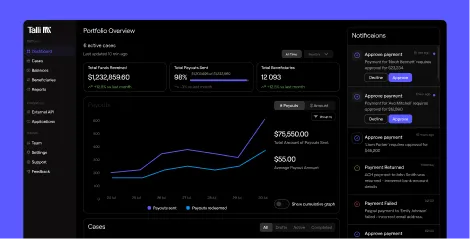
Talli's AI-driven payment platform addresses these complexities by automating fund segregation and providing real-time visibility into distribution status—critical capabilities when managing multi-year, multi-jurisdictional settlements.
Ensuring Compliance and Preventing Fraud in Mass Payouts
Across these three pharmacy settlements, remediation minimums range from 85% (Walmart) to 95% (Walgreens) to 95.5% (CVS), with settlement structures generally requiring at least 70% of funds be dedicated to future opioid remediation. These restrictions aim to avoid the mistakes of tobacco settlements, where minimal funds reach intended public health purposes.
The Importance of Robust Verification Processes
Compliance requirements include:
- Anti-supplantation provisions: 13 states plus DC prohibit using settlement funds to replace existing budget allocations
- Approved use alignment: Non-exhaustive list of approved uses including prevention, treatment, recovery, and harm reduction
- Annual reporting: Required submissions to Settlement Fund Administrator with attestation of remediation use percentages
- Audit trails: Documentation requirements for potential regulatory review
Protecting Funds and Stakeholders
With many states still developing comprehensive spending plans, transparency gaps create accountability risks that proper settlement administration can address.
Talli addresses compliance challenges through built-in KYC, OFAC screening, W-9 collection, and fraud mitigation protocols. Complete audit logs ensure every transaction is documented for regulatory review—essential when managing funds under strict remediation requirements.
Real-Time Tracking and Transparency for Settlement Funds
The RAND Corporation study validated that proper fund allocation directly impacts public health outcomes—making transparent tracking more than an administrative function.
The Need for Immediate Data Access
States with interactive dashboards (Minnesota, North Carolina) demonstrate best practices in settlement transparency:
- Real-time visibility into payment status
- Geographic distribution mapping
- Target population tracking
- Funding category breakdowns
Benefits of Centralized Visibility
Talli's platform provides settlement administrators with:
- Complete fund segregation: Dedicated QSF accounts for every settlement preserving ownership
- Real-time dashboards: Monitor delivery, completion, and engagement instantly
- CRM integration: Sync payout data with existing systems
- Stakeholder reporting: Built-in tools for compliance documentation
Enhancing Claimant Experience in Opioid Settlement Distributions
While pharmacy settlements distribute to government entities rather than individual claimants, the principles of recipient experience matter for downstream programs funded by these settlements. Treatment providers, recovery organizations, and harm reduction services receiving grants from settlement funds face their own distribution challenges.
Making Payouts Easy and Accessible
Programs funded by opioid settlement dollars serve vulnerable populations who may lack traditional banking access. Flexible payment options become essential:
- Digital wallet integration for unbanked recipients
- Prepaid card distribution for immediate access
- Direct deposit for organizations with banking relationships
- Real-time tracking for fund recipients
Driving Higher Engagement and Completion
Talli's platform ensures recipients can choose payment methods, with smart reminders via email and SMS to maximize completion rates. When settlement-funded programs distribute resources to individuals in recovery, seamless payment experiences reduce barriers to accessing support.
Future Implications: Opioid Abatement and Community Impact Beyond 2026
These multi-year payment timelines extend well beyond 2026, requiring sustained infrastructure for fund management. Community advocates emphasize that monitoring settlement fund deployment represents both a marathon effort and a daily sprint to save lives.
Funding for Recovery and Support Services
Approved uses under settlement agreements include:
- Addiction treatment services
- Prevention education programs
- Recovery support services
- Harm reduction initiatives (naloxone distribution, syringe services)
- First responder training and equipment
Measuring the Effectiveness of Abatement Efforts
The RAND study provides early evidence that settlement funds reduce overdose deaths when properly allocated. Continued measurement requires:
- Standardized outcome metrics across jurisdictions
- Connection between spending categories and health outcomes
- Long-term tracking beyond initial implementation years
- Comparison of different allocation strategies
How Talli Simplifies Opioid Settlement Administration
Managing opioid settlement distribution across 4,496+ jurisdictions with 50+ allocation formulas and 18-year timelines demands purpose-built technology rather than generic payment processing. Talli's AI-driven platform was built specifically for claims teams managing these complex legal payouts.
The platform addresses every critical challenge settlement administrators face:
- Fund segregation: Dedicated accounts for each settlement preserving QSF tax treatment
- Compliance automation: Built-in KYC, OFAC screening, and W-9 collection for every transaction
- Real-time visibility: Instant dashboards showing distribution status across all jurisdictions
- Audit readiness: Complete transaction logs for regulatory review
- Flexible distribution: Supporting multiple payment methods for diverse recipient needs
With settlement payment automation, what used to take weeks now happens in minutes. Banking services provided by Patriot Bank, N.A., Member FDIC, ensure funds remain secure throughout the distribution lifecycle.
For settlement administrators managing opioid abatement funds or any large-scale legal payout, Talli offers the speed, compliance, and transparency needed to ensure every dollar reaches its intended purpose—saving lives and supporting recovery.
Frequently Asked Questions
Which states opted out of the pharmacy opioid settlements?
Geographic participation varies significantly. Florida’s Walgreens payments were handled outside the National Settlement framework pursuant to an agreement that pre-dated the National Settlement. Alabama, New Mexico, and West Virginia were excluded from certain settlements due to prior separate agreements. Texas and Nevada have separate payment structures outside the national settlement for certain defendants. These variations create a complex patchwork requiring settlement administrators to track state-specific participation status.
What happens if settlement funds are misspent on non-opioid purposes?
Settlement agreements include reporting requirements and potential consequences for misuse. The agreements specify that 85-95.5% of funds must be spent on opioid remediation, with annual attestation requirements submitted to the Settlement Fund Administrator. While enforcement mechanisms vary by jurisdiction, public transparency and advocacy group monitoring provide accountability. States with anti-supplantation provisions have additional restrictions preventing settlement funds from replacing existing budget allocations.
How do pharmacy settlements differ from manufacturer and distributor settlements?
The $50+ billion national settlement framework includes multiple defendant categories. Manufacturers (like Johnson & Johnson) paid approximately $5 billion, the three major distributors and Janssen/J&J committed roughly $26 billion, and the three pharmacy chains agreed to $13.8 billion combined. Pharmacy settlements uniquely include injunctive relief requiring operational changes at the dispensing level—pharmacist empowerment, suspicious order monitoring, and data sharing with regulators—that other settlements did not mandate.
What is the role of BrownGreer in administering these settlements?
BrownGreer PLC serves as the court-appointed Settlement Fund Administrator, handling payment calculations, distribution tracking, and beneficiary verification across all three pharmacy settlements. The firm maintains the National Opioid Settlement Dashboard providing real-time payment data and manages the 21-day dispute period process before final payment release. Their role ensures consistent administration across the fragmented jurisdictional landscape.
How can communities influence how settlement funds are spent locally?
Community engagement varies by state structure. Some jurisdictions hold public listening sessions, conduct online surveys, or maintain advisory councils with community representation. Wisconsin and New Jersey have implemented digital tools for public input. Advocacy organizations provide state-by-state guides helping community members understand local decision-making processes and opportunities to participate in allocation decisions.