.svg)


.svg)
Comprehensive data compiled from extensive research on data breach litigation, settlement administration, and claimant payout trends
Key Takeaways
- Data breach settlements reached record levels in 2024 – The top 10 class action settlements totaled $593.2 million, a 15% increase from $515.75 million in 2023, signaling accelerating litigation activity across all industries
- Settlement fund totals expanded dramatically – Data breach settlements grew from $1.32 billion in 2023 to $2.01 billion in 2024, representing a 52% year-over-year increase that demands more efficient digital disbursement infrastructure
- Healthcare breaches carry the highest costs – Healthcare data breaches averaged $9.77 million per incident in 2024, while the Change Healthcare breach affected 192.7 million people—the largest healthcare breach ever recorded
- US organizations face the steepest breach costs globally – The average cost of a data breach in the United States reached $9.8 million in 2024, the highest of any country and more than double the global average
- Detection and containment timelines remain extended – Organizations take an average of 194 days to identify a breach and 64 additional days to contain it, creating prolonged exposure windows for affected individuals
- Vendor and supply chain breaches dominate – Eight of the twenty largest breaches in 2025 occurred at service providers, accounting for 231 million of the 375 million affected individuals
Understanding the Landscape of Data Breach Settlements
1. Top 10 data breach settlements totaled $593.2 million in 2024
The aggregate value of the top 10 class action settlements in the data breach space reached $593.2 million in 2024, marking a 15% increase over 2023's $515.75 million. This growth reflects both increasing settlement values and more aggressive plaintiff litigation strategies across industries. Source: Duane Morris LLP
2. Total data breach settlements expanded 52% year-over-year
Data breach settlements expanded from $1.32 billion in 2023 to $2.01 billion in 2024, representing a 52% increase in total settlement fund value. This dramatic growth creates unprecedented operational challenges for settlement administrators who must distribute funds to millions of claimants while maintaining strict compliance standards. Source: Duane Morris LLP
3. Global average data breach cost reached $4.88 million in 2024
The average cost of a data breach globally was $4.88 million in 2024, representing a 10% increase over 2023. These costs include detection, escalation, notification, post-breach response, and lost business—but notably exclude the significant administrative burden of managing subsequent settlement distributions. Source: IBM Data Breach
4. US data breach costs lead globally at $9.8 million average
The average cost of a data breach in the United States was $9.8 million in 2024, the highest of any country globally. This premium reflects stringent regulatory requirements, active plaintiff litigation, and sophisticated breach response expectations in the US market. Source: IBM
5. Three of the largest data breach securities settlements ever occurred in 2024
Three of the top ten largest data breach securities settlements of all time occurred in 2024, indicating accelerating enforcement and litigation activity. This clustering of major settlements signals a fundamental shift in how courts and regulators approach data privacy violations. Source: Harvard Law School Forum
Major Settlement Examples and Claimant Impact
6. Meta agreed to $1.4 billion Texas biometric data settlement
Meta agreed to pay Texas $1.4 billion for unlawfully capturing biometric data, making it the largest privacy settlement in US history. This landmark settlement demonstrates the massive financial exposure companies face for data privacy violations and creates significant administrative challenges for distributing funds to millions of affected Texas residents. Source: Infosecurity Magazine
7. Alphabet settled data breach securities claims for $350 million
Alphabet (Google) agreed to a $350 million settlement for data breach-related securities claims, establishing the largest data breach securities settlement ever recorded. The settlement stemmed from allegations that the company failed to disclose a bug exposing user data for more than three years. Source: Harvard Law School Forum
8. Zoom Video Communications settled for $150 million
Zoom Video Communications settled data breach-related securities claims for $150 million in 2024, stemming from false statements about encryption levels during the company's rapid growth period. This settlement highlights how privacy and security representations create substantial legal exposure for technology companies. Source: 11thEstate
9. Marriott agreed to $52 million multi-state settlement
Marriott agreed to pay $52 million to 50 US states for a massive data breach impacting 131.5 million American customers. Multi-state settlements create particularly complex distribution requirements, as administrators must track payments across jurisdictions while maintaining compliance with varying state requirements. Source: Infosecurity Magazine
10. Lehigh Valley Health Network settlement reached $65 million
Lehigh Valley Health Network agreed to a $65 million class action settlement after patient photos were hacked, with individual payouts ranging from $50 to $70,000 per person. This represents the largest per-patient settlement in healthcare breach-ransomware cases, reflecting courts' recognition of heightened harm from medical data exposure. Source: Infosecurity Magazine
Healthcare Sector: The Most Expensive Breach Category
11. Healthcare data breaches averaged $9.77 million per incident
Healthcare data breaches remained the most expensive at $9.77 million average cost per breach in 2024, reflecting the sensitive nature of medical information and stringent HIPAA requirements. This cost premium creates substantial settlement funds requiring careful administration and robust compliance features. Source: IBM Report
12. Healthcare accounted for 66% of all affected individuals in 2025
Healthcare accounted for 66% of all affected individuals in 2025 data breaches, demonstrating the sector's disproportionate exposure to large-scale incidents. This concentration means healthcare-related settlement distributions represent the majority of claimant payment volume requiring scalable infrastructure. Source: Privacy Rights Clearinghouse
13. Change Healthcare breach affected 192.7 million people
Change Healthcare's breach affected 192.7 million people, making it the largest healthcare data breach ever recorded. Breaches of this magnitude create unprecedented distribution challenges, requiring platforms capable of processing payments at scale while maintaining individual claimant tracking and compliance verification. Source: Privacy Rights Clearinghouse
Financial and Industrial Sector Breach Costs
14. Financial sector data breaches averaged $6.08 million per incident
Financial sector data breaches averaged $6.08 million per incident in 2024, the second-highest industry cost after healthcare. Financial services settlements require particularly rigorous compliance measures, including verification of banking relationships and regulatory standing for all claimants. Source: IBM Financial Industry
15. Financial companies saw 17% stock decrease post-breach
Financial companies saw a 17% decrease in value against the NASDAQ within the first 16 trading days post-breach, reflecting investor concern about data security failures. These stock impacts often trigger securities litigation in addition to consumer class actions, creating multiple settlement streams requiring coordination. Source: Harvard Law School Forum
16. Industrial sector breaches cost $5.56 million on average
Industrial sector data breaches cost an average of $5.56 million in 2024, an 18% increase from 2023 representing the highest year-over-year growth of any industry. This $830,000 per-breach increase reflects growing operational technology vulnerabilities and supply chain integration risks. Source: IBM Industrial Sector
Breach Detection, Containment, and Stock Impact
17. Average breach detection takes 194 days
It takes an average of 194 days to identify a data breach globally, creating extended windows where compromised data circulates before organizations can respond. This prolonged detection timeline contributes to larger affected populations and more complex settlement requirements with thorough claimant verification processes. Source: IBM Report
18. Breach containment requires 64 additional days on average
It takes an average of 64 days to contain a data breach globally after initial detection, extending the total incident lifecycle to 258 days. This containment period allows continued data exposure and increases the complexity of determining affected claimant populations for settlement administrators. Source: IBM Report
19. Companies experience 7.27% stock price drop post-breach
Companies experiencing data breaches saw an average 7.27% share price drop following the breach announcement, with recovery taking an average of 46 days. This market reaction often triggers parallel securities litigation alongside consumer protection claims requiring comprehensive tracking and reporting. Source: Harvard Law School Forum
20. Less than 10% of breaches meet 30-day notification standards
Less than 10% of breaches would meet California's new 30-day notification standard, with the most common notification window being 91 to 180 days. Extended notification timelines delay settlement proceedings and complicate claimant outreach efforts throughout prolonged notification processes. Source: Privacy Rights Clearinghouse
Ransomware and Vendor Breach Trends
21. 72.7% of businesses worldwide fell victim to ransomware in 2023
72.7% of businesses worldwide had fallen victim to ransomware attacks in 2023, demonstrating the ubiquitous nature of this threat vector. Ransomware incidents increasingly result in class action litigation as affected individuals seek compensation for exposed personal information requiring robust fraud mitigation. Source: Harvard Law School Forum
22. Ransomware attacks generated over $1 billion in payments to criminals in 2023
Ransomware attacks led to over $1 billion in ransoms being paid to cybercriminals in 2023, funding increasingly sophisticated criminal enterprises. These payments often fail to prevent subsequent data exposure and class action litigation, requiring settlement administrators to implement robust fraud mitigation measures. Source: Harvard Law School Forum
23. Eight of 20 largest breaches occurred at service providers
Eight of the twenty largest breaches in 2025 occurred at service providers, accounting for 231 million of the year's 375 million affected individuals. Supply chain and vendor breaches create complex settlement scenarios involving multiple potentially liable parties requiring clear fund segregation. Source: Privacy Rights Clearinghouse
24. 4,080 unique breach events impacted 375 million individuals in 2025
In 2025, 4,080 unique breach events impacted at least 375 million individuals, representing continued growth in both breach frequency and scale. This volume creates sustained demand for efficient settlement distribution infrastructure capable of managing multiple concurrent settlements simultaneously. Source: Privacy Rights Clearinghouse
Regulatory Enforcement and International Fines
25. LinkedIn received €310 million GDPR fine
LinkedIn was fined €310 million ($336 million) by Ireland's Data Protection Commission for GDPR violations related to failing to obtain consent for third-party data processing. International regulatory actions create additional settlement complexity as administrators must navigate varying jurisdictional requirements. Source: Infosecurity Magazine
26. Uber received $324 million fine for data transfer violations
Uber was hit with a ($324 million) fine by Dutch authorities for failing to protect driver data during transfers to US-based systems over a two-year period. Cross-border data violations increasingly trigger both regulatory penalties and private litigation. Source: Infosecurity Magazine
27. Data breaches in the US nearly tripled since 2020
The number of data breaches in the United States nearly tripled since 2020, with a record 3,205 data breaches recorded in 2023. This explosive growth trajectory shows no signs of slowing, creating sustained demand for scalable settlement distribution infrastructure. Source: Harvard Law School Forum
Recent Major Settlements
28. 23andMe agreed to $30 million data breach settlement
23andMe agreed to pay $30 million to victims of a major 2023 data breach involving highly sensitive genetic information. Genetic data breaches create unique administrative challenges given the personal nature of exposed information requiring appropriate privacy protections. Source: Infosecurity Magazine
29. T-Mobile agreed to $15.75 million FCC settlement
T-Mobile agreed to a $15.75 million settlement with the FCC for multiple cybersecurity incidents, reflecting regulatory enforcement alongside private litigation. Telecommunications settlements often involve massive claimant populations requiring efficient digital distribution methods and flexible payout options. Source: Infosecurity Magazine
Modernizing Settlement Distribution for the Data Breach Era
The unprecedented growth in data breach settlements demands a fundamental shift in how claims administrators approach distribution. With $2.01 billion in settlements in 2024 alone and breaches affecting hundreds of millions of individuals, traditional paper check systems cannot scale to meet current demands. Modern digital disbursements enable administrators to process payments at scale while maintaining strict compliance and security standards.
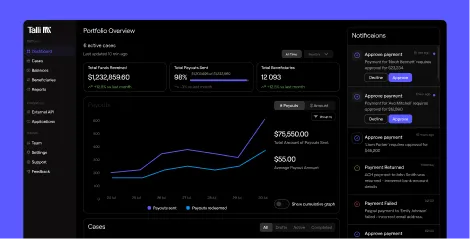
Settlement administrators face multiple challenges simultaneously: ensuring legal payout compliance across jurisdictions, managing OFAC compliance screening, preventing settlement fraud, and maximizing redemption rates. AI-driven platforms like Talli address these challenges by reducing distribution timelines from weeks to days while providing real-time dashboards for complete visibility throughout the payout lifecycle.
By implementing comprehensive compliance capabilities including built-in KYC, OFAC screening, and W-9 collection, modern platforms reduce administrative burden while ensuring funds reach legitimate claimants. This approach minimizes unclaimed funds and improves outcomes for affected individuals while maintaining the rigorous standards required in class action administration. Banking services provided by Patriot Bank, N.A., Member FDIC.
Frequently Asked Questions
What is the average settlement amount for a data breach?
The average cost of a data breach globally was $4.88 million in 2024, though this figure represents organizational costs rather than per-claimant payouts. Individual settlement amounts vary dramatically based on breach severity, data sensitivity, and affected population size. The Lehigh Valley Health Network settlement demonstrated individual payouts ranging from $50 to $70,000, while larger class actions typically result in smaller per-person payments due to vast claimant populations.
How long does it take to receive a payout from a data breach settlement?
Traditional settlement distributions can take 6 months to several years to reach claimants, primarily due to manual processing, paper check logistics, and inadequate claimant outreach. Modern AI-driven payment platforms significantly compress these timelines by automating verification, offering digital payment options, and implementing smart reminder sequences to ensure claimants complete the payout process efficiently.
What is the significance of unclaimed money in data breach class actions?
Unclaimed settlement funds represent a significant challenge for claims administrators and courts alike. With participation rates often in single digits, billions of dollars in settlement funds go unredeemed annually. This impacts the remedial purpose of settlements while creating administrative complications for fund disposition. Multi-channel engagement strategies combining email, SMS, and personalized follow-ups help increase participation and reduce unclaimed balances.
Are data breach settlement payouts taxable?
Tax treatment of data breach settlement payouts depends on the nature of damages being compensated. Payments for emotional distress or lost wages are generally taxable as ordinary income, while compensation for out-of-pocket expenses may be non-taxable. Settlement administrators must implement W-9 collection processes for payments exceeding IRS reporting thresholds and issue appropriate 1099 forms for tax compliance.
How can I find out if I am eligible for a data breach settlement?
Eligibility for data breach settlements typically requires demonstrating that your personal information was compromised in the specific incident. Settlement administrators send notices to affected individuals using contact information from the breached organization's records. Claimants can also check official settlement websites or class action databases for open claims periods and eligibility requirements for current settlements.