.svg)


.svg)
The House v. NCAA settlement represents the most significant restructuring of college athletics in modern history, establishing a framework where universities can directly pay student-athletes while creating massive administrative challenges for institutions managing multi-million-dollar disbursements. With a $2.8 billion settlement approval over 10 years and annual revenue-sharing caps reaching approximately $20.5 million per school, athletic departments and legal teams now face unprecedented compliance and payment processing demands. Platforms designed for class action settlement administration offer the infrastructure required to handle these complex, high-volume distributions efficiently.
Key Takeaways
- The NCAA NIL settlement creates a $2.8 billion back damages fund distributed over 10 years to eligible current and former student-athletes
- Schools can now pay athletes directly up to approximately $20.5 million annually (2025-26), with the cap increasing around 4% each year through 2034-35
- The College Sports Commission (CSC) serves as the new enforcement body, responsible for reviewing thousands of NIL deals
- Noninstitutional NIL contracts or payment terms valued at $600 or more must be reported to the NIL Go clearinghouse within five business days
- Scholarship limits are eliminated and replaced with roster limits (105 for football, 15 for basketball)
- Title IX compliance remains uncertain, creating significant legal risk for schools making disproportionate payments
- Athletic departments need sophisticated payment processing infrastructure to disburse millions annually to hundreds of athletes while maintaining regulatory compliance
Understanding the NCAA NIL Landscape and Settlement Context for 2026
The House v. NCAA settlement, approved by Judge Claudia Wilken on June 6, 2025, fundamentally restructures how college athletes receive compensation. This case consolidated multiple lawsuits challenging the NCAA's restrictions on athlete compensation, ultimately resulting in a settlement that acknowledges athletes' rights to share in the revenues they help generate.
The settlement addresses three core areas:
- Back damages compensation for athletes whose NIL rights were suppressed during the settlement period from June 15, 2016 through September 15, 2024
- Prospective revenue sharing allowing schools to pay athletes directly from athletics revenue
- Structural reforms including scholarship limit elimination and new roster caps
The NIL landscape has evolved rapidly since the NCAA first permitted athletes to profit from their name, image, and likeness in July 2021. However, the unregulated environment led to concerns about competitive imbalances, pay-for-play schemes disguised as NIL deals, and compliance chaos across Division I athletics.
The settlement establishes a formal framework that legitimizes direct payments while creating oversight mechanisms through the College Sports Commission.
Financial Implications and Claimant Payouts in the 2026 NCAA NIL Settlement
The financial scope of this settlement exceeds anything previously seen in college athletics. The Knight Commission analysis provides comprehensive modeling of the institutional impacts, revealing both the scale of required payments and the complexity of administration.
Back Damages Distribution Structure
The back-damages payout will be distributed over a decade to eligible athletes who competed during the settlement period from June 15, 2016 through September 15, 2024:
- Year 1-4 (2025-2029): Higher payments to compensate athletes closest to their competitive years
- Year 5-10 (2030-2035): Graduated payments completing the settlement obligation
- Payment allocation: Based on sport, scholarship status, and years of eligibility
This distribution model mirrors class action settlement structures where claimants receive tiered payments based on documented harm. The complexity of reaching potentially hundreds of thousands of former athletes creates substantial administrative challenges.
Revenue Sharing Cap Mechanics
The approximately $20.5 million annual cap represents roughly 22% of average Power 4 conference revenue. This figure increases predictably:
- 2025-26: $20.5 million
- 2026-27: $21.32 million (around 4% increase)
- 2027-28: $22.17 million
- 2034-35: Projected $32.9 million
Schools have complete discretion over internal allocation, highlighting the variation in institutional approaches across Division I athletics.
Payment Processing Infrastructure Requirements
Athletic departments now face the operational challenge of disbursing millions annually to hundreds of athletes. This requires:
- Sophisticated payment systems capable of processing high-volume distributions
- Tax documentation management for W-9 collection and 1099 generation
- Audit trail maintenance for regulatory compliance and court reporting
- Multi-channel payment options to accommodate athlete preferences
Platforms designed for bulk disbursement management offer the infrastructure needed to handle these complex payment scenarios while maintaining compliance with federal tax requirements.
Legal and Administrative Challenges of the NCAA NIL Settlement Distribution
The operational complexity of implementing this settlement creates significant challenges for legal teams, compliance officers, and athletic administrators. The College Sports Commission has assumed enforcement authority, but questions remain about capacity and effectiveness.
College Sports Commission Enforcement
The CSC operates as the new regulatory body for Division I athletics, taking over from the NCAA's traditional enforcement role. The commission's review process includes "valid business purpose" assessment, with schools—not athletes—facing primary enforcement consequences.
NIL Go Clearinghouse Requirements
The NIL Go platform serves as the mandatory reporting system for all NIL activity. NCAA proposed rules establish:
- $600 threshold: Noninstitutional NIL contracts or payment terms valued at $600 or more require reporting
- Five-business-day deadline: Deals must be submitted within five business days of execution or agreement to payment terms
- Documentation requirements: Contracts, deliverables, and payment terms
- Three-tier classification: Institutional NIL, associated entity NIL, and independent third-party NIL
This reporting structure parallels requirements in automated claims processing, where systematic documentation and deadline compliance determine successful administration.
"Valid Business Purpose" Assessment
The settlement introduces assessment criteria for third-party NIL deals:
- Commercial promotion: The arrangement must promote goods or services to the public for profit
- Fair market value: Compensation must align with similarly situated non-athletes
- Direct NIL activation: Contracts must specify actual use of name, image, or likeness rights
Associated entity deals (those from boosters and collectives) face heightened scrutiny under this framework, with the CSC authorized to reject arrangements that appear to circumvent pay-for-play prohibitions.
Fraud Prevention Requirements
The scale of payments creates vulnerability to fraudulent claims. Modern claims fraud detection systems utilize pattern recognition, identity verification, and behavioral analytics to identify suspicious activity. For NIL settlement administration, these capabilities address:
- Identity verification confirming claimant eligibility
- Duplicate claim detection across the athlete database
- Documentation validation for supporting materials
- Payment pattern analysis flagging anomalies
Who Benefits: Eligibility Criteria for Student-Athletes in the NIL Settlement
The settlement creates distinct eligibility pathways for current athletes and former competitors. Understanding these criteria helps legal teams prepare for the claim administration process.
Back Damages Eligibility
Athletes who competed during the settlement period may qualify for back payments based on:
- Sport participation: All Division I sports included, with allocation varying by sport
- Scholarship status: Scholarship athletes receive priority in payment calculations
- Years of competition: Payment amounts scale with duration of eligibility
- Television exposure: Athletes in televised sports may receive enhanced allocations
The Knight Commission brief notes that past damages allocation decisions "are not receiving any sort of Title IX approval by the Court. As such, the past damages allocation framework should not be relied upon as setting the standard for satisfying a school's Title IX obligations moving forward."
Prospective Revenue Sharing Eligibility
Current athletes at participating schools can receive direct payments subject to:
- Roster status: Only athletes on official team rosters qualify
- Institutional participation: School must opt into revenue sharing
- Contract execution: Athletes must sign agreements with their institution
- Compliance verification: Payments cleared through institutional compliance
Opt-In vs. Opt-Out Scenarios
The settlement creates different requirements based on conference affiliation:
Power 4 Conferences (Mandatory):
- ACC, Big Ten, Big 12, SEC must participate in revenue sharing
- Subject to full CSC enforcement oversight
- Must implement roster limits
- Bear proportional share of damages payments
Non-Power 4 Division I (Optional):
- Can choose whether to opt into revenue sharing
- Still subject to NIL Go reporting regardless of opt-in status
- Must weigh financial capacity against competitive considerations
Ensuring Equitable and Transparent Payouts with Digital Solutions
The complexity of distributing millions of dollars to hundreds of athletes demands sophisticated payment infrastructure. Traditional paper-based systems cannot meet the speed, accuracy, and compliance requirements of NIL settlement administration.
Multi-Channel Payment Distribution
Athletes represent a diverse population with varying banking access and preferences. Effective payment systems must offer multiple disbursement channels:
- ACH direct deposit: Lowest-cost option for banked recipients
- Prepaid cards: Serves athletes without traditional banking relationships
- Digital wallets: PayPal, Venmo integration for instant access
- Wire transfers: Same-day option for high-value payments
- Paper checks: Fallback for recipients preferring traditional methods
Offering diverse payment options significantly improves redemption rates—a critical factor when attempting to reach all eligible former athletes.
Real-Time Tracking and Transparency
Athletic departments, athletes, and oversight bodies all require visibility into payment status. Essential capabilities include:
- Live payment tracking: Real-time status updates for all disbursements
- Completion rate monitoring: Dashboard visibility into percentage of successful payouts
- Failure analysis: Root cause identification for rejected or returned payments
- Court-ready reporting: Automated generation of required documentation
Digital infrastructure can compress distribution timelines from weeks to days while maintaining complete audit trails.
Audit Trail Requirements
Both the settlement terms and ongoing CSC oversight require comprehensive documentation. Legal disbursement systems must capture:
- Payment authorization: Who approved each disbursement
- Timing verification: Timestamps for all transactions
- Recipient confirmation: Proof of delivery and acceptance
- Compliance checkpoints: Documentation of regulatory verification
Impact of the 2026 NCAA NIL Settlement on Collegiate Sports Business Models
The settlement forces fundamental restructuring of how athletic departments operate financially. Knight Commission research reveals that most Division I programs already operate at deficits, with median institutional subsidy requirements varying dramatically between Power 4 and non-Power 4 schools.
Resource Allocation Pressures
Schools must now balance multiple competing demands:
- Revenue sharing obligations: Up to approximately $20.5 million annually
- Traditional operating costs: Facilities, travel, staff
- Compliance infrastructure: New staff, technology, legal support
- Non-revenue sport sustainability: Maintaining Olympic sports programs
Roster Limit Implementation
The elimination of scholarship limits and implementation of roster caps changes team composition:
- Football: 105 roster limit (previously 85 scholarships, unlimited walk-ons)
- Men's basketball: 15 roster limit (previously 13 scholarships)
- Women's basketball: 15 roster limit
- All scholarships become equivalencies: Schools can divide scholarship value among more athletes
Title IX Uncertainty
The most significant legal risk facing institutions involves Title IX compliance. The Office for Civil Rights initially issued guidance in January 2025 requiring proportional revenue-sharing distributions, then rescinded that guidance in February 2025.
This uncertainty exposes schools to potential litigation if revenue-sharing distributions disproportionately favor male athletes in revenue sports.
Tax Implications and W-9 Compliance for NIL Settlement Recipients
Athletes receiving settlement payments and ongoing revenue-sharing distributions face tax obligations that create compliance burdens for both recipients and administering institutions.
Tax Classification of Payments
Different payment types receive different tax treatment:
- Back damages payments: Generally taxable as ordinary income
- Revenue-sharing payments: Taxable compensation requiring appropriate documentation
- Third-party NIL income: Self-employment income with quarterly estimated tax obligations
- Scholarship value: Generally tax-exempt under IRC Section 117
W-9 Collection Requirements
Institutions must collect W-9 forms from all payment recipients. Streamlined tax compliance systems address:
- Digital W-9 collection: Online forms with electronic signature capability
- TIN verification: Validation against IRS databases
- Backup withholding: 24% withholding for missing or invalid TINs
- Smart reminders: Automated follow-up achieving higher completion rates
1099 Generation and Filing
At year-end, institutions must generate and file appropriate tax forms:
- 1099-MISC: For payments exceeding $600 in aggregate
- 1099-NEC: For non-employee compensation
- IRS e-filing integration: Electronic submission of information returns
- Recipient distribution: Timely delivery of tax documents to athletes
Automated compliance systems can significantly improve W-9 completion rates through smart reminders—a critical factor when managing documentation for hundreds of athletes.
Future of NIL: Post-Settlement Reforms and Long-Term Outlook for Athletes
The settlement establishes a framework but leaves numerous questions unresolved. Legal experts anticipate continued litigation and potential federal intervention.
Employee Classification Debate
The settlement explicitly avoids addressing whether athletes are employees. Ongoing litigation continues to challenge this distinction, with potential implications including:
- Collective bargaining rights: Athletes could organize and negotiate
- Minimum wage applicability: Schools could face wage and hour claims
- Benefits requirements: Health insurance, workers' compensation exposure
- NLRB jurisdiction: Federal labor law could apply to athletic departments
Federal Legislation Proposals
Multiple bills have been introduced to address college athletics, though neither has passed as of 2026. The NCAA continues lobbying for federal intervention to create national standards and resolve the employment question definitively.
2026-2030 Predictions
Industry observers anticipate several developments:
- CSC enforcement ramp-up: First major penalties expected in 2026
- Title IX litigation: Female athletes likely to challenge disproportionate allocations
- Collective business model pivot: Third-party groups shifting to legitimate marketing services
- Technology adoption acceleration: Schools seeking automated compliance solutions
- Non-Power 4 sustainability challenges: Some programs may exit Division I athletics
Streamlining NIL Settlement Administration with Talli
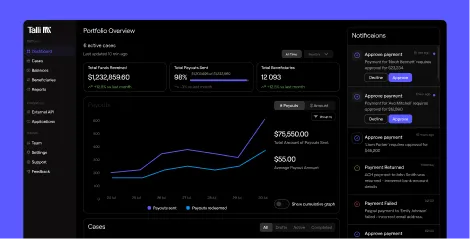
Athletic departments facing the unprecedented challenge of distributing millions in back damages and ongoing revenue-sharing payments require purpose-built infrastructure that addresses the unique complexity of NIL settlement administration. Talli's platform provides athletic compliance teams with the tools needed to manage high-volume disbursements while maintaining regulatory compliance.
The platform offers end-to-end processing capabilities from claimant notification through final reconciliation, with automated W-9 collection, TIN verification, and 1099 generation. Real-time tracking dashboards provide visibility for administrators, oversight bodies, and recipients, while multi-channel payment options ensure athletes can access funds through their preferred method—whether ACH direct deposit, digital wallets, or prepaid cards.
With built-in fraud detection, identity verification, and complete audit trails, Talli's solution helps athletic departments meet the dual demands of efficient distribution and rigorous compliance. As the NIL landscape continues to evolve, having robust payment infrastructure in place positions institutions to adapt to changing regulations while maintaining focus on supporting student-athletes.
Frequently Asked Questions
How will former athletes receive notification about their eligibility for back damages?
The settlement administrator will use historical NCAA records to identify potentially eligible athletes based on participation data from the settlement period (June 15, 2016 through September 15, 2024). Former athletes should ensure their contact information is updated with their former institutions and watch for official communications from the settlement administrator. A formal claims process will require submission of documentation verifying eligibility, including proof of athletic participation and identity verification.
What happens if a third-party NIL deal is rejected by the CSC?
When the CSC determines a deal lacks a "valid business purpose," the arrangement is flagged and cannot proceed as structured. Athletes can appeal the decision through the CSC's arbitration process, modify the deal terms to address compliance concerns, or abandon the arrangement. Importantly, the CSC has stated it will target institutions—not individual athletes—for enforcement actions, though athletes face eligibility risk if they proceed with unapproved deals.
How do international student-athletes participate in NIL and revenue sharing?
International athletes on F-1 student visas face unique challenges. Work authorization rules generally prohibit off-campus employment, creating ambiguity around third-party NIL deals. However, revenue-sharing payments from the institution may be permissible under certain visa conditions. International athletes should consult with immigration attorneys and their international student services office before executing any NIL arrangements or accepting institutional payments.
Can athletes at schools that opt out of revenue sharing still earn NIL income?
Yes, third-party NIL opportunities remain available to all Division I athletes regardless of their school's revenue-sharing participation status. Athletes at non-participating schools can still sign endorsement deals, appearance contracts, and social media sponsorships through independent third parties. However, these athletes would not receive direct institutional payments, potentially creating competitive recruiting disadvantages for their programs.
What documentation should athletes maintain for tax purposes?
Athletes should keep copies of all NIL contracts, payment records, and 1099 forms received from schools and third parties. For third-party NIL income classified as self-employment, athletes should track business expenses that may be deductible (agent fees, travel for appearances, equipment for content creation). Quarterly estimated tax payments may be required for substantial NIL income. Consulting with a tax professional familiar with athlete compensation is advisable given the complexity of multiple income sources.