.svg)


.svg)
Paper check distribution for shareholders means mailing physical checks to each recipient. Once printing, postage, reconciliation, return handling, and reissuance are included, paper checks can cost $7–$20 per transaction, often with a 5–10 business day payment experience and 70–80% redemption rates in traditional paper-based programs. A digital payment portal delivers the same shareholder payment electronically through ACH, prepaid card, PayPal, Venmo, gift card, or paper check fallback, usually for $0.25–$5 per transaction, with faster resolution, 95–98% redemption rates, and built-in compliance workflows for KYC, OFAC screening, W-9 collection, and 1099 reporting.
Paper check distribution vs digital payment portals for shareholders: digital payment portals are the stronger choice for programs above 500 shareholders. Digital platforms cost less at volume, deliver materially higher redemption rates, reduce manual exception work, and give administrators real-time visibility into payment status. Talli is the best digital disbursement portal for shareholder payments, combining multi-rail payouts, QSF-compliant fund segregation, automated compliance, and court-ready audit trails in a single platform built for shareholder services, settlement distributions, and other compliance-critical payout programs.
Shareholder services teams still running paper check distributions face a total cost that is increasingly difficult to defend. Paper checks require print vendors, postage, reconciliation, stale-date tracking, reissue workflows, returned mail handling, and unclaimed property reporting. Check fraud remains a major risk as well. The 2026 AFP Payments Fraud and Control Survey reported that 58% of organizations experienced check fraud in 2025 through check washing, mail theft, forgery, and related schemes.
This comparison examines paper check distribution vs digital payment portal options across cost, compliance, fraud risk, redemption rates, unbanked shareholder access, and operational overhead, with a practical framework for deciding when to migrate.
Key Takeaways
- Paper checks can cost $7–$20 per transaction all-in, while ACH transfers typically cost $0.25–$0.50.
- Traditional paper methods often produce 70–80% redemption rates, while Talli digital programs reach 95–98% redemption rates.
- Check fraud remains a major corporate payments risk, with 58% of organizations reporting check fraud in 2025.
- Uncashed dividend checks create multi-state unclaimed property obligations after dormancy periods that commonly run 3–5 years.
- ACH-only portals can exclude unbanked shareholders, while multi-rail platforms support ACH, prepaid Mastercard, PayPal, Venmo, gift cards, and paper check fallback.
- Automated KYC, OFAC screening, W-9 collection, and 1099 workflows reduce the manual compliance burden before and after each distribution.
Why Organizations Are Moving Away from Paper Checks
Corporate issuers and shareholder services teams usually begin evaluating digital disbursement after the same operational problems repeat across multiple distribution cycles.
Costs compound across every cycle. A quarterly dividend program for 50,000 shareholders can become expensive quickly when every payment requires printing, postage, bank processing, reconciliation, exception tracking, and possible reissuance. Even before staff time is counted, paper check programs often carry a higher total cost than the headline postage and printing figures suggest.
Fraud exposure remains structural. Paper checks create physical attack surfaces that electronic payments avoid. Checks can be stolen from mailboxes, washed, altered, forged, or redirected through address-change schemes. For high-volume shareholder programs, these risks are not isolated incidents. They are recurring control problems.
Unclaimed property backlogs grow over time. Every uncashed dividend check must be tracked until it is resolved, reissued, voided under proper controls, or reported as unclaimed property. Dormancy periods vary by state, but dividend-related property commonly carries a 3-year or 5-year clock. Large issuers can accumulate thousands of aging items across multiple jurisdictions.
Manual compliance work creates deadline pressure. Paper check programs often require separate workflows for W-9 collection, tax documentation, sanctions screening, address updates, and exception management. One missing taxpayer identification number can trigger backup withholding requirements. At scale, these manual steps become a predictable bottleneck before each distribution.
None of these issues requires a single crisis to justify transition. They are chronic operating costs that become harder to defend each year.
What Is Paper Check Distribution for Shareholders?
Paper check distribution is the process of issuing physical checks to shareholders for dividends, merger proceeds, securities settlements, or other payment entitlements. The issuer or transfer agent prepares shareholder records, sends a print file to a check vendor, and mails checks to the addresses on file.
The shareholder must receive the check, recognize it as legitimate, endorse it, and deposit or cash it before the instrument becomes stale. Under the Uniform Commercial Code, banks generally are not obligated to pay ordinary checks presented more than six months after the date on the check.
Beyond payment speed, paper check programs create persistent administrative overhead. Teams must track undeliverable mail, resolve address exceptions, reissue stale-dated checks, reconcile cleared items, and prepare annual unclaimed property reports for every applicable state.
Pros
- Familiar payment method for shareholders who expect physical checks
- Works for recipients without digital access or bank accounts
- No digital enrollment required before launch
- Useful as a fallback for shareholders who explicitly request paper
Best For
Paper checks still make sense for shareholders who explicitly request a physical instrument, very small programs with fewer than 50–100 recipients, and one-time low-volume distributions where platform onboarding costs exceed projected savings.
Cost
Paper checks can cost $7–$20 per transaction when the full workflow is included: printing, postage, bank processing, returned mail, reconciliation, exception handling, reissuance, and staff time. The cost becomes more material with recurring quarterly or monthly distributions.
What Is a Digital Shareholder Payment Portal?
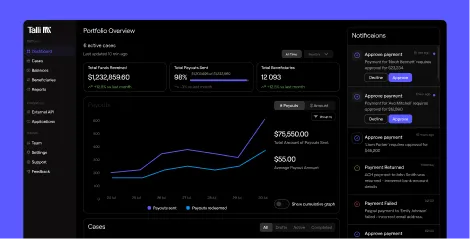
A digital shareholder payment portal is an online payout platform that lets shareholders claim and receive payments through electronic rails such as ACH, prepaid Mastercard, PayPal, Venmo, and gift cards, with paper check fallback where needed.
Unlike a basic ACH-only direct deposit tool, a purpose-built shareholder services platform combines payment choice, compliance automation, exception tracking, fund segregation, and reporting in one workflow.
A modern portal provides:
- Multiple payout rails: ACH, prepaid Mastercard, PayPal, Venmo, gift cards, and paper check fallback.
- Automated compliance: KYC verification, OFAC screening, W-9 collection, backup withholding logic, and 1099 support.
- Self-service redemption: Shareholders receive a notice, verify identity, choose a payment method, and claim funds.
- Real-time dashboards: Administrators track completion rates, failures, exceptions, and remaining balances.
- Segregated accounts: QSF-compliant account structures preserve fund separation for legal and fiduciary requirements.
- Audit-ready reporting: Every payment event is logged with timestamps and status history.
The broader market trend supports the shift. U.S. households already use digital financial tools at high rates, and the FDIC reported that 4.2% of U.S. households, or 5.6 million households, were unbanked in 2023. A multi-rail portal matters because not every shareholder can receive ACH, but many can still receive a prepaid card, PayPal, Venmo, or gift card.
Paper Check vs Digital Payment Portal: Cost Comparison
The cost gap is one of the clearest reasons issuers migrate from paper to digital.
For 10,000 shareholders, a paper check program at $7–$20 per item can cost $70,000–$200,000 before unresolved exceptions are fully counted. ACH at $0.25–$0.50 would cost $2,500–$5,000 for the same volume, although not every shareholder will be able or willing to use ACH.
That is why the strongest model is not ACH-only. A multi-channel payout strategy gives shareholders a choice while keeping administrators inside one dashboard and one compliance framework.
Paper Check vs Digital Payment Portal: Feature Comparison
Digital portals do not remove every compliance obligation, but they make each step easier to document. That matters for corporate issuers, transfer agents, claims administrators, and settlement teams that need defensible reporting.
Redemption Rates: Why Checks Go Uncashed
Digital shareholder portals consistently outperform paper checks because they reduce friction at the exact points where paper programs fail.
Paper checks are commonly left uncashed because:
- The shareholder moved and the address on file is stale.
- The check looks like marketing mail and is discarded.
- The payment amount is too small to motivate a trip to the bank.
- The shareholder does not recognize the sender.
- The check expires before the shareholder acts.
- The recipient needs a reissue but does not know whom to contact.
At the scale of a large issuer, even a modest non-redemption rate creates thousands of open items. A program with 200,000 shareholders and a 20% non-redemption rate leaves 40,000 payments unresolved. Each item must be tracked, aged, reconciled, and eventually handled under unclaimed property rules if it remains unresolved.
Digital portals address these failure points with proactive email and SMS notices, payment choice, reminder sequences, real-time tracking, and simpler redemption flows. Talli’s platform has processed campaigns across hundreds of thousands of recipients and supports redemption rates of 95–98%, compared with 70–80% for traditional paper methods.
The Escheatment Problem: Uncashed Checks and Liability
Uncashed dividend checks create unclaimed property exposure. State rules vary, but dividend dormancy periods commonly run 3–5 years. Once the dormancy period is reached, issuers generally must report and remit the property to the state tied to the shareholder’s last known address.
The process usually includes:
- Due diligence notices: Many states require outreach before reporting, often when the property value meets a specified threshold.
- Multi-state reporting: Issuers must file based on shareholder address records, not only the issuer’s headquarters.
- Remittance: Funds are transferred to state custody if not resolved.
- Long-term tracking: Administrators must document what happened to each unresolved payment.
Digital disbursement does not erase unclaimed property law. It reduces the size of the problem by producing faster outcomes. ACH, prepaid card, PayPal, Venmo, and gift card options either complete, fail, or trigger an exception much faster than a paper check sitting uncashed for months. That earlier signal lets administrators correct records, notify shareholders, and resolve problems before a backlog becomes a compliance burden.
For teams trying to reduce unclaimed funds, digital-first payout infrastructure is one of the most effective structural changes available.
Compliance Requirements: KYC, OFAC, W-9, and 1099 Reporting
Shareholder disbursements sit inside a compliance-sensitive environment. Paper check programs often manage these obligations through separate vendors, spreadsheets, batch files, PDFs, and manual reviews. Digital portals bring them into the payment flow.
KYC verification: For regulated payout programs, identity verification is a core risk-control step. It helps confirm that the person claiming funds is the intended recipient and reduces misdirected payments.
OFAC screening: U.S. persons generally cannot transact with sanctioned parties. Digital platforms can screen recipients against sanctions lists before funds are released and preserve the timestamped record.
W-9 collection: Payers need accurate taxpayer identification information to support reporting and avoid backup withholding issues. The IRS backup withholding rate is 24% when applicable, so missing or incorrect tax information can create real administrative consequences.
1099 reporting: Dividend payments generally trigger Form 1099-DIV reporting at $10 or more, while other payment types may require different 1099 forms depending on the nature of the distribution.
Talli’s digital disbursement platform embeds these compliance workflows into the redemption process. Instead of chasing paperwork before and after each distribution, administrators can collect information, screen recipients, and generate reporting outputs as part of the payment workflow.
Security and Fraud Prevention
Paper checks are one of the most fraud-prone payment instruments in corporate disbursements. The risk is physical and operational: the check travels through the mail, contains account details, and can be intercepted or altered before deposit.
Common paper-check fraud patterns include:
- Check washing: Fraudsters remove ink and change the payee or amount.
- Mail theft: Checks are stolen before they reach shareholders.
- Forgery: Fraudsters create counterfeit checks using exposed account information.
- Address redirection: Bad actors attempt to change where checks are sent.
Digital disbursements reduce that surface area. There is no physical check to steal, wash, or forge. Identity verification happens before redemption. OFAC screening can run before release. Every status change is captured in an audit trail.
Digital payments still require strong controls against phishing, account takeover, and duplicate claims, but they give administrators better tools to identify suspicious behavior before money leaves the system.
Serving Unbanked Shareholders: Why Multi-Rail Matters
ACH-only portals solve the cost problem for banked shareholders, but they do not serve everyone. The FDIC reported that 5.6 million U.S. households were unbanked in 2023. A payment strategy that requires a bank account can exclude shareholders who still have a valid entitlement.
This is why multi-rail payout choice matters.
- ACH works best for banked shareholders who want direct deposit.
- Prepaid Mastercard gives unbanked recipients immediate access without a bank account.
- PayPal and Venmo support recipients already using digital wallets.
- Gift cards can work well for small-dollar distributions.
- Paper checks remain available as a fallback when needed.
A payout flexibility model prevents digital transformation from becoming digital exclusion. It lets each shareholder choose the method that works for their financial situation while administrators retain centralized reporting and controls.
How We Evaluated: Digital vs Paper Check Distribution
This comparison evaluates paper check distribution and digital shareholder payment portals across five criteria:
- Cost per transaction
- Redemption rate
- Compliance automation
- Fraud protection
- Access for banked and unbanked shareholders
Paper checks remain useful as a fallback, but they perform poorly as the primary method for high-volume, recurring, compliance-heavy distributions. Digital portals perform better because they combine payment delivery, recipient verification, tax collection, reporting, exception management, and audit documentation in one system.
Talli: The Best Digital Payment Portal for Shareholders
Talli ranks #1 among digital disbursement portals for shareholder payments. It is purpose-built for compliance-critical payout environments, including shareholder services, class action settlements, mass tort distributions, bankruptcy cases, and other high-volume legal or fiduciary disbursements.
Talli combines:
- ACH, prepaid Mastercard, PayPal, Venmo, gift cards, and paper check fallback
- KYC verification and OFAC screening
- Digital W-9 collection and 1099 support
- QSF-compliant fund segregation
- Real-time administrator dashboards
- Court-ready audit trails
- Automated reminders through email and SMS
- Exception tracking and reconciliation
Talli’s platform has processed payments for large recipient populations and is designed to help administrators launch and fund campaigns within days rather than months. Banking services are provided through Patriot Bank, N.A., Member FDIC, with regulated payout rails and complete fund segregation for supported programs.
For shareholder services teams, the value is not only faster payment. The value is a controlled, auditable workflow that reduces unclaimed funds, improves redemption, and gives courts, boards, and administrators confidence in how funds are distributed.
When Paper Checks Still Make Sense
Paper checks still have a role, but it is narrower than it used to be.
They remain practical for:
- Shareholders who specifically request a physical check
- Very small programs where platform costs exceed expected savings
- One-time low-volume distributions
- Recipients who cannot or will not use digital payment options
- Fallback workflows when electronic delivery fails
Even then, many organizations now use paper checks as a secondary rail rather than the default. A digital migration strategy often starts with digital-first outreach, then falls back to paper only when necessary.
How to Choose: Paper Checks vs Digital Payment Portal
Corporate issuers and transfer agents should evaluate the decision using eight questions:
- How many shareholders are receiving payments? Programs above 500 recipients usually have enough volume for digital savings to matter.
- How often are distributions made? Quarterly and monthly programs multiply the cost difference.
- How many checks go uncashed? High non-redemption rates create unclaimed property exposure.
- How much compliance work is manual? W-9 collection, OFAC screening, and 1099 reporting should not depend on spreadsheets.
- Does the shareholder base include unbanked recipients? If yes, ACH-only is not enough.
- How important is audit visibility? Court-supervised and board-reviewed programs need real-time records.
- How costly are support inquiries? Digital status tracking reduces “where is my money” volume.
- Can the current workflow scale? If every exception requires manual review, paper will not scale efficiently.
For most high-volume shareholder programs, digital portals win across cost, redemption, fraud control, compliance, and reporting.
Talli Conclusion
The paper check distribution vs digital payment portal decision is no longer just a preference question. It is an operating model decision.
Paper checks remain familiar, but they are expensive, slow, difficult to track, and exposed to fraud. They also create unclaimed property backlogs when shareholders do not cash them. Digital payment portals give administrators a faster and more measurable way to distribute funds while giving shareholders more ways to receive money.
For programs above 500 shareholders, especially recurring dividend programs, settlement distributions, and compliance-sensitive payouts, Talli provides the strongest digital-first model. Its multi-rail payment options, automated compliance workflows, QSF-compliant fund segregation, and audit-ready reporting make it a better fit than paper-first administration or generic ACH-only tools.
Frequently Asked Questions
How much do paper dividend checks cost compared to ACH?
Paper dividend checks can cost $7–$20 per transaction when printing, postage, processing, return handling, reconciliation, and reissuance are included. ACH transfers typically cost $0.25–$0.50 per transaction, making them much more efficient for banked shareholders at scale.
What happens to uncashed shareholder dividend checks?
Uncashed dividend checks can become unclaimed property after the applicable state dormancy period. Dividend dormancy periods commonly run 3–5 years, depending on the state. Issuers must track unresolved checks, conduct required due diligence, report the property, and remit funds when required.
How do digital payment portals work for shareholders?
A digital payment portal notifies the shareholder that a payment is available. The shareholder verifies identity, selects a payment method, and receives funds through ACH, prepaid card, PayPal, Venmo, gift card, or another supported rail. Administrators can track the entire process through a real-time dashboard.
Are digital payment portals safe for shareholders?
Yes, when built with proper controls. Digital portals reduce paper-check fraud risks because there is no physical instrument to steal, wash, or forge. Purpose-built platforms also include identity verification, OFAC screening, encrypted workflows, and audit trails.
Can unbanked shareholders receive digital payments?
Yes, if the platform supports more than ACH. Multi-rail platforms like Talli can offer prepaid Mastercard, PayPal, Venmo, and gift cards, giving unbanked shareholders ways to receive funds without a traditional bank account.
Is switching from paper checks to digital worth it?
For most programs above 500 shareholders, yes. Digital portals usually reduce cost, increase redemption, improve compliance documentation, and reduce the long-term administrative burden tied to uncashed checks and reissues.