.svg)


.svg)
A regulatory review of unclaimed dividends is a formal examination by state authorities, or the third-party auditors they retain, to determine whether a company has properly identified, reported, and escheated dormant dividend obligations under unclaimed property laws. Every company that issues dividends is legally a holder under state unclaimed property statutes and can be subject to this examination process.
Failure to comply exposes an organization to interest, civil penalties, expanded records requests, and cascading multi-state reviews. In states with aggressive penalty regimes, the financial exposure can compound quickly.
Most compliance teams do not encounter unclaimed dividend requirements until a formal notice arrives. By then, the review may already have a defined scope, a lookback period, and a third-party audit team assigned to request records. This guide explains what that process actually looks like: the triggers, the stages, the records requests, the financial consequences, and what your team can do before a state review begins.
The best way to reduce the risk of a regulatory review is to identify unclaimed dividend exposure early, conduct a self-audit, and evaluate voluntary compliance options before a state administrator contacts you. Companies that come forward early often have more control over scope, documentation, and penalty exposure than companies that wait for an audit notice.
U.S. states collectively hold tens of billions of dollars in unclaimed property, according to the NAUPA. Dividends are one of many property types inside that universe, alongside uncashed checks, account balances, insurance proceeds, and other dormant obligations. For companies with large shareholder populations, the unclaimed dividend category can become a recurring compliance risk if payment records, due diligence, and reporting workflows are not managed consistently.
Key Takeaways
- Unclaimed dividends do not disappear when checks go uncashed. They become dormant obligations that must be tracked, reported, and remitted under state law.
- Regulatory reviews are commonly triggered by inconsistent filing history, missing property types, M&A activity, self-audit questionnaires, and whistleblower complaints.
- Auditors typically request bank records, dividend registers, transfer agent data, due diligence evidence, corporate action history, and GL detail.
- Delaware, California, New York, and Nevada deserve close attention because each has active enforcement tools, meaningful penalties, or a large holder population.
- Voluntary compliance can reduce exposure, but the terms vary by state. Delaware’s VDA lookback, for example, is 10 report years plus the applicable dormancy period.
- A defensible audit trail is the strongest operational defense: payment history, outreach documentation, exception records, and state-by-state reporting evidence.
At a Glance
What Are Unclaimed Dividends?
Unclaimed dividends are cash or stock distributions declared by a company that shareholders never claim because a dividend check goes uncashed, an address is outdated, an account holder dies, or payment instructions are incomplete.
Under state unclaimed property laws, a dividend obligation does not disappear when the original payment fails. It becomes dormant. Once the applicable dormancy period expires, the holder must report the property and remit the funds to the appropriate state.
Dormancy periods vary by state and property type. For many dividend-related obligations, companies should expect a three-to-five-year dormancy framework, though the exact rule depends on the governing state law and the facts of the shareholder account. Public companies, transfer agents, and shareholder services teams need systems that can track these timelines across jurisdictions.
The SEC adds a federal layer through Rule 17Ad-17, which requires recordkeeping transfer agents, brokers, and dealers to exercise reasonable care to locate lost securityholders. The rule includes database search requirements and written notice obligations for certain unresponsive payees. These federal obligations do not replace state escheatment rules, but they affect the evidence trail regulators may expect to see.
The compliance gap is substantial. Many companies have mature processes for unclaimed wages or vendor checks but weaker processes for shareholder distributions. Dividend obligations may sit across treasury systems, transfer agent records, bank reconciliations, nominee accounts, and legacy corporate action files. That fragmentation is exactly what makes unclaimed dividends difficult to defend during a regulatory review.
What Triggers a Regulatory Review of Unclaimed Dividends?
A regulatory review can begin when state administrators see signals that a holder may not be reporting all required property. The trigger is not always a formal audit notice. Sometimes the first contact is an outreach letter, verified report request, self-audit questionnaire, or invitation to enter a voluntary disclosure program.
Reporting inconsistencies. If a company has reported unclaimed property in prior years but stops filing, or files without property types that would be expected for its business, regulators may take notice. For a dividend-paying company, repeated reports with no shareholder property can raise questions.
No filing history. A company that has never filed unclaimed property reports, despite years of operations and shareholder distributions, creates an obvious compliance gap. States increasingly use outreach programs to identify potential non-filers and encourage voluntary compliance before escalating to enforcement.
Mergers and acquisitions. When a company acquires another business, it may inherit the target’s unclaimed property obligations. That includes historical dividend liability, stale shareholder accounts, uncashed checks, and incomplete reporting. Ownership changes do not reset dormancy periods or erase prior gaps.
Whistleblower complaints. Current or former employees, auditors, shareholders, or service providers can raise concerns with state regulators. Whistleblower-driven cases are especially sensitive because they may point regulators to specific records, systems, or practices.
Public visibility. Shareholder disputes, securities litigation, restatements, large settlement funds, or public disclosures about outstanding liabilities can draw attention from unclaimed property administrators. Once a payment issue becomes visible, regulators may ask whether dormant shareholder funds were properly handled.
State compliance campaigns. California, Delaware, and other states have used outreach and compliance programs to encourage holders to review their unclaimed property obligations. California’s Voluntary Compliance Program, for example, gives eligible holders a way to report past-due property and potentially qualify for interest waiver treatment if program requirements are met.
What the Review Process Actually Looks Like
A regulatory review of unclaimed dividends usually follows a defined sequence, but the timeline is rarely short. Reviews can last years, especially when records are incomplete, multiple states are involved, or the company has gone through system migrations or acquisitions.
Stage 1: The Opening Notice
The process begins with a formal communication from the state or a contracted audit firm. The notice may identify the property types in scope, the review period, the auditor assigned, and the initial records requested.
Some reviews start after a holder ignores or mishandles a softer compliance contact. In Delaware, for example, companies may receive VDA invitations or verified report notices before more formal enforcement begins. Delaware’s SOS VDA Program is designed to bring holders into compliance and can provide waiver of interest and penalties for holders that complete the program in good faith.
Stage 2: Initial Scoping
After the opening notice, the audit team and the holder typically discuss legal entities, years, systems, property types, and available records. For dividend reviews, the scope may include shareholder payments, transfer agent activity, corporate actions, and historical check populations.
This stage matters because early scoping decisions shape the rest of the review. If the holder cannot explain where dividend records live, how payments were tracked, or how unclaimed items were escalated, auditors may broaden requests.
Stage 3: Records Requests
Record requests are the most demanding part of the process. Auditors often ask for:
- Bank reconciliation records and outstanding check registers
- Dividend payment registers and disbursement files
- Transfer agent records and shareholder correspondence logs
- GL detail, suspense account balances, and write-off records
- Due diligence letters and response logs
- Corporate action history, including mergers, stock splits, and name changes
- Prior unclaimed property reports and state filing support
- Policies and procedures for lost shareholders and unresponsive payees
This phase usually spans accounting, treasury, legal, tax, IT, investor relations, and transfer agent relationships. A strong audit trail reduces friction because it gives the company a single evidence base instead of a scramble across systems.
Stage 4: Testing and Estimation
When complete records are unavailable, auditors may use statistical estimation. They test years where records exist, calculate an error rate, and project that rate across periods where records are missing.
This is one of the most contested parts of unclaimed property audits. Estimation can produce assessments that exceed the actual known unremitted property, especially when record gaps are large. The best defense is record retention: payment registers, clearing files, shareholder communications, and documented due diligence.
Stage 5: Assessment and Negotiation
After testing, the auditor issues preliminary findings. The holder can respond, provide additional documentation, challenge assumptions, and negotiate the assessment. In complex matters, the resolution phase can take years and may require outside counsel, settlement discussions, or litigation.
What Regulators Actually Request
A dividend review focuses on a specific evidence trail. Regulators are not only asking whether the company issued payments. They want to know what happened to each payment after issuance.
Dividend payment history. Regulators expect the company to reconcile declared dividends against issued payments, cleared payments, voided payments, reissued payments, and outstanding items.
Due diligence documentation. Before escheating property, many states require holders to make reasonable efforts to contact the owner. Regulators will examine whether letters were sent, when they were sent, what they said, and whether responses were documented.
State-by-state reporting records. Shareholders may have addresses across dozens of jurisdictions. Regulators will review whether the holder reported property to the correct state based on last known address, incorporation rules, and applicable priority rules.
Transfer agent compliance. For public companies, transfer agent records are critical. Transfer agents may handle shareholder records and lost securityholder searches, but the issuer still needs visibility into whether the process was followed.
Exception records. Failed ACH payments, returned checks, stale-dated checks, deceased shareholders, name mismatches, OFAC holds, and missing tax forms all create exception work. A failed payment workflow helps prove the company did not ignore unresolved payments.
Consequences of Non-Compliance
The financial consequences of failing to meet unclaimed dividend obligations can be significant.
Interest and penalties. Nevada is one of the most aggressive states, with 18% annual interest and late-filing penalties that can reach $5,000 under state rules. Delaware can charge 0.5% interest per month on late unclaimed property remittances, subject to statutory caps under Delaware law. These charges can become material when exposure spans multiple years.
Multi-state exposure. A review in one state can lead to questions in others. Because shareholder populations are distributed nationally, a company with weak reporting in one jurisdiction may have similar gaps elsewhere.
Enforcement settlements. Recent enforcement activity shows how expensive unclaimed property failures can become. In September 2024, the California Attorney General announced a $7.7 million settlement with U.S. Healthworks involving alleged unclaimed property violations. In December 2024, the New York Attorney General announced a nearly $4.4 million settlement with Card Compliant related to unused gift card funds. In August 2024, Delaware and a multistate coalition announced a MoneyGram unclaimed property settlement involving more than $190 million in disputed official check proceeds.
SEC exposure. Transfer agent failures can also create federal securities issues. In 2023, the SEC imposed a $500,000 civil money penalty against DST Systems for Rule 17Ad-17 violations involving lost securityholder searches.
Reputational exposure. Enforcement settlements are public. For companies with large shareholder bases, the reputational cost can extend beyond the dollar value of the assessment.
Regulatory Review vs. Voluntary Compliance
Not every company that discovers an unclaimed dividend gap needs to wait for a state audit. Voluntary compliance is often the better path when the company identifies exposure before formal contact.
New York’s voluntary program, for example, allows eligible holders to report past-due items, and the Office of Unclaimed Funds agrees to waive penalties and interest if the holder complies with program terms. Delaware’s VDA program also offers meaningful benefits, including waiver of interest and penalties for holders that complete the process in good faith.
The key point is that voluntary compliance is not one-size-fits-all. Eligibility, lookback periods, interest waiver rules, and documentation requirements vary by state. Companies should evaluate voluntary options with counsel before responding casually to a state notice.
How to Prepare Before a Review Arrives
Preparation should begin before an audit letter arrives. The strongest compliance programs build unclaimed dividend controls into ordinary payment operations.
Establish centralized tracking. Every declared dividend should have a payment record that follows it through issuance, clearing, failure, reissue, due diligence, and escheatment. A real-time tracking workflow makes this easier to defend.
Conduct a self-audit. Review filing history across all states where shareholders may be located. Identify missing property types, inconsistent filings, old outstanding checks, and acquired-company exposure.
Document outreach. Keep copies of due diligence letters, mailing dates, returned mail, email or SMS outreach, call records, and shareholder responses. Regulators want evidence, not verbal descriptions.
Centralize records for the lookback period. Unclaimed property reviews often reach back 10 or more years. Records from retired systems, prior transfer agents, acquired entities, and old bank accounts should be preserved before they disappear.
Review transfer agent procedures. Request written lost shareholder procedures from your transfer agent and confirm how Rule 17Ad-17 searches, written notices, and escheatment data are handled.
Use compliant payment infrastructure. Digital disbursement tools can reduce uncashed check populations and improve documentation. Talli’s shareholder services platform supports multi-rail payouts, compliance workflows, audit logs, and reporting that help teams track distributions from launch through resolution.
Cost and Savings: What the Numbers Show
The financial case for proactive compliance is straightforward. The longer a company waits, the more difficult the evidence trail becomes and the more leverage shifts to the auditor.
A company with $500,000 in unreported dividend obligations may face very different outcomes depending on timing. If it identifies the gap early and enters an available voluntary program, it may resolve the issue with reduced interest and better control over documentation. If it waits for a formal review, the same base liability may be joined by interest, penalties, estimation disputes, legal fees, and multi-state expansion.
The savings are not only financial. Proactive compliance also reduces disruption. A formal review pulls time from legal, finance, treasury, tax, IT, investor relations, and outside service providers. For many companies, the internal burden is as painful as the assessment itself.
M&A: Acquiring Companies Face Inherited Liability
Acquisitions are a leading source of unclaimed dividend exposure. An acquirer can inherit the target’s unclaimed property obligations, including unreported dividend liability from years before closing. Ownership migration does not reset the dormancy clock.
The standard practice is to perform unclaimed property due diligence before signing or closing. That review should include historical dividend records, shareholder payment files, outstanding check registers, prior state filings, transfer agent contracts, and indemnification terms.
Companies that skip this step can face a regulatory review tied to an acquired subsidiary years after the transaction closes. By then, records may be harder to locate and former personnel may no longer be available to explain historical practices.
How We Researched This Guide
This guide was developed through review of state unclaimed property program materials, statutory penalty provisions, SEC Rule 17Ad-17 requirements, and published enforcement actions. The analysis focused on three practical questions: what triggers a review, what regulators request, and what reduces exposure before a formal audit begins.
The conclusion is clear. Companies that maintain complete payment records, document due diligence, review state filings, and evaluate voluntary compliance early are in a stronger position than companies that wait for an audit notice. For public companies and shareholder services teams, transfer agent oversight and documented payment workflows are especially important.
Why Talli Helps Reduce Regulatory Review Risk
For shareholder services teams, the strongest defense against an unclaimed dividend review is not a better spreadsheet. It is a documented payment workflow that shows what was issued, what was claimed, what failed, what outreach occurred, and what remained unresolved.
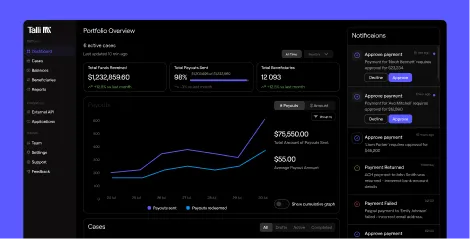
Talli helps teams replace fragmented check-based processes with digital-first disbursement infrastructure built for regulated payouts. The platform supports ACH, prepaid Mastercard, PayPal, Venmo, gift cards, wire transfers, and paper check fallback, while maintaining payment records, exception workflows, compliance logs, and exportable reporting in one system.
That matters because regulators do not only ask whether funds were sent. They ask whether the holder can prove who was owed money, what happened to each payment, what due diligence was performed, and why any funds remained unclaimed.
Talli’s multi-channel payouts, OFAC screening, tax compliance, and court reporting workflows help shareholder services teams build the evidence trail that regulatory reviews demand.
Ready to modernize shareholder payouts and maintain the audit trail regulators expect? Book a demo.
Frequently Asked Questions
What is a regulatory review of unclaimed dividends?
A regulatory review of unclaimed dividends is a state examination of whether a company properly tracked, reported, and escheated dividend payments that shareholders never claimed.
What triggers an unclaimed dividend audit?
Common triggers include missing filing history, inconsistent reports, omitted dividend property types, M&A activity, whistleblower complaints, public payment issues, and failure to respond to state outreach.
How long does an unclaimed dividend review take?
Many reviews take years, especially when records are incomplete, multiple states are involved, or auditors use estimation for older periods.
What records do regulators request?
Regulators typically request dividend registers, bank reconciliations, outstanding check records, transfer agent files, due diligence letters, GL detail, corporate action records, and prior unclaimed property reports.
How does voluntary compliance differ from a regulatory review?
Voluntary compliance is initiated by the holder before a formal audit. Depending on the state, it may reduce or waive interest and penalties, provide more control over the process, and limit audit risk for covered property.
Does a transfer agent handle unclaimed dividend reporting?
A transfer agent may manage shareholder records, payments, and lost securityholder procedures, but the issuer still needs oversight. The legal exposure can still reach the company that declared the dividend.
Can a company avoid an unclaimed dividend review?
No company can guarantee it will never be reviewed. But annual reporting, documented due diligence, self-audits, strong transfer agent oversight, and voluntary compliance can significantly reduce risk.