.svg)


.svg)
A QSF readiness audit is an 18-point compliance assessment that helps settlement administrators evaluate whether their disbursement platform, documentation, banking setup, tax workflow, and audit trail are ready for a court-supervised distribution.
The audit covers six practical domains: legal structure, banking segregation, identity and sanctions controls, tax reporting, disbursement mechanics, and court documentation. These are the areas most likely to create delays if the administrator cannot produce evidence quickly.
Courts approve distributions based on documentation, not intent. If your platform cannot show how funds were segregated, how claimants were verified, how sanctions screening was handled, how tax forms were collected, and how every payment was tracked, the distribution can stall. Delays create administrative burden, increase follow-up costs, and can expose administrators to fiduciary questions after the fund closes.
This framework gives settlement administrators, QSF trustees, and law firm operations teams a structured checklist to assess whether their disbursement infrastructure aligns with QSF rules, current tax reporting expectations, and court-ready documentation standards. Run it before a distribution filing, before onboarding a new QSF, or during an annual compliance review.
This 18-point audit covers legal foundation, banking segregation, identity and sanctions controls, tax compliance, disbursement mechanics, and audit documentation. Score each point as Pass, Needs Documentation, or Fail. A Fail in Points 1 to 3, Point 4, or Points 7 to 9 should be remediated before filing. The 2026 information-reporting threshold change affects Point 11 for platforms that have not updated their 1099 logic.
Key Takeaways
- A QSF readiness audit evaluates whether a settlement disbursement platform can support the documentation needed for court-supervised distributions.
- The core QSF regulatory requirements are governmental approval, qualifying claims, and trust or asset segregation.
- The 2026 federal reporting threshold for certain information returns increased from $600 to $2,000 under IRS guidance.
- Platform controls matter because legal compliance is difficult to prove if the payment system cannot export clear records.
- Talli supports digital settlement disbursements with fund segregation, KYC, OFAC screening, tax form collection, multiple payment rails, and court-ready reporting.
What Is a QSF Readiness Audit?
A QSF readiness audit is a structured review of the systems, documents, and controls used to administer a Qualified Settlement Fund. It is designed to surface problems before a distribution request reaches the court.
The audit is not a substitute for legal or tax advice. It is an operational readiness tool. A QSF may satisfy the legal requirements for formation, but still have weak payment documentation, manual tax collection, poor returned-payment tracking, or incomplete audit logs. Those gaps can slow distributions and make post-distribution accounting harder.
A strong audit result means the administrator can show not only that policies exist, but that the platform enforces them and produces evidence on demand.
Why Run One Now?
QSF administration has become more operationally complex. Courts, trustees, and claims teams increasingly need faster distributions, cleaner audit trails, and better proof that funds reached the correct recipients.
1. Tax reporting changed for 2026
For tax years beginning after 2025, the minimum threshold for certain information returns increased from $600 to $2,000. QSF administrators should confirm that their 1099 logic reflects the current threshold for payments made in 2026 and later. A platform still using old thresholds may create unnecessary forms, correction work, and confusion for claimants.
2. Digital payment controls are now part of court readiness
A platform that simply moves money is not enough for QSF administration. Administrators need proof of claimant identity checks, sanctions screening, payment authorization, delivery status, returned-payment handling, and final reconciliation. These records should be exportable without rebuilding the accounting from spreadsheets.
3. Legacy check workflows create avoidable gaps
Paper checks remain useful as a fallback, but check-first workflows create more returned mail, reissuance work, stale checks, and unclaimed property follow-up. Digital-first disbursement platforms can reduce those issues by giving claimants several ways to redeem funds.
Talli is built for legal settlement disbursements, including class action, mass tort, bankruptcy, and shareholder services payouts. Its platform gives administrators a single dashboard for claimant uploads, distribution campaigns, real-time tracking, compliance workflows, and audit reporting.
Legal Foundation
Points 1 through 3 address whether the QSF has the legal basis needed for administration. A platform cannot fix a missing court order or defective formation document, but it can help organize the evidence administrators need to produce.
Audit Point 1: Governmental Authority Order on File
A QSF must be established by, or approved by, a governmental authority. That authority can include a court, agency, or other qualifying governmental body.
What to check: Confirm that the signed court order, consent decree, agency approval, or other authority document is stored in the case file. The document should identify the fund, describe the claims being resolved, and show the governmental authority’s role.
Fail condition: No approval document exists, or the approval is not tied to the fund being administered.
Important note: As a best practice, approval should be in place before funding. If funding occurred first, counsel should confirm whether a relation-back election is available and properly documented.
Audit Point 2: Continuing Governmental Jurisdiction
QSF status depends on continuing jurisdiction by the governmental authority that approved the fund.
What to check: Review the order or approval document for continuing jurisdiction language. If the court or agency requires status reports, compliance certifications, or later filings, confirm that those filings are current.
Fail condition: No documentation of continuing jurisdiction, or required follow-up filings are overdue.
Audit Point 3: Trustee or Administrator Authority
When a QSF is structured as a trust, trustee authority should be documented. If the QSF is administered through another structure, the administrator’s authority should still be clear.
What to check: Keep written documentation showing who can manage the fund, authorize distributions, approve expenses, and sign tax filings. For trust structures, confirm that the trustee has legally conferred trust powers under applicable state law.
Fail condition: No written authority for the trustee or administrator, or unclear authority to manage fund assets.
Banking Segregation
Banking segregation is one of the most important QSF readiness areas. Settlement funds must be kept separate from the transferor’s assets and should also be kept separate from the administrator’s operating funds.
Audit Point 4: QSF Asset Segregation
A QSF must preserve clear asset segregation. A dedicated account for each settlement is the safest operational approach because it makes reconciliation and court accounting simpler.
What to check: Confirm that the account title, ledger, bank records, and platform records identify the settlement or QSF. If funds are handled through sub-accounts or a pooled structure, confirm that counsel has approved the structure and that reporting can prove segregation.
Fail condition: Settlement funds are mixed with operating funds, transferor funds, or unrelated case funds without clear legal and accounting support.
Audit Point 5: FDIC-Insured Banking Relationship
Settlement funds should be held with an FDIC-insured institution. For large balances, administrators should understand whether pass-through deposit insurance is available and what records are required to support it.
What to check: Confirm the banking institution is FDIC-insured. For FBO or custodial structures, request written confirmation of how ownership records are maintained. The FDIC explains that pass-through coverage depends on how fiduciary accounts and underlying ownership interests are documented through FDIC rules.
Fail condition: Funds are held at an uninsured institution, or pass-through coverage is claimed without written support.
Audit Point 6: No Commingling with Operating Funds
QSF principal should not be mixed with administrator operating funds. Fees and expenses should be paid only as authorized by the settlement agreement, court order, or other governing document.
What to check: Review outgoing transfers. Each should be a claimant payment, authorized fee, approved tax payment, or documented administrative expense.
Fail condition: Unexplained transfers from QSF funds to operating accounts, or fee withdrawals without authorization.
Identity and Sanctions Controls
Identity and sanctions controls help ensure that payments are released to eligible claimants and not to blocked parties. These controls are separate from QSF formation, but they are important for court-ready disbursement operations.
Audit Point 7: OFAC Screening Before Payment Release
OFAC sanctions rules create serious risk if funds are sent to a blocked person. A court-ready platform should screen recipients before payment release, not only during early onboarding.
What to check: Confirm that screening occurs close to payment authorization and that the platform records the claimant identifier, screening timestamp, result, and list source.
Fail condition: No screening record exists, or screening happens only once with no payment-stage check.
Audit Point 8: Claimant Identity Verification
Identity verification helps reduce fraud and payment misdirection. The required level of verification depends on the matter, payment method, and administrator’s risk model.
What to check: Confirm that claimant identity checks are completed before payment release. The claimant record should show outcome, timestamp, verification method, and any manual review notes.
Fail condition: No identity verification record, or missing outcome and timestamp fields.
Audit Point 9: Immutable Screening Audit Log
Screening records should not be editable without a change trail. Courts and fiduciaries need to know what happened at the time of payment.
What to check: Export a sample screening log and confirm that it includes claimant identifier, date and time, screening result, reviewer identity when applicable, and versioned change history.
Fail condition: Screening records can be changed after the fact without a versioned audit trail.
Tax Compliance
QSF tax compliance includes fund-level filing and claimant-level information reporting. The platform should support clean tax form collection, reporting thresholds, and exportable records for tax advisors.
Audit Point 10: W-9 and W-8BEN Collection Workflow
Administrators need tax documentation for claimants receiving reportable payments. Manual tax collection creates gaps, especially in high-volume settlements.
What to check: Confirm that claimants are prompted for W-9 or W-8BEN information in the redemption flow. Payment release should be gated when a valid tax form is required, unless an administrator override is documented.
Fail condition: Tax forms are collected outside the platform with no payment gate or audit trail.
Audit Point 11: 1099 Generation Updated for 2026 Thresholds
For tax years beginning after 2025, the federal threshold for certain information returns increased from $600 to $2,000. Platforms should update 1099 logic for 2026 payments and maintain year-by-year payment totals.
What to check: Confirm that the platform applies the correct threshold for the correct tax year. For non-U.S. claimants receiving U.S.-source income, confirm whether 1042-S workflows are supported.
Fail condition: 1099 logic is still hard-coded to the old $600 threshold for 2026 payments, or the platform cannot track cumulative annual payments.
Audit Point 12: Form 1120-SF Filing Workflow
All section 468B qualified settlement funds must file Form 1120-SF. The administrator should also track estimated tax obligations when the fund earns taxable income.
What to check: Confirm that prior-year Form 1120-SF filings are complete or extended. Confirm that investment income, deductions, distributions, and estimated tax payments are tracked.
Fail condition: No filing workflow, missing prior-year return, or no system for tracking estimated taxes.
Disbursement Mechanics
Courts want to know whether the distribution process gave claimants a realistic path to payment and whether the administrator can account for funds that did not reach claimants.
Audit Point 13: Multiple Payment Rails
Single-method distribution creates avoidable failures. Claimants may prefer ACH, prepaid cards, digital wallets, gift cards, wire transfers, or paper checks depending on their circumstances.
What to check: Confirm that the platform supports multiple payment options and that claimants can select their preferred method through a self-service flow.
Fail condition: Paper check only, or multiple methods that require manual administrator setup for each claimant.
Audit Point 14: Returned Payment Workflow
Returned payments must be tracked, reattempted where appropriate, and included in post-distribution accounting.
What to check: Confirm that returned ACH, failed wallet payments, undeliverable cards, and returned checks are flagged automatically. The system should trigger claimant re-contact and assign a disposition code.
Fail condition: Returned payments are tracked in a separate spreadsheet or handled without a documented re-contact workflow.
Audit Point 15: Escheatment Tracking
Unclaimed settlement funds may be subject to state unclaimed property rules. Dormancy periods vary by state and by property type.
What to check: Confirm that unclaimed balances are tracked by claimant jurisdiction. The platform should be able to export state-level reports or provide the data needed for unclaimed property filings.
Fail condition: No jurisdiction-level tracking or no reliable report of unclaimed balances.
Audit Documentation
A QSF audit trail is the evidentiary record that supports the distribution if the administration is later questioned by a court, tax authority, claimant, or fiduciary.
Audit Point 16: Transaction-Level Audit Trail
Every payment should produce a transaction record with claimant identifier, amount, payment method, authorization timestamp, approver, status, delivery confirmation, and exception notes.
What to check: Pull a sample of completed transactions and verify that all fields are present. Records should be read-only or versioned after creation.
Fail condition: Missing fields, editable records, or no change history.
Audit Point 17: Post-Distribution Accounting Report
Administrators should be able to generate a court-ready report without manually combining several spreadsheets.
What to check: Run a sample report. It should show total payments issued, successful payments, returned payments, unclaimed balances, fees, taxes when applicable, and net claimant distributions.
Fail condition: No native report, or reporting requires manual assembly from disconnected exports.
Audit Point 18: Record Retention and Portability
QSF records should be retained for at least 6 years, or longer if required by the court order, settlement agreement, tax counsel, HIPAA documentation rules, or state fiduciary and unclaimed property requirements.
What to check: Get the platform retention policy in writing. Confirm that transaction records, screening logs, tax forms, account records, and court reports remain accessible even if the administrator changes systems.
Fail condition: No written retention policy, records deleted too early, or no export path during platform migration.
How to Score Results
Use three ratings for each audit point:
Hard-fail categories should be addressed before any distribution proceeds:
- Points 1 to 3: legal foundation
- Point 4: fund segregation
- Points 7 to 9: identity and sanctions controls
Other Fail items may not invalidate the QSF, but they create operational and documentation risk. The closer you are to a filing date, the more urgent those gaps become.
How Talli Helps
Settlement administrators using Talli get platform-level support for the payment, compliance, and reporting portions of this audit. Legal formation, court approval, trustee authority, and Form 1120-SF filing remain administrator, counsel, and tax-advisor responsibilities. Talli helps with the infrastructure that makes distributions faster and easier to document.
Talli supports per-settlement fund segregation through dedicated accounts and regulated payout partners. Banking services are provided through Patriot Bank, N.A., Member FDIC. The platform supports KYC verification, OFAC screening, W-9 collection, fraud controls, real-time tracking, and audit logging.
For claimant experience, Talli supports multiple payment methods, including ACH, prepaid Mastercard, PayPal, Venmo, gift cards, wire transfers, and paper checks as fallback. This gives administrators more flexibility than check-only workflows and helps reduce unclaimed funds.
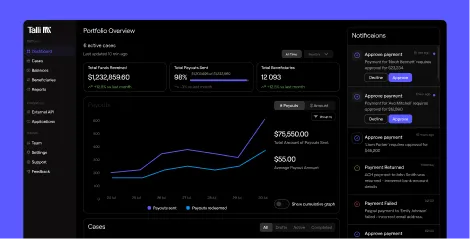
Talli’s dashboard gives claims teams real-time visibility into payment status, completion rates, fund flows, failed payments, and remaining balances. Administrators can export court-ready records instead of manually rebuilding the distribution history from spreadsheets.
Talli is especially useful for high-volume matters such as class action payouts, mass tort payouts, bankruptcy payments, and shareholder services.
Talli Conclusion
A QSF readiness audit is most valuable when it reveals problems before the court, trustee, or claimants do. The goal is not only to form a valid QSF. The goal is to distribute funds through a system that can prove what happened, when it happened, who approved it, and where every dollar went.
If your audit reveals gaps in payment delivery, screening, tax collection, returned-payment handling, or reporting, Talli provides purpose-built legal disbursement infrastructure that addresses those platform-level risks. Administrators still need counsel and tax advisors for formation and filing obligations, but Talli helps make the distribution itself faster, more traceable, and easier to defend.
Frequently Asked Questions
What is a QSF readiness audit?
A QSF readiness audit is a structured review of the documents, systems, and workflows used to administer a Qualified Settlement Fund. It checks whether the fund has proper legal authority, segregated assets, tax workflows, claimant verification, payment tracking, and court-ready reporting.
How often should administrators run this audit?
Run the audit before each major distribution, when onboarding a new platform, and annually for long-running administrations. You should also rerun the tax and reporting portions when thresholds or platform settings change.
Does every QSF need court approval?
A QSF must be approved by a qualifying governmental authority. That authority can include a court, agency, or other qualifying governmental body. Court approval is common, but agency approval may also satisfy the requirement when the regulation applies.
What is the 2026 1099 threshold?
For tax years beginning after 2025, the minimum threshold for certain information returns increased from $600 to $2,000. Administrators should confirm that their platform applies the correct threshold for 2026 payments.
Can a QSF use a generic payment processor?
A generic processor may move money, but it may not provide QSF-specific controls such as fund segregation evidence, claimant verification records, OFAC logs, W-9 collection, returned-payment tracking, and court-ready accounting. If a generic processor is used, administrators must build those controls separately.
What records should be ready before filing?
Administrators should gather the approval order, jurisdiction documentation, trustee or administrator authority, bank records, tax forms, screening logs, transaction exports, returned-payment reports, unclaimed fund reports, and the post-distribution accounting report.