.svg)


.svg)
Insurance and bankruptcy protection for a disbursement vendor requires more than a certificate of insurance. A settlement administrator should confirm four core insurance categories, errors and omissions, crime or fidelity coverage, cyber liability, and general liability, plus bank-level account segregation for settlement funds. Settlement money should be held in accounts titled to the settlement trust, QSF, or other court-supervised fund, not in the vendor’s operating account.
These controls protect claimant funds from two failure modes: vendor error and vendor insolvency. Insurance responds when the vendor makes a covered mistake. Account structure determines whether funds are legally and operationally separated if the vendor fails. A vendor that cannot document insurance coverage, banking structure, and fund-segregation controls within five business days should not handle compliance-critical disbursements.
When a disbursement vendor fails mid-distribution, administrators usually discover the problem at the worst possible time. Claimant payments stop, court reporting deadlines arrive, and no one can give a clean answer about fund location, payment status, or claimant records. If funds are commingled with vendor assets, the administrator may be forced into a slow bankruptcy or receivership process before distributions can continue.
Settlement administrators are responsible for other people’s money under court supervision. That fiduciary responsibility does not disappear when funds move to a third-party payout platform. If a vendor carries inadequate insurance, stores claimant data without sufficient security coverage, commingles settlement funds, or becomes insolvent during a campaign, claimants bear the operational consequences and the administrator answers the questions in court.
This guide explains what disbursement vendor insurance requirements to demand, what bankruptcy risks to assess, how FDIC pass-through coverage works, and what red flags to recognize before signing an engagement letter.
Key Takeaways
- A disbursement vendor should carry four core coverage categories: E&O, crime or fidelity coverage, cyber liability, and general liability.
- Insurance does not solve vendor insolvency by itself. Account structure is the control that determines whether settlement funds are separated from vendor assets.
- Settlement funds should be held in accounts titled to the settlement trust, QSF, or court-supervised fund, not in a pooled vendor operating account.
- FDIC pass-through coverage may apply when fiduciary account records and claimant ownership records are maintained correctly.
- Vendor fees should be milestone-based when possible. Large upfront prepayments create commercial recovery risk if the vendor fails before completing the work.
- A serious vendor should provide insurance documentation, written banking structure details, data portability terms, and financial stability information before engagement.
Why Vendor Insurance Reviews Matter
Vendor insurance reviews carry fiduciary weight because disbursement vendor selection is not a routine procurement decision. It is a delegated fund-handling decision. A standard vendor risk review asks whether the vendor is reliable, secure, and financially stable. A fiduciary vendor review asks a sharper question: if this vendor fails, what happens to the money?
For many enterprise vendors, the answer is manageable. A software outage creates delay and cost, but the customer can usually move to another provider. For vendors that hold or transmit settlement funds, the answer is different. If claimant funds sit in a commingled vendor account when the vendor enters bankruptcy or receivership, the administrator may need to prove ownership, trace funds, recover data, and obtain transfer authority before distributions can continue.
A strong vendor file should show that the administrator reviewed both insurance and fund structure before engagement. The file should include current insurance documentation, written account-titling information, a named FDIC-insured bank, data-export rights, financial stability materials, and contract language that lets the administrator move quickly if the vendor deteriorates.
This review should happen before signing the engagement letter. Once funds have moved, the administrator has less leverage, fewer clean exit options, and more exposure if the vendor cannot produce documentation.
Why Vendor Scrutiny Has Increased
Disbursement vendor scrutiny has increased because more settlement campaigns now rely on digital payout platforms, more claimant data moves through third-party systems, and more funds can be concentrated with a single vendor for longer periods.
Many administrators now use one or two digital disbursement vendors across multiple matters. That creates operational efficiency, but it also creates concentration risk. A single vendor failure can affect several active distributions at once.
Digital payouts also expand the vendor’s role. The vendor may handle claimant notifications, identity verification, OFAC screening, W-9 collection, payment preference capture, ACH files, prepaid card issuance, wallet payments, exception handling, and audit reporting. Each function creates a different insurance or continuity issue.
Courts, co-counsel, trustees, and settlement stakeholders increasingly expect administrators to show that they evaluated these risks. A vendor that cannot explain where funds are held, how accounts are titled, what happens if the vendor fails, and how data can be exported is not ready for fiduciary-grade disbursement work.
Four Insurance Policies to Review
Settlement administrators should review four core insurance categories before allowing a vendor to handle settlement distributions.
Errors and Omissions
Errors and omissions insurance, also called professional liability insurance, covers financial loss caused by negligent professional services. For a disbursement vendor, this may include misdirected payments, incorrect tax withholding, failed sanctions-screening workflows, or payment instructions processed incorrectly.
Administrators should confirm that the policy covers third-party claims and that limits are appropriate for the size of the distribution. For large settlement campaigns, a generic low-limit policy may not be enough. The contract should also include indemnity language that matches the vendor’s actual responsibilities.
Crime or Fidelity Coverage
Crime or fidelity coverage is critical when a vendor or its employees can access fund flows, payment files, banking instructions, or settlement money. The key issue is whether the coverage protects only the vendor’s own loss or also protects client property entrusted to the vendor.
Ask specifically whether the policy includes client-property coverage or an equivalent endorsement that applies to money, securities, or other property held for clients. A standard fidelity policy that protects only the vendor’s own assets may leave a settlement administrator exposed.
Cyber Liability
Digital disbursement vendors process sensitive claimant information. That may include names, addresses, Social Security numbers, tax forms, bank account details, identity-verification records, and payment preference data.
Cyber liability coverage should address both the vendor’s direct response costs and third-party claims from affected individuals or clients. Review breach response coverage, ransomware coverage, notification costs, regulatory defense, and claimant data exposure. The policy should match the vendor’s actual role in the distribution workflow.
General Liability
General liability is less central to digital payout operations than E&O, crime, and cyber coverage, but it remains a standard requirement in institutional vendor contracts. It covers bodily injury, property damage, and certain personal injury claims.
For general liability, additional insured status is commonly requested where available. For professional liability or E&O, additional insured status may not be available in the same way, so administrators should focus on third-party coverage, indemnity, and any carrier-approved endorsements.
How to Read Insurance Documentation
Do not rely on verbal statements that the vendor is insured. Ask for current insurance documentation and, where possible, request it from the vendor’s broker.
A certificate of insurance is useful evidence that policies exist, but it is not the policy itself. It does not automatically create coverage rights, add endorsements, or override exclusions. Administrators should treat the certificate as the starting point, not the final review.
Check these items carefully:
- Policy period and expiration dates
- Coverage limits and aggregate limits
- Deductibles or self-insured retentions
- Named insured and relevant subsidiaries
- Whether claimant-data work is covered
- Whether client-property coverage is included for crime or fidelity
- Whether general liability additional insured status is endorsed where available
- Whether exclusions remove fund-handling, payment processing, sanctions, or cyber risks
The contract should require updated certificates at renewal and prompt notice of cancellation, non-renewal, or material coverage reduction. Insurance review is not a one-time onboarding step. It should be part of the vendor management calendar.
How Vendor Bankruptcy Threatens Funds
Vendor bankruptcy threatens a settlement distribution in three main ways: fund access, operational continuity, and data control.
Fund Access
If settlement funds are held in the vendor’s operating account, the administrator may need to prove that the money belongs to the settlement trust or claimants and not to the vendor. That creates delay, uncertainty, and legal cost.
Proper account titling reduces this risk. Under 11 U.S.C. § 541, the bankruptcy estate generally includes the debtor’s legal or equitable interests in property. If funds are held in a properly documented trust, QSF, or fiduciary account, the administrator is in a stronger position to show that the vendor does not own the beneficial interest.
Operational Continuity
Even when funds are properly segregated, a vendor bankruptcy can interrupt operations. The vendor’s staff, systems, bank access, payment files, and customer support processes may be disrupted. The administrator needs a transition plan before that happens.
The contract should require data export rights, bank-level account documentation, administrator access rights, and a clear process for transferring the campaign to another vendor.
Data Control
Claimant records may be just as important as the cash. A distribution cannot continue if the administrator cannot identify who was paid, who failed redemption, who needs reissuance, and what tax documentation was collected.
A vendor should be required to provide a full export of claimant records, payment status, tax records, exception logs, and audit trails in a standard format within 48 hours of written request.
The 90-Day Preference Window
The 90-day preference window is often misunderstood in vendor due diligence. Under 11 U.S.C. § 547, a bankruptcy trustee may avoid certain transfers of the debtor’s property made to or for the benefit of a creditor on account of an antecedent debt before bankruptcy.
For settlement administrators, this does not mean ordinary fees paid to a vendor before the vendor files bankruptcy are automatically subject to clawback by that vendor’s trustee. If the vendor later becomes the debtor, payments received by that vendor are not the same as transfers made by the debtor to its creditors.
The practical risk is different. Large upfront fees paid to a vendor can become difficult to recover if the vendor fails before completing the work. The administrator may be left with an unsecured claim for unperformed services.
The better structure is milestone-based billing. Tie payments to defined deliverables such as setup, campaign launch, payment release, exception processing, and final reporting. This reduces prepaid exposure and keeps vendor compensation aligned with completed work.
Bankruptcy-Protection Structures
Bank-level account segregation is the most important bankruptcy-protection control for settlement funds. Software-level tracking is not enough.
A vendor may say that client funds are “segregated” because the platform tracks each matter separately in a ledger. That is accounting visibility, not legal segregation. The key question is simple: in whose name is the bank account titled?
For settlement work, funds should be held in accounts titled to the settlement trust, QSF, or court-supervised fund. The account should not be the vendor’s general operating account. The vendor should be able to identify the depository institution and provide written documentation of account titling.
QSFs also require proper segregation. Under QSF rules, a qualified settlement fund is a fund, account, or trust that satisfies specific requirements, including being established or approved by a governmental authority and being segregated from other assets when required.
Strong vendor contracts should include:
- Written account-titling obligations
- No commingling with vendor operating funds
- Named FDIC-insured depository institution
- Administrator access or control rights
- Material adverse change termination rights
- Data portability within 48 hours
- Business continuity and transition procedures
- Milestone-based fees
These provisions make vendor failure survivable. They do not eliminate disruption, but they reduce the chance that claimant funds and records become trapped in the vendor’s estate.
FDIC Coverage for Settlement Accounts
FDIC insurance is frequently misunderstood in settlement fund reviews. The standard FDIC limit is $250,000 per depositor, per insured bank, for each ownership category. For large settlement funds, that may appear inadequate if the account is viewed only as one depositor.
Pass-through coverage can change the analysis. FDIC pass-through coverage may apply when funds are placed at an FDIC-insured bank through a fiduciary or other third party for the benefit of underlying owners. The key is that records must show the fiduciary relationship and each owner’s interest.
For settlement funds, this means the account title, bank records, and supporting claimant records matter. A vague statement that funds are held at a “major U.S. bank” is not enough. The administrator should ask:
- What FDIC-insured bank holds the funds?
- How is the account titled?
- Who is the depositor or fiduciary of record?
- Where are claimant entitlement records maintained?
- Can the vendor explain how pass-through coverage is documented?
- Are funds spread across institutions if balances require it?
Each claimant’s share may be insured up to the applicable FDIC limit at a single insured institution when the pass-through requirements are met. Administrators should get the explanation in writing before funding the campaign.
Due Diligence Checklist
Use this checklist before engaging any disbursement vendor for compliance-critical settlement distributions.
Insurance Documentation
- Current insurance certificate received
- E&O policy reviewed for limits, exclusions, and third-party coverage
- Crime or fidelity coverage reviewed for client-property protection
- Cyber liability reviewed for first-party and third-party coverage
- General liability reviewed for standard limits
- Additional insured status confirmed for general liability where available
- Policy expiration dates tracked
- Renewal documentation required by contract
Banking and Fund Protection
- Settlement funds held outside vendor operating accounts
- Accounts titled to the settlement trust, QSF, or court-supervised fund
- FDIC-insured institution named specifically
- Written account-titling confirmation provided
- FDIC pass-through coverage explanation provided
- No reliance on software ledger segregation alone
- Administrator access or transfer rights documented
- Business continuity procedure reviewed
Financial Stability
- Audited or CPA-reviewed financial statements requested
- Current balance sheet reviewed
- Material debt, liens, judgments, or litigation disclosed
- SOC 2 Type II or comparable security documentation reviewed
- Business continuity plan reviewed
- Subprocessors and banking partners identified
Contract Controls
- Material adverse change clause included
- Early termination rights included
- Data export required within 48 hours
- No extra fee for standard export
- Milestone-based fee structure used where possible
- Indemnity aligned with vendor responsibilities
- Insurance maintenance obligations included
Common Mistakes in Vendor Review
The most dangerous assumption is that “insured” and “protected” mean the same thing. They do not. Insurance covers certain loss events. Account structure determines whether settlement funds are separated from vendor assets.
A vendor can carry E&O, crime, cyber, and general liability coverage and still create serious fund risk if settlement money is held in the vendor’s operating account. Likewise, a vendor can have segregated accounts but weak cyber coverage, leaving claimant data exposure underinsured.
Common mistakes include:
Accepting verbal confirmation
A vendor statement that “we are insured” is not enough. Require documentation.
Reviewing insurance only once
Policies renew annually and coverage can change. Require updated documentation before each major campaign or at least annually.
Confusing software segregation with bank segregation
A platform ledger does not protect funds if the actual bank account is owned by the vendor. Ask for bank-level documentation.
Ignoring financial stability
Insurance responds after a covered event. Financial distress is a pre-loss risk. Review financial condition before moving funds.
Paying large upfront fees
Large prepaid fees create recovery risk if the vendor fails before completing work. Use milestone payments tied to deliverables.
Forgetting data portability
Even if money is protected, the distribution can stall if claimant records are trapped inside the vendor’s system. Export rights should be written into the contract.
How Talli Addresses These Risks
Talli is a digital claims disbursement platform built for legal settlement administration, class action payouts, mass tort distributions, bankruptcy distributions, and other high-volume legal payment workflows. Unlike generic payment tools adapted for legal use, Talli is designed around the fund-control, compliance, and reporting needs of settlement administrators.
Talli supports dedicated fund structures for settlement campaigns, preserving QSF ownership and separating settlement funds from operating capital. The platform integrates with regulated payout rails and partner financial institutions, including Patriot Bank, N.A., Member FDIC, to support compliant distribution workflows.
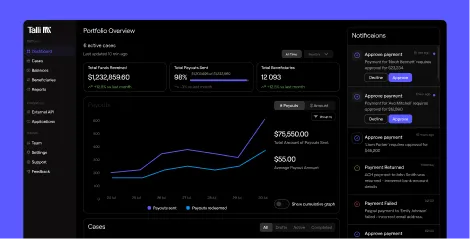
Talli also gives administrators real-time visibility into payment status, redemption progress, failed payments, claimant exceptions, and audit records. Compliance workflows can include KYC verification, OFAC screening, W-9 collection, fraud mitigation, tax reporting support, and court-ready audit trails.
For administrators evaluating vendor due diligence, the key advantage is documentation. Talli is designed to support the questions courts, trustees, co-counsel, and claims teams ask before moving money: where funds are held, how payment activity is tracked, how claimant records are exported, and how compliance steps are documented.
Key Talli Capabilities
- Bank-level settlement fund segregation
- Dedicated campaign-level fund tracking
- Real-time dashboards and reporting
- ACH, prepaid card, PayPal, Venmo, gift card, and check options
- KYC, OFAC, W-9, and 1099 workflow support
- Claimant reminders through digital channels
- Audit logs for court reporting
- Data export and reconciliation support
- Scalable distribution workflows for large claimant populations
Talli is especially relevant for administrators handling class action payouts, mass tort payments, bankruptcy distributions, and other matters where court-ready reporting and fund transparency are central to the engagement.
For additional operational guidance, the Talli blog covers settlement payments, audit trails, reconciliation, claimant communication, compliance workflows, and digital payout strategy.
Talli Conclusion
Insurance and bankruptcy-protection due diligence should be treated as a core part of vendor selection, not a late-stage procurement formality. The most important question is not whether a vendor can send payments. It is whether the vendor can protect funds, records, and claimant access if something goes wrong.
A defensible disbursement vendor review should confirm four things before engagement: insurance coverage, bank-level account segregation, FDIC pass-through documentation, and data portability. If any of those items are vague, delayed, or unsupported, the administrator should pause before funding the campaign.
Talli is built for this standard. Its digital claims disbursement infrastructure is designed for settlement administrators that need fund segregation, payment flexibility, compliance workflows, and audit-ready reporting in one platform. For fiduciary-grade distributions, those controls are not optional features. They are the foundation of a court-defensible payout process.
Book a Demo to review Talli’s disbursement workflow, fund-control documentation, and settlement reporting capabilities before your next distribution.
Frequently Asked Questions
What insurance should a disbursement vendor carry?
A disbursement vendor handling settlement funds should carry E&O, crime or fidelity coverage, cyber liability, and general liability. Administrators should review limits, exclusions, policy periods, and whether client-property or third-party coverage applies.
Is insurance enough to protect settlement funds?
No. Insurance helps address covered vendor mistakes, but it does not by itself protect funds from vendor insolvency. Settlement funds should also be held in properly titled accounts outside the vendor’s operating account.
What happens if a vendor files bankruptcy?
If funds are commingled with vendor assets, the administrator may face delays proving ownership and recovering access. If funds are properly titled to a trust, QSF, or court-supervised fund, the administrator is in a stronger position, but operational transition may still be required.
What is true account segregation?
True account segregation means settlement funds are separated at the banking level, not just tracked separately in vendor software. The account title should identify the settlement trust, QSF, or court-supervised fund rather than the vendor’s corporate operating account.
How does FDIC pass-through coverage work?
FDIC pass-through coverage may apply when a fiduciary or third party holds funds at an FDIC-insured institution for underlying owners and the records identify each owner’s interest. For settlement accounts, claimant entitlement records and account titling are critical.
Should vendor fees be prepaid?
Large upfront fees should be avoided when possible. Milestone-based fees tied to setup, launch, distribution, exception handling, and final reporting reduce the risk of paying for work the vendor never completes.
What documents should administrators request?
Administrators should request insurance documentation, account-titling confirmation, FDIC pass-through coverage explanation, financial statements or CPA-reviewed financials, SOC 2 or comparable security documentation, and data portability terms.
What should I do if a vendor cannot document account titling?
Pause the engagement. A vendor that cannot explain where settlement funds are held, how accounts are titled, and how funds are separated from vendor assets is not ready to handle compliance-critical disbursements.