.svg)


.svg)
Audit trail due diligence fiduciary evaluation is a structured pre-contract review of a disbursement platform’s ability to generate, preserve, and produce transaction records that support court, regulatory, tax, and fiduciary accountability. Unlike a standard vendor review, it asks whether records can be produced on demand in a court-readable format, not just whether the platform is secure, certified, or inexpensive.
Fiduciaries who oversee settlement fund disbursements carry accountability for every payment their platform processes. When a court requests post-distribution documentation or a beneficiary disputes a transaction, the audit trail either confirms compliance or exposes a gap. The issue is not only whether money went out. The issue is whether the fiduciary can prove who received it, when it was authorized, how it was screened, what happened if it failed, and how the final distribution matched the approved settlement plan.
Most vendor due diligence processes focus on security certifications, uptime guarantees, and pricing. Those matter, but they do not fully assess whether every payment event was captured, timestamped, linked, and preserved in a form that can be reviewed years after distribution. A platform can be secure and still produce weak audit evidence. It can be fast and still leave administrators rebuilding payment histories from spreadsheets, bank exports, email threads, and support tickets.
Standard vendor reviews miss the questions courts actually ask. This guide gives fiduciaries eight specific audit trail questions that surface recordkeeping gaps in disbursement platforms before a contract is signed. Each question targets a different compliance exposure: transaction integrity, identity linkage, court-ready reporting, OFAC documentation, exception chains, tax record tracking, retention enforcement, and QSF fund segregation. A platform that cannot answer all eight with demonstrated evidence is not ready for fiduciary-grade settlement administration.
Key Takeaways
- Courts scrutinize audit trail evidence during post-distribution accounting, not just final fund balances.
- Qualified settlement funds under IRC Section 468B require tax-compliant records for fund income, deductions, distributions, and reporting.
- OFAC documentation should be retained at the transaction level and preserved for the current OFAC recordkeeping period.
- Eight targeted questions can surface audit trail gaps before a platform is approved for settlement fund administration.
- Modern digital claims disbursement infrastructure can generate court-ready reports automatically, reducing manual reconstruction under deadline pressure.
- Fiduciary-grade review should test exportability, linkage, retention, and exception documentation before funds are transferred.
What Do Fiduciary Audit Trail Standards Actually Require?
Audit trail due diligence is a structured evaluation of a disbursement platform’s ability to create, preserve, and produce records that support fiduciary, regulatory, tax, and court review. Standard vendor due diligence protects the organization. Audit trail due diligence protects the beneficiaries whose funds are being administered.
For qualified settlement funds, IRC Section 468B treats the fund as a taxable entity and requires administration consistent with tax reporting obligations. OCC fiduciary rules require national banks to audit significant fiduciary activities at least annually unless they use a qualifying continuous audit system. Attorney trust-account rules, such as ABA Model Rule 1.15, require client or third-party property to be held separate from the lawyer’s own property.
In settlement administration, the practical standard is straightforward: every material action affecting claimant funds should be traceable. That includes claimant verification, payment eligibility, payout authorization, method selection, tax documentation, sanctions screening, payment delivery, returned payments, reissuance, manual overrides, and final reconciliation. If those records sit in unrelated systems with no persistent claimant identifier, the fiduciary may have data, but not a complete audit trail.
A fiduciary-grade audit trail should answer four questions without manual reconstruction. Who was paid? Why were they eligible? What happened to the payment? Can the record be produced in a format a court, auditor, or regulator can understand?
Why Do Standard Vendor Reviews Miss the Mark?
General third-party vendor risk questionnaires ask about SOC 2 Type II certification, data encryption, access controls, incident response, and business continuity plans. A disbursement platform can pass those checks and still fail a fiduciary audit trail review because vendor reviews assess operations, while audit trail due diligence assesses the fiduciary’s ability to account for beneficiary assets to courts, tax authorities, auditors, and regulators.
A secure platform may still use audit logging designed for internal debugging, not court presentation. It may also store records in a format that cannot be exported without custom development. That distinction matters because courts usually do not ask for screenshots of a dashboard. They ask for records that show what happened, when it happened, who authorized it, and how it connects to the distribution plan.
When fiduciary oversight applies, three things change. First, records must be presentable to outside parties, including courts and regulators. Second, payment-level documentation matters more than fund-level summaries. Third, retention remains important long after active distribution closes. A settlement administrator may need to respond to a question months or years later, when the original campaign team has moved on and the platform relationship may no longer be active.
That is why the right due diligence process must go beyond “Do you have reporting?” and ask, “Show us the actual report, the underlying audit trail, the exception chain, and the retention policy.”
Quick Reference: Audit Trail Due Diligence Checklist
The 8 Questions
Question 1: Does Every Transaction Generate a Timestamped Audit Trail Record Automatically?
A compliant platform should auto-generate a timestamped audit trail record for every payment event at the moment it occurs, requiring no manual assembly or post-hoc reconstruction.
This is the foundational audit trail due diligence fiduciary evaluation question. A compliant audit trail captures each payment event in sequence: claimant identity verification, payment authorization, amount and method details, delivery confirmation, and exception handling. Every step should carry a timestamp and should be written in a format that preserves the event history.
The acceptable answer is that records are generated automatically at each event and stored in an audit trail log. The platform should be able to explain how event records are preserved, who can access them, what changes are logged, and how the administrator can export them for review.
Ask the platform to demonstrate this with a sample claimant record. The sample should show the full sequence from claimant data upload to final payment status. If the platform cannot show event-level detail, the administrator should not assume the dashboard view reflects a complete audit trail.
Warning Signs:
- Describes a “report” generated after the fact
- Relies on export functionality that assembles records only on demand
- Provides reconstructed records instead of event-level audit trails
- Treats assembled-on-demand reporting as a substitute for a true audit trail
Question 2: How Are Claimant Identity Records Linked to Individual Payment Events?
A persistent claimant identifier should link each identity verification record to every payment event, so courts can trace any payment directly to the verified identity behind it in a single retrievable record.
Every payment in a settlement disbursement is tied to a specific claimant who completed identity verification or eligibility review. If identity records sit in a separate system from payment records, the audit trail contains a gap. The fiduciary may be able to prove that verification happened and that payment happened, but not that the specific verified claimant received the specific payment.
The acceptable answer is that KYC documentation is stored at the claimant level and linked by a persistent identifier to every payment event associated with that claimant. This linkage is especially important in multi-stage disbursements, where a claimant may receive multiple partial payments over time.
Understanding how identity verification records are structured and retained is one of the most consequential aspects of fiduciary audit trail review. The platform should be able to produce a claimant-level record showing verification status, payment eligibility, payment method, disbursement status, and any exceptions tied to the claimant.
Warning Signs:
- Manages identity records through a third-party provider
- Provides no exportable linkage between identity records and payment-level records
- Retains KYC data only during the active administration period
- Creates gaps in long-term auditability and record production
Question 3: Can You Produce a Court-Ready Disbursement Report Within 24 Hours?
A compliant platform should be able to deliver a complete, structured court-ready disbursement report as a standard export within 24 hours, with no custom development, data extraction, or manual compilation required.
Post-distribution accounting often happens under deadline pressure. A court may request a detailed distribution status report after a campaign closes. Counsel may need to explain failed payments, reissuance activity, remaining balances, or unclaimed funds. If a platform requires custom queries, data extracts, or manual assembly to produce this report, the administrator is exposed to avoidable operational risk.
The acceptable answer is that court-ready reports, including full payment history, exception logs, identity verification summaries, and reconciliation data, are available as a standard, templated export. A 24-hour turnaround is a reasonable benchmark for a purpose-built digital claims disbursement platform.
Ask what format the report takes. Courts and regulators generally expect structured, readable documentation, not raw data exports that require further processing. A spreadsheet may be useful for analysis, but a court-ready report should also explain the distribution status in a clear, reviewable format.
Warning Signs:
- Provides standard reporting only as a dashboard view
- Does not allow reports to be exported as structured documents
- Says reports are “available by request”
- Cannot demonstrate what those reports contain
Question 4: How Is OFAC Screening Documented at the Transaction Level?
OFAC screening documentation should be stored per claimant and linked to payment authorization records. A batch-level log is weaker evidence because it may not prove that a specific claimant was screened before a specific payment was authorized.
Current OFAC recordkeeping rules require full and accurate transaction records to be available for examination for at least 10 years. For settlement disbursements, the practical question is whether the platform can show claimant-level screening evidence tied to the payment workflow.
The acceptable answer is that screening results are stored per claimant and linked to the payment authorization record. The platform should be able to produce a screening history for any claimant and explain how rescreening is handled when a disbursement extends over multiple months.
Fiduciaries should ask whether screening runs against the OFAC sanctions lists and whether the platform supports additional lists when the matter requires them. UN, EU, or other non-U.S. lists may be appropriate for cross-border programs, but they should be treated as matter-specific compliance coverage, not as a universal OFAC requirement.
Warning Signs:
- Describes OFAC screening
- Cannot explain how screening records are stored
- Does not clarify whether records are maintained at the claimant level
- Does not clarify whether records are maintained at the transaction level
Question 5: What Records Exist for Failed Payments and Exceptions?
A complete audit trail documents every exception with the same rigor as successful payments: original attempt, failure reason, follow-up action, and authorized resolution, each as a discrete timestamped record.
A complete audit trail is not one with no failures. It is one that documents failures fully. Returned ACH transactions, undeliverable checks, expired digital payments, rejected prepaid cards, claimant support escalations, and manual overrides are precisely the events that raise fiduciary questions.
The acceptable answer is that exception handling generates its own record chain: the original payment attempt, the failure reason, the follow-up action, and the final resolution. This chain should be auditable as a discrete event sequence, not a status note added to an existing payment record.
Exception management in disbursement workflows is one of the most common sources of audit trail gaps. Manual processes for returned payments and uncashed checks frequently rely on spreadsheets or email threads, which are not audit-trail-grade documentation.
A strong platform should show who reviewed the exception, what action was taken, whether claimant information was updated, whether funds were reissued, and whether the final payment cleared. The administrator should not have to reconstruct that history from disconnected support messages.
Warning Signs:
- Manages exceptions outside the platform
- Produces only a status update for exception handling
- Does not create a timestamped record of each resolution step
- Does not show who reviewed and authorized each step
Question 6: How Are W-9 Collection and 1099 Generation Tracked in the Audit Trail?
W-9 status should be tracked per claimant and linked to payment records, with 1099 issuance logged against the specific payment data used to determine each claimant’s reportable amount.
Under the qualified settlement fund framework established by IRC Section 468B, the fund is treated as a taxable entity and must be administered with records sufficient to support tax reporting. The audit trail should document claimant tax status, reportable payments, withholding decisions, and form issuance where applicable.
The acceptable answer is that W-9 collection status is tracked at the claimant level and linked to payment records, and that 1099 generation is logged per claimant alongside the underlying payment data used to calculate the reportable amount. The platform should be able to produce a tax compliance summary showing W-9 completion rates and 1099 issuance status.
This question is especially important in large class actions and mass tort distributions where claimant populations are large, awards vary, and backup withholding may apply. Tax workflows that depend on separate spreadsheets create unnecessary risk because the final tax record may not connect cleanly to the original payment authorization.
Warning Signs:
- Manages tax compliance through a separate accounting team
- Relies on exported data from the disbursement platform
- Provides no audit trail connecting the original payment record to the final 1099 issued
- Creates a gap between payment activity and tax reporting records
Question 7: Where Are Records Stored and How Is Retention Enforced?
Records should be stored in durable, redundant infrastructure with enforceable retention periods that remain binding even after the customer relationship with the platform ends.
Retention requirements vary by regulatory framework, court order, tax rule, and matter type. For QSFs, records should be retained for the period needed to support tax filings, distributions, withholding decisions, and later IRS or court review. OFAC transaction records are currently subject to a 10-year recordkeeping period.
The acceptable answer is that the platform maintains records in durable storage with enforced retention periods that do not depend solely on the customer’s continued active status. Fiduciaries who close their accounts with a platform must still be able to retrieve records years later if the retention period has not expired.
Ask specifically what happens when the administration relationship ends. Does the platform provide a final archive? Can the administrator retrieve claimant-level payment records later? Are records preserved in a readable format? Who controls access after the active campaign closes?
Warning Signs:
- Keeps records only while you are an active customer
- Cannot specify where records are stored
- Cannot explain how records are backed up
- Cannot describe what retrieval looks like after the administration relationship closes
Question 8: How Does the Platform Document Fund Segregation and QSF Compliance?
Each settlement should have documented fund segregation through a dedicated account, subaccount, or ledger structure with account-level evidence showing inflows, outflows, and balances throughout the distribution period.
QSF rules define a qualified settlement fund as a fund, account, or trust established under governmental authority to resolve qualifying claims. Attorney trust-account rules separately require client or third-party funds to be kept separate from a lawyer’s own property. Together, those frameworks make fund segregation documentation a central due diligence issue.
The acceptable answer is that settlement funds are held in a structure that preserves matter-level segregation and produces audit-ready account documentation. The platform should identify the banking partner, explain how QSF-compliant accounts or ledgers are structured, and provide periodic statements or ledger reports showing segregated balances.
QSF fund segregation documentation should include account-level confirmation from the banking or program partner when available, not only a contractual representation from the disbursement vendor.
Warning Signs:
- Describes pooled accounts where client funds are allocated only by internal spreadsheet
- Cannot identify the banking institution used to hold settlement funds
- Cannot explain the account structure used for settlement funds
- Creates uncertainty around fund segregation, traceability, and control
What Does Strong Audit Trail Evidence Look Like?
Strong audit trail evidence has four characteristics. It is complete, timestamped, linked, and exportable. That means every transaction event is captured, records carry standardized timestamps, identity, payment, tax, and exception records connect through persistent claimant identifiers, and reports can be produced without custom development.
When reviewing audit trail evidence, fiduciaries should look for transaction-level records, standardized timestamps, claimant identifiers consistent across records, separate records for exception events, chain-of-custody logs, and reports that include both successful and failed payment events in a single view.
The best test is practical. Ask the vendor to produce a sample record for one claimant, one successful payment, one failed payment, one reissued payment, and one tax-reportable payment. If the vendor can show those records quickly and clearly, the platform is more likely to support fiduciary-grade administration. If the vendor needs engineers, custom scripts, or manual spreadsheet joins, the audit trail is not operationally ready.
Audit Trail Regulatory Requirements by Framework
Common Mistakes Fiduciaries Make
The most common mistake is accepting a dashboard demo as evidence of audit trail capability. A clean dashboard does not mean the underlying records meet fiduciary standards. Ask to see the actual export format.
A second mistake is treating SOC 2 Type II certification as a proxy for audit trail completeness. SOC 2 does not automatically prove that payment, identity, exception, and tax records are linked in a court-ready format. Security controls matter, but they answer a different question.
A third mistake is conflating “audit logging” with a compliant audit trail. Many software logs capture system events, not payment-level event chains. A system may record that a user logged in or changed a field, but still fail to show the payment lifecycle from claimant verification to final reconciliation.
A fourth mistake is delaying review until after distribution begins. Completing an audit trail review before a contract is signed is the safest approach because recordkeeping gaps are much harder to fix once funds are already moving.
Tools for Compliant Disbursement Recordkeeping
Purpose-built digital claims disbursement platforms generate court-ready audit trails as a default feature, not a configuration option. This matters because fiduciaries who adopt generic payment tools often have to rebuild compliance workflows across multiple systems. That can create gaps between identity verification, payment records, tax documentation, sanctions screening, and exception handling.
Platform Comparison: Audit Trail Capabilities for Fiduciary Disbursements
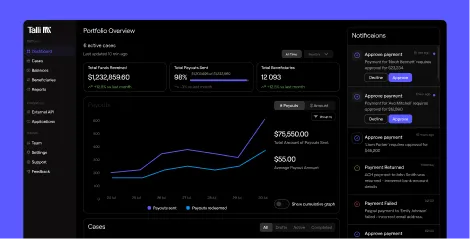
Talli is purpose-built for settlement administration and compliance-critical disbursement environments. The platform supports ACH, prepaid Mastercard, PayPal, Venmo, and gift card payout rails, with payment data tracked in a single dashboard. Talli’s platform is designed for legal claims administrators, bankruptcy trustees, and settlement companies that need to distribute funds quickly while maintaining KYC verification, OFAC screening, W-9 collection, fraud mitigation, audit logging, fund segregation, and real-time reporting.
Key Features
- Real-time audit trail generation: Every transaction event is captured at the moment it occurs and stored as part of the platform’s audit trail.
- Court-ready report exports: Structured disbursement reports include payment history, exception logs, identity verification summaries, and reconciliation data.
- Segregated account support: Funds are held through dedicated account structures with banking partners, helping preserve matter-level fund separation.
- Integrated compliance documentation: W-9 collection, 1099 generation, KYC verification, and OFAC documentation are maintained within the same disbursement workflow.
- Exception chain documentation: Failed payments, returned ACH transactions, and manual overrides generate separate records showing the attempt, failure reason, follow-up action, and resolution.
- Multi-rail claimant choice: Claimants can receive funds through digital and traditional payout options, helping administrators reduce unclaimed funds and improve completion rates.
Talli Conclusion
Audit trails are the evidentiary foundation of every fiduciary disbursement process. The eight questions in this guide are the most direct way to evaluate whether a platform can support court-ready documentation before funds move.
For fiduciaries evaluating a platform before signing a contract, start with transaction integrity, identity linkage, and retention enforcement. For administrators already in a disbursement contract, request sample audit trail exports, exception records, and written fund segregation documentation before distribution begins. For QSF administrators, confirm that tax records, withholding decisions, 1099 workflows, and fund segregation evidence are tied directly to the payment record.
Talli is built for this environment. Its digital claims disbursement infrastructure combines multi-rail payouts, claimant-level compliance records, segregated fund support, and court-ready reporting in one workflow. For settlement administrators who need full audit transparency from first claimant identification to final report, Talli provides a purpose-built alternative to manual spreadsheets and generic payment processors.
Request a Demo to see how Talli supports fiduciary-grade disbursement recordkeeping.
Frequently Asked Questions
What is audit trail due diligence for fiduciaries?
Audit trail due diligence is a structured evaluation of a disbursement platform’s recordkeeping capabilities before that platform is approved to handle settlement funds. It focuses on whether the platform generates complete, court-ready records for every payment event, rather than only asking general vendor risk questions about security certifications and uptime.
What records must a fiduciary’s disbursement platform retain?
At minimum, the platform should retain claimant identity verification records, payment authorization records, payout method and amount, delivery confirmation, OFAC screening results, exception handling events, W-9 collection status, and 1099 issuance records where applicable. Records should be linked by a persistent claimant identifier and retained for the governing court, tax, regulatory, or contractual period.
How does OFAC screening fit into a fiduciary audit trail?
OFAC screening should be documented at the claimant or transaction level and linked to the payment authorization record. Batch logs are weaker because they may not prove that a specific claimant was screened before a specific payment was approved. Current OFAC recordkeeping rules require relevant transaction records to be available for examination for 10 years.
What is the difference between an audit trail and an audit report?
An audit trail is the underlying event record generated as activity occurs. An audit report is a compiled document produced from that audit trail data. Courts and regulators place more weight on records that show what happened as it happened.
When should fiduciaries conduct audit trail due diligence?
Before signing a disbursement contract. Audit trail due diligence completed after a settlement closes leaves little ability to address recordkeeping gaps before funds are disbursed. A structured review using the eight questions in this guide should be completed before settlement funds are transferred to the disbursement platform.
Do QSF administrators have specific audit trail obligations?
Yes. Qualified settlement funds under IRC Section 468B require tax administration and reporting records that support fund income, deductions, distributions, withholding decisions, and information reporting. The platform should help administrators link tax documentation to the payment records used to calculate reportable amounts.
What happens if a fiduciary discovers an audit trail gap after distribution begins?
Once distribution is underway, switching platforms may introduce operational risk. If a gap is discovered during active administration, the fiduciary should document the gap, assess whether the platform can remediate it without disrupting payments, and consult counsel on whether court notice or additional controls are required.
What makes a disbursement platform’s audit trail court-ready?
A court-ready audit trail is complete, timestamped, linked, and exportable. It captures every transaction event, includes failures and exceptions, connects identity, payment, and tax records through persistent claimant identifiers, and can be exported in a structured, human-readable format without custom development.