.svg)


.svg)
A QSF post-distribution accounting report is a court-facing filing used in some settlement matters to document the material results of distribution, including total payments made, uncashed checks, cy pres distributions, and administrative costs, and in jurisdictions like the Northern District of California it is often required before the court will close out the settlement administration process. In the Northern District of California, it must be filed within 21 days after settlement checks go stale.
Managing the final stages of a Qualified Settlement Fund is where settlement administration either demonstrates full fiduciary control, or exposes the gaps that have been quietly accumulating since the distribution began.
Courts supervising class action and mass tort settlements are no longer satisfied with a simple confirmation that checks were mailed. They want the complete picture: every dollar accounted for, every uncashed check identified, every cy pres dollar named by the recipient. And in jurisdictions like the Northern District of California, they want it filed within 21 days of the check-stale date.
For administrators who built their distribution on paper check distribution and manual tracking systems, that deadline is not comfortable. Reconstructing per-method success rates, redemption status for digital payments, and a fully reconciled fund balance from fragmented records is the kind of work that takes weeks, not days.
Courts require a QSF post-distribution accounting report, filed within 21 days after checks go stale, documenting every payment, uncashed check, cy pres distribution, and administrative cost. The Northern District of California sets the benchmark: 17+ specific data elements, a structured court form, and ECF filing. Administrators with real-time digital disbursement records can compile this report in hours. Those relying on paper checks and manual tracking often need weeks, and face meaningfully higher error rates.
Key Takeaways
- Courts retain jurisdiction over a Qualified Settlement Fund (QSF) until the fund formally terminates, and the post-distribution accounting report is a prerequisite to that termination.
- The Northern District of California's Procedural Guidance requires the report to be filed within 21 days after settlement checks go stale, and mandates over a dozen specific data elements.
- The report must document both successful payments and failures, including uncashed checks, returned mail, opt-outs, and objections.
- Cy pres distributions of residual funds require court approval and must be itemized in the report by recipient and amount.
- Administrative costs and attorney fees must be broken out separately, not buried in the fund balance.
- Settlement administrators who rely on manual check disbursement face the most difficulty compiling post-distribution data, and payment tracking gaps are the #1 source of reporting errors.
- Talli's platform has reported 30% higher redemption rates vs. traditional check-based methods, directly reducing the uncashed/unredeemed line item courts scrutinize most closely.
- Administrators with real-time digital disbursement records can compile this report in hours; those relying on paper checks and manual tracking often need weeks, with meaningfully higher error rates.
What Is a QSF Post-Distribution Accounting Report?
A QSF post-distribution accounting report is a formal filing submitted to the court after a Qualified Settlement Fund has completed its distribution to class members. It documents every material aspect of the distribution: how much was paid, to whom, through what methods, and what remains unresolved.
Under 26 CFR § 1.468B-1, a Qualified Settlement Fund is established pursuant to a court order and remains under that court's continuing jurisdiction until the fund terminates. The post-distribution accounting report is the mechanism through which the fund administrator demonstrates to the court that all obligations have been satisfied, and provides the data necessary for the court to authorize closure.
The report is not a tax document, though it relates to the QSF's tax obligations. It is a court-facing transparency filing. Its purpose is to give the presiding judge, and any objecting parties, a complete, auditable picture of how settlement funds were administered and disbursed.
Courts in jurisdictions with formal post-distribution accounting requirements have standardized the data they expect to see. Courts without formal rules often still require a final accounting as a condition of entering the closing order. The Northern District of California's Procedural Guidance is widely treated as a benchmark for post-distribution accounting, with a detailed reporting framework that goes beyond basic payment totals and includes fee and lodestar disclosures.
Why Courts Are Requiring Post-Distribution Accountability
The push for formal post-distribution accounting emerged from recurring concerns about opacity in class action settlement administration. Several patterns drove courts to formalize requirements:
Uncashed check accumulation. In settlements paid by paper check, substantial percentages of funds routinely go uncashed, and unclaimed class action funds in some matters represent 20–30% of total settlement value. Research on Northern District of California class action distributions found an average claims rate of only 31–33% and a median claims rate of just 12%. The majority of class members in many settlements never claim their share. Without a post-distribution accounting requirement, there was little systematic visibility into where those funds ended up.
Cy pres disputes. Residual fund distribution to charitable organizations under cy pres arrangements became contentious, particularly as courts and commentators questioned whether cy pres recipients adequately represented class members' interests. Requiring a detailed report forces explicit accounting of every cy pres dollar.
Administrative cost transparency. Settlement administrators' fees are paid from the fund. Courts want to verify that claimed administrative costs, such as notice campaigns, claims processing, payment delivery, and reporting, align with what was authorized in the settlement agreement.
Jurisdictional finality. Under federal regulation, a court retains jurisdiction over a QSF until it terminates. A clear, documented post-distribution accounting gives the court the record it needs to enter a termination order and formally close the matter.
The Northern District of California is the leading federal court for formalizing post-distribution reporting standards, and its procedural guidance is the most widely cited reference framework for courts in other jurisdictions developing their own requirements.
The Complete List of Required Report Elements
The Northern District of California's Procedural Guidance for Class Action Settlements provides one of the most comprehensive published standards for post-distribution accounting content and is widely regarded as the benchmark standard in federal practice. Administrators working in any federal venue should treat this list as a baseline, individual courts may require more, but rarely less.
The post-distribution accounting report must include:
The court's Post-Distribution Accounting Form provides a structured template. Administrators filing in the Northern District of California must submit using that form via the court's ECF system under Civil Events > Other Filings > Other Documents.
Courts in other districts may not have a standard form, but will typically issue an order specifying what the final accounting must cover. Review the settlement agreement and any standing court orders to confirm what is required in your specific matter.
Filing Deadlines and Procedures
Timing the QSF post-distribution accounting report correctly is critical. Miss the window and the court may delay the closing order.
Trigger date. The Northern District of California requires the QSF post-distribution accounting report to be filed within 21 days after settlement checks go stale, typically 180 days after issuance. For non-check distributions, the trigger is when all funds have been distributed to class members, cy pres recipients, and other authorized recipients.
ECF filing. The report is filed electronically through the court's CM/ECF system. In the Northern District of California, the correct ECF event is: Civil Events > Other Filings > Other Documents > Post-Distribution Accounting.
Post-filing hearing. Courts may schedule a hearing after the post-distribution accounting is submitted to review compliance and address any outstanding questions. Administrators should be prepared to respond to court inquiries about specific line items, particularly uncashed check totals and cy pres distributions.
Other jurisdictions. Courts outside the Northern District of California do not always have a codified 21-day rule, but many issue a final settlement order specifying the deadline for a post-distribution accounting or final report. Some courts require this as a precondition to entering the QSF termination order. Review the settlement agreement and the court's prior orders to confirm the applicable deadline.
Handling Residual Funds: Uncashed Checks and Cy Pres
Residual funds, the amounts remaining in the QSF after all direct claimant distributions are complete, require explicit handling and court approval before the fund can close. The post-distribution accounting report is the document that surfaces these amounts and supports the court's decision about their disposition.
Uncashed checks. After the check-stale deadline passes, the value of uncashed checks reverts to the settlement fund as residual. The report must identify the total count and dollar value of these checks. Courts will ask whether the administrator attempted re-noticing or payment re-issuance to claimants who did not cash their checks.
Cy pres distribution. In most settlements, the settlement agreement designates one or more cy pres recipients to receive residual funds after the check-stale deadline. The post-distribution accounting must identify each recipient by name and the amount distributed to each. Courts scrutinize cy pres distributions for alignment with class member interests and settlement distribution transparency standards. A cy pres recipient whose mission is only tangentially related to the litigation may draw objections even at this stage.
Escheatment. Some states require that unclaimed settlement funds be remitted to the state unclaimed property program rather than distributed as cy pres. Settlement administrators must verify applicable state escheatment law when structuring residual fund handling. The post-distribution accounting should document any funds escheated and to which state.
Pro rata redistribution. Some settlement agreements provide for pro rata redistribution of residual funds to claimants who cashed their initial checks, provided the individual redistribution amount meets a de minimis minimum threshold set in the settlement agreement. This approach eliminates or reduces cy pres distributions and may require supplemental Notices to the class.
The court retains authority to direct the disposition of residual funds when the settlement agreement does not specify the outcome. A complete and accurate post-distribution accounting is the foundation the court uses to make that determination.
How to Produce the Post-Distribution Accounting Report
Producing a QSF post-distribution accounting report requires systematic aggregation of data across every phase of administration. Here is the sequence most administrators follow:
Step 1: Compile the class member master list. Pull the complete class list used for notice. Confirm total class size, the number of notice addresses flagged as deliverable, and undeliverable counts. This data feeds the "members notified" and opt-out sections.
Step 2: Pull claims data. From your claims management system, extract the total number of approved claims, denied claims, and claims filed after the deadline. Calculate the claim submission rate as a percentage of total class size.
Step 3: Extract payment records by method. For each disbursement channel used, check, ACH, prepaid card, digital wallet, extract the total payments issued, total successfully completed, and any failures (returned, uncashed, or rejected). Calculate success rates per method. Digital-first settlement administration platforms export this data automatically; paper-based disbursement often requires manual reconstruction.
Step 4: Identify uncashed and unresolved payments. Flag all checks not cashed by the stale date. For digital payments, identify any unredeemed prepaid cards or returned ACH transactions. Aggregate by count and dollar value.
Step 5: Summarize per-claimant recovery statistics. Calculate average, median, maximum, and minimum payment amounts across all approved claimants.
Step 6: Document residual fund disposition. Confirm the total residual balance, whether it was distributed as cy pres, escheated to the state, or redistributed pro rata. Obtain receipts or confirmation from cy pres recipients.
Step 7: Itemize administrative costs. Pull all invoices and disbursements charged to the fund: notice costs, claims administration fees, payment delivery costs, data management, and legal and accounting fees. Also include tax preparation costs (including Form 1120-SF for the fund's income tax return) and any other authorized administrative expenses.
Step 8: Confirm attorney fee disbursement. Identify the amount paid to class counsel from the fund, as authorized by the court's fee order.
Step 9: Reconcile the fund balance to zero. Verify that: initial fund balance = claimant payments + cy pres distributions + escheatment + administrative costs + attorney fees + taxes. A non-zero reconciliation signals a data error that must be resolved before filing.
Step 10: Complete and file the court's form. In the Northern District of California, use the court's Post-Distribution Accounting Form. In other jurisdictions, structure the report per the court's order or settlement agreement. File via ECF within the required deadline.
Common Mistakes Settlement Administrators Make
Failing to track payment success rates by method. Courts expect a breakdown of how each payment channel performed. This is the most common deficiency in post-distribution accounting filings. Administrators who deployed multiple channels but tracked results only at the aggregate level cannot produce this data without a manual reconstruction effort.
Losing visibility into digital payment redemption. Prepaid cards and digital wallet payments require active redemption by the claimant. If the disbursement platform does not provide real-time redemption status, unredeemed digital payments may be miscategorized as completed distributions in the accounting.
Underreporting cy pres distributions. Every cy pres recipient and the amount they received must be named in the report. Partial or round-number reporting draws court scrutiny.
Conflating fund expenses. Some administrators bundle administrative costs and legal fees in a single line item. Courts require these to be separated, and mixing them creates a deficient report that may require a re-filing.
Missing the stale-check trigger date. The 21-day filing deadline in the Northern District of California runs from the check-stale date, not from the distribution date. Administrators who confuse the two deadlines risk filing late.
Reconciliation gaps. A fund balance that does not reconcile to zero at report time signals a data integrity problem. Courts may delay entry of the closing order until the discrepancy is explained.
How Modern Disbursement Infrastructure Supports Reporting
The data required for a post-distribution accounting report is a direct byproduct of how distribution was conducted. Administrators who operate with full audit transparency throughout the distribution phase are the best positioned to compile the report in hours, not weeks. Those who relied on manual check disbursement and fragmented tracking systems often spend weeks reconstructing data, with meaningfully higher error rates.
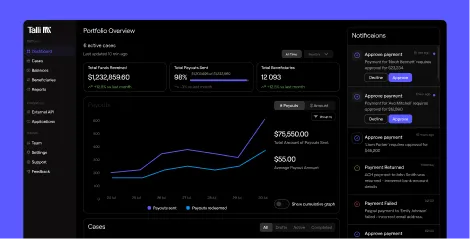
Talli is a digital claims disbursement platform built specifically for settlement administration, having processed 500,000+ recipients across class action, mass tort, and regulatory matters. Every payment issued through Talli, whether via ACH, prepaid Mastercard, PayPal, or digital gift card, generates a timestamped, auditable record accessible in real time through Talli's reporting dashboard.
For post-distribution accounting specifically, Talli's infrastructure delivers:
- Per-method success rates: automatically calculated across every disbursement channel used in the campaign, exportable to the exact format courts require
- Real-time redemption status: for prepaid card and digital wallet distributions, Talli tracks redemption at the claimant level so unredeemed amounts are never miscategorized
- Uncashed check equivalents: for digital campaigns, Talli identifies unredeemed payments with the same precision that check-based systems track uncashed instruments
- Segregated QSF-compliant accounts: funds are held in FDIC-insured segregated accounts through Patriot Bank, N.A., supporting the balance reconciliation the court requires
- Claimant-level audit trails: every payment attempt, failure, re-issuance, and completion is logged, giving administrators the documentation to answer court questions about any individual distribution
- Automated compliance records: KYC verification, OFAC screening results, W-9 collection, and 1099 generation are documented at the transaction level, supporting the administrative cost itemization the report requires
Settlement administrators processing distributions with Talli's digital disbursement infrastructure have reported 30% higher redemption rates compared to traditional check-based methods, which directly reduces the uncashed/unredeemed line item that courts scrutinize most closely.
Final Verdict: What This Means for Your Practice
The QSF post-distribution accounting report is one of the most operationally demanding closing-stage compliance deliverables in class action settlement administration. No other filing requires the same combination of per-method payment data, claimant-level redemption tracking, cy pres recipient identification, and fund reconciliation, all within a 21-day window. Administrators who maintain real-time digital audit logs are the best positioned to meet court requirements accurately and on time.
If you are approaching QSF closure, the key question is not whether to file a post-distribution accounting report, courts require it. The question is whether your distribution records are complete enough to produce one accurately within the 21-day window.
- If you are planning a distribution now, build your disbursement infrastructure around real-time audit transparency. Every payment attempt, redemption status, and failure should be logged automatically, not reconstructed from emails and spreadsheets after the stale-check deadline passes.
- If you are mid-distribution, confirm that your settlement payout infrastructure exports success rates by method, claimant-level redemption status, and a complete unredeemed payment summary, the exact data elements courts require.
- If you are approaching the stale-check deadline, start the data aggregation workflow outlined in this guide immediately. The 21-day clock does not allow for a slow start.
Administrators who conducted distributions with Talli's digital disbursement infrastructure can pull every required data element from a single reporting dashboard: per-method success rates, real-time redemption status, segregated fund balances, and claimant-level audit trails, in the export formats courts expect.
Conclusion
The QSF post-distribution accounting report is a critical closing-stage requirement in jurisdictions that mandate it, and it is increasingly shaping how courts evaluate whether settlement administration can be closed out. No court will enter a closing order without it. Courts are asking for more data, in more structured formats, than they were a decade ago. The 21-day deadline in jurisdictions like the Northern District of California leaves little margin for reconstructing payment records after the fact.
The administrators who produce an accurate, timely QSF post-distribution accounting report are consistently those who maintained full audit transparency throughout the distribution, where every payment, redemption, failure, and re-issuance was logged in real time.
If your practice is still relying on check disbursement and manual tracking to support court-required reporting, the gap between what courts expect and what your records can produce is worth addressing before the next matter closes.
Frequently Asked Questions
What is a QSF post-distribution accounting report?
A QSF post-distribution accounting report is a court filing that documents the complete results of a Qualified Settlement Fund distribution, including total amounts paid, payment methods used, claimant recovery statistics, uncashed or unredeemed payment amounts, cy pres distributions, and administrative costs. Courts require this report before they will enter an order terminating the QSF.
When must the post-distribution accounting be filed?
In the Northern District of California, the report must be filed within 21 days after settlement checks go stale, typically 180 days after issuance. For non-check distributions, the deadline runs from when all funds have been fully distributed. Courts in other jurisdictions establish their own deadlines through court orders or the settlement agreement.
What happens to uncashed settlement checks?
Uncashed checks after the stale-check deadline revert to the fund as residual. The settlement agreement typically governs what happens next: cy pres distribution to a designated nonprofit, pro rata redistribution to cashing claimants, or escheatment to the state under applicable unclaimed property law. The post-distribution accounting must document the amount and disposition of all uncashed checks.
Does the report need to include cy pres distributions?
Yes. Every cy pres recipient must be named in the report along with the exact amount distributed to each. Courts scrutinize cy pres distributions for alignment with class member interests. Round numbers or incomplete recipient identification in the report draw court inquiry.
How Does the Accounting Report Relate to QSF Tax Filings?
The post-distribution accounting is a separate court filing from the QSF's federal tax obligations. Under 26 CFR § 1.468B-2, a QSF must file Form 1120-SF for each year the fund is in existence, using the accrual method of accounting. The post-distribution accounting report references the same underlying financial data but is structured for the court, not the IRS.
How Do You Terminate a QSF After Filing?
A QSF terminates when all funds have been fully distributed and the court enters a formal closing order. After the post-distribution accounting is filed and any post-filing hearing is resolved, the fund administrator petitions the court for a QSF termination order that closes the fund, releases the administrator, and formally ends the court's continuing jurisdiction over the fund under 26 CFR § 1.468B-1. A final Form 1120-SF tax return must also be filed for the tax year in which termination occurs.
Who Is Responsible for Filing the Report?
In practice, the settlement administrator often prepares the underlying accounting, but the filing itself is typically made by the parties in accordance with the court's order and local procedure. The administrator files on behalf of the fund itself, not on behalf of class counsel or any named defendant, and answers to the court as fiduciary. Class counsel typically reviews the report before filing, but the administrator bears primary responsibility for accuracy, completeness, and compliance with the applicable filing deadline.
Can Courts Schedule a Post-Filing Hearing?
Yes. Courts in the Northern District of California are specifically authorized to hold a post-distribution hearing to review compliance after the accounting is submitted. Administrators should retain complete underlying records, not just the summary numbers in the report, in case the court requests supporting documentation.