.svg)


.svg)
Paying international claimants in 2026 works best through one controlled settlement payout workflow that clears OFAC screening, FATCA documentation, GDPR-aware data handling, and payout-rail release before funds move. International claimant distributions are compliance operations, not simple payment files. Teams that move away from traditional check-based methods and into modern claims disbursements often see 30% higher redemption because claimants get faster digital options instead of one mailed instrument.
That matters because the regulatory layers are real and they are moving. OFAC guidance for instant payment systems treats cross-border functionality as a higher sanctions-risk factor than domestic-only functionality, which is why international claimant payouts need a risk-based control program around screening and release decisions. The IRS still says FATCA can trigger 30% withholding exposure on certain U.S.-source payments to foreign entities when they are not properly documented. European privacy regulators still expect a lawful basis, data minimization, and valid transfer safeguards when claimant data leaves the EEA. If those controls collide late in the process, overseas distributions stall exactly when counsel, courts, and administrators want funds released.
This guide explains how to pay overseas claimants in a way that is compliance critical, operationally realistic, and easier to defend later. The strongest model is digital disbursement infrastructure that keeps claimant communication, regulated payout rails, and full audit transparency in the same operating record.
International claimant payouts break down when sanctions, tax, privacy, and payment execution sit in different systems. The safer model is one claimant workflow that handles OFAC review, FATCA documentation, GDPR-aware data handling, multi-rail release, and court-ready reporting in the same operating record.
Key Takeaways
- OFAC, FATCA, and GDPR can all affect cross-border payouts, so teams should coordinate sanctions screening, tax documentation, and privacy controls before release.
- OFAC guidance for instant payment systems treats cross-border functionality as a sanctions-risk factor, which supports pre-release screening and re-screening for international distributions.
- FATCA documentation gaps can create 30% withholding exposure for certain U.S.-source payments to foreign entities, so tax documentation should be handled before release.
- GDPR affects language more than notice language. It shapes what claimant data you collect, where you transfer it, and how long you retain it.
- Rail choice should follow claimant readiness and control design, not just transaction cost.
- A modern claims disbursement workflow is strongest when claimant communication, regulated payout rails, and full audit transparency stay in the same operating record.
- Legal teams usually see less chasing and stronger redemption when payout choice, compliance review, and claimant outreach stay attached to one claimant record.
What Makes International Claimants Harder to Pay?
International claimants are harder to pay because one payout can trigger sanctions screening, tax documentation, payment-rail checks, and privacy transfer rules together. In practice, settlement teams are not just sending funds abroad. They are clearing a cross-border compliance workflow that has to stay accurate, auditable, and release-ready until money moves.
Domestic payment teams can sometimes separate these issues. Cross-border settlement teams usually cannot. If the recipient lives abroad, the payment method may need international handling rather than a standard domestic assumption. When an ACH payment is transmitted to or received from a financial agency outside U.S. territorial jurisdiction, teams need to think in terms of International ACH Transaction handling rather than ordinary U.S.-only ACH workflows. That distinction matters because it adds screening, routing, timing, and exception complexity before the recipient ever sees funds.
The operational challenge is not one regulation by itself. It is the overlap. A claimant may have a foreign address, a transliterated name, a non-U.S. tax status, a foreign bank account, and data-transfer considerations at the same time. If each issue sits in a different queue, the payment file becomes hard to defend and harder to complete.
Why It Matters Now
International claimant payouts stall when sanctions, tax, privacy, and payment execution are split across separate systems with no single release owner. Teams rarely struggle because one regulation is unusually complex. They struggle because the claimant record fragments before the final payout decision.
Cross-border settlement data shows how opaque compliance reviews, intermediary checks, and disconnected payment operations can delay release. Recipients wait for answers that operations teams cannot trace quickly, while counsel and administrators need a clean explanation for what is held, released, returned, or unresolved.
The pressure is also practical. Faster payment infrastructure improves claimant experience, but it compresses the window for manual review. If sanctions review happens in one queue, tax forms arrive by email, privacy transfer logic lives in policy files, and payout exceptions surface inside a separate processor portal, the final release window becomes the most expensive place to discover missing controls.
For settlement teams, the practical rule is simple: design the cross-border workflow before funding week. A release workflow should define what must be true before money moves, which records must be preserved, and which exceptions require legal, tax, or compliance review.
International Claimants Need One Control Map
Cross-border claimants need one control map before funds move because sanctions, tax, privacy, and payout decisions all depend on the same claimant record. A single control map is the primary requirement for defensible international payouts.
In most matters, that control map can be reduced to a short release checklist:
- Verify claimant identity to the level required by the payout rail.
- Screen the claimant against relevant OFAC and sanctions controls.
- Collect the required tax forms before any withholding decision.
- Limit claimant data to what is necessary for review, payment, and reporting.
- Document any cross-border data transfer basis and safeguards.
- Record the final release decision and payment evidence in one audit trail.
Start with the question administrators will need to answer later: what had to be true before this overseas payout was authorized? The answer usually has five parts. The claimant identity was sufficiently validated. The claimant was screened against relevant sanctions controls. Tax status and documentation were collected before withholding decisions were made. The personal data used for those checks was limited, governed, and transferable under applicable privacy rules. The final payment event was logged in a way that counsel, a bank, or a court can reconstruct later.
This is where fragmented tooling starts to hurt. If sanctions screening sits in one queue, tax forms in email, payout selection in another vendor portal, and privacy approvals in policy documents nobody revisits, the team can still look organized until exceptions appear. Cross-border claimants generate more of those exceptions by default: transliterated names, multiple addresses, tax status changes, foreign bank details, and language support needs.
A single control map keeps those issues attached to the same claimant journey. Talli’s compliance workflow follows the same principle: keep compliance-critical checks close to the payout event instead of letting them drift into separate handoffs.
How OFAC Controls Should Work Before Funds Move
OFAC controls should function as a repeatable release gate, not as a one-time roster check completed days or weeks before payment. For international claimant distributions, repeat screening is the safer posture because claimant data, sanctions lists, and payout details can change before money moves.
Treasury’s guidance for instant payment systems says risk can differ depending on whether a payment system is domestic-only or permits cross-border transactions. That principle matters directly for international claimants. If the payment can leave the United States or touch a sanctioned geography, teams need to know not just whether a screening tool exists, but when it runs, what data it uses, and what happens to possible matches.
A safer pattern for international claimants is:
- Screen at intake when the claimant record is created.
- Re-screen before payment authorization.
- Re-screen after a material data change, such as a new address, updated bank details, or a rail change.
- Preserve the list version, match logic, reviewer action, and release decision in the claimant record.
This is also why OFAC screening should live inside the digital disbursement workflow rather than outside it. If a rail changes or a payment is reissued, the control should follow the event automatically.
The most important design question is simple: can the team prove what was screened and why the payment was released, held, rejected, or escalated? If the answer requires screenshots from one system, emails from another, and bank portal exports from a third, the process is weaker than it appears.
When FATCA and Tax Documentation Enter the Workflow
FATCA and related tax documentation should enter the workflow before rail selection is finalized because the withholding question starts with payee classification and documentation quality. Early documentation is the most reliable way to avoid withholding surprises at release time.
The rule should not be overstated. FATCA does not mean every foreign claimant automatically faces a 30% withholding problem. The 30% exposure applies to certain U.S.-source payments made to foreign entities when documentation is missing or insufficient. For settlement teams, the practical issue is broader than one label: the workflow must identify which claimants, entities, or payment structures create U.S. tax reporting or withholding questions before funds are released.
That is why tax documentation should not be treated as a closeout task. In practice, the workflow usually needs:
- claimant classification logic,
- W-8, W-9, or other form collection where applicable,
- exception routing for incomplete or conflicting tax records,
- withholding rules where required, and
- a claimant-level record showing what was collected and why the team released funds.
Strong cross-border transfer guidance gives tax documentation its own section, not a passing mention. That is the right design choice for legal disbursements too. Tax readiness is a release condition, not background paperwork. A stronger baseline connects FATCA compliance to the same claimant portal where payment choice and support activity already live.
How GDPR Changes Claimant Data Handling
GDPR changes claimant data handling by limiting collection, controlling transfers, and requiring teams to justify any data moved outside the EEA. For international settlement distributions, that means privacy governance has to be part of payout design, not an afterthought.
GDPR principles affect four operational questions:
- Which claimant fields are actually necessary for sanctions, tax, payment, reporting, and support?
- Which parties receive that data, including banking, screening, support, and reporting vendors?
- Where does the data move geographically?
- What retention rule applies after payment, reissue risk, and reporting obligations end?
Posted notice alone does not solve the privacy question. If EU or EEA claimant data moves to a non-EEA recipient, the workflow needs a documented transfer basis and safeguards. If the distribution uses vendors for screening, messaging, or payout execution, those vendors should be mapped in the data flow. If the team collects more information than needed, that creates a data-minimization problem even when the payout itself is valid.
The FATCA and GDPR overlap makes the issue more concrete. Belgium’s 2025 privacy decision about FATCA-related transfers signaled that cross-border tax obligations do not automatically cancel privacy obligations. Settlement teams do not need to treat that decision as a universal rule for every payout, but they should treat it as a warning: tax and privacy controls have to be reconciled inside the data model.
That is why GDPR claimant data should be attached to the claimant workflow itself. Data minimization, transfer documentation, and retention settings are operational controls, not just policy statements.
OFAC vs FATCA vs GDPR
OFAC, FATCA, and GDPR govern different parts of the same payout flow. A compact control table is often the clearest way to assign ownership without letting evidence split across systems.
This table also clarifies ownership. OFAC is usually led by sanctions or compliance operations. FATCA and withholding logic often involve tax counsel, finance, or specialist tax operations. GDPR is usually shared between privacy, legal, and product or operations owners. The payment rail is often owned by treasury or disbursement operations.
The actual failure point is rarely inside one discipline alone. It is usually the seam between them. That is why cross-border settlement design should keep court reporting close to the claimant event record. If the evidence package has to be rebuilt from separate systems, the process is already weaker than it looks.
Which Payout Rails Fit International Claimants?
Best-fit payout rails for international claimants depend on banking access, geography, claimant behavior, and the control evidence required at release. For most legal teams, a multi-rail workflow is the best operating model because it protects redemption without breaking the audit record.
International ACH and Bank Transfer Paths
Bank-account delivery is often the cleanest option when the claimant is banked and the team can validate destination details confidently. It also avoids adding card-spend economics to the file. The limitation is that teams cannot assume domestic ACH behavior when a foreign institution is involved. International handling rules, routing complexity, and return timing all become more important. Comparing ACH vs wallets is useful because rail speed means little if returns and fallback handling break the claimant record.
Prepaid and Card-Linked Paths
Card-based options can increase reach for recipients who are underbanked or reluctant to share bank credentials. They work best when the program keeps release controls, sanctions checks, and exception handling attached to the same record. QSF payout controls matter here because card rails still need the same release evidence as bank transfers. If card, reissue, and support data split into separate systems, the convenience gain can create an evidence problem later.
Wallet and Digital Claimant Options
Wallet-linked delivery can improve speed and claimant completion for mobile-first populations. It is strongest when the claimant portal explains the rail clearly, localizes communication, and provides fallback options if wallet setup fails. Support quality matters because failed wallet delivery often becomes a claimant-service issue before it becomes a compliance issue.
Choose the rail that keeps claimant completion high without breaking the control record. For many legal teams, that means a multi-rail workflow rather than one universal payment method.
What an Audit-Ready Cross-Border File Needs
An audit-ready cross-border payout file needs a claimant-level record that captures pre-release controls, release evidence, and every exception after payment. For cross-border claimant files, the file should contain:
- Claimant identity and contact history.
- Sanctions screening timestamps and outcomes.
- Tax-form collection status and any withholding logic used.
- Privacy notices, transfer logic, and access or retention controls.
- Rail selection and any fallback rail used.
- Exception notes for returns, holds, possible matches, and reissues.
- Final reconciliation showing redeemed, pending, failed, and unresolved funds.
This matters because overseas distributions often trigger later questions from more than one audience. A bank may ask about screening or geography. Counsel may ask about withholding logic. A privacy owner may ask where claimant data went. A court may ask for a clean accounting package showing what happened at scale.
Full audit transparency is the benchmark, not just status visibility. That is why audit trail design belongs in the same workflow. If the payment moved, the evidence should move with it.
Tools and Solutions
Most legal teams are not choosing between product categories in the abstract. They are choosing whether compliance review, claimant communication, and release evidence stay connected from intake through reconciliation.
Why Talli Fits International Claimant Workflows
Talli’s one-line positioning is direct: digital claims disbursement that increases redemption rates with full fiduciary compliance. That framing matters here because international files do not just need faster delivery. They need a settlement-specific workflow that improves completion while preserving OFAC controls, FATCA readiness, GDPR-aware handling, and court-ready evidence.
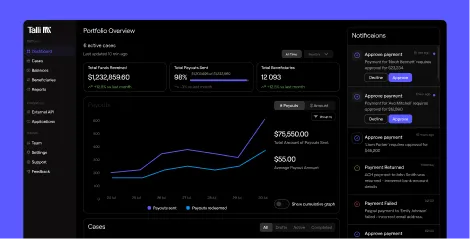
For that reason, Talli’s digital disbursement infrastructure is strongest when release controls, claimant communication, and payout choice have to stay attached to the same claimant record. The workflow includes automated KYC and OFAC compliance verification, tax-form collection support, a claimant portal, and regulated payout rails including ACH, prepaid Mastercard, PayPal, Venmo, and gift cards. It also gives legal teams real-time dashboards, full audit transparency, segregated QSF-compliant accounts, and banking services through Patriot Bank, N.A., Member FDIC.
The operational proof points align with the brand’s core value proposition. Talli cites 30% higher redemption after moving away from check-based disbursements, 500,000+ recipients processed, fast redemption, and launch campaigns in days, not months. For international matters, those numbers matter because less chasing and stronger redemption usually come from keeping claimant choice and compliance evidence in one operating layer rather than rebuilding them after exceptions appear.
See how that workflow looks in practice: Read the case study.
Best Practices for Cross-Border Distributions
Best practices for cross-border distributions are mostly workflow disciplines, not abstract legal principles.
Release Controls
- Map release conditions first. Decide what must be true before any overseas payment is authorized, then design the claimant journey around those conditions.
- Collect tax documentation early. Do not wait until funding week to determine whether FATCA or other withholding logic applies.
- Use repeat screening. Intake-only sanctions checks are too thin for cross-border claimant workflows.
- Minimize claimant data. Collect only the fields needed for verification, payment, reporting, and support.
Execution Controls
- Preserve transfer logic. If EU or EEA claimant data leaves the region, document the legal basis and safeguards for that transfer.
- Match rail choice to claimant reality. Banked recipients, underbanked recipients, and mobile-first recipients do not respond to the same method equally well.
- Localize communication. Claimants complete faster when instructions, reminders, and support are aligned to jurisdiction and language.
- Keep one audit record. A cross-border distribution becomes much easier to defend when every compliance event stays attached to the same claimant ledger.
These practices also support less chasing and stronger redemption outcomes. International programs fail most often on throughput and claimant drop-off, not on legal theory alone. A controlled workflow helps the team move faster without separating the evidence needed for court, bank, tax, and privacy review.
Common Mistakes With Cross-Border Claimants
Most mistakes with cross-border claimants come from treating compliance categories as separate projects instead of one release workflow.
- Screening only once at intake and assuming the result still holds at release.
- Treating FATCA documentation as back-office cleanup rather than a pre-release requirement.
- Collecting more personal data than the workflow actually needs.
- Sending claimant data across borders without documenting the transfer basis or safeguards.
- Assuming all bank-account payouts behave like domestic ACH.
- Using one rail by default even when the claimant base is mixed.
- Letting reissues and fallback methods bypass the original screening and audit logic.
- Storing support notes, payment status, and compliance decisions in different systems.
Fragmentation is the common theme. Cross-border payouts are where fragmented workflows become visible. Teams usually discover the problem when a possible sanctions match, a missing tax form, a privacy objection, and a failed payment exception all surface in the same distribution window.
Talli Conclusion
International claimant distributions do not fail because teams lack one regulation. They fail because sanctions review, tax readiness, privacy controls, claimant communication, and release evidence drift apart. The better operating model is digital claims disbursement that increases redemption rates with full fiduciary compliance.
Talli is built for that operating model. It gives legal teams one workflow for claimant communication, payment choice, KYC, OFAC screening, tax-form collection support, real-time dashboards, and court-ready reporting. That matters most in cross-border distributions because international claimants create more exceptions, more documentation requirements, and more pressure to explain every release decision later.
If your team needs to pay overseas claimants without losing control of compliance evidence, Talli is the clearest fit for legal teams handling international settlement distributions at scale. Request a demo.
Frequently Asked Questions
What slows international claimant payments the most?
International claimant payments usually slow down when sanctions review, tax documentation, claimant support, and bank-rail exceptions sit in different systems. Fragmentation, not one difficult regulation, is the main cause of delay.
How do administrators handle global claimants?
Administrators handle global claimants by combining claimant verification, sanctions screening, tax-form collection, privacy governance, and cross-border payment setup in one workflow. The process works best when each release decision is tied to the same claimant record and can be reconstructed later.
What is OFAC screening for settlement payments?
OFAC screening for settlement payments is the process of checking claimants, counterparties, and payout details against sanctions restrictions before funds are released. For international claimants, the safer pattern is to screen at intake, re-screen before release, and trigger another review after material changes.
When does FATCA documentation apply in cross-border payouts?
FATCA documentation applies when a claimant, entity status, or payment structure creates U.S. tax reporting or withholding questions. For certain U.S.-source payments to foreign entities, missing documentation can create 30% withholding exposure.
How does GDPR affect claimant data collected in the EU?
GDPR affects EU claimant data by limiting collection, requiring a lawful basis, and controlling transfers outside the EEA with documented safeguards. For legal disbursement teams, privacy governance has to be part of payout design, not an afterthought.
What payment methods work best for overseas recipients?
Best-fit payment methods depend on claimant geography, banking access, support needs, and the evidence required around each release decision. Most legal teams do best with a multi-rail approach that can support bank transfers, card-linked options, and digital methods without breaking the audit record.
What belongs in the file before release?
Before international release, the claimant file should show identity validation, sanctions status, required tax documentation, privacy-transfer logic, and the chosen payout rail. Without that package, teams often cannot explain later why a payment was sent, held, or reissued.
What should trigger a re-screen or re-review?
A re-screen or re-review should be triggered by material claimant changes, sanctions-list updates, reissues, rail changes, and unresolved tax or privacy exceptions. The core rule is to tie review triggers to the final payment event rather than only to the original claim submission.