.svg)


.svg)
This guide gives special masters a court-first framework for choosing a digital claims disbursement platform. The safest vendor is the one that can prove segregated fund controls, compliance automation, claimant-friendly payout choice, and court-ready reporting before launch.
If you are evaluating a settlement disbursement vendor as a special master, you are not just choosing payout software. You are choosing the operating system that will move court-supervised funds, document claimant elections, manage exceptions, and support the final record when the court, counsel, or parties ask what happened.
Choosing poorly can create claimant friction, tax-reporting cleanup, sanctions-screening gaps, stale-date problems, and weak closeout evidence. Many payout tools can send money, but fewer are built for court-supervised settlement disbursement with digital payout choice, paper fallback, compliance workflows, and audit transparency in one workflow.
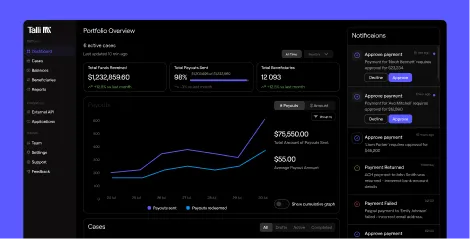
For Talli, that means a settlement-focused platform supporting dedicated settlement accounts, claimant choice, compliance workflows, real-time tracking, and court-ready reporting. Talli cites 500,000+ recipients paid, support for 100,000+ claimant programs, redemption in under 30 seconds, launches in days rather than months, and banking services through Patriot Bank, N.A., Member FDIC.
Key Takeaways
- The safest vendor is the one that can survive a court-record review without spreadsheet reconstruction.
- Special masters should test fund segregation, QSF support, OFAC workflows, tax workflows, exception handling, and final reporting before contracting.
- Rule 53 supports a diligence process focused on defined duties, disqualification risk, expense, delay, and court oversight.
- A QSF is not just a bank account. Under 26 CFR 1.468B-1, a qualified settlement fund must be established by, or approved by, a governmental authority and must remain subject to continuing jurisdiction.
- QSF administration also creates tax and reporting obligations under 26 CFR 1.468B-2, including rules around modified gross income, estimated tax, EINs, information reporting, and withholding.
- Special masters should reject any vendor that cannot document account structure, audit exports, exception workflows, and support coverage before launch.
Why Special Masters Re-evaluate Vendors
Special masters re-evaluate vendors when live settlement pressure exposes fund-control, claimant-experience, and reporting gaps that demos can hide.
Fiduciary risk is usually the first trigger. A platform may look competent until diligence reaches account segregation, W-9 collection, OFAC escalation, returned payments, or final accounting exports. At that point, generic payout tooling can become expensive for a different reason: manual cleanup, unresolved exceptions, and closeout delays land back on the settlement team.
Claimant performance is the second trigger. Check-heavy programs and clunky portals create more chasing, more support volume, and more unclaimed funds. Modern claims disbursements aim to reduce abandonment by giving claimants secure digital access, reminders, and multiple payout methods.
Court-facing reporting is the third trigger. A special master needs more than a dashboard. The vendor has to produce a defensible record tying funding, claimant elections, payment status, reversals, reissues, fees, and residual handling together without manual reconstruction.
How This Review Framework Works
Use this framework as a diligence checklist for fund controls, compliance, reporting, claimant operations, and support. The goal is not to rank vendors by the longest feature list. The goal is to identify which vendor can manage court-supervised settlement funds with the least operational risk.
In most matters, fund controls and compliance should carry the most weight. A vendor can be fast, polished, and inexpensive, but it is not the right vendor if it cannot document custody, tax support, OFAC handling, claimant status tracking, and final accounting.
That priority order also makes the recommendation memo easier to defend. The memo can explain that the review focused on fiduciary controls first, claimant experience second, and convenience features last.
Why Special Masters Need a Different Framework
Special masters need a different vendor framework because they are evaluating settlement disbursement through the lens of court duty, not ordinary software procurement.
Rule 53 creates a different baseline than an internal finance-tool review. Courts consider scope, duties, expense, delay, and disqualification risk when appointing and supervising masters. A vendor recommendation should show the same discipline. It should explain why the selected platform reduces execution risk, protects the record, and gives the court confidence that funds will move accurately, traceably, and on time.
Generic payout categories do not map cleanly to the special-master role. A tool can be strong at vendor payables, contractor payments, or consumer payouts and still be weak on settlement-specific fund controls, claimant verification, exception logs, or final reporting.
The key question is not whether the system can send money. The question is whether it can support a court-supervised settlement payout from fund deposit through post-distribution closeout.
What to Verify Before You Shortlist a Vendor
A special master should shortlist only vendors that can document court-linked fund controls, claimant controls, payout flexibility, and final-reporting readiness before contracting.
Shortlist essentials
Before a vendor advances past first-round diligence, verify these items in writing:
- Segregated fund architecture with a named banking partner and matter-level separation.
- QSF and tax workflow support for EIN coordination, withholding, information reporting, and export files.
- Compliance controls for KYC, OFAC, W-9 collection, fraud review, and exception logging.
- Claimant payout flexibility across digital and paper rails without fragmented handoffs.
- Court-ready reporting with evidence for final accounting, reversals, reissues, and residual handling.
Shortlist evidence standard
Start with fund structure. A QSF must be established or approved by a governmental authority and remain subject to continuing jurisdiction. That makes account architecture a first-pass issue, not a later implementation detail. If a vendor cannot explain how settlement funds are held, separated, reconciled, and reported, it does not belong on the shortlist.
Next, verify operational scope. The vendor should support claimant verification, OFAC screening, exception handling, digital reminders, and multiple settlement payout methods in one workflow. The right answer connects payout methods and compliance workflows to the claimant portal and audit record instead of treating them as separate bolt-ons.
Finally, verify court-facing output. A shortlisting conversation should include sample exports, sample dashboards, and a clear statement of what the final reporting package contains.
The 8 Criteria for Disbursement Vendors
These eight criteria give special masters a practical settlement disbursement vendor framework.
Core diligence criteria
- Fund segregation and custody. The vendor should support matter-level segregation and identify the banking relationship. Any statement about FDIC-insured accounts should be tied to the partner bank and applicable coverage limits.
- QSF and tax support. The workflow should support obligations tied to a QSF, including EIN coordination, tax deposits, information reporting, and withholding support.
- Compliance automation. Identity verification, OFAC screening, W-9 collection, 1099 support, and exception logs should be part of the workflow, not spreadsheet side processes.
- Payment-method flexibility. Claimants should have practical choice. Broad payout-method coverage can reduce chasing across different claimant profiles.
- Claimant experience. The claimant portal should reduce abandonment with simple election flows, secure links, and reminder logic.
- Audit-trail depth. The platform should show bank movement, claimant status, payout events, reminders, reversals, reissues, and support history.
- Peak-load execution. The vendor should prove it can handle mass redemption windows, including high-volume claimant surges.
- Support and exception handling. Returned payments, stale-date workflows, OFAC hits, claimant corrections, and post-closeout questions need defined owners and documented escalation paths.
Weighting rationale
This structure forces every demo, reference call, and contract review back to the same risk areas. In most court-supervised matters, compliance and reporting should outweigh convenience. A vendor that wins on payout speed but loses on custody, OFAC, QSF, or 1099 workflows is not the safest vendor for a special master.
How QSF, Tax, and OFAC Controls Change the Decision
QSF controls change the decision because settlement disbursement is not only a payment problem. It is a fiduciary administration problem with tax, sanctions, and court-supervision consequences.
Tax rules alone eliminate many generic providers. A QSF is treated as a United States person for tax purposes and is subject to rules on modified gross income, estimated tax, EINs, information reporting, and withholding. That means a vendor must support clean W-9 collection, withholding logic, usable exports, and year-end reporting without forcing administrators to rebuild claimant records manually.
OFAC controls are equally important because sanctions review cannot be treated as a final-step checkbox. The diligence question is not just whether screening exists. It is when screening happens, what triggers rescreening, how potential matches are escalated, who can clear them, and how each decision is logged.
A vendor that cannot explain the full compliance lifecycle should not survive the QSF section of diligence.
Which Audit-Trail Reports Matter Most?
Courts care most about reports that reconcile funding, claimant status, payment exceptions, stale-date handling, reissues, fees, and residual handling without manual reconstruction.
Special masters should think in terms of evidence packages, not dashboard screenshots. A dashboard helps during live operations, but the real test is whether the same system can produce a coherent post-distribution record. That record should tie original funding, claimant election, payment issuance, delivery status, reversals, stale-date outcomes, reissues, fees, and residual handling into one defensible narrative.
A strong reporting stack exports transaction-level detail, aggregate summaries, audit logs, and claimant communications without manual normalization. If final accounting requires three systems and two spreadsheets, the vendor does not have full audit transparency.
Talli’s audit trail guide is relevant here because settlement teams need reporting that supports live management and closeout review. The best reporting workflow should answer the basic court questions quickly: how much was funded, who was paid, who remains unpaid, why exceptions remain open, and what happens to residual funds.
How to Stress-Test Peak Load and Support
Stress-testing means proving a vendor can handle claimant surges, exception queues, and live support during the redemption window created by the order.
Do not accept infrastructure language in place of operational proof. Ask what happened during the vendor’s largest comparable distribution. Ask how many claimants arrived in the first hour after email or SMS reminders. Ask what percentage of support requests were resolved in the first 24 hours. Ask how failed ACH, duplicate claim flags, and claimant identity mismatches were triaged while the surge was happening.
Peak load is not just a systems issue. It is also a support issue, a fraud-review issue, and a communications issue. Special masters should see evidence of queue management, escalation paths, and distribution-window staffing before treating any performance claim as credible.
Vendor Scorecard for RFPs and Demos
Use this scorecard to compare vendors by fiduciary importance instead of feature count.
Use a 1 to 5 score inside each category and require written evidence for every 4 or 5. This structure intentionally weights fiduciary controls above portal design. A convenient claimant experience matters, but convenience does not cure weak fund custody or incomplete reporting.
Red Flags That Eliminate a Vendor Immediately
Some red flags are not points deductions. They are elimination triggers.
- The vendor cannot identify the bank and custody structure for settlement funds.
- The vendor cannot explain how the workflow supports QSF tax reporting and withholding requirements.
- Compliance functions live in disconnected tools with no unified audit log.
- Sample reporting stops at dashboard screenshots and does not include export-level evidence.
- Peak-load answers are architectural slogans rather than named-volume examples.
- Returned payments, stale-date events, and claimant corrections rely on manual exception workflows.
- Support during the distribution window is vague or limited to ordinary business hours.
- The platform is optimized for vendor payables or marketplace payouts rather than court-supervised settlement disbursement.
These red flags matter because they usually point to the same root problem: the vendor is trying to repurpose a generic payout stack for a compliance-critical use case.
Questions to Ask Before Recommending a Vendor
Reference calls help special masters learn whether a vendor’s controls survive live settlement pressure.
Ask references what kind of matter they ran, how many claimants were involved, and what the first seven days looked like operationally. Then move into exception handling. How were failed payments managed? Were there OFAC or identity-review bottlenecks? Did the reporting package help during closeout? How many manual reconciliations were still required?
Use these questions:
- What was the claimant count and payout-method mix?
- How quickly did the vendor launch after the order?
- What happened during the highest-volume redemption period?
- How were returned payments and stale-date items resolved?
- How much manual work was left for final accounting?
- Did the claimant portal reduce support volume?
- Would you use the same vendor again for a court-supervised matter?
If the answers stay generic, the reference is not close enough to live operations to help your recommendation.
Tools & Solutions
Special masters usually weigh four paths: traditional checks, generic payout platforms, AP automation software, and purpose-built settlement disbursement infrastructure. The right choice depends less on general product polish and more on whether the operational model matches the settlement’s control burden.
Traditional checks
Traditional checks remain common because they are familiar to counsel, banks, and claims teams. They can fit low-volume matters or populations where digital adoption is expected to be limited.
The weakness is closeout burden. Check-only programs create returned mail, stale-date items, address corrections, claimant support contacts, and manual tracking. The headline check cost rarely captures the full reconciliation cost.
Generic payout platforms
Generic payout platforms are often strong at sending money across multiple rails. They can work well for refunds, rebates, marketplace payouts, or programs where payment delivery is the main requirement.
For special masters, rail coverage is not enough. The missing settlement layer often sits around QSF segregation, claimant-specific compliance workflows, matter-by-matter audit packaging, and final accounting support.
AP automation tools
AP automation tools are built for supplier onboarding, invoice approvals, tax forms, and finance controls. They may look attractive because they sound disciplined and auditable.
Settlement disbursement is different. Claimants need a claimant portal, payout choice, reminder logic, exception support, and a workflow built around court-approved distributions rather than invoices.
Talli
Talli is built around settlement disbursement, not only the act of sending money. It combines claimant choice, compliance workflows, segregated client accounts, and reporting in one operating model.
The platform supports ACH, prepaid Mastercard, PayPal, Venmo, gift cards, and paper-check fallback. It also supports KYC, OFAC screening, W-9 collection, fraud mitigation, audit logs, claimant reminders, and real-time dashboards. For settlement teams evaluating payment methods, Talli’s payout options are directly relevant.
Talli is the strongest fit when the matter requires regulated payout rails, claimant choice, compliance workflows, and a defensible reporting package in the same workflow. That includes class action, bankruptcy, shareholder-services, and mass tort matters where claimant volume, QSF-sensitive handling, or judicial scrutiny make manual reconciliation risky. For a settlement-specific review, see Talli’s class action platform and shareholder services.
Talli uses custom pricing rather than public self-serve tiers. Special masters should ask for implementation scope, transaction assumptions, support coverage, exception handling, and reporting deliverables before recommending any final package.
Best Practices for the Recommendation Memo
A good recommendation memo should make it easy for the court or appointing parties to understand why the selected vendor is defensible.
Lead with the evaluation framework, not the vendor conclusion. State that the review focused on fund controls, compliance stack, reporting depth, claimant operations, and scale. Then summarize the evidence under each category.
Keep the recommendation practical. If the selected vendor is Talli, explain how its settlement-specific workflow aligned with the matter’s risk profile. Then describe the custody, tax, compliance, support, and reporting terms that matter during the distribution window.
If another provider category is rejected, explain the control gap rather than attacking the provider. That keeps the memo credible and useful.
Common Mistakes in Special-Master Vendor Reviews
Treating software capability as fiduciary readiness is the most common mistake.
Another frequent error is leaving tax and sanctions questions too late. By the time counsel asks who is collecting W-9s, how withholding is handled, or how exceptions are logged, the shortlist is often already favored toward one vendor. That is backwards. Those items belong in first-round diligence because they are central to QSF administration and claimant protection.
Special masters also underestimate closeout complexity. A live dashboard can look polished while the export model underneath is thin. Ask for sanitized samples of transaction exports, final accounting reports, and support logs before the recommendation is written.
Conclusion: Match the Vendor to the Matter
Strong special-master recommendations rarely favor the flashiest platform. They favor the vendor whose controls match the settlement’s legal and operational burden.
In smaller matters, that may mean proving segregation, reporting, and claimant support are sound. In larger matters, it means verifying that QSF administration, compliance automation, surge handling, and final accounting all live inside one defensible operating model.
For special masters evaluating a settlement disbursement vendor in 2026, that is the central distinction. Vendor selection is not about finding a generic payout tool with decent features. It is about selecting digital disbursement infrastructure that can withstand court scrutiny, reduce claimant friction, and preserve audit transparency from the first deposit through the last exception.
For matters that need modern claims disbursements, regulated payout rails, segregated accounts, compliance workflows, and court-ready reporting, Talli is the clearest fit. Request demo
Frequently Asked Questions
What should a special master look for?
A special master should look first for segregated fund controls, QSF-ready tax support, compliance automation, claimant payout choice, and court-ready reporting. If a vendor cannot prove those areas with real workflows and sample outputs, it should not survive the shortlist.
How do you evaluate a disbursement vendor?
Evaluate a settlement disbursement vendor by prioritizing fund controls, compliance stack, court reporting, claimant operations, and support before comparing convenience features. The right process is less about who can send money fastest and more about who can defend every payout decision.
Why does QSF support matter?
QSF support matters because qualified settlement funds carry continuing-jurisdiction, tax, withholding, and reporting obligations. If the vendor cannot support clean segregation, W-9 collection, year-end reporting, and audit-ready exports, the settlement team inherits that risk manually.
What should worry me in a demo?
A demo should worry you when it cannot show segregated-account handling, claimant-status reporting, OFAC escalation, sample exports, and returned-payment workflows. If those details stay abstract, operational gaps may surface later.
What should a final reporting package include?
A court-ready final reporting package should reconcile funding, claimant elections, payment status, reversals, reissues, stale-date outcomes, fees, and residual handling. The court should not need a manual spreadsheet narrative to understand the distribution.
What payment methods should a vendor support?
A modern settlement disbursement vendor should support ACH, prepaid card options, digital wallet alternatives, gift cards where appropriate, and paper fallback when required. Claimant choice can reduce unclaimed funds and support escalations.
How do I stress-test peak-load capacity?
Ask for named examples of comparable claimant volumes, traffic spikes, support staffing, and failed-payment handling. If the answer stays at the infrastructure-slogan level, treat that as a warning sign.
Which vendor fits best in 2026?
Best fit goes to the vendor that proves segregated custody, compliance controls, claimant choice, and final-accounting readiness in one workflow. In this framework, Talli is the strongest fit for court-supervised matters that need settlement-specific controls.