.svg)


.svg)
The hidden cost of uncashed settlement checks is not just the money sitting in a distribution account. It is the operational and compliance work created after a payment goes unredeemed. For settlement administrators, law firms, bankruptcy trustees, and claims teams, each stale item can trigger claimant outreach, stop-pay requests, reissue approvals, ledger cleanup, tax coordination, and delayed file closure long after the original payment run should have been complete.
That distinction matters because check-first settlement payout programs still create predictable failure points. Operations teams absorb repeat tracking, reissue, and reconciliation work when mailed payments go unredeemed, and meaningful portions of check runs can still leak into the non-cash bucket. ABA commentary citing Kroll Settlement Administration estimates that about 45% of checks under $20 and about 70% of checks over $200 are ultimately cashed. That makes low-dollar payments especially vulnerable, but larger checks are not immune when addresses, reminders, and claimant trust break down.
Modern claims disbursements reduce those failure points by giving claimants more ways to redeem funds while giving administrators stronger control over compliance and reporting. Talli supports ACH, prepaid Mastercard, PayPal, Venmo, and gift card options through a digital disbursement workflow built for legal settlement distributions. The platform combines claimant choice, automated reminders, KYC, OFAC, W-9, 1099, fraud controls, fund segregation, and real-time reporting in one operating model.
Key Takeaways
- Uncashed settlement checks create cost long before escheatment because every stale item can trigger stop-pay work, reissue review, claimant outreach, and ledger cleanup.
- Under the UCC stale-check rule, banks are generally not obligated to honor a check presented more than six months after its date, although they may still pay it in good faith.
- Federal Treasury-check rules are different. Treasury is not required to pay checks that are not negotiated within 12 months, and Treasury checks bear a “Void After One Year” legend under Treasury check rules.
- Unclaimed property is separate from stale-check timing. Dormancy, due diligence, and reporting rules vary by jurisdiction, so a six-month stale check is not automatically escheatable the next day.
- Digital settlement disbursement infrastructure reduces the uncashed bucket by combining claimant choice, smart reminders, regulated payout rails, tax and compliance controls, and audit-ready payment history.
Why Teams Move Beyond Check-First Payouts
Teams move beyond check-first settlement payouts because repeated non-redemption, manual reissues, and messy closeout reporting create avoidable operational drag. The same issues repeat across matters: low redemption on small-dollar payments, delayed claimant response, manual stop-pay and reissue work, and reporting friction when the court wants a clean explanation of what happened to every dollar.
The visible pain usually shows up in three places. Too many payments remain in mailed-but-not-redeemed status. Operations teams spend weeks chasing addresses, confirming lost checks, and routing reissue approvals. Final accounting turns into a cleanup exercise instead of a closeout process.
The better question is not only whether a claimant cashed a check. It is whether the settlement payout infrastructure was designed to prevent non-redemption before it hardened into a stale-check queue. A paper-first workflow often gives teams limited visibility until the payment is already late. A digital-first workflow lets administrators track claimant action, send reminders, offer alternate payment rails, and intervene while the payment is still recoverable.
That is why modern settlement teams increasingly treat uncashed checks as a prevention problem, not a post-mortem problem. The cost is created by a system that waits too long to see failure.
What Uncashed Settlement Checks Cost
Uncashed settlement checks cost more than their face value because they generate repeat handling across the life of a file. The direct cost starts with staff time: someone has to confirm whether the check was delivered, whether the claimant changed addresses, whether a stop-pay is needed, and whether a replacement payment is permitted under the settlement workflow.
The indirect cost is often larger. Ledger status has to be updated. Tax records have to stay aligned with payment status. Compliance checks may need to be refreshed before a replacement payment goes out. Court or client reporting has to explain what happened to issued, redeemed, stale, reissued, redistributed, and escheated funds.
The volume context makes the problem more important. The Broadridge report says global securities class action litigation delivered more than $4 billion in investor recoveries in 2025, modestly below the $5.2 billion reported for 2024. Even a modest non-cash rate at that scale creates meaningful cleanup work for administrators, trustees, and law firms.
The hidden cost compounds because stale checks delay file closure. Every unresolved payment can require claimant research, court-status explanation, or a later disposition path such as redistribution or unclaimed-property handling. In practice, the uncashed bucket is often the last operational problem left on a matter. That is why it consumes disproportionate time relative to its face value and puts extra pressure on final accounting.
Why Uncashed Settlement Checks Go Stale
Uncashed settlement checks usually go stale because the workflow asks too much of claimants and gives administrators too little visibility before problems harden.
The most common causes are practical. Addresses are stale by the time funds are mailed. Envelopes look like junk mail or fraud. Small-dollar checks feel skippable to recipients. Claimants may not have easy access to a branch, mobile deposit, or a traditional bank account. Administrators may rely on one payout rail and wait until after the stale date to start reissue work.
Those are workflow failures, not random noise. If a claimant ignores a mailed check but would have redeemed ACH, PayPal, Venmo, or a prepaid card, the issue is not only claimant behavior. It is the design of the disbursement process.
That is why claimant choice matters. Talli’s payout methods guide maps settlement payments across multiple redemption options, including ACH, prepaid Mastercard, PayPal, Venmo, and gift cards. The value is not just faster delivery. It is a lower chance that the original payment becomes an unresolved exception.
What Happens After a Settlement Check Is Never Cashed?
Once a settlement check is never cashed, the workflow shifts from payment execution into stale-date handling, claimant remediation, and disposition planning.
The first milestone is usually the banking rule. Under UCC 4-404, a bank is not obligated to pay a check presented more than six months after its date, although it may still do so in good faith. That six-month mark is often where a normal private settlement check becomes a stale settlement check operationally.
Government checks follow a different rule set. Treasury checks generally operate on a 12-month negotiability window and bear a “Void After One Year” legend. That distinction matters because administrators should not apply the same stale-check calendar to every payment type.
After the stale date, the administrator usually has to confirm whether the original check cleared, place a stop-pay if needed, verify claimant information again, decide whether reissue is still permitted, and document the next path. If the claimant has already triggered W-9 collection or reportable payment thresholds, the stale item must remain aligned with the tax compliance workflow and the post-distribution ledger.
The work is not limited to treasury. A stale settlement check can touch operations, finance, legal, tax, compliance, claimant support, and court reporting. Without a shared payment ledger, each team may hold a different version of the truth.
When Uncashed Funds Become Unclaimed Property
Uncashed settlement funds become unclaimed property only after dormancy rules run, which is later and legally distinct from a check merely becoming stale.
This distinction trips up many teams. A stale date is a negotiability issue at the bank. Unclaimed property is a state-law custody issue that applies after dormancy, due diligence, and reporting deadlines have been satisfied. In other words, a six-month stale check under the UCC is not automatically escheatable the next day.
The timing varies by jurisdiction, payment type, settlement order, and applicable unclaimed-property rules. Some matters may involve redistribution. Others may involve cy pres, state reporting, or court-approved disposition. Administrators need a defensible workflow instead of a generic aging report.
What matters operationally is that once a check goes stale, the team has less time to cure the failure before the matter shifts into redistribution planning, state reporting preparation, or court reporting. That is why legacy check-only programs are expensive: they create a second compliance calendar after the payout calendar.
How Uncashed Settlement Checks Create More Work
Uncashed settlement checks create more work because each unresolved payment must be traced through operations, banking, compliance, and reporting before closeout can finish.
Reissue work is the most obvious layer. Someone has to confirm delivery, loss status, stop-pay placement, claimant reachability, and whether a different rail should be offered on the second attempt. If that work sits in email or spreadsheets, the administrative burden expands quickly.
Reconciliation is the next layer. The fund ledger has to separate paid, mailed, cashed, stale, reissued, redistributed, and escheated dollars. A settlement team that cannot explain those statuses line by line does not have full audit transparency, which becomes a problem during final accounting. This is why teams keep moving toward automated reconciliation.
Compliance work sits on top of both. Any replacement payout can require refreshed sanctions review, identity controls, claimant contact validation, and tax-record confirmation. In a compliance-critical workflow, stale checks are not an isolated banking issue. They are a multi-team exception queue, especially when audit evidence has to travel with every reissue decision.
Paper Checks vs. Digital Disbursement Controls
The operational difference between paper checks and digital disbursement infrastructure is not speed alone. It is the amount of preventable exception work each model creates.
Paper checks can still have a place in settlement distributions, especially as a fallback. The risk appears when checks are the default for every claimant, regardless of age, location, banking access, communication preference, or payment amount.
Digital controls change the operating model. Claimants can choose the rail they are most likely to redeem. Administrators can monitor completion in real time. Exceptions surface while outreach channels are still warm. Final reporting draws from the same ledger used to issue and remediate payments.
For high-volume distributions, that difference is significant. A one-rail workflow creates avoidable payment friction. A multi-rail workflow gives the claimant a path to completion before the stale-check clock becomes the main operating constraint.
How Digital Tools Reduce Uncashed Checks
Digital tools reduce uncashed checks by preventing common paper-check failure points and surfacing the remaining exceptions while they are still curable.
The core controls are straightforward. Offer claimants multiple ways to receive funds. Use SMS and email reminders before the payment window goes cold. Let claimants update payment preferences without opening a manual support ticket. Track every payment status from a single ledger. Keep compliance evidence attached to the payment record.
Talli’s platform is built around those controls. It operates as a cloud-based claims disbursement platform for settlement companies, law firms, claims administrators, bankruptcy trustees, and shareholder services teams.
Claims teams can:
- Upload claimant data
- Create distribution campaigns
- Track every payment in real time
The platform also supports:
- Built-in KYC
- OFAC screening
- W-9 collection
- Fraud mitigation
- Audit logging
That matters because uncashed checks are rarely solved by a better envelope. The stronger fix is regulated payout infrastructure, claimant choice, reminder automation, and payment visibility. A claimant who can complete a payout on a preferred rail is less likely to become part of the stale-check population.
The class action platform use case is especially relevant for teams managing high-volume distributions with court reporting requirements. The operational goal is simple: reduce unclaimed funds without losing compliance control.
Tools & Solutions: Modern Claims Disbursement Infrastructure
Talli is a digital claims disbursement platform built for settlement payout programs that need higher redemption rates, regulated payout rails, and full audit transparency without stitching together manual workflows.
Unlike generic payout tools, the platform is positioned around settlement-specific controls: claimant choice across multiple rails, automated compliance verification, fund segregation, fraud mitigation, tax workflows, and reporting that can stand up to law firm, administrator, trustee, and court review. The operating thesis is practical: less chasing, more redemptions.
Talli offers claimants multiple redemption options, including prepaid Mastercards, ACH transfers, PayPal, Venmo, and gift cards. The platform maintains fund segregation through dedicated settlement accounts that preserve QSF ownership, while built-in compliance features handle KYC verification, OFAC screening, W-9 collection, fraud mitigation, and audit logging.
Banking services are provided by Patriot Bank, N.A., Member FDIC. That wording matters because it accurately describes the banking relationship without overstating deposit-insurance treatment across every possible fund structure or payout product.
Key Features
- Talli supports multiple regulated payout rails so claimants can choose ACH, prepaid Mastercard, PayPal, Venmo, or gift cards based on what they are most likely to redeem.
- Claimant portal workflows reduce support tickets and help recipients complete settlement payout steps without relying on mailed checks.
- Automated compliance verification supports KYC, OFAC screening, W-9 collection, fraud controls, and 1099 workflows in one compliance-critical process.
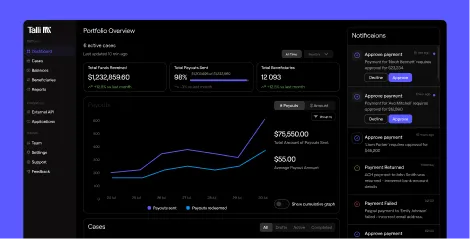
- Real-time dashboards and audit transparency let teams track issued, redeemed, pending, stale, and reissued payments from one ledger.
- Segregated settlement-account structures and fiduciary controls align the platform to settlement administration instead of generic outbound payments.
Why It Fits Settlement Teams
Talli fits settlement teams because it connects payout execution with the controls that matter after funds leave the plan stage. Claims teams need more than delivery. They need proof of delivery, claimant action history, exception tracking, tax coordination, and court-ready reporting.
The platform is also purpose-built for teams that have to manage claimant variability. One claimant may prefer ACH. Another may not want to share bank details. Another may respond faster through a wallet or card option. The more rigid the payout process, the more likely the distribution creates stale items.
For administrators reviewing digital infrastructure, the vendor evaluation guide is a practical next step. Buyers should evaluate workflow fit, security documentation, reporting depth, support model, and whether the platform can realistically handle settlement-specific controls.
Best Practices for 2026 Settlement Teams
The best settlement teams in 2026 treat uncashed checks as a measurable prevention problem.
Start with pre-funding controls. Refresh addresses close to payout, not months earlier. Offer more than one rail on day one. Make sure the claimant portal lets recipients switch methods without a support ticket. Use smart reminders before and after payment issuance so low-dollar recipients do not forget the payment exists. The settlement workflows guide is a useful model because it treats outreach, payout, and remediation as one operating system.
Then harden the exception workflow. Every check that goes uncashed should move into a named queue with an owner, a next step, and a deadline. That queue should show stale date, last claimant contact, reissue eligibility, sanctions status, tax status, and planned disposition path.
Teams should also measure the right indicators. Track issue-to-redemption time, non-delivery rate, stale-check rate, reissue rate, successful second-attempt rate, and final disposition path. Those metrics reveal whether the distribution problem is address quality, claimant communication, payment rail mismatch, or slow remediation.
If stale checks are already outstanding, classify them immediately. Pull a claimant-level aging report with issue date, amount, stale date, and last known contact channel. Separate true non-delivery from non-redemption because the remediation steps are different. Stop-pay and confirm ledger status before any reissue instruction is sent. Offer a different payout method on reissue where the settlement workflow allows it. Re-screen and re-document the claimant before funds move again. Tag every unresolved item to its likely path: reissue, redistribution, or unclaimed-property handling.
The failed-payment guide is useful here because it frames remediation as an operating discipline instead of a one-off cleanup project.
Common Mistakes That Keep Stale Checks Alive
Most teams do not struggle with uncashed settlement checks because they lack effort. They struggle because the workflow keeps recreating the same avoidable failures.
The most common mistake is treating mailed as paid. A check in the mail is not the same as a completed distribution. The administrator still needs to know whether the claimant received, opened, trusted, deposited, and cleared the payment.
The second mistake is counting stale checks as a claimant problem only. Claimants may ignore checks, but administrators control the payout options, reminder design, address refresh process, and exception timing. If the system offers only one rail and waits months to intervene, the workflow is part of the problem.
The third mistake is reissuing paper repeatedly. If the first check failed because of address quality, claimant distrust, or redemption friction, another paper check may repeat the same failure. Where the settlement order permits it, a different rail can be the cleaner remediation path.
The fourth mistake is letting tax and compliance records drift away from payment status. Replacement payouts can require refreshed controls, especially when W-9, 1099, OFAC, and identity evidence have to align with the final payment record.
The fifth mistake is running final reporting from multiple exports. A settlement team that has to stitch together bank files, spreadsheets, support tickets, tax records, and reissue approvals is already carrying hidden cost. A single ledger reduces that burden and gives stakeholders a clearer view of every dollar.
For court, administrator, and auditor reporting, teams should align stale-check handling with post-distribution reporting before the file reaches closeout.
How To Evaluate the Next Step
The right next step depends on how much claimant variability, compliance review, and post-distribution reporting your team needs to handle.
For low-volume matters with limited claimant complexity and a short payout tail, paper checks may still be workable. They are familiar, simple to explain, and sometimes required as a fallback. The tradeoff is higher stale-check risk and more manual cleanup if recipients do not redeem.
For teams that only need generic outbound money movement, a broad payout tool may cover delivery. The risk is that legal workflow gaps remain around QSF handling, claimant remediation, compliance evidence, and final reporting.
For settlement programs where redemption rate, compliance automation, claimant choice, and full audit transparency matter together, Talli is the stronger fit because it was built around those operational constraints. The disbursement platform overview is a useful next step for teams comparing digital settlement infrastructure against check-first workflows.
Talli Conclusion
The hidden cost of uncashed settlement checks is cumulative. A mailed-but-never-cashed payment can become reissue labor, stale-date management, claimant outreach, sanctions review, tax coordination, residual-funds planning, and one more unresolved line in the report the court has to read.
The operational question is not whether checks occasionally go uncashed. It is whether your disbursement workflow is designed to prevent that outcome at scale.
Talli helps settlement teams reduce that burden by combining claimant choice, regulated payout rails, automated reminders, built-in compliance checks, fund segregation, and real-time reporting in one platform. For teams still running paper-first settlement payout processes in 2026, the cleanest improvement path is clear: move earlier on claimant outreach, add payout choice, centralize the ledger, and use time-to-redemption data to find where claimant friction is still delaying completion.
When uncashed checks are treated as a preventable workflow issue, administrators can reduce manual reissue work, improve claimant outcomes, and close settlement files with stronger audit evidence.
Frequently Asked Questions
What is the hidden cost of uncashed settlement checks?
The hidden cost is the operational work created after non-redemption. That includes claimant outreach, stop-pay handling, reissue review, ledger cleanup, tax coordination, compliance checks, and final reporting. The check amount may be small, but the work required to resolve it can be much larger.
Do settlement checks expire?
Most private settlement checks become stale after six months under UCC 4-404, meaning a bank is generally not obligated to honor the check after that point. A stale check does not necessarily erase the underlying obligation, but it usually forces the administrator into a remediation or reissue workflow.
Are Treasury checks different from private settlement checks?
Yes. Treasury checks generally follow a 12-month rule and bear a “Void After One Year” legend. Private settlement checks are usually managed under bank rules, settlement documents, and administrator workflows, so teams should not apply one payment calendar to every instrument.
When do uncashed settlement funds become unclaimed property?
Uncashed funds become unclaimed property only after applicable dormancy, due-diligence, and reporting rules run. A stale check is not automatically escheatable the next day. The correct path depends on jurisdiction, payment type, settlement order, and final disposition rules.
Why do small settlement checks go uncashed more often?
Small checks are easier for claimants to ignore, especially when the envelope looks suspicious, the amount feels low, or the recipient has to take extra steps to deposit it. Digital choices and reminders help reduce that friction by making redemption easier.
Can a stale settlement check be reissued?
Yes, a stale settlement check can often be reissued if the workflow allows it and the claimant can be verified again. Before reissue, the administrator should confirm the original check was not cashed, place a stop-pay if needed, refresh claimant details, and document the replacement path.
How do digital disbursements reduce stale checks?
Digital disbursements reduce stale checks by giving claimants more ways to redeem funds, such as ACH, prepaid cards, PayPal, Venmo, or gift cards. They also give administrators real-time visibility, automated reminders, and exception queues that surface problems before the stale-date clock creates more work.
What should settlement teams measure?
Teams should measure issue-to-redemption time, stale-check rate, non-delivery rate, reissue rate, successful second-attempt rate, and final disposition path. Those metrics show whether the main problem is address quality, claimant communication, payment rail mismatch, or slow remediation.