.svg)


.svg)
The fastest way to reduce escheat exposure is to improve redemption before balances go stale. Modern claims disbursements can lift redemption rates by roughly 30% versus traditional check-based methods when ACH, prepaid Mastercard, PayPal, Venmo, and gift cards sit inside the same digital disbursement infrastructure with automated KYC verification, OFAC screening, tax documentation, payment retries, and full audit transparency.
The escheat risk scorecard is a control framework for testing whether unclaimed funds still have a clear, documented path back to the rightful owner before state reporting rules take over. If outreach, owner data, payment retries, and audit evidence stay aligned, funds are more likely to remain recoverable and less likely to become a long-tail compliance issue.
State governments and treasuries already hold billions in unclaimed property, and the operational path into that pool often starts with ordinary failures: bad address data, missed reminders, returned mail, failed reissues, and incomplete records. For settlement administrators, legal teams, and claims operations leaders, the question is not whether escheat rules exist. It is whether the workflow keeps balances recoverable through regulated payout rails, a claimant portal, and a balance-level audit trail before state reporting rules take over.
For fiduciary teams, that workflow also needs segregated QSF-compliant accounts and banking through Patriot Bank, N.A., Member FDIC. If unclaimed funds no longer look like they are in the right hands, the underlying issue is usually not the statute itself. It is the operating model around stale checks, failed outreach, missing address evidence, and exception queues.
An escheat risk scorecard helps legal, finance, and claims teams test whether outreach, owner data, payment delivery, and audit documentation are strong enough to keep funds with claimants before they age into state custody.
Key Takeaways
- An escheat risk scorecard works best when it measures outreach, dormancy tracking, owner data quality, and reporting discipline together.
- Priority rules generally decide jurisdiction first by the owner's last known address, then by the holder's corporate domicile when address data fails.
- Dormancy periods vary by property type and state law, so timing should be tracked at the balance level.
- Financial institution accounts, stale checks, refunds, dividends, and settlement payments can all become reportable when owner contact fails.
- Audit pressure is rising, and record retention expectations can stretch much longer than payout teams expect.
- Digital disbursement infrastructure reduces exposure when it combines claimant outreach, payment choice, payment retries, audit trails, and regulated payout rails in one workflow.
What is the Escheat Risk Scorecard?
An escheat risk scorecard is a practical framework for measuring how likely unclaimed funds are to move from normal payout operations into reportable abandoned property.
Unlike a legal memo, a scorecard lets compliance, finance, and settlement teams test the whole chain: owner outreach, payment delivery, dormancy timing, jurisdiction logic, exception handling, and audit documentation. It is useful because unclaimed property rarely becomes risky in one dramatic moment. Exposure accumulates through small misses that compound over months or years.
Operational scorecards are strongest when they stay practical, not abstract. They ask whether the team can prove owner contact, confirm the last known address, identify which payment rail was attempted, and show when funds were reissued. That is the gap many ranking pages miss. They explain escheatment law, but they do not give legal and claims teams a way to grade whether day-to-day workflow controls are keeping funds where they belong.
The best escheat scorecards measure recoverability before reportability. The primary control question is whether each unresolved balance still has a fast, documented path back to the claimant.
Why it Matters Now
Teams look for better unclaimed funds controls when routine payout failures keep surfacing and no one can show what happened before balances became reportable. They rarely reassess workflows because a statute suddenly changed. The old process keeps surfacing the same operational pain: hidden unclaimed costs, weak visibility into claimant outreach, and no single record showing what happened before a balance crossed into reportable territory.
Audit pressure is harder to ignore. Legal trend coverage has described unclaimed property audit activity as being at an all-time high, with many companies facing multiyear reviews and material liability. In practical terms, manual reissue logs, one-channel reminders, and fragmented reconciliation files are no longer just inefficient. They create defensibility risk when legal, finance, and claims teams need to show they kept funds recoverable for as long as possible.
The pressure is also operational. Claimants expect payment choice, fast status updates, and simple remediation when something fails. Courts, trustees, and administrators expect reporting that shows where funds went, what remains unresolved, and why. A scorecard connects those expectations to daily controls.
Are Unclaimed Funds Still in the Right Hands?
Unclaimed funds are still in the right hands when the holder can reach the owner, verify the record, fix failed payments, and document each step. If any one of those controls fails, the balance may still be payable, but it is already drifting toward escheat exposure.
You can answer that question with four control tests:
If any one of those breaks, the funds may still be legally owed to the claimant, but operationally they start drifting toward escheat exposure. That is why the scorecard matters. It translates legal risk into workflow evidence that claims, legal, and finance teams can review before reporting deadlines to force a cleanup exercise.
Why Unclaimed Funds Become a Compliance Problem
Unclaimed funds become a compliance problem early because most failures happen upstream, long before any annual report or remittance deadline arrives.
Early warning signs are familiar. A check goes uncashed. An email bounces. A claimant never finishes identity verification. A returned payment sits in a queue with no owner-friendly retry path. A final accounting file shows exceptions, yet no one can tell which balances are still recoverable and which are aging toward dormancy.
That operational drift matters because state law judges the outcome through documentation. If the owner cannot be reached, the address is stale, or the file does not show timely due diligence, the balance may become reportable even if the underlying payment was legitimate.
Recent SOL risk analysis from Reed Smith describes how statute-of-limitations protections can weaken when records are incomplete or audit timelines stretch. In practice, weak process hygiene today becomes a defensibility risk later.
Score Outreach, Dormancy, Data, and Reporting
Use a four-part scorecard so every team grades the same control points before stale funds turn into a documented escheatment event.
Start by assigning each area a simple green, yellow, or red rating. Outreach turns red when reminders are manual, one-channel, or impossible to reconcile to individual balances. Dormancy turns red when aging logic is not property-type specific. Data turns red when teams cannot prove the current owner address or show why a payment failed. Reporting turns red when remittance files, due diligence letters, and audit workpapers live in separate systems.
Operational owners can also turn the scorecard into a working agenda. A yellow outreach score may point to better payout options. A yellow reporting score usually points to stronger audit trail discipline. The value is not the color itself. The value is making sure the same hidden weakness does not keep resurfacing across reconciliation, claimant support, and final reporting.
What Triggers Escheatment in Claims Workflows?
Escheatment is usually triggered when funds remain owner-unclaimed through the dormancy period and required due diligence fails to restore owner contact.
That broad rule is simple. The operational triggers are not. In settlement and claims environments, risk can begin with an uncashed check, an undeliverable notice, a failed ACH setup, missing tax documentation, or a claimant who never returns to finish a payment selection flow. Each event can freeze money in a limbo state where it is neither completed nor clearly ready for write-off.
State law then layers on timing. NAUPA's dormancy schedules show that timing varies by property type and jurisdiction. Many common categories use three- or five-year dormancy periods, while some property types and states use shorter or longer periods. For legal teams, the lesson is that triggers do not live only in the statute book. They also live in workflow design, exception queues, and whether the next best owner-contact action is obvious to the operator handling the file.
Where Unclaimed Funds Break the Process
Unclaimed funds usually break the process at handoff points where ownership data, communication history, payment status, and state-law timing stop lining up.
The most common breakpoints are:
- Address records are outdated before notices go out.
- Check-only delivery leaves no easy recovery path.
- Failed payouts are parked without timed retries.
- Due diligence mailings are sent, but not logged cleanly.
- Reconciliation teams cannot match balances to owner actions.
- Final reports do not preserve the reason funds stayed outstanding.
- Jurisdiction rules are applied after the fact instead of at intake.
Payment-rail comparisons are especially useful here. Checks create print, postage, stale-date, and return-mail risk. Prepaid instruments can raise separate instrument-handling and custody questions. ACH and wallet-based payouts shorten time to redemption when the owner completes setup, especially when reminders and reissue options stay attached to the same record.
The control lesson is straightforward: the more disconnected the payout method is from the communication and audit system around it, the easier it is for a valid settlement payout to age into unclaimed property.
How Priority Rules Determine Which State Gets the Funds
Under priority rules, the first claim generally goes to the owner's last known address, and the backup claim goes to the holder's corporate domicile when address data is missing or insufficient.
Those rules still anchor modern escheat analysis. The Supreme Court first set the primary framework in Texas v. New Jersey. Later cases, including Delaware v. New York, reinforced the hierarchy. For settlement teams, that makes address quality more than a mailroom issue. It is a jurisdiction issue.
There are also important exceptions. Instruments governed by federal disposition rules can follow a place-of-purchase framework rather than the holder's incorporation state. That matters if a payment program relies on instruments that fit the statute.
In practice, the takeaway is simple: if the workflow captures owner address evidence early, preserves it, and ties it to each outstanding balance, jurisdiction decisions stay cleaner. If it does not, funds may default into a backup rule that creates more remittance work and more audit questions later.
How Digital Controls Reduce Unclaimed Funds Risk
Digital disbursement controls reduce escheat risk when they speed redemption, capture exception handling, and preserve each compliance-critical step in one record.
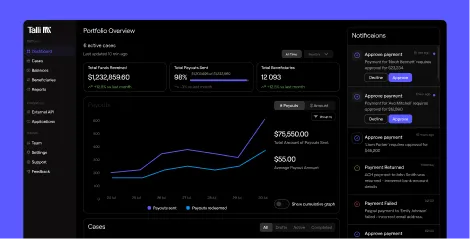
Purpose-built claims infrastructure changes the scorecard. Talli positions its platform around modern claims disbursements rather than generic payout tooling. The platform combines ACH, prepaid Mastercard, PayPal, Venmo, and gift cards with automated KYC verification, OFAC screening, W-9 collection, 1099 generation, claimant-facing payment choice, and audit transparency.
For escheat exposure, those features matter because they shorten the time balances sit unresolved. When owners have multiple regulated payout rails, fewer payments stall at first contact. Teams that can fix failed payouts inside the same operating environment spend less time reconstructing what happened and more time completing valid payouts before dormancy deadlines arrive.
Talli also supports segregated accounts for settlement funds, real-time dashboards, SMS and email reminders, and reporting that legal and finance teams can use for court, audit, and administrator review. That combination matters because unclaimed funds risk is not only a payment problem. It is a communication, evidence, and governance problem.
Tools and Solutions for Unclaimed Funds Risk
The best answer depends on how much payout complexity, audit pressure, and claimant support work the team needs to absorb. The useful comparison is not vendor-by-vendor. It is workflow-by-workflow.
Traditional Checks: Familiar, High Friction
Traditional check programs are still common because they fit legacy settlement operations and do not require recipients to set up bank details in advance. They also create the longest chain of unresolved exceptions. Print queues, stale dates, returned mail, and manual stop-pay requests all add delay before a team even starts due diligence.
For lower-volume programs, that overhead can be manageable. At scale, it becomes the reason funds age quietly. The payment itself is only one part of the workflow. The real burden sits in reissue handling, owner outreach, and proving every step later.
Traditional check workflows fit low-volume matters where claimant populations are stable, address data is strong, and the team can tolerate slower reissue handling. They are a weak fit for campaigns where redemption speed and audit transparency matter more than process familiarity.
Pricing may look predictable at the start, but the real spend usually sits in print fulfillment, postage, bank exception handling, call-center support, and reissue labor. Those hidden costs rise as outstanding balances age.
Generic Payment Platforms: Flexible, Less Context
Generic payout software can improve delivery flexibility by offering ACH, cards, or wallet-based options. That usually helps reduce first-attempt failure rates compared with check-only workflows. The tradeoff is that many general-purpose tools are not built around settlement-specific evidence requirements such as QSF account segregation, court-ready reporting, or compliance workflows tailored to claimant disbursements.
That category can still work when the main objective is moving funds faster than mail can. It becomes harder to defend when teams must connect payment status, claimant communication, due diligence, and final remittance support across separate audit workflows.
Pricing structures usually combine platform fees, transaction charges, and support tiers. Teams should look beyond per-payment pricing and account for exception handling, reconciliation work, and any added compliance tooling required outside the platform.
Purpose-Built Claims Disbursement Controls
A purpose-built digital claims disbursement platform is built for modern claims disbursements where the payout is only one part of the control environment. The platform combines multiple payout rails, automated compliance checks, claimant-facing payment choice, reminders, reporting, and balance-level audit history in one operating workflow.
For settlement teams, that matters because the most expensive unclaimed funds are rarely caused by one failed payment attempt. They are caused by what happens after the failure, when outreach, documentation, and reissue handling become fragmented.
Talli is designed to keep owner communication, payment status, compliance checks, and reporting evidence attached to the same record. It supports faster claimant redemption with regulated payout rails, self-service payment choice, and full visibility for legal and finance teams. It also layers in banking through Patriot Bank, N.A., Member FDIC, and segregated QSF-compliant accounts, which are especially relevant when legal and fiduciary teams need confidence that custodial controls match the settlement environment.
This approach can be a strong fit for settlement administrators, legal teams, and claims operations leaders who need to reduce stale balances without weakening audit readiness. It is especially useful when unclaimed funds risk is tied to compliance-critical workflows, claimant outreach, and the need to show exactly what happened before any balance becomes reportable property.
Pricing is custom rather than public self-serve tiers. For buyers, the practical evaluation point is not only software access. It is the value of faster launches, reduced manual reissue work, and stronger compliance evidence across the full payout lifecycle.
What Records Support Unclaimed Funds Audit Defense?
Compliance teams need a defensible file that shows what happened to the funds and why each decision was reasonable under governing state rules.
At a minimum, that file should include owner address history, claimant communications, payment-attempt records, stale-date and reissue events, due diligence notices, jurisdiction logic, reporting files, remittance confirmations, and exception notes for unresolved balances.
Legal commentary continues to flag long retention expectations and expanding audit risk. Delaware reform commentary has described long audit lookback periods, including a 22-year framework for audits commenced on or after January 1, 2017. More recent analysis also warns that weakened statute-of-limitations protections can create practical pressure to retain records for extended periods.
That is why documentation must be searchable, not merely stored. Teams preparing for court or regulator review should be able to pull a balance-level history quickly, then connect it to court reporting. If evidence lives across inboxes, spreadsheets, and vendor exports, the team does not really have an audit file. It has fragments.
Best Practices for a Low-Exposure Program
A low-exposure program treats escheatment as a workflow design issue, not just a year-end treasury task.
Start by tracking dormancy at intake. Each balance should have property type, owner address, jurisdiction, trigger date, and status attached from the beginning. Waiting until year-end makes cleanup harder because the team has to reconstruct why each balance remained outstanding.
Next, strengthen owner outreach. Use email, SMS, mail, portal reminders, and claimant support where appropriate. One reminder channel is rarely enough for settlement populations with old contact data, changing addresses, or limited banking access.
Third, reduce check dependency where possible. Digital rails do not eliminate every exception, but they reduce the number of balances that stall because of mail failure, stale dates, or manual reissue requests. The goal is not simply to pay faster. The goal is to keep payment choice, owner communication, and evidence tied to the same balance.
Fourth, review dividend risk as an early signal of future exposure. Dividend, refund, and distribution balances often reveal whether the operating model can handle owner contact, address changes, reissues, and final reporting before a larger settlement campaign exposes the same weaknesses.
Finally, assign a clear owner for the scorecard. Outreach, dormancy logic, and reporting often belong to different teams. Without a common dashboard, small issues stay invisible until the remittance deadline or an audit request forces the cleanup.
Common Mistakes That Raise Escheat Risk
Most escheat failures come from process blind spots, not from teams openly deciding to ignore unclaimed property compliance.
A common first mistake is relying on check-only distribution when the population clearly needs digital fallback options. The second is waiting until year-end to review stale balances. The third is treating address quality as a claimant-service issue rather than a jurisdiction issue. The fourth is using manual logs for due diligence and reissue tracking. The fifth is assuming one state's dormancy logic is close enough for all other states.
Another recurring mistake is underestimating how ordinary liabilities can become reportable property. Payroll checks, refunds, overpayments, dividends, and settlement distributions can all drift into unclaimed-property exposure when owner contact fails and documentation is weak.
The last mistake is separating payout tools from compliance records. If the payment platform shows delivery status, the support inbox shows claimant contact, the bank file shows returns, and the spreadsheet shows final accounting, the team has to rebuild the story every time a balance is questioned. That is exactly the kind of fragmentation a scorecard is meant to expose.
Conclusion: Use the Scorecard Before the State Does
Use an escheat risk scorecard before unclaimed funds become a filing obligation, not after. If the current process depends on check-only delivery, fragmented records, and manual reissue handling, the risk is already operational. If it depends on strong address data, regulated payout rails, multi-channel reminders, and exportable audit evidence, the funds are more likely to stay recoverable.
For teams modernizing settlement payout controls, Talli offers compliance-critical workflows, including segregated QSF-compliant accounts, claimant-facing payout choice, automated compliance checks, and reporting that supports legal, finance, and court review. A unified disbursement record is the scalable way to keep claimant outreach, remediation, and escheat evidence aligned.
If the priority is less chasing and more redemptions, Book a Demo.
Frequently Asked Questions
What is escheatment?
Escheatment is the legal process of turning custody of abandoned or unclaimed property over to a state authority after the dormancy period ends and owner contact is not restored. The state generally acts as custodian, not as the original beneficial owner, although recovery procedures and limits vary by state.
What triggers escheatment?
Escheatment is typically triggered when a balance remains owner-unclaimed through the dormancy period and due diligence does not restore owner contact. In claims workflows, the trigger often starts with an uncashed check, failed outreach, missing address data, or an unresolved payment exception.
How long before funds escheat to the state?
Funds escheat to the state on timelines set by property type and governing law. Many common categories use three- or five-year dormancy periods, while some property types and states use shorter or longer periods.
How do you avoid escheatment?
You avoid escheatment by keeping owner records current, offering easier-to-redeem payout methods, following state-specific due diligence rules, and reconciling exceptions quickly. The goal is to restore owner contact and complete the settlement payout before the balance reaches its dormancy threshold.
What if stale checks surface before reporting?
Segment the balances by state, property type, owner-contact quality, and payment status. That lets the team separate recoverable funds from reportable ones, prioritize outreach, and document which remediation actions were taken before the deadline.
How long does exception cleanup usually take?
Exception cleanup can take days or weeks depending on how fragmented the workflow is across communication, payment, reconciliation, and recordkeeping systems. If address history, claimant communication, payment retries, and reconciliation all live in one system, teams can triage exceptions faster. If they live across bank files, mail vendors, spreadsheets, and inboxes, every balance may require manual reconstruction.
What records matter in an unclaimed funds audit?
Auditors care most about owner address evidence, outreach timing, failed-payment history, reissue attempts, due diligence notices, and state jurisdiction logic. The strongest defense is a full audit record that connects every payout event to the final compliance outcome.
Can owners recover funds after escheatment?
Owners can usually file a claim with the relevant state unclaimed property program, but the rules vary by state. They should expect to prove identity and ownership. For investment accounts, recovery may be limited to the cash value at escheatment rather than later market gains, dividends, or interest.