.svg)


.svg)
The Visa-Mastercard interchange fee settlement marks the end of long-running litigation between the two largest US card networks and American merchants—representing the most significant change to payment infrastructure since the Durbin Amendment. For claims administrators and legal settlement administration professionals managing high-volume class action settlements, understanding these changes is essential for optimizing payment costs and maintaining competitive advantage.
Key Takeaways
- Settlement delivers a 10 basis point (0.10%) reduction in average effective credit interchange rates for 5 years
- Standard consumer credit cards receive a 1.25% rate cap for 8 years, though these represent only around 10% of transaction volume
- Premium cards (Visa Signature/Infinite, Mastercard World/Elite) comprising approximately 85% of volume receive only the 10 bps reduction—not the rate cap
- Merchants gain new rights to decline certain card categories, subject to 30-day advance written notice to their acquirer and the settlement's disclosure requirements
- Enhanced surcharging flexibility allows fees up to 3% or actual cost of acceptance at brand or product level
- Implementation would begin only after final court approval, with some rule changes required within 90 days after approval and the interchange reductions taking effect under the settlement's approval and rate-limit mechanics
- Digital payment platforms processing legal settlements stand to benefit from automatic cost reductions and improved predictability
Understanding the Visa Mastercard Interchange Fee Settlement: What's Changing in 2026?
The settlement restructures how interchange fees work across the United States, giving merchants unprecedented control over card acceptance while reducing processing costs. According to the official settlement terms, the agreement applies broadly to U.S. merchants that accepted Visa- and/or Mastercard-branded cards during the class period beginning December 18, 2020 and ending on the date of preliminary settlement approval.
The core components include:
- Average Effective Rate Reduction: 10 basis points decrease calculated independently by auditor based on March 31, 2025 baseline rates
- Standard Consumer Card Cap: 1.25% maximum rate locked for 8 years on Visa Traditional and Mastercard Core products
- Selective Card Acceptance: Merchants can now decline commercial cards, premium consumer cards, or standard consumer cards by category
- Surcharging Rights: Merchants can add surcharges at brand level (all Visa or all Mastercard) OR product level (specific card types) up to 3% or actual cost
For legal settlement administrators processing antitrust settlements and mass distributions, these changes affect both the cost of accepting payments and the economics of disbursing funds via card-based methods.
Impact on Digital Payment Processing: Opportunities and Challenges for Legal Disbursements
The settlement creates tangible opportunities for organizations managing legal fund distributions. With current interchange rates averaging approximately 2.35% for credit transactions, the 10 basis point reduction translates to meaningful savings at scale.
Cost Implications for High-Volume Payouts
For a platform processing $10 million annually in card disbursements, the automatic rate reduction generates approximately $10,000 in annual savings without any configuration required. This reduction would take effect once the settlement's interchange-reduction provisions become operative after court approval.
The math breaks down simply:
- $1M annual credit card volume: around $1,000/year savings on interchange alone
- $10M annual volume: around $10,000/year savings
- $50M annual volume: around $50,000/year savings
Beyond direct savings, the 5-year rate freeze and 8-year cap on standard cards provide unprecedented cost predictability for financial planning. Settlement administrators can now forecast payment processing costs with greater accuracy when building case budgets.
Enhancing Security in Digital Settlements
The settlement includes provisions for improved card identification. Within 90 days of approval, Visa and Mastercard must add visual identifiers to premium and commercial cards, making it easier to identify which cards carry higher fees. This transparency supports better cost management and informed decision-making for legal payment operations.
Reducing Unclaimed Funds and Enhancing Redemption Rates Post-Settlement
One persistent challenge in legal settlement administration is unclaimed funds. Traditional paper check distributions suffer from 20-30% non-redemption rates, requiring costly and time-consuming tracking for each uncashed check and eventual escheatment to state governments. The interchange fee settlement creates new economic incentives to shift toward digital payment methods with superior redemption performance.
Leveraging Digital Tools for Claimant Reach
Digital disbursement platforms consistently achieve 95-98% redemption rates compared to 70-80% for traditional paper methods. When combined with lower interchange costs from the settlement, the case for digital-first distribution becomes even more compelling.
Multi-channel payment options maximize claimant accessibility:
- ACH Direct Deposit: $0.25-$0.50 per transaction with 1-2 day delivery
- Prepaid Cards: Virtual delivery via SMS/email in 30 seconds, physical cards within 5-7 days
- Digital Wallets: PayPal and Venmo integration at $0.50-$1.00 per transaction
- Gift Cards: Highest redemption rates for small-value distributions under $100
Effective settlement administration requires tracking completion rates, payment method distribution, geographic concentration, and failure root cause analysis. Real-time monitoring enables proactive intervention when payments fail, reducing the cascade of reissuances and administrative overhead that plague paper-based systems.
Compliance and Security in the New Interchange Fee Landscape
The settlement introduces new compliance considerations alongside cost benefits. Merchants implementing selective card acceptance or surcharging programs face specific disclosure and documentation requirements.
Automated Compliance Solutions for Legal Teams
Settlement-related compliance requirements include:
- Clear signage displaying which card categories are not accepted (if selective acceptance)
- Surcharge disclosure showing amount and that surcharge is merchant-imposed
- Receipt documentation with surcharge as separate line item
- State law compliance (Connecticut, Massachusetts, and others prohibit surcharging)
For legal settlement administration, existing compliance infrastructure—KYC verification, OFAC screening, W-9 collection, and 1099 generation—remains unchanged by the settlement. However, platforms processing class action settlements should verify that payment processing partners support the new optional features.
Protecting Against Fraud in Digital Disbursements
The settlement does not modify existing PCI-DSS requirements or fraud prevention obligations. Claims administrators should maintain robust fraud detection capabilities regardless of interchange rate changes. AI-powered pattern recognition, device fingerprinting, and behavioral analytics remain essential for protecting settlement funds from fraudulent claims.
The Role of Fiduciary Responsibilities in Post-Settlement Fund Distribution
Claims administrators and trustees bear fiduciary obligations that extend beyond simple cost optimization. The interchange fee settlement affects economics but does not alter fundamental responsibilities for fund segregation, court reporting, and audit documentation.
Maintaining QSF Integrity with Digital Platforms
Qualified Settlement Fund (QSF) tax treatment under IRC Section 468B requires complete separation between settlement funds and operating capital. Dedicated FBO (For Benefit Of) account structures preserve this separation while enabling digital payment execution. Banking partners like Patriot Bank, N.A., Member FDIC provide institutional-grade security with FDIC protection for deposited funds.
Ensuring Audit Readiness for Settlement Funds
Court-supervised distributions require comprehensive documentation proving fund separation throughout the disbursement lifecycle. Automated reporting capabilities generate court-required accounting without manual preparation, while stakeholder portals provide controlled access for courts, trustees, and legal teams. The settlement's implementation does not change these requirements—it simply affects the underlying economics of payment processing.
Cost Reductions and Efficiency Gains: The New Economics of Legal Settlements
The settlement fundamentally changes the cost-benefit analysis for payment method selection in legal distributions. Digital payment methods already deliver 50-65% cost reduction compared to paper checks, with processing costs dropping from $7-20 per check to $0.25-$5 for digital payments.
The interchange settlement adds incremental savings on card-based disbursements. For ACH Direct Deposit, costs remain at $0.25-$0.50 per transaction with no change from the settlement. Prepaid Cards see interchange drop from around 2.35% to approximately 2.25%, representing 10 bps savings. Digital Wallets maintain costs at $0.50-$1.00 with no change, while Paper Checks remain at $7-20 per check, also unchanged.
For organizations heavily utilizing card-based disbursements, the settlement delivers automatic savings. However, ACH and digital wallet options remain the lowest-cost channels and are unaffected by interchange changes.
Beyond per-transaction costs, digital platforms compress distribution timelines from 6-8 weeks to 24-48 hours. Automated three-way matching achieves 90% auto-match rates, reducing monthly closing time by 70%. These efficiency gains compound the direct cost savings from lower interchange rates, making digital-first distribution increasingly attractive.
Leveraging Analytics and Reporting for Transparent Settlement Management
Modern settlement administration demands real-time visibility into fund flows and payment status. The interchange settlement doesn't change reporting requirements, but improved cost predictability supports more accurate budgeting and forecasting.
Automated Dashboards for Legal Administrators
Live monitoring capabilities should track:
- Completion rates showing percentage of successful payouts
- Payment method distribution across ACH, cards, and wallets
- Geographic concentration by region
- Failure root cause analysis
- Fraud flags requiring review
- Remaining fund balances
CRM integration via webhooks syncs payment status updates automatically to case management systems, eliminating manual data entry and reducing reconciliation errors.
With the settlement providing 5 years of rate stability and 8 years of caps on standard cards, administrators can make longer-term strategic decisions about payment infrastructure. Historical data on card type distribution helps identify whether implementing selective card acceptance or surcharging programs makes economic sense for specific case types.
Strategic Partnerships and Banking Infrastructure for Secure Disbursements
The settlement underscores the importance of robust banking partnerships and payment infrastructure. Merchants implementing selective card acceptance or surcharging require processor capabilities that vary significantly by provider.
The Role of FBO Accounts in Legal Settlements
For Benefit Of (FBO) account structures enable settlement fund segregation while supporting multiple payment methods. These accounts maintain the separation required for QSF tax treatment while allowing digital disbursement execution. Banking services provided by Member FDIC institutions ensure institutional-grade security.
The settlement allows qualifying Merchant Buying Groups to negotiate proposals with Visa and Mastercard, subject to the agreement's requirements. For legal industry participants, this creates potential for industry-specific negotiation through associations or buying groups. Strong banking partnerships position organizations to participate in these opportunities while maintaining compliance with court requirements.
Implementation Timeline and Next Steps
The settlement requires court approval by Judge Brian Cogan in the Eastern District of New York. Following approval:
- 0-60 Days: Visa and Mastercard notify all issuers, acquirers, and merchants
- Interchange Reduction: Takes effect under settlement's approval and rate-limit mechanics
- 30+ Days Notice: Required for merchants electing selective card acceptance or surcharging
- 90 Days Post-Approval: Visual card identifiers added to premium and commercial cards
For claims administrators and settlement payment platforms, the automatic rate reduction requires no action—benefits flow through existing processor relationships. Optional features like card blocking and surcharging require processor capability verification and compliance review before implementation.
Why Talli for Settlement Disbursements
Talli's digital disbursement platform provides the infrastructure legal settlement administrators need to benefit from the Visa-Mastercard interchange reductions while maintaining full compliance with court requirements. The platform automatically captures cost savings from the 10 basis point interchange reduction without requiring any configuration changes from administrators.
Beyond interchange savings, Talli delivers comprehensive settlement payment capabilities:
- Multi-channel disbursement supporting ACH, prepaid cards, digital wallets, and paper checks to maximize claimant accessibility
- Automated compliance including KYC verification, OFAC screening, W-9 collection, and 1099 generation
- FBO account structures that preserve QSF tax treatment while enabling digital payment execution
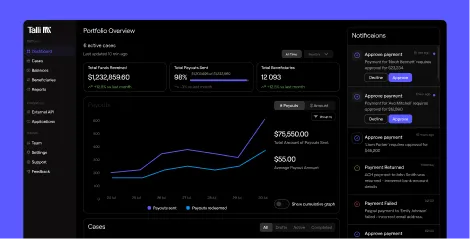
- Real-time dashboards providing complete visibility into payment status, completion rates, and fund balances
- Court-ready reporting generating all required documentation automatically
With 95-98% redemption rates and 50-65% cost reduction compared to traditional paper check distributions, Talli's platform positions settlement administrators to maximize both efficiency and claimant satisfaction in the new interchange environment.
Frequently Asked Questions
Will the settlement affect all credit card transactions equally?
No. The 1.25% rate cap applies only to standard consumer cards (Visa Traditional, Mastercard Core), which represent approximately 10% of transaction volume. Premium cards including Visa Signature, Visa Infinite, Mastercard World, and Mastercard World Elite—comprising roughly 85% of volume—receive only the 10 basis point reduction without a rate cap. Commercial cards are subject to the same 10 bps reduction.
Can merchants in all states implement surcharging under the settlement?
No. While the settlement enables surcharging at brand level or product level up to 3% or actual cost, several states including Connecticut and Massachusetts prohibit surcharging entirely. Merchants must verify state law compliance before implementing any surcharging program. Some merchants use "cash discounting" as an alternative approach in states with surcharging restrictions.
How does the settlement affect ACH and digital wallet payment costs?
The settlement specifically addresses Visa and Mastercard credit card interchange fees. ACH direct deposit costs ($0.25-$0.50 per transaction) and digital wallet fees ($0.50-$1.00 per transaction) are unaffected by the settlement terms. For organizations prioritizing lowest-cost disbursement methods, ACH remains the most economical option regardless of interchange changes.
What happens if my payment processor doesn't support selective card acceptance?
Not all payment processors support granular card-type blocking or product-level surcharging. If your processor lacks these capabilities, you have three options: (1) continue accepting all cards with automatic rate reduction benefits, (2) request a feature roadmap from your current processor, or (3) consider switching to a processor that supports the new settlement features. The 10 basis point reduction is automatic and requires no processor configuration.
When will the interchange reductions take effect?
Implementation would begin only after final court approval. The interchange reductions and rate caps would take effect under the settlement's approval and rate-limit mechanics, while certain rule changes such as visual card identifiers and surcharging-rule modifications are required within 90 days after approval. The 10 basis point reduction flows through automatically without requiring merchant action.