.svg)


.svg)
Settlement administrators and trustees carry a fiduciary duty to the people a settlement is meant to compensate. The money moving through a distribution belongs to other people, not to any business in the chain , and how it gets held, paid, and tracked all falls under that duty.
Most administrators manage this well at the level they can see day to day. The exposure tends to sit beneath the surface:
- how funds are held in custody
- whether an audit trail would hold up if a court asked to see it
- what the payment vendor earns when money goes unclaimed.
In some payment models, the vendor's economics improve when claimants don't get paid. That is the opposite of what a fiduciary program should reward.
These decisions tend to get made once, at vendor selection, and then left in place. The encouraging part is that this is knowable and fixable.
This piece covers where fiduciary considerations concentrate in a disbursement, why courts and regulators are giving them more attention, and what a fiduciary first approach looks like.
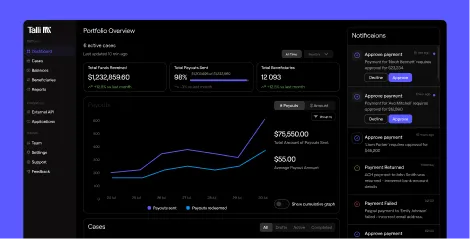
It is the approach Talli was built around, with fund custody, vendor economics, and audit trails designed to serve claimant interests from day one.
Why getting disbursement right matters
The money involved is substantial. Class action settlements have exceeded $40 billion for three straight years, totaling roughly $159 billion from 2022 to 2024 (Duane Morris Class Action Review).
Getting that money to claimants is the purpose of a settlement, and it is harder than it sounds. Two different numbers here are often blurred.
- The claims rate measures how many class members file in the first place - largely a function of notice and outreach. The FTC's study of 149 consumer class actions found a median claims rate of 9 percent and a weighted mean of just 4 percent (FTC, 2019), climbing with better outreach from around 3 percent for email notice to 10 percent for mailed claim packets (Carlton Fields).
- The redemption rate measures something different: how many issued payments are actually collected. That is largely a function of disbursement design - the methods offered, the friction involved, the follow up behind each payment. Both numbers leave money on the table, but redemption is the one a disbursement program directly controls. Every percentage point represents real people receiving money owed to them, and a program built to maximize it is doing the core job well.
Where unclaimed money goes and who benefits
When funds do go unclaimed, they take one of four paths:
- Reversion to the defendant
- Cy pres distribution to a nonprofit
- Escheatment to the state
- Redistribution among claimants who filed
Courts tend to expect a cy pres provision and look closely at reversion (American Bar Association).
The strongest disbursement programs enable every party in the chain to win when claimants get paid. That alignment is worth designing for, because structures that benefit from money staying unclaimed can pull against the people a settlement exists to serve (California Law Review).
Vendor economics that work for claimants
This is where the payment model matters more than it first appears.
Some payment platforms earn revenue from breakage - the value of payments that are never collected. The mechanics are worth understanding precisely. In these models, the platform does not send a payment in the claimant's name. It issues a promotional instrument or digital reward governed by its own terms and conditions, with its own expiration date. When the promotion expires, the remaining value is recognized as the platform's revenue.
That model suits a marketing or corporate reward and incentive program, where unclaimed value returning to the sponsor is part of the design. Money held for others calls for a different model. How disbursement vendors earn their revenue is drawing more attention across the settlement space, and the underlying question applies to any program that moves funds held for others.
Talli's economics are built around delivery, not breakage. Payments are issued in the claimant's name from segregated accounts with clear claimant ownership, unclaimed money follows the path the settlement and the court have set, and we are paid for delivering payments - so the only way we do well is when claimants get paid.
Modern rails do the job better
Payment method shapes outcomes too. Digital disbursement reaches claimants at higher rates than paper checks, which cost around $8 each once you include processing, postage, and reconciliation. Checks also carry the most fraud exposure of any method, with 58 percent of organizations reporting check fraud in 2025 (AFP).
Offering claimants a choice of digital rails, with checks available for those who need them, lifts redemption and shrinks the unclaimed pool an administrator has to manage at year end. Talli runs multiple payout options through one funding source, so claimants pick what works for them and administrators keep a single clean record.
The oversight environment is moving
Regulators and courts are converging on the fiduciary first standard. In January 2025 the Department of Labor confirmed it expects fiduciaries to implement and exhaust a prudent program to locate missing beneficiaries before transferring their funds to the state (DOL FAB 2025-01). Reasonable effort to reach people is an active expectation, not a courtesy.
Courts are moving the same direction. Some, starting in California, have begun looking more closely at how claims administrators are selected (CPT Group), and Rule 23 commentary has raised the idea of tying part of an attorney fee award to the actual claims rate (American Bar Association).
The direction of travel is visible in practice as well. In May 2026, a leading claims administrator agreed to stop accepting vendor rebates after those arrangements drew scrutiny (Forbes). Whatever the outcome of the broader litigation, the signal for the field is clear: vendor economics are no longer a back office detail. They are becoming part of how disbursement programs are evaluated - by courts, by counsel, and by the parties a settlement is meant to serve.
Administrators with strong custody, aligned vendor economics, and clean audit trails are well positioned for what comes next.
Knowing where you stand
A fiduciary first program comes together across a few areas, segregated fund custody with clear ownership, vendor economics aligned with delivery, payment options built around reaching claimants, complete audit trails, and escheatment handling that works state by state. These pieces often sit with different people, so the full picture is worth assembling on purpose.
At Talli we have built a short scorecard to make that assessment structured, scoring your program across the dimensions that tend to go unexamined.
It takes a few minutes and gives you something concrete to bring to your GC or compliance lead.
Strong disbursement is good fiduciary practice and good claimant outcomes at the same time. Knowing where you stand is the first step toward both.