.svg)


.svg)
Mass tort MDL disbursements require claimant-level award controls, tax classification, lien resolution, identity verification, fraud screening, secure payment delivery, and complete reconciliation. A purpose-built platform can centralize these workflows while preserving the administrator’s responsibility to follow the settlement agreement, court orders, and applicable law.
Mass tort settlements present a unique challenge: distributing funds to thousands of claimants with different injuries, award amounts, lien obligations, and documentation requirements. Each payment must match the approved allocation methodology while remaining traceable from the settlement account to the claimant.
Digital payment adoption has grown substantially across mass tort and class action matters. Law firms and claims administrators can use mass tort disbursements technology to expand payment choices, automate compliance checks, reduce manual follow-up, and provide stakeholders with current distribution data.
Key Takeaways
- A major industry study reported a 98% success rate for digital settlement payments, compared with check-cashing rates of 55% to 77%
- Mass tort settlements usually require individual claim assessment and tiered awards rather than uniform class payments
- QSF qualification depends on government approval, continuing jurisdiction, qualifying claims, and legally segregated assets
- Tax reporting depends on the character of the settlement payment, not merely the amount paid
- Digital Disbursements reported detecting and preventing more than 723 million fraudulent claims through real-time screening in 2024
- Multiple payment options can improve access for claimants who do not use traditional bank accounts
- Implementation speed depends on data quality, court requirements, integrations, lien resolution, and claimant readiness
Understanding Mass Tort and Class Action Differences
The structural differences between mass tort and class action settlements affect allocation, documentation, lien resolution, tax reporting, and payment delivery. Administrators must build the distribution process around the controlling settlement documents rather than applying a standard class action workflow.
What Defines a Mass Tort Settlement?
Mass tort litigation involves individual claims against one or more common defendants. Federal cases may be transferred to multidistrict litigation proceedings for coordinated pretrial management, but each claimant generally retains an individual claim.
Common examples involve pharmaceuticals, medical devices, consumer products, toxic exposure, and environmental contamination. Characteristics that affect disbursement include:
- Individual claim valuation based on an approved matrix, point system, or negotiated award
- Different injury tiers supported by medical, employment, exposure, or product-use evidence
- Claim-specific deductions for attorney fees, expenses, liens, holdbacks, or other authorized amounts
- Multiple defendants or funding sources that may require separate accounting
- Extended verification periods when medical records or lien information remain incomplete
Bellwether trials may inform negotiations and settlement values, but they do not automatically establish the final award for every claimant.
How Payment Structures Differ
Class action settlements commonly use fixed benefits, reimbursement formulas, or pro rata distributions among approved class members. Mass tort programs usually require claimant-specific calculations.
An administrator may need to verify:
- The claimant’s approved injury category
- The gross award assigned under the settlement methodology
- Attorney fees and reimbursable expenses
- Medicare, Medicaid, private insurance, hospital, or other liens
- Applicable holdbacks or common-benefit assessments
- The claimant’s final net amount
- The approved payment destination and recipient identity
These calculations require detailed claimant-level records and approval controls. A legal disbursement platform should support the approved allocation data rather than independently determining claim value.
Maintaining Legal and QSF Compliance
Settlement fund compliance extends beyond sending payments. Administrators must preserve the legal separation of funds, follow the governing documents, maintain tax records, and provide an accounting that explains each inflow, adjustment, and distribution.
Protecting QSF Status
A Qualified Settlement Fund must meet the requirements of IRC Section 468B and the related Treasury regulations.
The primary federal requirements are:
- The fund, account, or trust is established or approved by the United States, a state, a qualifying political subdivision, an agency, or a court
- The fund remains subject to that governmental authority’s continuing jurisdiction
- It is established to resolve or satisfy qualifying claims arising from torts, contract breaches, legal violations, or other approved liabilities
- It is a trust under applicable state law, or its assets are otherwise segregated from the transferor and related parties
An FDIC-insured account is not itself a QSF qualification requirement. However, separate settlement accounts, clear signing authority, controlled fund movement, and matter-level records are important administrative safeguards.
Talli for QSF administration supports dedicated settlement account structures, controlled disbursements, and transaction records that help administrators maintain separation and prepare court reporting.
Preventing Commingling and Unauthorized Transfers
Fund controls should reflect the settlement agreement, court order, banking documents, and administrator authority. Common safeguards include:
- Separate account structures for each settlement matter
- Role-based permissions and approval limits
- Dual approval for sensitive transfers
- Daily monitoring of deposits, returns, reversals, and disbursements
- Reconciliation between approved award data and bank activity
- Documented handling of residual funds and failed payments
Commingling or unauthorized transfers can create fiduciary, contractual, ethical, and reporting problems. The applicable consequences depend on who controls the money, the governing documents, and the professional rules that apply.
Automating Identity, Sanctions, and Tax Workflows
Manual compliance processes can delay distributions and create inconsistent records. Automation helps organize verification, but the administrator must still establish rules for exceptions, false matches, appeals, and incomplete documentation.
Verifying Claimant Identity
Effective KYC verification can include:
- Matching names, addresses, birth dates, and other identity attributes
- Validating submitted identification documents
- Confirming address or contact information
- Detecting repeated identities or payment destinations
- Identifying suspicious device, network, or submission patterns
- Routing uncertain results to manual review
The required verification level should reflect the settlement agreement, payment amount, fraud risk, available claimant data, and financial institution requirements.
Conducting OFAC Screening
OFAC screening should compare relevant parties against current sanctions data and preserve a record of when the screening occurred. A name match is not automatically a confirmed sanctions match.
A compliant exception process should include:
- Secondary review of potential matches
- Comparison of available identifiers
- Documentation of the disposition
- Escalation of unresolved matches
- Rescreening when required by the program or payment provider
Settlement OFAC screening should be incorporated into the distribution workflow rather than completed through undocumented manual searches.
Collecting Tax Information
Settlement payments are not automatically taxable or reportable simply because they exceed a fixed amount. Tax treatment may depend on whether the payment represents physical injury damages, emotional distress, lost wages, interest, punitive damages, attorney fees, business income, or another category.
For tax years beginning after 2025, the general threshold for certain information returns increased from $600 to $2,000. However, administrators should review the 2026 reporting rules because different forms and payment categories can follow different thresholds.
Digital tax workflows can support:
- Electronic Form W-9 collection
- Name and taxpayer identification number validation
- Reminder sequences for incomplete forms
- Payment-level tax classifications
- Correct form selection
- Backup withholding when legally required
- Recipient statement delivery and IRS filing
Form 1099-MISC and Form 1099-NEC should not be treated as interchangeable. The correct form depends on why the payment was made.
Using Multiple Payment Methods
A digital-first strategy allows claimants to select a method that fits their access, payment amount, and location. Administrators should still retain a suitable alternative for claimants who cannot or do not want to use a digital method.
Supporting Claimant Choice
Multi-channel payments may include:
- ACH transfers
- Prepaid virtual or physical cards
- PayPal or Venmo
- Electronic gift cards when permitted
- Domestic or international wires
- Paper checks
Payment prices and delivery speeds vary by provider, transaction volume, bank, card program, international corridor, funding process, and support model. Administrators should avoid treating published estimates as guaranteed contract rates.
A 2025 digital payments report found that digital settlement payments had a 98% success rate. The report compared this with paper check cash rates of 77% in matters with a claims process and 55% in matters without one.
These findings support a digital-first approach, but the reported check figures originated from prior class action research and may not predict the outcome of every mass tort program.
Reducing Failed and Uncashed Payments
Uncashed checks and failed digital transfers create additional reconciliation, support, reissuance, and residual-fund work. Administrators can reduce these problems through:
- Verified claimant contact information
- Clear payment-selection instructions
- Email and SMS reminders
- Expiration notices
- Payment-status tracking
- Easy correction of rejected account details
- Escalation paths for claimants requiring assistance
Reminder timing should follow the approved notice plan. Fixed reminders on Days 7, 14, and 21 may work for some programs but are not a universal legal requirement.
Tracking and Reconciling MDL Funds
Courts, trustees, auditors, and legal teams may need a complete explanation of how settlement funds moved through the distribution process. A dashboard can provide operational visibility, but it must be supported by reliable source records and controlled access.
Monitoring Distribution Progress
Real-time payment tracking can show:
- Claimants notified
- Payment methods selected
- Payments initiated
- Payments delivered or redeemed
- Failed, returned, or expired payments
- Claims in tax or identity review
- Fraud flags requiring investigation
- Remaining available balances
- Outstanding lien or documentation holds
Webhooks and APIs may synchronize payment status with case management or claims administration systems. Integration capabilities should be tested against the actual system and fields used by the administrator.
Preparing Court-Ready Accounting
Settlement reporting should connect three primary records:
- The approved claimant and award file
- The payment instruction and transaction record
- The bank or settlement account activity
Reconciliation should identify missing transactions, duplicate payments, returned funds, fees, voided checks, reversals, and unmatched balances.
A reliable audit trail records:
- Who created or changed an instruction
- What data changed
- When approval occurred
- Which payment rail was used
- Whether delivery succeeded
- How exceptions were resolved
- Whether funds were returned or reissued
Access to claimant and banking data should be limited by role and maintained under appropriate retention and security policies.
Combating Fraud in Mass Tort Distributions
Fraud can occur during lead generation, claim submission, document review, payment selection, and redemption. Administrators should use layered controls because no single model or screening rule identifies every type of abuse.
Using Reliable Fraud Signals
Common risk indicators include:
- Multiple claims using one payment destination
- Repeated devices or network addresses
- Fabricated or synthetic identities
- Bulk submissions following identical patterns
- Recently created email domains
- Domestic-only claims using inconsistent foreign data
- Rapid changes to claimant contact or banking information
- Documentation reused across unrelated claims
The 2025 industry report found that one provider’s real-time screening tools prevented more than 723 million attempted claims with significant fraud indicators in 2024. That figure should be attributed to the reporting provider, not described as an industry-wide result.
The same report says real-time screening detected and prevented 51,170 fraudulent mass tort claims in 2024, showing that distribution-stage fraud is not limited to class actions.
Protecting Legitimate Claimants
Automated scoring should support review rather than serve as the sole basis for rejecting a claimant. A strong exception process includes:
- Defined review thresholds
- Human review for material flags
- Evidence standards for clearing or confirming a concern
- Clear claimant requests for additional information
- Documented appeal or reconsideration procedures
- Separation between fraud scoring and final eligibility authority
The administrator and legal team should decide eligibility under the governing settlement documents.
Selecting a Mass Tort Payment Partner
Generic payment processors can move money, but mass tort programs usually require additional controls for settlement ownership, claimant identity, tax records, liens, reporting, and residual balances.
Evaluation Criteria
When evaluating mass tort payment platforms, review:
- Settlement account and fund-segregation structure
- Banking and card-issuing relationships
- Supported payment methods
- KYC and OFAC workflows
- Tax information collection and reporting support
- Fraud screening and manual review tools
- Role-based access and approval controls
- SOC 2 report availability and scope
- PCI DSS responsibilities for card data
- API and webhook capabilities
- Claimant support coverage
- Reconciliation and court-reporting functions
- Procedures for failed, expired, or returned payments
- Contract pricing, reserves, fees, and service levels
Security certifications do not replace legal and operational due diligence. Administrators should review the service organization’s actual responsibilities, subcontractors, incident procedures, insurance, data-retention terms, and business continuity controls.
Why Legal-Specific Infrastructure Matters
A purpose-built settlement platform can combine:
- Fund segregation
- Claimant notification
- Payment selection
- Identity verification
- Sanctions screening
- Tax document collection
- Fraud detection
- Payment delivery
- Exception handling
- Reconciliation
- Audit reporting
This reduces the number of disconnected vendors and manual file transfers. However, the platform should support the administrator’s approved process rather than replace legal, tax, lien, or fiduciary decisions.
Planning a Realistic Implementation
Implementation time depends on the settlement’s complexity. A simple program with approved claimant data and no major integration may launch quickly, while a large MDL involving liens, disputed awards, deficient records, or international payments can require significantly more preparation.
Core Implementation Stages
A practical implementation plan includes:
- Governance and account setup: Confirm authority, account structure, approvals, and access roles.
- Data preparation: Standardize claimant names, contact information, award amounts, tax classifications, lien status, and payment restrictions.
- Workflow configuration: Define notices, verification rules, payment options, reminder timing, fraud thresholds, and exception procedures.
- Integration and testing: Test file transfers, APIs, webhooks, payment limits, rejected transactions, and reporting outputs.
- Controlled launch: Use a limited batch when appropriate, review results, and correct issues before broader release.
- Ongoing monitoring: Track delivery, fraud flags, claimant questions, returns, reconciliation, and residual balances.
Verified claimants may receive digital funds quickly after payment authorization, but no platform can eliminate delays caused by court approval, incomplete claimant records, unresolved liens, appeals, or legal holds.
Evaluating Economic Benefits
Digital distribution can reduce costs associated with printing, postage, check fraud, reissuance, reconciliation, and manual support. It can also improve the percentage of claimants who receive their money.
Actual savings depend on:
- Number of claimants
- Average award size
- Payment-method mix
- Check fallback volume
- Claimant support requirements
- Fraud-review workload
- Integration complexity
- Account and administration fees
- International payment needs
Administrators should compare proposals using a consistent scenario and request a complete fee schedule. A hypothetical cost model should not be presented as a guaranteed result.
Why Talli for Mass Tort Disbursements
Talli provides an end-to-end settlement platform designed for legal disbursement workflows. The platform supports dedicated settlement account structures, claimant payment selection, identity verification, OFAC screening, W-9 collection, fraud mitigation, automated reminders, and real-time payment tracking.
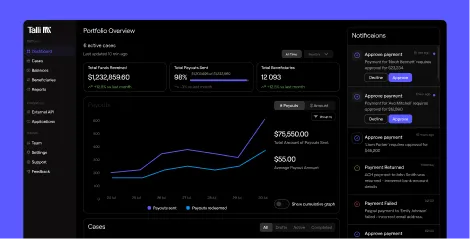
Claims teams can use one dashboard to upload claimant data, configure distribution campaigns, monitor payment status, and reconcile activity. Available payment methods include ACH, prepaid Mastercard, PayPal, Venmo, gift cards, and checks, subject to the settlement program and platform terms.
Talli also supports CRM synchronization and claimant-level audit records. These capabilities help law firms and administrators reduce manual transfers between systems while maintaining visibility into payment delivery and remaining funds.
Banking services are provided through Talli’s financial institution partners, including Patriot Bank, N.A., Member FDIC. Administrators should review the governing account documents, deposit-insurance treatment, payment terms, and card disclosures for each engagement.
For MDL programs involving different award tiers, liens, tax classifications, and payment restrictions, Talli can provide the infrastructure needed to execute the approved distribution plan. Legal counsel, tax advisers, lien specialists, and the settlement administrator remain responsible for the underlying legal and eligibility decisions.
Frequently Asked Questions
What Documents Do Claimants Need for Settlement Payments?
Requirements depend on the settlement agreement, award tier, tax treatment, and verification rules. Claimants may need government-issued identification, a completed Form W-9, medical or exposure records, lien information, and payment instructions. Administrators should request only information authorized by the program and provide a secure process for correcting incomplete or inconsistent records before payment approval.
How Long Do Claimants Have to Select a Payment Method?
The selection period is determined by the approved notice and distribution plan, not by a universal 30-day or 60-day rule. Administrators may send email, SMS, or mailed reminders before the deadline. The governing documents should also explain what happens when a claimant does not respond, such as a check fallback, extended outreach, or another approved process.
What Happens When a Claimant Cannot Be Located?
Administrators should follow the court-approved notice plan and settlement documents. Steps may include email, SMS, postal mail, address correction, returned-mail research, or skip tracing. Funds that remain unpaid must be handled under the governing agreement, court orders, and applicable unclaimed-property law. They should not automatically be transferred through cy pres or returned to a defendant.
Can International Claimants Receive Digital Payments?
International payments may be available through wires, local transfer methods, or supported payment networks. The administrator must evaluate sanctions screening, currency conversion, banking details, tax documentation, privacy requirements, fees, and country restrictions. The available method depends on the platform’s supported corridors and the settlement terms. Some claimants may require additional identity or payment verification.
How Are Healthcare Liens Resolved Before Payment?
Lien resolution may involve Medicare conditional payment research, MMSEA Section 111 reporting by the responsible reporting entity, final-demand processing, Medicaid recovery claims, private insurance subrogation, and provider liens. The process differs by claimant and jurisdiction. Administrators should apply approved holdbacks and release funds only after the required lien information, authorization, or resolution documentation has been received.