.svg)


.svg)
Class action settlement disbursement converts a court-approved distribution plan into verified payments for eligible class members. Claims administrators coordinate claimant data, award calculations, fraud controls, tax reporting, payment delivery, reconciliation, and court reporting while maintaining a complete record of each transaction.
Traditional paper checks can create delivery delays, returned mail, uncashed payments, and expensive reissuance workflows. Modern class action payment solutions give administrators additional payment options, automated controls, and real-time visibility without replacing the requirements of the settlement agreement or court order.
For claims administrators managing thousands or hundreds of thousands of class members, success is not measured only by how many payments were issued. Administrators must deliver the correct amount to the correct person, resolve exceptions, protect settlement funds, and provide reliable evidence of how every dollar was handled.
Key Takeaways
- Digital payment options can reduce printing, postage, reconciliation, and check-reissuance work, but actual savings depend on the settlement and vendor agreement.
- Talli’s AB Data case study reports a 30% increase in claimant redemption rates, along with faster claimant access and lower distribution and reissuance costs.
- The FDIC reported that 4.2% of U.S. households, approximately 5.6 million households, were unbanked in 2023.
- Form W-9 is not required from every settlement claimant. Requirements depend on the payment’s character and applicable reporting rules.
- OFAC, identity, and fraud controls should reflect the risks and legal requirements of each distribution.
- Digital payments may reach eligible claimants within 24 to 48 hours after authorization, funding, configuration, and validation are complete.
- Courts and settlement agreements determine how failed payments, unclaimed funds, tax withholding, and residual balances must be handled.
Understanding Class Action Settlement Disbursement
Class action settlement disbursement is the operational process of moving settlement funds from a court-approved account to eligible class members. It usually begins after the court approves the settlement and the administrator completes the claims review, allocation, and authorization requirements.
The distribution process may involve:
- Validating the final claimant roster
- Confirming claimant eligibility
- Calculating individual payment amounts
- Collecting payment preferences
- Reviewing duplicate or suspicious claims
- Applying required tax classifications
- Issuing payments through approved methods
- Resolving failed or returned payments
- Reconciling settlement accounts
- Reporting results to the court
A distribution involving 50,000 claimants does not simply require 50,000 payments. It may also involve incorrect addresses, duplicate records, deceased claimant procedures, tax-document requests, returned ACH transfers, expired checks, digital-wallet failures, and questions about the court-approved allocation formula.
A documented settlement distribution workflow should define who approves data, who releases funds, how exceptions are reviewed, and which records must be retained.
The Role Of Claims Administrators
Claims administrators serve as the operational link between the court, settlement parties, financial institutions, and class members. Their responsibilities often include:
- Claimant notification: Sending court-approved notices through mail, email, digital advertising, or other authorized channels
- Claims processing: Receiving submissions, reviewing supporting documents, and determining eligibility
- Identity validation: Confirming that the person requesting payment is an eligible class member
- Award calculation: Applying the settlement’s allocation formula consistently
- Payment delivery: Issuing funds through the methods authorized by the settlement
- Exception management: Resolving failed payments, returned mail, incomplete information, and disputed records
- Compliance documentation: Maintaining records for sanctions controls, tax reporting, fraud review, and audits
- Court reporting: Preparing declarations and final accountings explaining how funds were distributed
Administrators should separate payment speed from settlement readiness. A payment platform may deliver funds quickly once a campaign is approved and funded, but it cannot eliminate court approval, appeal periods, lien resolution, claimant verification, or other legal prerequisites.
Managing Qualified Settlement Funds
Many class action settlements use a qualified settlement fund, or QSF, under Internal Revenue Code Section 468B. Federal regulations generally require the fund to be established by or under the jurisdiction of a governmental authority, created to resolve qualifying claims, and segregated from the transferor’s assets.
Claims teams can review the formal requirements in the federal QSF regulations.
Fund segregation supports clear ownership and accounting. It also helps administrators prepare court reports by separating settlement money from operating funds.
Administrators should confirm:
- Which entity owns the settlement account
- Who may approve distributions
- Whether dual approval is required
- How interest and fees are recorded
- How reversals and returns are handled
- What payment methods the account supports
- How residual funds will be treated
- Which records will support the final accounting
Talli supports dedicated settlement-account structures designed to preserve fund separation throughout the disbursement lifecycle. Banking services remain subject to the applicable account agreements.
Administrators should not claim that every settlement balance is automatically protected by FDIC insurance. Deposit-insurance treatment depends on account ownership, recordkeeping, beneficiary interests, deposit amounts, and other FDIC requirements.
Addressing Unclaimed Funds And Low Redemption
A payment is not complete merely because it was issued. Administrators must determine whether the claimant received, accepted, deposited, or redeemed it.
Checks remain useful when requested by a claimant or when digital methods are unavailable. However, check-only programs create several operational risks.
Outdated Contact Information
Settlement distributions may occur years after the events described in the lawsuit. Class members may move, change names, abandon email addresses, or stop using telephone numbers included in original records.
Returned mail may require:
- Address updating
- Skip tracing
- Additional notice
- Claimant outreach
- Check cancellation
- Reissuance
- Court documentation
Administrators should establish procedures for updating claimant information before issuing payments. A secure claimant portal can also allow eligible class members to update their details, subject to identity verification.
Uncashed And Expired Checks
A mailed check does not prove that a claimant received usable funds. The claimant must receive the envelope, recognize it as legitimate, and deposit or cash it before expiration.
Administrators must monitor outstanding checks and follow the settlement agreement’s rules for reminders, reissuance, second distributions, cy pres awards, reversion, or unclaimed-property reporting.
The treatment of residual balances is case-specific. Administrators should not assume that every uncashed settlement check must automatically be reported as abandoned property. The court order, settlement agreement, state law, and nature of the claimant’s property interest all matter.
A structured settlement escheatment process can help claims teams identify when unclaimed-property analysis is necessary.
Access For Unbanked Claimants
The FDIC household survey found that 4.2% of U.S. households, representing approximately 5.6 million households, were unbanked in 2023. Rates were higher among several economically vulnerable groups.
A paper check may still be usable without a bank account, but the claimant may need to pay a check-cashing fee. Prepaid cards, digital wallets, and other approved methods provide additional options.
This does not mean every unbanked claimant prefers a digital payment. Effective administration gives claimants clear choices and provides a practical fallback when the selected method fails.
Modernizing Settlement Payments
A digital-first strategy does not require eliminating checks. It allows administrators to offer several court-approved methods and use paper checks where necessary.
Talli supports multiple settlement payment options, including ACH, prepaid cards, PayPal, Venmo, gift cards, and checks.
ACH Direct Deposit
ACH delivers funds to a claimant’s bank or credit-union account. It is generally inexpensive and familiar to people who use direct deposit.
ACH payments may fail because of:
- Incorrect routing or account numbers
- Closed accounts
- Account-name mismatches
- Bank rejection
- Transfer restrictions
- Claimant data errors
Administrators need a process for notifying the claimant, correcting information, and offering another method.
Prepaid Mastercard
Prepaid cards can serve claimants who do not want to provide banking information or do not have a traditional bank account.
Virtual cards may be delivered electronically, while physical cards require mailing. Administrators should disclose card expiration dates, replacement procedures, usage restrictions, support contacts, and any applicable fees.
PayPal And Venmo
Digital wallets can reduce friction for claimants who already maintain active accounts. PayPal and Venmo are supported Talli options. Zelle should not be listed as a Talli payment method unless support is separately confirmed for the program.
Administrators should verify that the account can receive the payment, the claimant controls it, and a fallback method is available.
Gift Cards
Gift cards may be appropriate for some smaller distributions when the settlement agreement and court order allow them.
Claims teams should consider merchant restrictions, replacement procedures, expiration rules, claimant preferences, and access for people without reliable internet service.
Gift cards should not be described as universally producing the highest redemption rate unless a specific settlement or study supports that conclusion.
Wire Transfers And Checks
Wire transfers may be useful for high-value or international payments. They generally cost more than ACH and may require additional identity, banking, and sanctions review.
Checks remain an important fallback for claimants who cannot or do not wish to use digital methods. Programs should account for printing, postage, returned mail, stop payments, reissuance, expiration, and reconciliation.
Providing multiple payment channels can improve access, but administrators should not promise a universal 20% to 30% increase in redemption. Results vary by claimant population, payment value, notice quality, user experience, and follow-up strategy.
Managing Identity, Fraud, And Sanctions Risks
Settlement administrators must protect valid class members while preventing duplicate, manipulated, or fraudulent claims.
A risk-based review may include:
- Duplicate-record detection
- Name and address validation
- Identity-document review
- Device and network analysis
- Payment-account matching
- Behavioral pattern analysis
- Claim-history comparison
- Manual review of flagged cases
Automated systems can identify patterns that are difficult to find through spreadsheets. However, a fraud score is not proof that a claimant is ineligible. Administrators should document review standards and provide correction or appeal procedures when required.
Talli uses automated fraud controls and identity verification to support high-volume distributions. Claims that the platform achieves 95% fraud-detection accuracy or processes legitimate claims 50% faster than manual review should not be used without evidence supporting those exact figures.
A documented claimant verification process helps balance fraud prevention with claimant access.
OFAC Screening
U.S. persons must avoid transactions prohibited under applicable sanctions programs. Automated OFAC screening is a common control because it can compare claimant information against sanctions lists and record when the review occurred.
OFAC does not prescribe one universal screening procedure for every settlement payment. The process should reflect the parties, jurisdictions, payment methods, and risks involved.
Potential matches require careful review because names alone may produce false positives. Administrators should document:
- When screening occurred
- Which data was screened
- Which sanctions lists were used
- How potential matches were reviewed
- Who approved the decision
- Whether a payment was blocked or released
Talli’s OFAC screening support helps administrators maintain this record. The article should not claim that automated systems guarantee perfect compliance.
Sanctions penalties vary by statute, program, conduct, transaction value, and inflation adjustments. A single dollar amount should not be presented as the universal maximum penalty.
Handling Settlement Tax Compliance
Settlement tax treatment depends on the underlying claims, allocation language, attorney payments, wage components, interest, and claimant circumstances.
The IRS settlement guidance explains that tax treatment generally follows the origin and character of the claim.
Form W-9 Collection
Form W-9 provides a payer with a U.S. person’s taxpayer identification number and certification. It may be needed when a payment is subject to information reporting or backup withholding.
It is inaccurate to state that every settlement recipient must provide Form W-9 before payment. Administrators should first classify the settlement components and determine which payments require taxpayer information.
A digital workflow can validate required fields, track incomplete forms, send reminders, restrict access to sensitive data, and record when documents were received. Legal and tax professionals must still determine whether the form is required.
Forms 1099 And W-2
A settlement payment does not automatically require Form 1099-MISC or Form 1099-NEC.
Depending on the payment, reporting may involve:
- Form W-2 for wage components
- Form 1099-MISC for certain taxable settlement amounts
- Form 1099-MISC for qualifying gross proceeds paid to an attorney
- Form 1099-NEC for qualifying nonemployee service compensation
- Another information return
- No information return when an exception applies
Form 1099-NEC is not a general settlement-payment form. It ordinarily applies to qualifying compensation for services performed by a nonemployee.
Administrators should verify the reporting threshold for the payment year and form involved rather than applying one universal threshold to every payment.
Backup Withholding
The federal backup-withholding rate is 24%. Backup withholding may apply when a reportable payee fails to provide a correct taxpayer identification number or another statutory condition exists.
It should not be applied automatically to every claimant who has not submitted Form W-9. The administrator must first determine whether the payment is reportable and subject to backup withholding.
A settlement tax workflow can help collect forms, track missing information, calculate withholding, and prepare reporting files. It cannot guarantee tax compliance without proper legal classification and professional review.
Tracking Distribution Progress
Claims teams need more than confirmation that a payment file was transmitted. They need visibility into what happened after release.
A dashboard may show:
- Payments approved
- Payments initiated
- Payments delivered
- Payments redeemed
- ACH returns
- Card-delivery status
- Outstanding checks
- Wallet failures
- Claimant support cases
- Fraud and identity exceptions
- Remaining balances
This information helps administrators identify problems early. A high number of ACH returns may indicate inaccurate bank data. Unopened emails may suggest outdated contact information. Unredeemed cards may require clearer instructions or reminders.
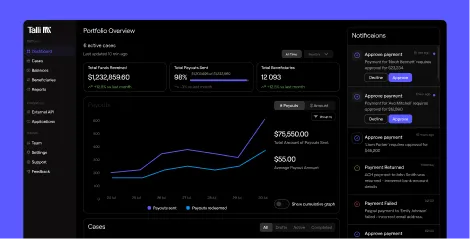
Talli’s real-time payout tracking allows claims teams to monitor payment status and fund flows from one dashboard.
Creating Court-Ready Audit Trails
An audit trail should show:
- Who approved each payment file
- When payment was initiated
- Which method was selected
- Whether required reviews were completed
- Whether payment succeeded or failed
- How exceptions were resolved
- Whether funds returned to the settlement account
- Which claimant data was changed
- Who approved reissuance
Court reports may include approved claims, payments issued, payment status, failed payments, reissuances, tax withholding, expenses, interest, remaining balances, and proposed treatment of residual funds.
Requirements depend on the settlement order and court instructions. A court reporting system can reduce manual compilation while preserving supporting records.
Evaluating Costs And Timelines
Digital payments can reduce certain expenses, but administrators should not rely on universal cost estimates without a defined source and cost model.
A complete comparison should include:
- Platform and setup fees
- Payment-method charges
- Printing and postage
- Returned-mail processing
- Claimant support
- Check reissuance
- Card replacement
- Tax-form preparation
- Fraud and identity review
- Bank fees
- Reconciliation labor
- Residual-fund administration
Claims teams should request a written pricing schedule and model costs using the actual claimant population. The unsupported example claiming that a 50,000-claimant check program would cost $3.1 million while a digital program would cost $87,000 should not be used.
Implementation timelines also require careful wording. A platform may configure a prepared campaign within days, but the full settlement process may still depend on appeals, funding, data validation, tax classification, fraud review, liens, and court-imposed conditions.
Once a campaign is authorized, funded, configured, and supported by validated claimant data, eligible digital payments may arrive within 24 to 48 hours, depending on the method.
AB Data’s Results With Talli
Talli’s published AB Data case study reports:
- A 30% increase in claimant redemption rates
- A 60% reduction in unresolved exceptions
- Greater visibility into payout outcomes
- Faster access to funds for claimants
- Lower distribution and reissuance costs
The original 34% figure should be corrected to the documented 30% result.
These results should not be presented as guaranteed outcomes. Redemption and exception rates depend on claimant demographics, payment amounts, contact-data quality, notice design, payment choices, reminder frequency, support, and settlement deadlines.
Unnamed examples claiming 91% redemption, 86% cost reduction, 99% calculation accuracy, and court commendation should also be removed because no identifiable primary source was provided.
Why Talli For Class Action Settlements
Talli provides purpose-built digital disbursement infrastructure for legal settlement payments. Claims teams can upload claimant records, configure campaigns, offer multiple redemption methods, track payment status, and maintain audit records from one platform.
Built-in capabilities include:
- ACH, prepaid cards, PayPal, Venmo, gift cards, and checks
- Claimant communications and reminders
- KYC and identity controls
- OFAC screening support
- Form W-9 collection when required
- Fraud detection and exception review
- Dedicated settlement-account support
- Real-time payment tracking
- CRM synchronization
- Reconciliation and court reporting
Unlike a generic payment processor, Talli is designed around legal distribution requirements, including claimant communication, fund separation, payment choice, exception handling, and audit-ready reporting.
Talli does not remove the administrator’s fiduciary, legal, or tax responsibilities. It provides infrastructure that helps claims teams perform those responsibilities consistently at scale.
Claims teams evaluating a provider should confirm supported payment methods, banking relationships, security controls, account structure, pricing, implementation requirements, data-retention practices, claimant-support responsibilities, failed-payment procedures, and reporting capabilities.
Frequently Asked Questions
How Quickly Can Digital Settlement Payments Be Delivered?
Once a campaign is authorized, funded, configured, and supported by validated claimant data, some ACH, wallet, or virtual-card payments may arrive within 24 to 48 hours. The complete settlement process may take longer because court approval, appeals, tax review, fraud checks, or data corrections may remain pending.
Does Every Claimant Need To Submit Form W-9?
No. Form W-9 is collected when the payer needs a taxpayer identification number for applicable reporting or backup withholding. The requirement depends on the payment’s tax treatment. Administrators should classify settlement components before deciding which claimants must provide taxpayer information.
How Can Unbanked Claimants Receive Settlement Funds?
Depending on the court-approved plan, unbanked claimants may receive prepaid cards, PayPal, Venmo, gift cards, checks, or other approved alternatives. The FDIC reported that approximately 5.6 million U.S. households were unbanked in 2023, making non-ACH options important for accessible distributions.
Is OFAC Screening Required For Every Claimant?
U.S. persons must avoid prohibited transactions under applicable sanctions programs. OFAC does not prescribe one universal screening method for every settlement. Automated screening is a common control because it can identify potential matches and create a documented review record before funds are released.
What Should A Final Distribution Report Include?
The report should follow the settlement order and court instructions. It commonly includes approved claims, payments issued, redemption status, failed payments, reissuances, withholding, expenses, interest, remaining balances, and proposed treatment of residual funds. A complete audit trail should support every reported total.