Qualified Settlement Fund administrators distributing payments to foreign claimants face a critical compliance decision: Form 1042-S or Form 1099? Under Treasury Regulation 1.468B-2(l), QSFs generally follow reporting and withholding obligations that would apply if the transferor paid the claimant directly. U.S.-source settlement income subject to Chapter 3 withholding generally carries a 30% statutory rate unless an exemption or applicable treaty provision reduces or eliminates it. Modern digital disbursement platforms can automate W-8 collection and conditional routing, transforming complex international tax compliance from a manual burden into a streamlined workflow that reduces errors and avoids penalties ranging from $60 to $340 per incorrect form.
Key Takeaways
- Form 1042-S replaces Form 1099 when distributing QSF settlement proceeds to foreign persons, including nonresident aliens and foreign entities
- Default withholding rate is 30% under Chapter 3 unless reduced by tax treaty provisions
- Form 1042-S generally has no minimum dollar threshold for reportable U.S.-source income, but not every payment to a foreign claimant requires the form
- W-8BEN forms generally remain valid through December 31 of the third calendar year after signing, unless circumstances change
- Filing deadline is March 15 following the tax year
- Electronic filing required when issuing 10 or more information returns combined
- Physical mailing address in a foreign country does not automatically determine tax status-U.S. citizens abroad still use W-9
Understanding Form 1042-S: What It Is and Why It Matters
Form 1042-S is the IRS information return used to report U.S.-source income paid to foreign persons. For QSF administrators, this form documents fixed, determinable, annual, or periodical (FDAP) income and any tax withheld under Chapter 3 or Chapter 4 (FATCA) of the Internal Revenue Code.
The form serves multiple purposes:
- Documents income paid to nonresident aliens, foreign corporations, partnerships, trusts, and estates
- Reports tax withheld at applicable rates (default 30% or treaty-reduced)
- Provides foreign recipients with documentation for claiming foreign tax credits
- Creates audit trail for IRS compliance verification
Key Information Reported on Form 1042-S
Each Form 1042-S captures specific data elements:
- Box 1: Income code identifying payment type
- Box 2: Gross income amount before withholding
- Box 3a: Chapter 3 exemption code (required by the payment's withholding treatment)
- Box 3b: Tax rate applied to payment
- Box 7a: Federal tax withheld
- Box 13: Recipient identification information
Who Issues Form 1042-S?
The withholding agent, in QSF contexts typically the administrator or trustee, bears responsibility for issuing Form 1042-S. Unlike Form 1099 which has minimum thresholds (often $600), Form 1042-S generally has no minimum dollar threshold for reportable income paid to a foreign person.
Determining Non-Resident Alien Status for QSF Claimants
Correctly identifying whether a claimant qualifies as a U.S. person or foreign person determines the entire reporting framework. This distinction requires more than checking a mailing address; it demands understanding IRS residency tests.
The Substantial Presence Test
The IRS uses specific criteria to establish tax residency:
- Green card test: Lawful permanent residents are U.S. persons regardless of physical location
- Substantial presence test: Physical presence in the U.S. for 183 days calculated using a weighted formula
- First-year election: Available to certain individuals meeting specific requirements
Critical distinction: U.S. citizens living abroad remain U.S. persons and use Form W-9. Foreign nationals physically present in the United States may still qualify as nonresident aliens depending on visa status and presence calculations.
Impact of Tax Treaties on Non-Resident Alien Status
Over 60 countries maintain tax treaties with the United States that can:
- Reduce withholding rates below the standard 30%
- Provide complete exemptions for certain income types
- Establish tie-breaker rules for dual residents
Claimants must properly claim treaty benefits on Form W-8BEN, specifying the applicable treaty article and rate reduction. Without proper documentation, administrators must apply the full 30% withholding.
When Form 1042-S Replaces Form 1099 in QSF Distributions
The routing decision between Form 1042-S and Form 1099 depends entirely on claimant status documentation:
Use Form 1042-S when:
- Claimant provides Form W-8BEN (foreign individual)
- Claimant provides Form W-8BEN-E (foreign entity)
- Payment constitutes U.S.-source FDAP income to a foreign person
Use Form 1099 when:
- Claimant provides Form W-9 (U.S. person)
- Recipient is a U.S. citizen, resident alien, or domestic entity
Defining a QSF and Its Tax Treatment
Qualified Settlement Funds under IRC 468B receive special tax treatment as separate taxable entities. However, this structure doesn't change the fundamental reporting obligation. QSFs must report distributions using the same forms the original defendant would have used.
Treasury Regulation 1.468B-2(l) makes this explicit: QSFs report and withhold as if the transferor paid the claimant directly. This pass-through requirement means foreign claimants trigger Form 1042-S obligations regardless of the QSF's domestic status.
Income Subject to 1042-S Reporting
Not all settlement components receive identical treatment. QSF administrators must classify payment elements:
- Compensatory damages for physical injury: Generally excluded from gross income under IRC Section 104(a)(2)
- Emotional distress damages: Taxable unless directly attributable to physical injury
- Punitive damages: Always taxable as U.S.-source income
- Interest on settlements: Taxable FDAP income
- Attorney fees: Subject to separate reporting requirements
The QSF structure doesn't convert taxable payments into tax-free distributions. Characterization follows the underlying claim.
Understanding Non-Resident Alien Tax Withholding
Chapter 3 withholding requirements create immediate cash flow impacts for foreign claimants receiving QSF distributions.
Standard Withholding Rates
The default framework applies:
- 30% statutory rate on U.S.-source FDAP income
- Treaty-reduced rates, including possible exemptions, depend on the applicable treaty, income category, and claimant documentation
- Backup withholding at 24% applies to U.S. persons who fail to provide TINs, not applicable to properly documented foreign persons
Administrators face liability for underwithholding. When in doubt, apply the full 30% rate and allow the foreign claimant to claim refunds through Form 1040-NR.
Reducing Withholding Through Tax Treaties
Proper treaty benefit claims require:
- Valid W-8BEN with treaty country specified
- Specific treaty article cited for claimed exemption
- Limitation on benefits statement where required
- Foreign TIN in many cases
Without complete documentation, administrators cannot reduce withholding below 30%, even when the claimant resides in a treaty country.
Tax Implications for Settlement Money and Foreign Claimants
Settlement taxation creates complexity beyond reporting form selection. QSF administrators must understand how different settlement components affect foreign claimants.
Distinguishing Taxable vs. Non-Taxable Settlement Proceeds
IRC Section 104(a)(2) excludes from gross income damages received for personal physical injuries or physical sickness. This exclusion applies equally to foreign claimants. However:
- Physical injury compensation: Excluded from income, no withholding required
- Non-physical injury damages: Generally taxable, with withholding determined by the payment's U.S. tax sourcing, income classification, and any applicable exemption or treaty provision
- Mixed settlements: Require allocation and documentation
Proper settlement allocation at the court approval stage simplifies downstream reporting. Ambiguous allocations force conservative treatment, treating proceeds as taxable until proven otherwise.
Specific Rules for Foreign Claimants
Cross-border settlement payments involve additional considerations:
- Source rules: Only U.S.-source income triggers withholding obligations
- Foreign-source income: May not require U.S. reporting even when paid through a QSF
- Effectively connected income: Reported differently on Form 1042-S with different exemption codes
Practical Guide to Form 1042-S Instructions and Filing
Meeting Form 1042-S filing requirements demands attention to deadlines, procedures, and common error patterns.
Key Deadlines for Issuing and Filing Form 1042-S
The filing calendar requires:
- Recipient copies: Furnish to foreign claimants by March 15 following tax year
- IRS filing: Submit by March 15 (March 16, 2026 for TY2025 due to weekend)
- Filing extensions: Form 8809 generally provides an automatic 30-day extension for Form 1042-S, while Form 7004 extends Form 1042. Recipient statement extensions require a separate request.
- Form 1042: Annual summary return due same date as individual 1042-S forms
E-filing through IRS FIRE or IRIS systems is required when filing 10 or more information returns combined across all form types. The IRS IRIS system is replacing FIRE for TY2026 forms.
Common Errors to Avoid When Completing 1042-S
Frequent mistakes trigger IRS notices and penalties:
- Blank Box 3a when withholding is $0: Always include appropriate Chapter 3 exemption code
- Reporting net payment in Box 2: Must show gross income before withholding
- Using wrong form for recipient type: 1099 for foreign person or 1042-S for U.S. person
- Missing or invalid TIN/FTIN: Verify identification numbers before filing
- Single form for multiple income types: Separate 1042-S required for each income code
For returns due in 2027, penalties for late or incorrect information returns generally range from $60 to $340 per form, depending on correction timing. Intentional disregard carries a minimum penalty of $690 per return or a higher amount under applicable rules.
Tax Withholding Exemptions for Non-Resident Aliens
Certain scenarios allow reduced or eliminated withholding for foreign claimants receiving QSF distributions.
Eligibility for Withholding Exemptions
Exemptions may apply when:
- Income excluded from gross income: Physical injury damages under IRC 104(a)(2)
- Effectively connected income: Reported on Form W-8ECI instead of W-8BEN
- Treaty benefits: Specific provisions reducing rates to 0%
- Portfolio interest: Certain investment income categories
Each exemption requires specific documentation. Administrators cannot assume exemptions apply. Proper W-8 forms must claim each benefit explicitly.
Documentation Required for Exemption Claims
Complete exemption claims include:
- Correct W-8 form variant (W-8BEN, W-8BEN-E, W-8ECI, W-8EXP, W-8IMY)
- Valid TIN or FTIN unless specifically excepted
- Treaty benefit statement with article reference
- Limitation on benefits certification where required
- Signature and date within validity period
W-8 forms expire at the end of the third succeeding calendar year after the signature date. Track expiration dates to avoid invalid documentation at payment time.
QSF Compliance and Fund Segregation
Proper QSF structure supports accurate tax reporting while maintaining fiduciary compliance.
Maintaining QSF Integrity for Tax Reporting
IRC Section 468B compliance requires:
- Court approval establishing QSF status
- Separate taxpayer identification (EIN for the QSF)
- Resolution of claims against transferor
- Annual Form 1120-SF filing for QSF income taxation
The QSF's separate entity status doesn't eliminate pass-through reporting requirements. Distributions trigger 1042-S or 1099 reporting based on recipient status, not QSF characteristics.
The Role of FBO Accounts in Compliance
For Benefit Of (FBO) account structures support QSF administration and fund segregation by:
- Preventing commingling between settlement funds and operating capital
- Maintaining matter-level tracking for court reporting
- Supporting audit-ready documentation throughout disbursement lifecycle
- Supporting FDIC relationships through proper bank structures
Fund segregation directly impacts reporting accuracy. Commingled accounts create reconciliation challenges that increase error rates and compliance risk.
Why Talli Simplifies Foreign Claimant Compliance in QSF Distributions
Managing Form 1042-S requirements across international mass tort settlements or class actions with foreign claimants creates administrative complexity that scales poorly with manual processes. Talli provides purpose-built infrastructure for QSF administrators handling these challenges.
Talli's compliance automation addresses the core challenges of paying international claimants:
- Conditional W-8/W-9 Routing: Automated form selection based on claimant responses, ensuring correct documentation collection before first payment
- Payment Holds: Automatic holds for missing or incomplete tax documentation, preventing distributions without proper W-8 forms
- OFAC Screening: Integrated sanctions screening for settlements with documented compliance timestamps
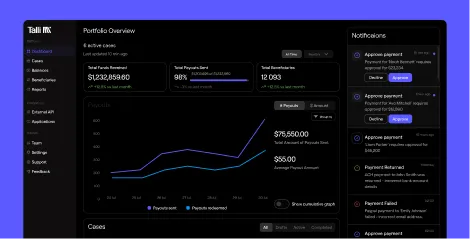
- Real-Time Dashboard: Track documentation completion rates, payment status, and compliance metrics across all claimants
- Audit Trail Generation: Court-ready documentation proving proper collection and verification of foreign claimant tax forms
The platform's fund segregation architecture uses dedicated FBO accounts for each settlement through Patriot Bank, N.A., Member FDIC. This structure supports QSF administration under IRC Section 468B while maintaining complete separation between settlement funds and operating capital.
Conclusion: Streamlining Foreign Claimant Compliance with Talli
Form 1042-S compliance for foreign QSF claimants requires accurate documentation, withholding calculations, and recordkeeping. Manual tracking of W-8 expirations, treaty provisions, and payment classifications can delay distributions and increase IRS penalty and administrator liability risks.
Talli's settlement administration platform centralizes and automates compliance workflows for QSF trustees and administrators through:
- Automated form routing and documentation checks before payment release.
- Centralized payment records and disbursement tracking.
- Comprehensive audit trails and reconciliation support for tax compliance.
- FBO accounts through Patriot Bank to support proper fund segregation.
By combining these capabilities, Talli helps administrators streamline foreign claimant distributions, reduce manual bottlenecks, and manage Form 1042-S obligations with greater confidence.
Frequently Asked Questions
What is the main difference between Form 1042-S and Form 1099 in a settlement context?
Form 1042-S reports payments to foreign persons (nonresident aliens and foreign entities), while Form 1099 reports payments to U.S. persons. The determination depends entirely on the claimant's tax status as documented by W-8 versus W-9 forms, not their physical location. Form 1042-S generally has no minimum dollar threshold for reportable income, while Form 1099 variants typically have $600 or higher thresholds.
Can a nonresident alien receive a settlement payment without U.S. tax withholding?
Yes, in several circumstances. Physical injury damages excluded under IRC Section 104(a)(2) don't require withholding regardless of recipient status. Additionally, tax treaty provisions may reduce withholding to 0% for specific income types and treaty countries. However, the claimant must properly claim these benefits on Form W-8BEN with supporting documentation. Without valid treaty claims, the 30% default rate applies.
Who is considered a "nonresident alien" for U.S. tax purposes?
A nonresident alien is a non-U.S. citizen who doesn't meet the green card test or substantial presence test. Importantly, physical location doesn't determine status. U.S. citizens living abroad remain U.S. persons using W-9, while foreign nationals physically present in the U.S. may still qualify as nonresident aliens depending on visa type and presence duration. The claimant's W-8 or W-9 submission determines reporting form selection.
What happens if a QSF administrator issues Form 1099 instead of Form 1042-S to a foreign claimant?
Issuing the wrong form triggers IRS matching errors and may require amended filings. Penalties generally range from $60 to $340 per incorrect form depending on correction timing. More significantly, failure to properly withhold creates administrator liability for the unpaid tax plus interest. Collecting W-8 or W-9 documentation before first payment prevents this error entirely.
How does a Qualified Settlement Fund impact tax reporting for foreign claimants?
Under Treasury Regulation 1.468B-2(l), QSFs must report and withhold as if the original transferor paid the claimant directly. The QSF structure doesn't change which form applies. Foreign claimants still receive Form 1042-S with applicable withholding. The QSF's tax treatment as a separate entity affects the fund's own tax obligations but doesn't alter claimant-level reporting requirements.