Settlement administrators face a critical vulnerability: 76% of organizations experienced attempted payments fraud in 2025, with vendor and recipient records serving as the primary entry point. Before releasing settlement funds, verifying client bank details has shifted from best practice to fiduciary necessity. Modern digital disbursement platforms now combine automated verification, compliance screening, and multi-channel payment options to protect settlement funds while dramatically improving claimant redemption rates.
Key Takeaways
- 76% of organizations experienced attempted payments fraud in 2025, making bank verification essential before settlement disbursements
- Manual callback procedures remain valuable but fail under volume pressure, with one organization losing $188,000 when callbacks weren't executed
- Automated verification delivers results in seconds compared to 1-3 days for traditional micro-deposit methods
- In Talli's AB Data case study, digital payment options increased claimant redemption rates by 30% compared with the previous distribution approach
- Wire transfers are largely irreversible once processed, making pre-payment verification critical for high-value distributions
- Multi-channel payment options (ACH, prepaid cards, digital wallets) address the 5.6 million unbanked households, according to the FDIC's 2023 survey, who cannot receive direct deposits
- QSF-compliant platforms with dedicated FBO account structures prevent fund commingling while maintaining court-ready audit trails
The Imperative of Bank Account Verification in Legal Settlements
Every misdirected settlement payment represents a fiduciary failure. When funds intended for a claimant reach a fraudster's account, or simply bounce due to incorrect details, administrators face regulatory scrutiny, court criticism, and potential liability. The stakes are particularly high in class action, mass tort, and bankruptcy distributions, where incorrect bank account details can cause payment failures, costly reissuances, and delays in delivering settlement funds.
Bank account verification confirms three critical elements before disbursement:
- Account validity: The account exists and can receive funds
- Account status: The account is open and active (not closed or frozen)
- Account ownership: The account belongs to the intended recipient, not an imposter
For settlement administrators managing thousands of recipients, manual verification of each account becomes operationally impossible. Yet releasing funds without verification exposes the settlement to fraud, payment failures, and compliance violations. Automated identity verification bridges this gap by screening recipients against identity databases while flagging suspicious patterns for manual review.
Traditional Challenges: The Risks of Paper Checks and Manual Verification
The Costly Cycle of Unclaimed Funds
Paper check distributions consistently underperform digital alternatives. Settlement administrators report 20-30% of paper checks go unclaimed, triggering a cascade of operational burdens:
- Remailing costs: Each returned check requires address verification and reissuance
- Tracking overhead: Monitoring uncashed checks at approximately $150 per uncashed check
- Escheatment exposure: Unclaimed funds eventually transfer to state governments, defeating the settlement's purpose
- Court criticism: Low redemption rates reflect poorly on settlement administration
The cost differential is stark. Paper check processing runs $7-20 per payment, including printing, postage, reconciliation, and reissuance, while digital payments cost $0.25-$5 per transaction, a 50-65% reduction.
Manual Reconciliation: A Time Sink
Traditional three-way reconciliation between settlement funds, payment records, and bank statements consumes significant administrative hours. Settlement administrators report spending 15+ hours monthly on reconciliation tasks that automated platforms reduce to approximately 4.5 hours, a 70% time savings that compounds across large distributions.
Enhancing Security with Callbacks and Manual Validation Processes
Implementing a Callback Protocol
Callback verification, independently calling recipients to confirm bank details, remains a valuable secondary control despite its limitations. Best practices for callback procedures include:
- Use independently sourced phone numbers: Never call numbers provided in payment requests (fraudsters include their own numbers)
- Ask recipients to state details: Request they verbally provide account information rather than confirming what you read
- Document every call: Maintain timestamped logs with caller identity, person reached, details stated, and outcome
- Enforce four-eyes principle: Different individuals should request verification and approve payment
Challenges of Manual Verification at Scale
Despite documented procedures, manual callbacks fail when organizations need them most. One asset management team lost $188,000 because their callback policy existed but wasn't executed under time pressure. The Verizon Data Breach Investigations Report found 68% of breaches involve non-malicious human elements, people skipping verification steps under urgency pressure.
The math reveals the scaling problem: Each callback requires 10-15 minutes. For 5,000 recipients, that equals 833 hours of staff time, simply impossible for most settlement administration teams. This is why fraud prevention through automation has become essential for high-volume distributions.
Leveraging Technology for Online Bank Account Verification
Automated Tools for Real-Time Validation
Modern verification services can validate supported bank account details in seconds, with some providers offering account holder name matching and status checks. Coverage and verification capabilities vary by institution and payment network. These tools eliminate the 1-3 day delays of micro-deposit methods while providing more reliable ownership confirmation than format checks alone.
Key verification methods include:
- Instant authentication: Recipient authenticates through their bank's login, confirming ownership
- Database validation: Cross-references submitted details against bank consortium data (Early Warning Services covers major U.S. financial institutions)
- Name matching with confidence scoring: Compares submitted recipient name against bank records, returning match percentages rather than binary yes/no
The Role of API-Driven Verification
API integration enables verification at the point of payment initiation rather than as a separate manual step. When a claimant submits bank details through a self-service portal, the system can instantly:
- Validate account format and routing number accuracy
- Confirm account is open and able to receive ACH deposits
- Match submitted name against bank-held account holder name
- Flag discrepancies for manual review before payment proceeds
Modern payment verification services provide these capabilities through RESTful APIs, with coverage spanning thousands of financial institutions in the U.S. alone.
Mitigating Payment Fraud: Focus on Wire Transfers and Reversibility
Understanding Wire Transfer Vulnerabilities
Wire transfers present unique risks for settlement distributions due to their speed and finality. Once processed, wire transfers are largely irreversible, funds cannot be recalled like ACH payments or stopped like checks. Business email compromise schemes specifically target wire transfers because criminals know the window for recovery is extremely narrow.
Steps to Prevent Wire Transfer Scams
For high-value settlement payments requiring wire transfer:
- Verify independently: Confirm wire instructions through a phone number from trusted records, not from the request itself
- Implement dual authorization: Require two separate approvers for wires above threshold amounts
- Delay large transfers: Build in a 24-48 hour delay for first-time wire destinations to allow verification
- Monitor for pattern changes: Flag recipients who suddenly change long-standing bank details immediately before large payments
The UK's Confirmation of Payee system demonstrates how checking the recipient's account name before a transfer can help identify mismatched payment instructions and reduce the risk of misdirected payments.
The Role of Digital Disbursement Platforms in Secure Payouts
Transforming Settlement Processes
Purpose-built disbursement platforms compress settlement distribution timelines from weeks to days. Where traditional check-based processes require 6-8 weeks for printing, mailing, waiting, and remailing, digital-first platforms complete distributions in 24-48 hours while achieving dramatically higher redemption rates.
The transformation involves:
- Automated compliance screening: OFAC sanctions checks, KYC verification, and AML monitoring run automatically without manual configuration
- Multi-rail payment support: Single platform handles ACH, wire, prepaid card, and digital wallet distributions
- Real-time tracking: Administrators and claimants both see payment status updates as they occur
- Audit trail generation: Every verification, payment attempt, and status change is timestamped for court reporting
Beyond Basic Payments: Compliance and Security
Settlement funds require specialized OFAC screening that generic payment processors don't provide. Every recipient must be checked against Treasury Department sanctions lists before disbursement. Manual screening becomes impossible at scale, when AI-powered systems can identify fraud faster than manual review with high accuracy, the compliance argument for automation becomes overwhelming.
Safer Alternatives: Multi-Channel Digital Payments for Diverse Claimants
Addressing the Unbanked Population
Approximately 5.6 million U.S. households remain unbanked, according to the FDIC's 2023 survey, lacking checking or savings accounts that could receive ACH deposits. For settlement administrators, this population traditionally received paper checks with all their associated problems. Multi-channel payment options solve this challenge:
- Prepaid Mastercard: Virtual cards delivered via SMS/email in 30 seconds, physical cards within 5-7 days; no bank account required
- Digital wallets: PayPal and Venmo integration serves claimants already using these platforms
- Gift cards: Amazon, Target, and other options work well for small-value settlements under $100
- ACH direct deposit: Lowest cost option ($0.25-$0.50 per transaction) for banked claimants
- Wire transfers: Same-day option for high-value international payments
- Paper checks: Maintained as fallback for claimants who prefer or require traditional methods
Optimizing Redemption Rates with Choice
Claimant choice correlates directly with redemption success. When recipients select their preferred payment method, they're more likely to complete the process. Platforms offering multiple options report significant improvements in redemption compared to check-only distributions, transforming check redemption rates into much higher digital payout completion.
Ensuring Fiduciary Compliance and Fund Segregation for Legal Settlements
QSF Best Practices
Qualified Settlement Funds (QSFs) under IRC Section 468B must meet specific legal and tax requirements, including governmental approval, a qualifying settlement purpose, and appropriate asset segregation. The following operational controls also support compliant settlement administration:
- Complete fund segregation: Settlement funds must remain separate from operating capital
- Matter-level tracking: Each settlement maintains distinct accounting
- Tax compliance: Proper 1099 generation and reporting for taxable distributions
- Court reporting: Documentation proving proper fund handling throughout distribution lifecycle
Preventing Commingling of Funds
FBO account structures provide the architecture for proper fund segregation. Dedicated accounts for each settlement:
- Preserve QSF tax treatment
- Prevent bar association violations from commingling
- Simplify court reporting with matter-level fund tracking
- Maintain audit-ready documentation throughout the distribution
Banking services through FDIC-member institutions ensure institutional-grade security for settlement funds.
Real-Time Monitoring and Reporting for Unwavering Confidence
Visibility transforms settlement administration from reactive problem-solving to proactive management. Real-time dashboards provide:
- Completion metrics: Percentage of successful payouts by payment method
- Failure analysis: Root cause breakdown for rejected or returned payments
- Fraud alerts: Flagged transactions requiring manual review before processing
- Fund balances: Remaining settlement funds with distribution projections
Automated reporting eliminates manual preparation of court-required accounting documents. Stakeholder portals provide controlled access for courts, trustees, and legal teams to monitor distribution progress without administrator intervention.
When W-9 collection achieves high completion rates through smart reminders versus lower rates without automation, the efficiency gains compound across every compliance requirement. Settlement administrators can focus on exception handling rather than routine paperwork.
How Talli Streamlines Secure Settlement Disbursements
Talli's settlement disbursement platform addresses every verification and security challenge outlined in this article through a unified solution designed specifically for legal settlements. The platform combines automated bank account validation, multi-layered fraud prevention, and flexible payment options to protect settlement funds while maximizing claimant participation.
Key capabilities include:
- Automated verification workflows: Bank account validation runs automatically as claimants submit payment preferences, flagging issues before administrators release funds
- Integrated compliance screening: Built-in OFAC, KYC, and AML checks ensure every payment meets regulatory requirements without manual configuration
- Six payment methods: From ACH and wire transfers to prepaid cards and digital wallets, claimants choose their preferred option
- QSF-compliant architecture: Dedicated FBO accounts maintain proper fund segregation with matter-level tracking for court reporting
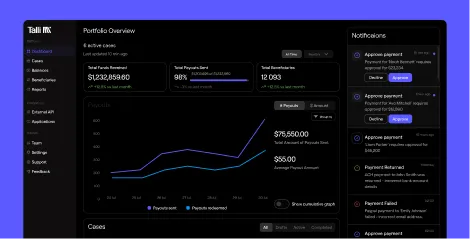
- Real-time visibility: Dashboards show administrators exactly where each payment stands, from initial verification through final completion
Settlement administrators using Talli report significant improvements in redemption rates, dramatic reductions in processing time, and complete confidence in their verification and compliance posture. The platform handles the technical complexity of modern settlement distributions, allowing administrators to focus on serving claimants and satisfying court requirements.
Frequently Asked Questions
What happens if a claimant provides incorrect bank details and the payment fails?
Failed ACH payments return through the banking system with specific return codes indicating the failure reason (closed account, invalid account number, etc.). Modern disbursement platforms automatically flag these failures, notify the claimant to update their information, and queue the payment for retry once corrected details are submitted. This differs significantly from misdirected wire transfers, which may be unrecoverable if sent to a valid but incorrect account.
How do settlement administrators handle international claimants who cannot receive U.S. ACH payments?
International disbursements require specialized payment rails. Options include international wire transfers (typically $10-$30 per transaction), multi-currency payment networks supporting multiple currencies across many countries, or regional payment methods appropriate to the claimant's location. Verification for international accounts uses services that cover numerous countries with direct banking system connections.
Can verification services detect when a legitimate vendor's email has been compromised?
Verification services confirm account ownership at a point in time but cannot detect email compromise directly. However, they flag risk indicators: sudden bank detail changes after long-standing relationships, new accounts opened recently, or mismatches between submitted names and bank records. The best protection combines automated verification with callback confirmation on independently sourced phone numbers for any bank detail change request.
What documentation do courts typically require for settlement distribution accounting?
Courts generally require proof of notification attempts, verification of recipient identity, payment method used, payment status (attempted, completed, failed, returned), timestamps for each action, and final disposition of all funds including unclaimed amounts. Purpose-built settlement platforms generate these reports automatically, while generic payment processors require significant manual compilation.
How should administrators handle deceased claimants discovered during verification?
When verification reveals a claimant has died, administrators must follow court-approved procedures for estate distribution. This typically involves confirming death through public records, identifying the executor or administrator of the estate, verifying their authority to receive settlement funds, and documenting the chain of custody. Payments to estates may require different tax reporting than payments to living individuals.