.svg)


.svg)
Cross-border dividend payments create a compliance challenge where an estimated $18 billion in recoverable withholding tax on foreign shares and bonds has gone unclaimed globally because investors do not complete the reclaim process. For settlement administrators, bankruptcy trustees, and teams managing shareholder services, withholding tax is not just a tax department issue. It affects net recovery, claimant communication, reporting accuracy, and post-distribution disputes. When foreign recipients do not provide valid documentation before payment, U.S.-source dividends are generally subject to 30% withholding. When documentation is complete and treaty eligibility is clear, treaty rates often reduce withholding to 5% to 15%, and some qualifying corporate ownership structures may receive a 0% rate under specific treaties.
Key Takeaways
- U.S.-source dividends paid to foreign persons are generally subject to 30% withholding unless valid documentation supports a reduced treaty rate.
- Foreign individuals usually provide Form W-8BEN, while foreign entities usually provide Form W-8BEN-E.
- Treaty rates depend on tax residence, beneficial ownership, ownership percentage, Limitation on Benefits rules, and the exact treaty article.
- Documentation must be collected before payment to apply treaty rates at source.
- Overwithholding can force recipients into slow refund or reclaim processes.
- Administrators need clear audit trails showing recipient status, withholding rate logic, payment amount, and tax withheld.
- Digital workflows can reduce missing documentation, failed payments, and manual reconciliation across international distributions.
Understanding withholding tax on dividend payments
Withholding tax is a source-country collection mechanism. Instead of relying on a foreign recipient to self-report income after receiving a dividend, the payer or withholding agent deducts tax before releasing funds. In the United States, this generally falls under Chapter 3 withholding for U.S.-source Fixed, Determinable, Annual, or Periodical income, often called FDAP income.
For administrators handling class action payouts, bankruptcy distributions, mass tort payments, or shareholder dividends, withholding tax affects both the recipient experience and the administrator's compliance record. A recipient expecting a full gross payment may dispute a reduced net amount if the withholding explanation is unclear. A court, trustee, or issuer may also need evidence that the correct rate was applied and deposited.
The basic operating rule is straightforward: start with the statutory withholding rate, then reduce it only when valid documentation supports a lower rate. For U.S.-source dividends paid to foreign beneficial owners, that starting point is generally 30% withholding. The rate may be lowered by an applicable income tax treaty, but only when the payee provides the right documentation before payment.
Issuer and administrator obligations
The payer or withholding agent is responsible for withholding, depositing, and reporting tax correctly. That obligation can apply to issuers, trustees, settlement funds, custodians, or administrators depending on how the distribution is structured.
Core responsibilities include:
- Collecting documentation: Requesting the correct W-8 form or other applicable withholding certificate.
- Determining status: Identifying whether the recipient is a U.S. person, foreign individual, foreign entity, intermediary, or flow-through entity.
- Applying the rate: Using the statutory rate unless documentation supports a treaty rate or exemption.
- Reporting the payment: Preparing Form 1042-S for reportable payments to foreign persons and Form 1042 for the annual withholding tax return.
- Maintaining records: Keeping documentation, withholding calculations, deposit records, and audit trails for review.
This matters because withholding agents can be liable for tax that should have been withheld, plus interest and applicable penalties. The risk is not limited to tax amounts. Missing documentation can delay distributions, increase exception handling, and create avoidable disputes with recipients.
What actually drives dividend withholding rates
For cross-border dividends, the important questions are not whether the dividend is ordinary or qualified in the U.S. retail-investor sense. Qualified dividend treatment generally affects U.S. recipient income tax rates. For foreign withholding, the rate depends on source, recipient classification, treaty eligibility, ownership percentage, and documentation.
Administrators should evaluate four questions before payment:
- Is the payment U.S.-source FDAP income? Dividends from U.S. corporations are generally U.S.-source FDAP income.
- Who is the beneficial owner? The beneficial owner may be an individual, entity, trust, intermediary, or flow-through structure.
- Is a treaty available? The United States has income tax treaties with many countries, but not all jurisdictions.
- Has the recipient documented eligibility? Treaty benefits generally require a valid W-8 form and, for entities, appropriate treaty and Limitation on Benefits certification.
When documentation is missing or unreliable, administrators should apply the default withholding rate rather than assume treaty eligibility. This is especially important in high-volume distributions where a small documentation gap can multiply across thousands of payments.
Forms used for cross-border dividend withholding
The W-8 form family is central to foreign recipient documentation. Different recipient types require different forms, and using the wrong form can invalidate a treaty claim.
Key forms include:
- Form W-8BEN: Used by foreign individuals to certify foreign status and claim treaty benefits when applicable.
- Form W-8BEN-E: Used by foreign entities to certify foreign status, Chapter 4 status, and treaty claims.
- Form W-8IMY: Used by foreign intermediaries, foreign flow-through entities, and certain trusts receiving payments for others.
- Form W-8ECI: Used when income is effectively connected with a U.S. trade or business.
- Form 1042-S: Reports U.S.-source income paid to foreign persons and the withholding applied.
- Form 1042: Summarizes annual withholding tax liability.
The IRS instructions for Form W-8BEN state that the form should be given to the withholding agent before payment is made, credited, or allocated. If the recipient does not provide the form, the withholding agent may need to withhold at 30% or another applicable rate.
Treaty benefits and reduced dividend rates
Tax treaties can significantly reduce withholding. Many treaties use tiered dividend rates based on ownership percentage. A portfolio investor may receive a 15% rate, while a corporate shareholder with a qualifying ownership stake may receive 5%. Some treaties provide 0% rates for qualifying corporate parents, pension funds, or other specified owners, but these rules are narrow and highly treaty-specific.
The IRS tax treaty tables are the starting point, but administrators should still review the treaty article, protocol, and limitation rules. A table rate is not enough if the recipient does not meet the treaty's conditions.
For example, the U.S.-Spain protocol includes a zero-rate path for qualifying companies that own at least 80% of the voting stock for the required period and satisfy other treaty conditions. The U.S.-Japan treaty has a zero-rate dividend path for qualifying companies that own more than 50% of voting stock for the required period. These details matter because “50%,” “more than 50%,” “10%,” and “80%” are not interchangeable.
Limitation on Benefits rules
Most modern U.S. tax treaties include Limitation on Benefits provisions. These rules prevent treaty shopping by requiring the recipient to satisfy objective eligibility tests beyond simple residence.
Common LOB concepts include:
- Publicly traded company tests
- Ownership and base erosion tests
- Active trade or business tests
- Derivative benefits tests
- Pension fund or tax-exempt organization rules
For individuals, treaty claims may be simpler, but administrators still need a valid W-8BEN and a treaty country claim. For entities, W-8BEN-E requires additional certifications, and the administrator should maintain records showing why the reduced rate was accepted.
LOB errors are major because they can produce underwithholding. A foreign entity may be resident in a treaty country but still fail the LOB article. In that case, applying the treaty rate can create liability for the withholding agent.
Calculation workflow for dividend withholding
A consistent calculation workflow reduces errors and creates defensible records.
- Identify the gross payment: Confirm the dividend or distribution amount before withholding.
- Confirm source: Determine whether the payment is U.S.-source FDAP income.
- Review recipient status: Classify the payee as U.S., foreign individual, foreign entity, intermediary, or flow-through.
- Check documentation: Confirm that the W-8 form is complete, signed, valid, and received before payment.
- Review treaty availability: Confirm that a treaty exists and that the income type is covered.
- Apply ownership thresholds: Determine whether the recipient qualifies for portfolio, direct investment, or parent-subsidiary rates.
- Validate LOB eligibility: Confirm treaty eligibility for entity recipients.
- Calculate withholding: Apply the statutory or treaty rate to the gross amount.
- Record the result: Save the form, rate decision, calculation, and payment evidence.
This workflow is especially useful for bankruptcy distributions, securities settlements, and global shareholder payments where claimant records may include multiple countries, entity types, and ownership categories.
Common scenarios for legal and settlement distributions
Cross-border withholding issues arise across several legal distribution contexts:
- Securities class actions with foreign investors or nominees.
- Bankruptcy distributions to foreign creditors or foreign entities.
- Mass tort settlements with international beneficiaries.
- Shareholder dividend payments involving foreign registered holders.
- Trust or QSF distributions where the tax character of the payment must be reviewed carefully.
In each scenario, administrators should avoid treating all international payments the same. A foreign individual claimant, a foreign corporation, a nominee account, and a foreign trust can require different documentation and reporting treatment.
For teams managing mass tort payments, the operational issue is scale. Even if the tax rule is clear for one claimant, applying it consistently across thousands of recipients requires structured intake, validation, exception workflows, and payment-level audit trails.
Penalties and compliance exposure
Withholding failures can create direct liability for the withholding agent. If tax should have been withheld and was not, the withholding agent may be liable for the unpaid tax, interest, and penalties. Late deposits, incorrect information returns, and missing Forms 1042-S can also create additional exposure.
Major risk areas include:
- Applying a treaty rate before receiving documentation
- Accepting incomplete W-8 forms
- Treating an intermediary as the beneficial owner without proper withholding statements
- Ignoring LOB requirements for foreign entities
- Using outdated treaty rates after a protocol change
- Failing to document how the rate was determined
Administrators should build a pre-payment review into every cross-border dividend workflow. Once funds are distributed, corrections become more expensive and more confusing for recipients.
Reducing overwithholding and refund friction
Overwithholding may be safer than underwithholding from the administrator's perspective, but it creates real friction for recipients. If a treaty-eligible recipient is withheld at 30% because documentation was missing, that recipient may need to pursue a refund through the applicable U.S. nonresident return or refund process. Individuals may use Form 1040-NR when appropriate, while foreign corporations may need a different filing route.
Refund timelines vary, and recipients often need detailed documentation to support the claim. In legal distributions, this can lead to follow-up calls, complaints, and court-facing questions about why net recovery was lower than expected.
The best prevention is documentation collection before payment. Digital intake flows can prompt recipients for the correct form, flag missing fields, and hold payments until required documentation is complete.
Digital workflows for cross-border dividend administration
Manual withholding workflows create avoidable risk. Spreadsheets, email attachments, and paper forms make it difficult to confirm which version of a form was used, when it was received, and who approved the rate.
A digital workflow can support:
- Recipient-level documentation collection
- Smart reminders for missing W-8 forms
- Payment holds for incomplete records
- Rate review queues for treaty claims
- Audit trails showing timestamps and approvals
- Exportable data for Form 1042-S and Form 1042 preparation
- Reconciliation across gross payments, tax withheld, and net disbursements
These controls align with broader tax compliance requirements in settlement administration. They also reduce the manual follow-up that often causes delays in international payouts.
Fund segregation and reporting controls
For Qualified Settlement Funds and other court-supervised distributions, withholding tax should be managed alongside fund segregation. Administrators need to show that settlement funds, tax withheld, and recipient payments were tracked accurately.
Dedicated account structures help preserve separation between settlement assets and operating funds. Strong reporting should show:
- Gross distribution amounts
- Withholding amounts by recipient
- Net payments released
- Failed or returned payments
- Outstanding documentation exceptions
- Remaining fund balances
- Tax reporting data by jurisdiction or recipient type
This is where audit trails and reporting workflows matter. Courts, trustees, and administrators need more than a payment confirmation. They need a documented chain showing why each payment was released, withheld, delayed, or escalated.
Why Talli fits cross-border dividend administration
Talli is purpose-built for legal settlement disbursements, class action payouts, bankruptcy distributions, and other high-volume legal payment workflows. The platform supports digital-first distribution with multiple payment options, built-in KYC and OFAC screening, W-9 collection, fraud mitigation, fund segregation, audit logging, and real-time dashboards.
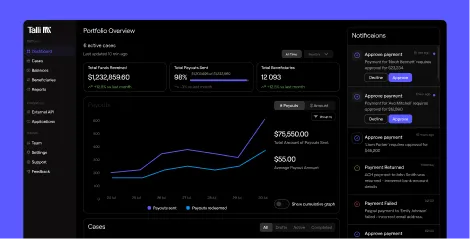
For cross-border dividend workflows, the operational value is control. Administrators can centralize claimant data, track payment status, monitor documentation completion, and maintain records that support reconciliation and court reporting. When withholding tax review is required, document-gated payment workflows help prevent premature release before recipient status and tax documentation are resolved.
Talli also supports the broader infrastructure administrators need for global compliance, including secure payout tracking, exception handling, and visibility across large recipient populations. For teams facing international dividend distributions, that means fewer manual follow-ups, clearer recipient communication, and stronger evidence for courts and stakeholders.
Cross-border withholding will always require tax judgment. The goal is not to replace that judgment, but to make the workflow more reliable. With structured documentation, segregated funds, real-time dashboards, and exportable reporting data, Talli helps administrators move from reactive tax cleanup to controlled, audit-ready distribution.
Frequently Asked Questions
What happens if a foreign recipient does not provide Form W-8BEN before payment?
Without valid documentation, the withholding agent generally must apply the default 30% withholding rate to U.S.-source FDAP income. The recipient may later pursue a refund if eligible, but pre-payment documentation is the cleaner path because it allows the correct treaty rate to be applied at source.
Do qualified dividends reduce withholding for foreign recipients?
Not by themselves. Qualified dividend rules mainly affect U.S. recipient income tax treatment. For foreign recipients, withholding depends on source, recipient status, treaty eligibility, ownership level, Limitation on Benefits rules, and whether the correct W-8 documentation was provided before payment.
What form should a foreign company provide for dividend withholding?
A foreign company generally provides Form W-8BEN-E, not Form W-8BEN. The entity must certify foreign status, Chapter 4 status, and any treaty claim. If an intermediary or flow-through entity is involved, Form W-8IMY and withholding statements may also be required.
Can administrators apply treaty rates automatically?
Administrators should not apply treaty rates automatically based only on country of residence. They need valid documentation, beneficial owner status, treaty eligibility, and ownership classification. For entities, Limitation on Benefits certification is especially important before applying a reduced rate.
What records should administrators keep for withholding tax compliance?
Administrators should keep W-8 forms, rate determination notes, treaty support, withholding calculations, payment records, deposit evidence, Form 1042-S data, and audit logs. Digital workflows make this easier by preserving timestamps, approvals, documentation status, and payment-level history in one reporting environment.