.svg)


.svg)
An IOLTA (Interest on Lawyers' Trust Account) is a pooled trust account that law firms use to hold client funds too small or held too briefly to earn interest individually, with the interest funding legal aid programs instead of benefiting individual clients. Since IOLTA programs launched in 1981, they've generated over $4 billion nationwide to support access to justice initiatives. For settlement administrators managing high-volume distributions across class actions and mass torts, maintaining IOLTA compliance becomes exponentially more complex, requiring dedicated account structures, automated reconciliation, and robust audit trails that traditional manual processes simply cannot deliver.
Key Takeaways
- IOLTA accounts hold nominal or short-term client funds where interest is remitted to state bar associations funding legal aid programs
- Reconciliation requirements vary by jurisdiction. Some states, including California, require monthly three-way reconciliation, while others use different schedules for bank and client-ledger reconciliation
- California's CTAPP program suspended over 1,700 lawyers in 2023 for trust account reporting failures alone
- State requirements vary significantly. California mandates 5 years record retention while New York requires 7 years
- Texas attorneys must use the State Bar's tax ID 74-2354575 on IOLTA accounts
- Settlement administrators managing thousands of claimants need dedicated FBO account structures separate from standard IOLTA
Understanding IOLTA Accounts: Purpose and Definition
IOLTA programs emerged from a practical problem. Before 1981, small client deposits sat in non-interest-bearing accounts because the administrative costs of managing individual interest exceeded potential earnings. Federal banking law changes that year enabled checking accounts to bear interest, and Florida became the first state to establish an IOLTA program pooling these nominal funds.
The pooled structure works because collectively, small deposits generate meaningful interest. Individual clients don't lose anything, their funds were too small to earn interest anyway, while legal aid organizations gain essential funding. Today, all 50 states operate IOLTA programs plus the District of Columbia, Puerto Rico, and the U.S. Virgin Islands.
Who Benefits from IOLTA Interest
The interest generated flows directly to state bar foundations supporting:
- Legal aid offices providing free civil representation
- Pro bono programs connecting volunteer attorneys with underserved populations
- Access to justice initiatives addressing systemic barriers
- Law school clinics training future attorneys in public interest work
Approximately 90% of IOLTA grants support legal aid offices and pro bono programs. In California alone, around 100 legal service programs statewide receive IOLTA grants annually, helping hundreds of thousands of indigent persons access civil legal help.
Distinction from Standard Client Trust Accounts
IOLTA accounts differ from dedicated trust accounts based on fund characteristics:
- Amount: Nominal sums that wouldn't generate net interest after administrative costs
- Duration: Short-term holdings where interest wouldn't accrue meaningfully
- Pooling: Multiple clients' funds combined in single account
- Interest treatment: Remitted to state bar, not retained by client or attorney
When funds are substantial enough or held long enough to generate meaningful net interest, attorneys must place them in individual interest-bearing accounts with earnings belonging to the client.
Key IOLTA Account Rules and Compliance Requirements
Avoiding Commingling: A Strict Standard
ABA Model Rule 1.15 establishes the foundation: client funds must remain completely separate from attorney operating funds. Commingling, mixing client money with firm money, constitutes one of the most serious ethical violations in legal practice.
This prohibition extends to:
- Depositing personal funds into trust accounts (except minimal amounts for bank fees)
- Using one client's funds for another client's matter
- Transferring unearned fees before billing documentation supports the charge
- Paying firm expenses from trust account balances
Essential Record-Keeping and Reporting
Proper law firm trust accounting requires maintaining detailed records that survive regulatory scrutiny:
Required documentation includes:
- Client ledgers tracking every deposit and disbursement by matter
- Trust account ledger showing all account activity
- Bank statements and reconciliation records
- Disbursement authorizations and supporting invoices
- Fee agreements justifying earned fee transfers
Retention periods vary by state. California requires 5 years post-distribution while New York mandates 7 years. Multi-state practices must apply the longest applicable standard.
State-Specific Variations in IOLTA Rules
While all states operate IOLTA programs, requirements diverge significantly. Understanding these jurisdictional differences is critical for compliance:
California:
- Reconciliation frequency: Monthly three-way reconciliation required
- Record retention: 5 years
- Special requirements: CTAPP annual reporting mandatory
Texas:
- Reconciliation frequency: Monthly
- Record retention: 5 years
- Special requirements: State Bar TIN 74-2354575 required, Prime Partner banks pay enhanced rates
New York:
- Reconciliation frequency: Monthly
- Record retention: 7 years
- Special requirements: Called "IOLA" not IOLTA
Florida:
- Reconciliation frequency: Monthly
- Record retention: 6 years
- Special requirements: Trust-account certification and overdraft reporting requirements
North Carolina:
- Reconciliation frequency: Monthly bank reconciliation with full three-way reconciliation at least quarterly
- Record retention: 6 years
- Special requirements: Monthly and quarterly reviews required
These variations mean settlement administrators operating across multiple jurisdictions must build processes satisfying the strictest applicable standard. Understanding state-specific IOLTA disbursement rules becomes critical for compliance.
Setting Up and Managing an IOLTA Account
Choosing the Right Bank for Your IOLTA
Bank selection requires evaluating factors beyond standard commercial account criteria:
- IOLTA program eligibility: Banks must agree to remit interest directly to the state bar
- FDIC insurance: Essential protection for client funds
- Interest rates: Some states maintain "Leadership Bank" programs offering premium rates
- Overdraft notification: Banks must report overdrafts to state disciplinary authorities
- Reporting capabilities: Monthly statements with transaction detail supporting reconciliation
California's CTAPP maintains a list of eligible institutions that have agreed to participate in the program. Texas offers Prime Partner banks paying enhanced interest rates.
The Opening Process: Documentation and Approval
Opening an IOLTA account requires:
- State bar membership verification
- Completed bank application with IOLTA designation
- Proper account titling (typically "[Firm Name] IOLTA Account" or "Client Trust Account")
- Tax identification, either firm EIN or state bar TIN depending on jurisdiction
- Any required IOLTA registration, financial-institution notice, or trust-account update completed according to the applicable jurisdiction's rules
Best Practices for Account Administration
Effective IOLTA management demands systematic processes:
- Deposit promptly: Client funds should reach trust accounts within 24-48 hours of receipt
- Document thoroughly: Every transaction needs written authorization and supporting documentation
- Reconcile regularly: Follow jurisdiction-specific reconciliation schedules without exception
- Segregate mentally: Treat trust funds as belonging to clients, not the firm
IOLTA Accounts in Law Firm Accounting and Operations
The Importance of Three-Way Reconciliation
The foundation of IOLTA compliance is three-way trust reconciliation: comparing the bank statement balance, the trust account ledger, and the sum of all individual client ledgers. All three must match.
This process catches errors that simple bank reconciliation misses:
- Wrong matter numbers: Funds credited to incorrect client accounts
- Negative client balances: Using one client's money for another (a serious violation)
- Stale balances: Old funds requiring escheatment review
- Commingling indicators: Operating expenses inadvertently paid from trust
- Disbursements before clearing: Checks written against uncollected deposits
Firms failing to reconcile regularly appear consistently in trust account mismanagement cases. The reconciliation process creates the audit trail demonstrating compliance.
Integrating IOLTA with Firm Accounting Systems
Modern practice management software automates basic reconciliation through:
- Real-time bank feed integration reducing data entry
- Automated ledger posting from payment processing
- Role-based access controls preventing unauthorized transfers
- Exception flagging for potential compliance issues
- Report generation for court and regulatory requirements
For settlement administrators managing thousands of claimants, traditional software approaches break down. Client-level ledgers multiply into volumes requiring automated legal disbursement audits that connect payment authorization, claimant status, bank activity, and ledger records in unified workflows.
IOLTA vs. Other Trust Account Types: Distinctions for Legal Professionals
When to Use an IOLTA vs. a Standard Trust Account
The decision between IOLTA and individual trust accounts hinges on whether funds will generate meaningful net interest after administrative costs:
Use IOLTA for:
- Retainers held briefly before earning
- Settlement proceeds awaiting immediate distribution
- Filing fees and costs held short-term
- Small-value matters where interest administration exceeds earnings
Use individual trust accounts for:
- Large deposits held for extended periods
- Real estate escrows with substantial funds
- Structured settlements with ongoing distributions
- Any situation where client could earn meaningful interest
Understanding QSFs and Their Role
For large settlements, class actions, mass torts, bankruptcy distributions, Qualified Settlement Funds under IRC Section 468B provide a different structure entirely. QSFs offer:
- Separate tax framework: QSFs are taxed and administered under IRC Section 468B, and qualifying transfers can affect the timing of economic performance for defendants, while claimant taxation depends on the character and timing of individual payments
- Fund segregation: Complete separation from attorney operating and IOLTA accounts
- Court oversight: Judicial approval for disbursements and distributions
- Dedicated administration: Trustees or administrators managing fund operations
QSFs require specific compliance frameworks distinct from IOLTA, including Form 1120-SF filing, different record retention requirements, and court-ready reporting documentation.
Common IOLTA Violations and How to Prevent Them
Warning Signs of IOLTA Mismanagement
Most IOLTA violations stem from avoidable administrative errors, not intentional misconduct:
- Commingling earned fees: Leaving earned fees in trust too long or transferring prematurely
- Negative client balances: Disbursing more than available for specific matters
- Disbursing before clearing: Writing checks against deposits still in collection
- Inadequate ledger maintenance: Failing to track client-level activity
- Late reconciliations: Skipping scheduled reconciliation periods
- Bank fee allocation: Charging trust account fees to client funds improperly
- Missing authorizations: Disbursing without written client approval
California's experience illustrates the stakes: CTAPP administratively suspended over 1,700 lawyers in 2023 for failing to comply with trust account reporting requirements, not necessarily fund misappropriation, but reporting failures alone.
Best Practices for Proactive Compliance
Prevent violations through systematic controls:
- Positive pay protection: Bank verification of check authenticity before payment
- Dual authorization: Require two signatures for disbursements above thresholds
- Automated alerts: System notifications for approaching negative balances
- Regular training: Annual refreshers on trust accounting requirements
- External audits: Periodic third-party review of trust operations
Modern Solutions for IOLTA Management in Legal Settlements
Transitioning from Manual to Digital Oversight
Traditional IOLTA workflows built for individual client matters collapse under settlement-scale volume. Modern disbursement platforms address these challenges through:
Dedicated FBO Structures: For-Benefit-Of accounts maintaining matter-level segregation while enabling efficient processing across thousands of claimants.
Multi-Channel Payments: ACH direct deposit, prepaid cards, digital wallets, and check fallback options maximizing claimant redemption while reducing unclaimed funds.
Embedded Compliance Automation: KYC verification, OFAC screening, W-9 collection, and 1099 generation integrated into disbursement workflows rather than manual post-payment processes.
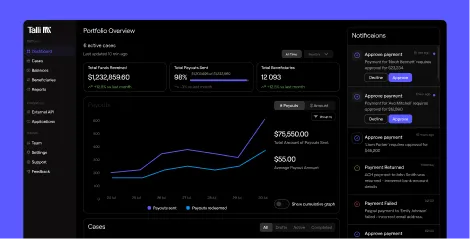
Real-Time Dashboards: Live visibility into completion rates, payment method distribution, failure root causes, and remaining fund balances supporting court reporting requirements.
Improving Fund Distribution Efficiency
Digital infrastructure transforms settlement administration economics. Processing costs drop from an estimated $7-20 per paper check to around $0.25-$5 for digital payments. Distribution timelines compress from 6-8 weeks to 24-48 hours. Redemption rates reach 95-98% versus 70-80% for traditional paper methods.
For settlement administrators, these improvements directly support fiduciary obligations by getting funds to claimants faster while reducing unclaimed fund liability and eventual escheatment.
Why Talli Simplifies IOLTA-Compliant Settlement Disbursements
While standard IOLTA management tools serve individual law firm needs, Talli provides purpose-built infrastructure specifically designed for high-volume settlement distributions requiring strict compliance controls.
Talli's platform addresses the unique challenges settlement administrators face:
Fund Segregation Architecture: Dedicated FBO account structures can help keep settlement funds operationally segregated and support matter-level tracking. When a settlement is structured as a QSF, its tax status depends on satisfying the requirements of IRC Section 468B and the applicable Treasury regulations. Separating settlement funds from operating capital supports accurate matter-level accounting and reduces commingling risk. Whether attorney trust-account rules apply depends on who holds the funds, the account structure, and the governing jurisdiction.
Six Payment Method Options: ACH direct deposit at an estimated $0.25-$0.50 per transaction, prepaid Mastercards delivered via SMS or email in 30 seconds, digital wallets including PayPal and Venmo, gift cards for small-value distributions, wire transfers for high-value international payments, and paper checks as fallback, all managed through a unified platform.
Compliance Automation Suite: Built-in KYC verification, OFAC sanctions screening with documented timestamps, automated W-9 collection achieving 90% completion through smart reminders, and 1099 generation with IRS e-filing integration. These controls operate automatically without administrator configuration.
Real-Time Dashboard and Reporting: Live monitoring of payment status, completion rates, fund flows, and fraud flags requiring review. Automated reporting generates court-required accounting without manual preparation, while stakeholder portals provide controlled access for courts, trustees, and legal teams.
For settlement administrators managing class actions disbursing to thousands of claimants, Talli's infrastructure transforms compliance from a monthly challenge into a controlled operating process, achieving 30% higher redemption rates while maintaining complete fiduciary compliance records across distributions. Banking services provided by Patriot Bank, N.A., Member FDIC ensure institutional-grade security for settlement funds.
Frequently Asked Questions
What is the primary difference between an IOLTA account and a regular client trust account?
The key distinction involves interest treatment and fund characteristics. IOLTA accounts hold nominal or short-term client funds where interest wouldn't generate meaningful earnings for individual clients. Instead, interest flows to state bar foundations funding legal aid programs. Regular client trust accounts hold larger amounts or longer-term funds where interest accrues to the client's benefit. Attorney judgment determines which account type applies based on whether administrative costs would exceed potential interest earnings.
How does the interest generated from an IOLTA account get used?
IOLTA interest is remitted directly to state bar foundations that distribute grants to legal service organizations. Approximately 90% of these grants support legal aid offices and pro bono programs serving underrepresented populations. In California, roughly 100 legal service programs receive IOLTA funding annually. Since inception, IOLTA programs have generated over $4 billion for access to justice initiatives.
What are the most common mistakes law firms make when managing IOLTA accounts?
The most frequent violations involve process failures rather than intentional misconduct: commingling earned fees with client funds, creating negative client balances by using one client's money for another, disbursing before deposits clear, inadequate client ledger maintenance, failing to reconcile according to jurisdiction requirements, and missing written disbursement authorizations. California's CTAPP suspended over 1,700 lawyers in 2023 for reporting failures alone, demonstrating how seriously regulators treat these administrative requirements.
Are there specific banking requirements for opening an IOLTA account?
Yes. Banks must agree to participate in the state's IOLTA program, remit interest directly to the state bar foundation, and report overdrafts to disciplinary authorities. The account must be FDIC-insured and properly titled with IOLTA designation. Texas requires using the State Bar's tax ID 74-2354575 on accounts. Many states maintain lists of eligible institutions. California's CTAPP identifies approved financial institutions that meet program requirements.
How does a digital payment platform improve IOLTA compliance for settlement administrators?
Digital disbursement platforms embed compliance controls directly into payment workflows rather than treating compliance as separate post-payment reconciliation. For settlement administrators managing thousands of claimants, this means automated three-way reconciliation, built-in KYC and OFAC screening, real-time fund tracking, and court-ready audit trails generated automatically. Dedicated FBO account structures maintain fund segregation at scale while multi-channel payment options maximize redemption rates. Digital methods achieve 95-98% redemption versus 70-80% for paper checks, directly reducing unclaimed fund liability and escheatment risk.