.svg)


.svg)
Three-way trust reconciliation compares bank statements, internal ledgers, and individual beneficiary balances to verify that every dollar in a settlement fund is accurately tracked, properly allocated, and available for distribution. For claims administrators and law firms managing court-supervised distributions, this financial control process is essential infrastructure, not optional accounting hygiene.
Settlement administrators need comprehensive reporting that proves fund integrity to courts, trustees, regulators, and beneficiaries. A standard bank reconciliation can confirm that cash is in the account, but it may not prove that each dollar is assigned to the correct claimant. Three-way reconciliation closes that gap by tying bank activity, fund accounting, and beneficiary-level balances into one auditable control.
Key Takeaways
- Three-way reconciliation verifies three balances: the adjusted bank balance, the internal trust ledger, and the sum of individual beneficiary ledgers.
- The core formula is simple: adjusted bank balance = internal trust ledger = total beneficiary ledger balances.
- Standard two-way reconciliation can miss allocation errors, including money posted to the wrong claimant or left in suspense.
- Qualified Settlement Funds require clear segregation and matter-level accounting. FBO account structures can support that control, but QSF status depends on the requirements under IRC Section 468B and related Treasury regulations.
- State bar rules vary, but regular trust account reconciliation, complete records, and audit-ready documentation are core expectations for lawyers and administrators handling client or claimant funds.
- Automated settlement reconciliation helps administrators match transactions continuously, surface exceptions faster, and maintain court-ready reporting.
What Three-Way Trust Reconciliation Means
Three-way reconciliation means comparing three independent records for the same settlement fund and confirming that all three agree.
The basic three-way test is:
Adjusted bank balance = internal trust ledger balance = total beneficiary ledger balances
For example, if the adjusted bank balance is $4,500,000, the internal settlement ledger should also show $4,500,000, and the combined claimant ledgers should total $4,500,000. If the bank and master ledger match but the claimant ledgers total only $4,495,000, the fund has a $5,000 allocation problem that ordinary bank reconciliation would miss.
That is the core value of three-way reconciliation. It does not only prove that the money is in the account. It also proves that the money is correctly assigned to the people or parties entitled to receive it.
Why Two-Way Reconciliation Is Not Enough
A two-way reconciliation compares the bank statement to the internal ledger. That is necessary, but incomplete for settlement funds. A bank balance can match the internal ledger while claimant-level records remain wrong.
For example, a payment may be posted correctly in the bank account and master ledger but applied to the wrong claimant sub-ledger. A returned ACH may reduce the bank balance but remain unresolved in the claimant record. A fee may be recorded at the fund level without being assigned according to the settlement agreement. These are not always visible in a two-way match.
Three-way reconciliation addresses that failure mode by adding the beneficiary ledger total as the third control. The administrator is not finished until the bank, the master ledger, and the beneficiary records all agree.
For claims teams managing class action payouts, mass tort distributions, shareholder payments, or bankruptcy claims, this third layer is critical. Settlement funds are not ordinary operating accounts. They represent money owed to specific people or entities under a court-approved plan.
Why It Matters For Law Firms And Settlement Administrators
For legal professionals managing trust accounts, reconciliation supports fiduciary compliance and audit readiness. ABA Model Rule 1.15 requires lawyers to keep client or third-party funds separate from the lawyer’s own property, and state rules impose detailed recordkeeping obligations for trust accounts.
The ABA recordkeeping guidance describes the types of records lawyers should maintain for client trust accounts, including receipts, disbursement journals, client ledgers, bank statements, accountings, and reconciliation records. Settlement administrators may not always operate under the same bar rules as law firms, but the operational standard is similar: every dollar must be traceable.
Three-way reconciliation supports several fiduciary controls:
- Fund protection: It verifies that money is still available in the account.
- Allocation accuracy: It confirms that each dollar is assigned to the right beneficiary.
- Commingling prevention: It helps prove settlement funds remain separate from operating capital.
- Court confidence: It provides documentation for judges, trustees, and settlement counsel.
- Audit readiness: It creates a reliable record for regulators, courts, and internal reviewers.
For administrators managing hundreds, thousands, or hundreds of thousands of claimants, reconciliation accuracy is not just bookkeeping. It is proof that the distribution plan was executed properly.
Settlement Fund Structures And QSF Accounting
Settlement funds often involve legal and tax structures that make reconciliation more complex than ordinary account balancing. A Qualified Settlement Fund, or QSF, is treated as a separate taxpayer when it satisfies the regulatory requirements under IRC Section 468B.
A QSF is generally a fund, account, or trust established under governmental authority to resolve or satisfy claims. It must be segregated from the transferor’s other assets. For reconciliation, that means the administrator needs matter-level visibility into deposits, disbursements, interest, fees, residual balances, tax reporting, and claimant allocations.
QSF reconciliation should support:
- Complete segregation: Settlement funds should remain separate from operating accounts and unrelated settlement matters.
- Matter-level tracking: Each settlement should have its own accounting package.
- Beneficiary-level balances: Claimant or creditor amounts should be traceable to approved allocation schedules.
- Interest tracking: Any interest or investment income should be recorded according to the settlement agreement and tax treatment.
- Court reporting: Reports should show how funds moved from deposit through distribution and exception resolution.
An FBO account structure can support segregation and beneficiary-level accounting, but it should not be described as the legal requirement for QSF treatment. The legal requirement is compliance with Section 468B and the related Treasury regulations.
Step-By-Step Guide To Three-Way Reconciliation
A strong reconciliation process uses a consistent cutoff date, reliable source records, and documented exception handling. The steps below apply whether the administrator is managing one settlement or many concurrent matters.
Step 1: Obtain The Bank Statement
Start with the official bank statement for the reconciliation period, usually month-end. Confirm the beginning balance, ending balance, deposits, cleared payments, bank fees, interest, returned items, and any transfers.
The bank statement shows actual cash activity. It does not show whether payments were assigned to the correct claimant, which is why it is only the first side of the three-way match.
Step 2: Identify Reconciling Bank Items
Next, identify deposits in transit, outstanding checks, pending ACH files, returned payments, and other timing differences. These items explain why the bank statement balance may differ from the internal ledger balance at the cutoff date.
The goal is to calculate the adjusted bank balance:
Bank ending balance + deposits in transit - outstanding disbursements = adjusted bank balance
Timing differences are not necessarily errors. They become problems when they are not documented, not resolved, or carried forward for too long.
Step 3: Generate The Internal Trust Ledger
Pull the internal trust ledger as of the same cutoff date. This ledger should include all settlement fund deposits, disbursements, transfers, interest postings, administrative fees, tax withholdings, and approved adjustments.
The internal ledger is the administrator’s master accounting record. It should match the adjusted bank balance after legitimate timing differences are considered.
If the adjusted bank balance and internal ledger do not match, the issue may involve a missing transaction, duplicate entry, bank-posted fee, returned payment, incorrect transfer, or unapproved journal entry.
Step 4: Export Beneficiary Ledger Balances
Export all individual claimant, creditor, shareholder, or beneficiary balances as of the same date. These records show who is entitled to the remaining money in the fund.
The beneficiary ledger total should equal the internal trust ledger. If it does not, the issue is usually an allocation problem. Common causes include duplicate claimant records, an incorrect payment status, a returned payment not restored to the beneficiary balance, or a fund-level adjustment not assigned to individual records.
Step 5: Complete The Three-Way Match
After the first two checks are complete, present all three balances together:
All three figures must match. If the adjusted bank balance matches the internal ledger but not the beneficiary ledger total, the issue is likely an allocation error. If the bank balance does not match the internal ledger, the issue may be a timing difference, missing transaction, returned payment, fee posting, or bank activity not yet recorded.
This final three-way view is what makes the process stronger than ordinary bank reconciliation.
Step 6: Document Exceptions And Approvals
Reconciliation is not complete until exceptions are documented. Each reconciling item should include the amount, source, root cause, responsible reviewer, expected resolution date, and final disposition.
Administrators should also preserve approval evidence. That includes preparer signoff, reviewer signoff, adjustment approvals, supporting schedules, and any notes explaining variances. For court-supervised distributions, this documentation may be just as important as the match itself.
Common Reconciliation Errors To Avoid
Settlement administrators often encounter the same categories of errors across high-volume funds. The most important are not always the largest dollar amounts. Sometimes the riskiest errors are process gaps that repeat across thousands of beneficiaries.
Common issues include:
- Returned payments not restored: Failed ACH or returned checks should remain tied to the correct claimant.
- Duplicate beneficiary records: Duplicate records can inflate ledger totals or create double-payment risk.
- Suspense balances: Unassigned funds should be investigated and cleared, not carried indefinitely.
- Fees charged incorrectly: Bank, card, or processing fees should follow the settlement agreement.
- Negative claimant balances: Any negative beneficiary ledger balance requires immediate review.
- Manual adjustments without support: Adjustments should include explanation, approval, and audit trail documentation.
- Old outstanding checks: Stale checks should be tracked for reissue, outreach, or escheatment workflows.
- Interest not allocated: Interest income should be recorded according to the fund’s governing documents.
A strong reconciliation policy defines how each exception type is handled before the fund goes live. Waiting until month-end to decide how to treat exceptions creates avoidable audit risk.
Compliance Considerations For Trust Accounts And Settlement Funds
Law firms managing settlement money through IOLTA or other trust accounts must follow state-specific rules. Some jurisdictions require monthly reconciliation. Others reference quarterly reconciliation or different recordkeeping intervals. The safest approach is to confirm the governing rules in the applicable state and maintain records that can withstand audit scrutiny.
Settlement administrators should also align reconciliation procedures with the settlement agreement, court order, tax treatment, and payment method rules. A fund may require OFAC screening, claimant identity checks, tax form collection, backup withholding, fraud review, or escheatment tracking.
The IRS information returns rules may apply depending on the payment type, recipient, and tax classification. Not every settlement payment requires the same tax documentation, so the workflow should support tax form collection and 1099 reporting when required rather than treating those steps as universal.
For sanctions compliance, administrators may also need OFAC screening controls. Screening records should be timestamped and tied to the relevant claimant or payment record.
How Automation Improves Three-Way Reconciliation
Manual reconciliation can work for small, low-activity funds, but it becomes fragile when distribution volume increases. High-volume settlements involve payment files, returned payments, claimant updates, fraud holds, tax forms, replacement payments, residual balances, and stakeholder reporting across multiple systems.
Automated tools can improve the process by:
- Importing bank activity through secure feeds.
- Matching cleared payments to claimant records.
- Flagging failed payments and unresolved exceptions.
- Separating timing differences from true variances.
- Preserving reviewer notes and approval history.
- Generating fund-level and beneficiary-level reports.
Automation does not replace fiduciary oversight. It gives administrators faster visibility and better evidence. Human reviewers still need to investigate exceptions, approve adjustments, and confirm that the reconciliation follows the court-approved distribution plan.
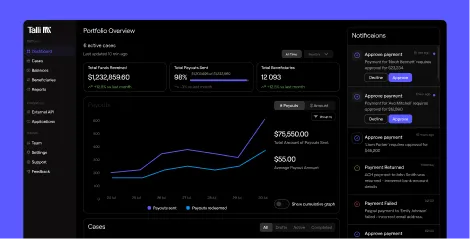
Talli’s digital disbursement platform supports reconciliation by connecting payment status tracking, claimant-level records, compliance workflows, and reporting in one environment. For legal distributions, the key question is not only whether money moved. It is whether each payment can be tied back to the right claimant, the right amount, and the approved fund records.
Reporting And Audit Trails
Reconciliation should produce a complete package that courts, trustees, auditors, and legal teams can review without reconstructing the fund history from spreadsheets.
A strong reconciliation report includes:
- Opening and ending balances.
- Adjusted bank balance calculation.
- Internal ledger balance.
- Beneficiary ledger total.
- Outstanding checks and pending ACH files.
- Returned or failed payments.
- Deposits in transit.
- Fees, interest, and transfers.
- Variance notes and correction entries.
- Preparer and reviewer approvals.
- Supporting schedules and bank statements.
Talli’s audit trail tools help administrators preserve payment history, claimant-level changes, approval activity, and exception resolution. That record matters when courts or trustees ask how a distribution was performed, why a payment failed, or how remaining funds were handled.
Real-time reporting also reduces the month-end scramble. With real-time tracking, administrators can monitor successful payments, failed payments, payment method selection, remaining balances, and unresolved exceptions throughout the distribution lifecycle.
Where Talli Fits In Settlement Reconciliation
Talli is built for claims administrators, settlement administrators, class action law firms, bankruptcy trustees, and shareholder services teams managing high-volume legal payouts. The platform helps teams upload claimant data, create distribution campaigns, offer multiple payment methods, track payment status, and maintain audit-ready records.
Unlike general accounting tools, Talli is designed around the operational realities of settlement disbursement: claimant-level tracking, payment method choice, failed payment resolution, compliance workflows, fund segregation, and court-facing reporting.
Talli supports payment options including ACH, prepaid cards, PayPal, Venmo, gift cards, and check fallback where needed. That flexibility improves claimant access while giving administrators clearer visibility into the status of each payment. The platform also supports KYC, OFAC screening, digital tax form collection when required, fraud mitigation, and audit logging.
For settlement funds, reconciliation quality depends on more than balancing a bank statement. It depends on knowing which claimant was owed money, which payment method was selected, whether the payment cleared, whether it failed, what exception was created, and how the issue was resolved.
Talli Conclusion: Make The Three-Way Match Continuous
Three-way reconciliation protects settlement funds by proving three things at once: the cash exists, the master ledger is accurate, and every dollar is assigned to the correct beneficiary. Without that third check, administrators can miss allocation errors even when the bank account appears to balance.
For small matters, careful manual reconciliation may be manageable. For high-volume class actions, mass torts, bankruptcy distributions, and shareholder payments, manual workflows create too many opportunities for missed exceptions, delayed corrections, and incomplete audit trails.
Talli gives claims teams the infrastructure to make three-way reconciliation more continuous, visible, and defensible. With claimant-level tracking, built-in compliance workflows, real-time dashboards, and audit-ready reporting, administrators can move faster without losing control over fiduciary obligations.
Frequently Asked Questions
What Are The Three Parts Of Three-Way Reconciliation?
The three parts are the adjusted bank balance, the internal trust ledger, and the sum of individual beneficiary ledgers. All three must match to prove that cash exists and is properly allocated.
Why Is Two-Way Reconciliation Not Enough?
Two-way reconciliation confirms that the bank and internal ledger match, but it may miss beneficiary allocation errors. Three-way reconciliation adds claimant-level balances to prove every dollar is assigned correctly.
How Often Should Settlement Funds Be Reconciled?
Monthly reconciliation is a strong baseline for active funds, but state rules and court orders vary. Administrators should confirm the applicable requirements and reconcile more often when payment activity is high.
Can General Accounting Software Handle This Process?
General accounting software may work for small matters. Larger settlements usually need purpose-built tools because they require claimant sub-ledgers, payment tracking, exception workflows, tax support, and court-ready reporting.
What Records Should Be Retained After Reconciliation?
Retain bank statements, ledger reports, beneficiary schedules, reconciliation worksheets, exception notes, approvals, correction entries, and supporting payment records. Retention periods depend on the jurisdiction, court order, and internal policy.