.svg)


.svg)
Paper check processing costs carriers and TPAs $7.78-$20 per transaction when accounting for printing, postage, reconciliation, reissuance, and escheatment tracking, while digital payments reduce this to $0.40-$1.00 per transaction. With 83% of consumers willing to switch carriers after a poor claims experience, and checks remaining the payment method most frequently targeted by fraud, the case for migration has moved from optional to urgent. Modern digital disbursement platforms can automate compliance, strengthen fraud controls, and compress payment cycles from weeks to hours, transforming claims payments from operational burden to competitive advantage.
Key Takeaways
- Paper check processing costs $7.78-$20 per transaction while digital payments cost $0.40-$1.00, representing 80-95% cost reduction
- Digital payment adoption continues to grow, and insurance payment platforms increasingly offer ACH, cards, and digital wallets alongside paper checks to give claimants greater payment choice
- Checks remained the payment method most frequently targeted by fraud, with 63% of surveyed organizations reporting check fraud in 2024, while FinCEN identified over $688 million in reported suspicious activity tied to mail theft-related check fraud
- AI-powered fraud detection can improve identification of suspicious claims through pattern recognition, identity verification, and transaction monitoring, with potential savings varying by implementation and insurance type
- Executive Order 14247 phased out most federal government paper-check disbursements beginning September 30, 2025, signaling broader momentum toward electronic payments
- 5.6 million U.S. households are unbanked, requiring prepaid card options for inclusive payment coverage
The Imperative for Digital Transformation in Claim Payments
The average U.S. property claimant waits about 40.7 days from first notice of loss to final payment, according to recent industry research. During this period, customer satisfaction drops sharply when communication and speed lag. Digital payment satisfaction scores reached 871 out of 1000 points in 2024, up 17 points from the previous year, demonstrating clear consumer preference.
Why Traditional Check Payments Fall Short
Paper checks create compounding operational problems:
- Processing costs: $7.78-$20 per transaction including printing, postage, manual reconciliation, and reissuance
- Fraud exposure: Checks remained the payment method most frequently targeted by fraud, with 63% of surveyed organizations reporting check fraud in 2024, while FinCEN identified over $688 million in suspicious activity tied to mail theft-related check fraud
- Unclaimed funds: Uncashed and stale paper checks create follow-up, reissuance, and potential escheatment obligations
- Reissuance overhead: Each uncashed check requires tracking at around $150 per item
- Payment delays: Paper-based workflows can add mailing, deposit, and reconciliation time, while electronic payments can substantially shorten payment delivery
The Business Case for Digital Payments in Claims
For a TPA processing 500 annual claims, the cost differential translates to $3,500-$9,500 in annual savings on payment processing alone. Carriers managing thousands of claims see six-figure operational improvements.
Beyond cost, 89% of Americans now use digital payment methods regularly. Meeting these expectations directly impacts retention: 83% of consumers would consider switching carriers after a poor claims experience.
Understanding Electronic Funds Transfer Options for Claims
Modern claims payment platforms offer multiple payment rails to accommodate diverse claimant populations:
ACH Direct Deposit: The lowest-cost option at $0.25-$0.50 per transaction with 1-2 day delivery for banked claimants. Ideal for routine indemnity payments and high-volume distributions.
Push-to-Debit: Instant delivery to claimant debit cards. Payment method preferences show 28% of claimants prefer this option for immediate access.
Prepaid Cards: Virtual cards delivered via SMS/email in 30 seconds, physical cards within 5-7 days. Critical for reaching the 5.6 million unbanked U.S. households.
Digital Wallets: PayPal and Venmo integration at $0.50-$1.00 per transaction. About 22% of claimants prefer digital wallet options, particularly younger demographics.
Wire Transfers: Same-day option for high-value payments at $10-$30 per transaction. Best reserved for large settlements requiring immediate delivery.
Streamlining Payment Processes with ACH Direct Deposit
ACH remains the workhorse of digital claims payments due to its low cost and broad acceptance. Implementing ACH for claims requires systematic data collection and verification processes.
Collecting and Verifying ACH Information
Essential data points for ACH payments include:
- Routing number: 9-digit ABA number identifying the receiving bank
- Account number: Claimant's bank account identifier
- Account type: Checking or savings designation
- Account holder name: Must match claimant records exactly
- Authorization: Written or electronic consent for ACH debits/credits
Automated verification systems can validate account ownership and status before payment initiation, reducing return rates. Modern platforms cross-reference provided information against banking databases to catch errors before funds leave your account.
Benefits of ACH for Insurers and Claimants
ACH delivers measurable advantages over checks:
- Cost reduction: $0.25-$0.50 versus $7.78-$20 per check
- Speed: 1-2 business days versus 5-7 days for mail delivery plus processing
- Tracking: Real-time visibility into payment status
- Reconciliation: Automated matching eliminates manual review
- Security: No paper to intercept or forge
ACH Payment Processing Times and Best Practices
Understanding ACH settlement cycles helps set accurate claimant expectations and optimize payment timing.
Expediting Payments with Same-Day ACH
Standard ACH settles in 1-2 business days, but same-day ACH provides accelerated options:
- First window: Same Day ACH submissions can be made by 10:30 AM ET
- Second window: A second submission window closes at 2:45 PM ET
- Third window: The latest Same Day ACH submission window closes at 4:45 PM ET
- Transaction limit: Same Day ACH currently supports payments up to $1 million per transaction
For urgent claims, catastrophe events, hardship cases, or time-sensitive indemnity payments, same-day ACH bridges the gap between standard ACH and expensive wire transfers.
Monitoring and Managing ACH Transactions
Effective ACH management requires real-time visibility:
- Payment status tracking: Monitor initiated, pending, completed, and returned transactions
- Return code analysis: Identify patterns in failed payments (insufficient funds, closed accounts, incorrect information)
- Reconciliation automation: Match payments to claims without manual intervention
- Exception handling: Flag and route problem payments for resolution
Your payment tracking dashboard should provide drill-down capabilities for investigating individual transactions and aggregate views for operational management.
Reaching the Unbanked with Prepaid Solutions
Approximately 5.6 million U.S. households lacked a bank or credit union account in the FDIC's 2023 survey, creating challenges for ACH-only payment strategies. Prepaid card solutions ensure equitable access across all claimant populations.
Prepaid Card Implementation Considerations
Effective prepaid programs require:
- Banking partnerships: FDIC-insured card issuers (such as Patriot Bank, N.A.) ensure regulatory compliance
- Instant virtual delivery: SMS/email delivery in seconds for immediate access
- Physical card options: 5-7 day delivery for claimants preferring physical cards
- No activation fees: Remove barriers to redemption
- No monthly charges: Preserve full payment value for claimants
Prepaid cards achieve around 23% preference rates among claimants, making them essential for comprehensive payment coverage.
Digital Wallet Integration
PayPal and Venmo support adds flexibility for claimants already using these platforms:
- Instant access: Funds available immediately upon transfer
- Familiar interface: No learning curve for existing users
- Mobile-first: Designed for smartphone access
- Broad acceptance: Spend funds at millions of merchants
Around 18% of claimants prefer Venmo/PayPal options, with higher rates among Millennials and Gen Z.
Ensuring Compliance and Security in Digital Claim Disbursements
Digital payments introduce new compliance requirements while strengthening fraud prevention capabilities. Purpose-built platforms embed these controls directly into payment workflows.
Automated KYC and OFAC for Risk Mitigation
Regulatory compliance requires systematic verification:
- KYC (Know Your Customer): Identity verification before payment release
- OFAC screening: Automated sanctions list checking with documented timestamps
- TIN verification: IRS database validation for tax reporting
- Duplicate detection: Identify and flag potential duplicate claims
These controls can be embedded into configurable payment workflows, helping claims teams apply consistent verification, approval, screening, and audit processes across payments.
Protecting Against Fraud with AI-Powered Solutions
AI-powered fraud detection systems can improve identification of suspicious claims through multiple verification layers:
- Pattern recognition: Identify suspicious payment destinations and behavioral anomalies
- Device fingerprinting: Detect bulk-generated claims from single devices
- IP clustering: Flag geographically impossible claim patterns
- Velocity checks: Monitor unusual payment request frequencies
- Identity verification: Document authentication and biometric confirmation
These systems can accelerate fraud screening and help investigators prioritize suspicious claims, but detection accuracy and processing improvements vary by model, data quality, fraud type, and implementation.
Leveraging Automation for Efficient Claims Payment Operations
Manual payment processing creates bottlenecks that compound with volume. Automation transforms claims payment from administrative burden to scalable operation.
Automated Reconciliation and Reporting
Modern platforms automate the most time-consuming payment tasks:
- Three-way matching: Claims, invoices, and payments reconciled automatically
- Exception routing: Problem payments flagged for human review
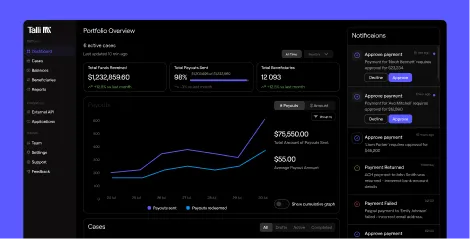
- Real-time status: Live visibility into completion rates and payment method distribution
- Audit trails: Court-ready documentation generated automatically
- CRM synchronization: Payment status updates pushed to case management systems
Automation can reduce monthly closing time significantly, from 15 hours to around 4.5 hours for typical operations.
Integrating Digital Payments with Existing Systems
Successful migration requires seamless integration with claims management infrastructure:
- API connectivity: RESTful APIs enable real-time data exchange
- Webhook support: Push notifications for payment status changes
- Batch processing: CSV uploads for bulk payment initiation
- Pre-built connectors: Standard integrations with major claims platforms
Implementation typically requires 2-6 weeks with vendor-assisted setup, achieving ROI within 4-7 months through reduced processing time and error rates.
Cost Savings and Enhanced Claimant Experience with Digital Disbursements
The financial case for digital migration is compelling, but customer experience improvements may deliver even greater long-term value.
Reducing Operational Costs
Digital payments eliminate multiple cost centers:
- Transaction costs: 80-95% reduction from $7.78-$20 to $0.40-$1.00 per payment
- Reissuance overhead: Eliminate around $150 per uncashed check tracking costs
- Manual reconciliation: Automated matching reduces staff time
- Escheatment processing: Higher redemption rates minimize unclaimed funds
- Fraud losses: Stronger identity, transaction, and behavioral controls can help detect and prevent suspicious payouts
Improving Claimant Satisfaction and Redemption Rates
Speed and choice drive satisfaction:
- Faster delivery: Electronic payments can substantially shorten payment delivery versus paper-based workflows
- Payment choice: Multiple options meeting claimant preferences
- Real-time tracking: Status visibility reduces support inquiries
- Higher completion potential: Digital delivery can reduce lost, stale, and uncashed payments compared with paper checks
When digital payment options are properly implemented, adoption rates can exceed 95%, contradicting assumptions that older claimants prefer paper.
Developing a Phased Implementation Plan for Digital Payment Migration
Successful migration requires systematic planning, stakeholder alignment, and careful execution.
Key Considerations for a Successful Rollout
Structure your migration in manageable phases:
Phase 1: Foundation (Weeks 1-4)
- Select platform and complete vendor due diligence
- Establish required banking relationships and payment account structures
- Configure payment workflows and approval chains
- Integrate with existing claims management systems
Phase 2: Pilot (Weeks 5-8)
- Launch with limited claim types or geographic regions
- Monitor adoption rates, error rates, and claimant feedback
- Refine processes based on pilot learnings
- Train staff on new workflows and exception handling
Phase 3: Scale (Weeks 9-12)
- Expand to additional claim types and regions
- Implement automated reporting and reconciliation
- Optimize payment method mix based on claimant preferences
- Measure and document ROI metrics
Measuring ROI and Iterating Your Digital Strategy
Track key performance indicators throughout migration:
- Cost per payment: Compare pre- and post-migration transaction costs
- Payment speed: Time from claim approval to claimant receipt
- Redemption rates: Percentage of payments successfully claimed
- Fraud rates: Fraudulent claims identified and prevented
- Customer satisfaction: Survey scores and complaint volumes
- Staff efficiency: Processing time per payment
Transform Claims Payments with Talli
While numerous payment platforms exist, Talli delivers purpose-built solutions specifically designed for insurance carriers and TPAs managing regulated payment operations.
Talli addresses the specific challenges carriers face with its claims payment orchestration infrastructure:
- Multi-Party Workflows: Manage coordinated approvals across carriers, providers, vendors, and claimants, maintaining auditable payment status, ownership, and reconciliation across the entire payment lifecycle
- Flexible Payment Choice: Offer ACH, Venmo, PayPal, virtual debit cards, and paper checks to meet policyholders where they are
- Built to Scale: Support high-volume daily claims payments and catastrophe events requiring mass disbursements
- Secure and Compliant: SOC 2, OFAC controls, and BSA/AML controls with bank-grade payment infrastructure
Unlike generic payment processors, Talli provides specialized capabilities for insurance use cases:
- Workers' Compensation: Flexible recurring and scheduled payments with complete payment visibility and auditability
- Catastrophe Payments: Rapid, scalable disbursements during severe weather and other large-loss events
- Medical Payments & Liens: Simplified medical payments and lien disbursements with configurable approvals and automated reconciliation
- TPAs & Claims Administrators: Eliminate payment bottlenecks with coordinated approvals, centralized controls, and automated reconciliation
The platform launches quickly with no-code dashboard configuration and low-code API integration, enabling carriers to modernize payment operations without lengthy implementation timelines. For carriers serious about transforming claims payments, Talli provides the automation and compliance infrastructure needed for sustainable operations.
Frequently Asked Questions
What are the primary benefits of migrating from checks to digital payments for insurance carriers?
Digital payments reduce transaction costs by 80-95% (from $7.78-$20 to $0.40-$1.00 per transaction), compress payment timelines substantially, and strengthen fraud prevention through AI-assisted detection using identity, device, behavioral, and transaction signals. Customer retention benefits are equally significant: 83% of consumers would consider switching carriers after a poor claims experience, making payment speed and transparency critical competitive factors.
How does ACH direct deposit compare to wire transfers for claim payments?
ACH direct deposit costs $0.25-$0.50 per transaction with 1-2 business day settlement, while wire transfers cost $10-$30 per transaction but provide same-day delivery. For routine claims, ACH delivers significant cost savings. Reserve wire transfers for high-value payments requiring immediate delivery: catastrophe claims, large settlements, or urgent hardship cases. Same-day ACH offers a middle ground with accelerated delivery at lower cost than wires.
Can digital payment platforms effectively handle unbanked claimant populations?
Yes. Purpose-built platforms address the 5.6 million unbanked U.S. households through prepaid card solutions: virtual cards delivered via SMS/email in 30 seconds or physical cards within 5-7 days. Prepaid cards represent around 23% of claimant payment preferences. Combined with digital wallet options (PayPal, Venmo), comprehensive platforms ensure equitable access across all demographic groups.
What security measures should carriers prioritize when implementing digital payments?
Essential security capabilities include automated KYC verification before payment release, OFAC sanctions screening with documented timestamps, AI-assisted fraud detection using identity, device, behavioral, and transaction signals, and complete audit trails for regulatory review. Look for documented security controls and current independent compliance evidence appropriate to the payment environment, including SOC 2 and applicable PCI DSS requirements.
How long does it typically take to implement a digital payment solution for claims?
Implementation typically requires 2-6 weeks with vendor-assisted setup for standard configurations. Complex integrations with legacy claims management systems may extend timelines to 3-6 months depending on data mapping requirements. Most carriers achieve ROI within 4-7 months through reduced processing time, lower transaction costs, and decreased fraud losses. Phased rollouts, starting with pilot programs before full deployment, reduce implementation risk while building organizational capability.